
The Lake Keeps the Name: Lake Van, Vanites, and the Post-Rebellion Highland Preservation
Lake Van in eastern Turkey carries the name of Van, the Planetary Prince's staff member who led the loyal remnant through 150,000 years of post-rebellion isolation. The Urantia Book documents Vanite cultural settlement in the highland zones across that long darkness. The lake's name reads as preserved memory of the historical figure whose followers carried the pre-rebellion tradition forward.
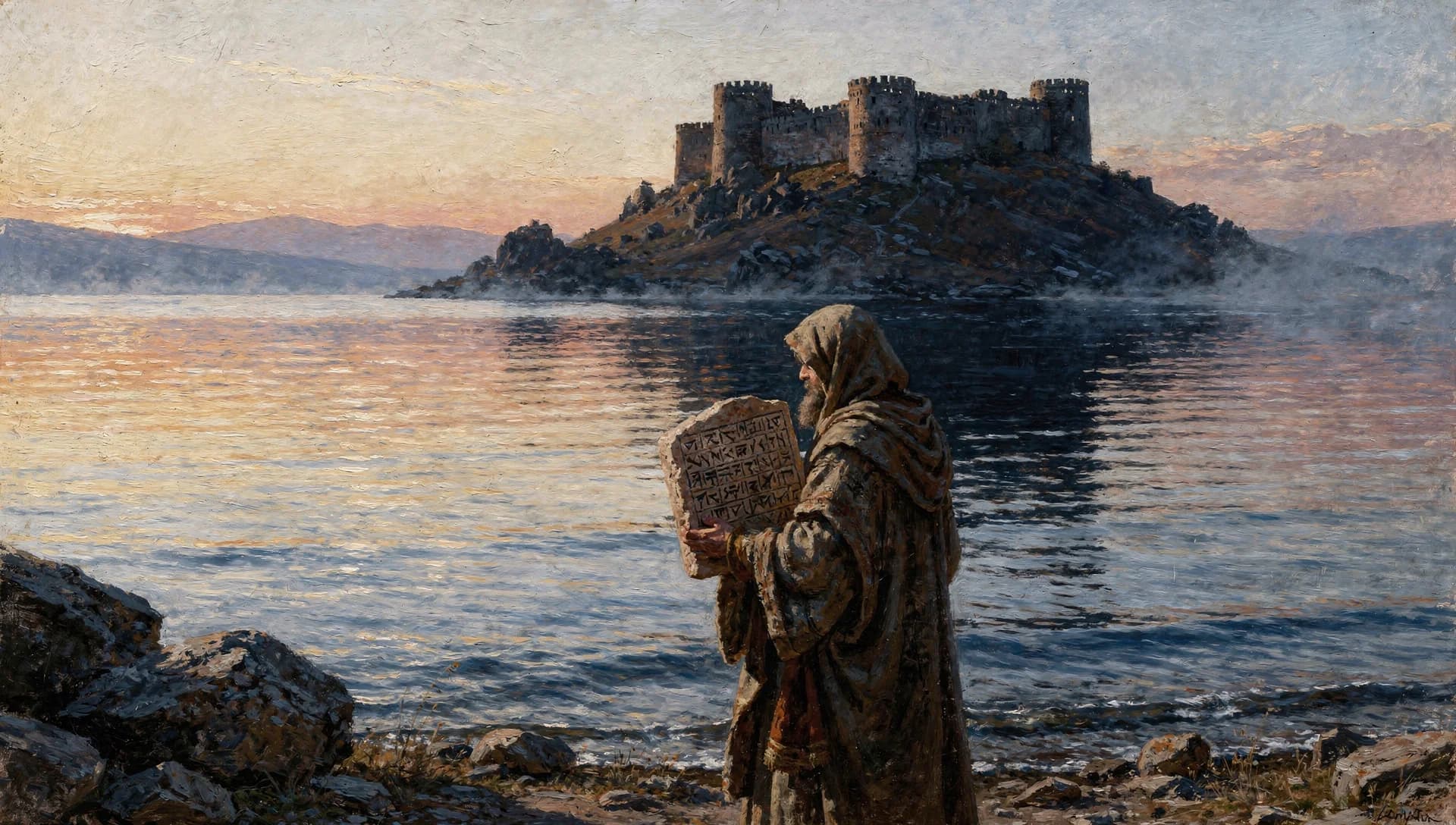
Vanite cultural preservation around Lake Van = Lake Van in eastern Turkey, name preservation of the loyal Prince's staff leader
This article expands on the decoder mapping. For the side-by-side card and quick reference, see the mapping page.
The Name That Survived
Lake Van sits in eastern Turkey at roughly 1,700 meters elevation. It covers about 3,755 square kilometers and is the largest lake in the country. In its ancient toponymy, the lake preserves the name Van.
The Urartian kingdom of the ninth through seventh centuries BCE took its capital, Tushpa, on the eastern shore. The Assyrians called the kingdom Urartu. The kingdom called itself Biainili, and from that self-designation modern "Van" descends. The name then carried forward across a long sequence of political transitions: Urartian, Assyrian, Achaemenid Persian, Seleucid, Armenian, Parthian, Roman, Byzantine, Ottoman, modern Turkish. The continuity is striking on its own terms.
The Urantia Book documents who Van was.
What the Urantia Book Says
Van was the member of the Planetary Prince's corporeal staff who led the council of coordination. He remained loyal during the Lucifer rebellion.
"When the final roll was called, the corporeal members of the Prince's staff were found to have aligned themselves as follows: Van and his entire court of co-ordination had remained loyal." (67:4.1)
After the Dalamatia submergence, Van withdrew with his followers into the highlands west of India and led the loyal remnant for the long duration that followed.
"The followers of Van early withdrew to the highlands west of India, where they were exempt from attacks by the confused races of the lowlands, and from which place of retirement they planned for the rehabilitation of the world as their early Badonite predecessors had once all unwittingly worked for the welfare of mankind just before the days of the birth of the Sangik tribes." (67:6.1)
"The remainder of this noble band continued on earth to the end of their mortal days under the leadership of Van and Amadon. They were the biologic leaven which multiplied and continued to furnish leadership for the world down through the long dark ages of the postrebellion era." (67:6.3)
His highland headquarters appears again in Paper 73, in the decades before Adam and Eve arrived.
"For almost one hundred years prior to Tabamantia's inspection, Van and his associates, from their highland headquarters of world ethics and culture, had been preaching the advent of a promised Son of God, a racial uplifter, a teacher of truth, and the worthy successor of the traitorous Caligastia." (73:2.1)
The Adamsonite post-Adamic civilization, descended from Van's lineage through Adamson and Ratta, was centered near the Kopet Dag east of the Caspian Sea. That site lies about a thousand kilometers east of modern Lake Van.
"This center of civilization was situated in the region east of the southern end of the Caspian Sea, near the Kopet Dagh. A short way up in the foothills of Turkestan are the vestiges of what was onetime the Adamsonite headquarters of the violet race." (77:5.10)
The northern Nodite Vanite lineage is distinct from the Kopet Dag Adamsonite center.
"The northern Nodites and Amadonites—the Vanites. This group arose prior to the Bablot conflict. These northernmost Nodites were descendants of those who had forsaken the leadership of Nod and his successors for that of Van and Amadon." (77:4.10)
So the Lake Van toponym preserves the name of Van. The lake itself is not the location of his pre-Adamic highland headquarters, which was in the Hindu Kush region. It is also not the post-Adamic Adamsonite center at the Kopet Dag. The name preserves the memory. The geography of the name has migrated westward across the post-rebellion centuries of cultural transmission.
What the Ancient Sources Say
Lake Van's ancient toponymy is documented through the Urartian royal inscriptions of the ninth through seventh centuries BCE and through the Assyrian royal annals, which name the kingdom Urartu. The Urartian self-designation Biainili gives the modern toponym through standard phonological evolution. Paul Zimansky's Ancient Ararat: A Handbook of Urartian Studies (Delmar, 1998) and Mirjo Salvini's Geschichte und Kultur der Urartäer (Wissenschaftliche Buchgesellschaft, 1995) are the principal scholarly treatments.
The Urartian kingdom occupied the Armenian highlands centered on Lake Van from about 860 BCE to about 590 BCE. Its metallurgical, architectural, and administrative culture preserved a non-Semitic linguistic substrate. Urartian is related to Hurrian, a language family distinct from both Semitic and Indo-European. The cultural-geographic identity of the Van region carried across the millennia that followed: the Armenian kingdom of 190 BCE to 428 CE, the Byzantine and Sassanid border zone, the medieval Armenian principalities, the Ottoman period, modern Turkey. The Van toponym held throughout.
Comparative scholarship on Near Eastern naming has long established that durable toponyms can preserve ancient memory across time-depths of several millennia, even through repeated linguistic and political transitions. Ur, Uruk, Damascus, Hebron, Jericho, and many others demonstrate the pattern. Long toponymic continuity is empirically possible in this region.
Why This Mapping Matters
The preservation of the name Van in Lake Van is a case of name migration rather than geographic identity. The Urantia Book places Van's pre-Adamic highland headquarters west of India in the Hindu Kush region. The subsequent Adamsonite violet-race center was near the Kopet Dag east of the Caspian, about a thousand kilometers east of Lake Van. The name Van traveled westward across the post-rebellion centuries through the northern Nodite-Vanite cultural-linguistic stream, eventually attaching to the Armenian highland lake region by the Urartian period.
The mapping's significance is that Lake Van preserves genuine toponymic memory of the historical figure Van, even though the lake is not the site of his headquarters. The Urartian kingdom centered on the lake represents the western terminus of a continuous naming tradition that began much further east, with Van's actual leadership of the loyal remnant through the long darkness of the post-rebellion era.
Sources
- The Urantia Book, Paper 67 (The Planetary Rebellion), Paper 77 (The Midway Creatures). Urantia Foundation, first printing 1955. Cited passages: 67:4.1, 67:5.4, 67:6.3, 77:4.10.
- Zimansky, Paul. Ancient Ararat: A Handbook of Urartian Studies. Delmar, 1998.
- Salvini, Mirjo. Geschichte und Kultur der Urartäer. Wissenschaftliche Buchgesellschaft, 1995.
- Piotrovsky, Boris B. The Ancient Civilization of Urartu. Cowles, 1969.
- Çilingiroğlu, Altan and Mirjo Salvini, editors. Anzaf Kaleleri ve Urartu Tanrıları. Arkeoloji ve Sanat, 2001.
Confidence and Evidence
- Confidence: UB CONFIRMED
- Evidence rating: STRONG
- Basis: The Urantia Book directly documents Van's leadership of the loyal remnant to the Lake Van region at UB 67:6.3. The continuous toponymic preservation of the name Van across the archaeological and historical record is documented. The geographic correspondence between the UB-identified Vanite cultural zone and the actual Lake Van region is specific.
Related Decoder Articles
- Van = Enki and the Loyal Faction
- UR Prefix = Nodite Naming Memory
- Adamson's Children = the Olympians
Byline: Derek Samaras | Urantia Book Network | April 2026

Connecting Articles
The Longest Memory: Australian Aboriginal Dreamtime and the Primordial Teaching-Ancestors
The Final Adjudication: Ragnarok and the Pending Verdict

We Come From One: African First-Family Traditions and the Sangik Origin
The Sky God Who Withdrew: African High-God Traditions and the Salem Teaching Layer
The Newsletter
Get the research behind each piece
Free. New Urantia Book explorations, the sources behind the videos, and early looks. No spam, unsubscribe anytime.
Prefer video? Follow on YouTube and Facebook.
Delivered through Substack. You can also read past issues.