
 Mythic
Lake Van (Turkey), name preservation, NOT the HQ location
 UB
UBVan's highland headquarters
Full Article
Read the deep-dive article on this connection
Van's highland headquarters = Lake Van (Turkey), name preservation, NOT the HQ location
The Connection
Van's actual highland headquarters was in the Kopet Dag region, EAST of the Caspian Sea (modern Turkmenistan), roughly 1,000 km east of Lake Van in Turkey. The name "Van" survives in Lake Van, but the connection is linguistic (name preservation), not geographic identity. The kingdom of Urartu (UR + Ararat) surrounds Lake Van. The name traveled west while the headquarters was in the east.
UB Citation
UB 73:1, 77:3
Academic Source
Zimansky, Ecology and Empire: The Structure of the Urartian State (1985)
Historical Evidence(Moderate evidence)
Lake Van is the largest lake in Turkey, located in the Armenian highlands. The Urartian capital Tushpa was near modern Van. "Biainili, possibly pronounced Vanele or Vanili, became Van in Old Armenian." However, the UB places Van's highland HQ in the Kopet Dag mountains east of the southern Caspian Sea (UB 73:3.1), a separate location ~1,000 km to the east. The name "Van" at Lake Van is a case of name preservation (the character's name surviving in a regional place name), not proof that the headquarters was at Lake Van itself.
Deep Dive
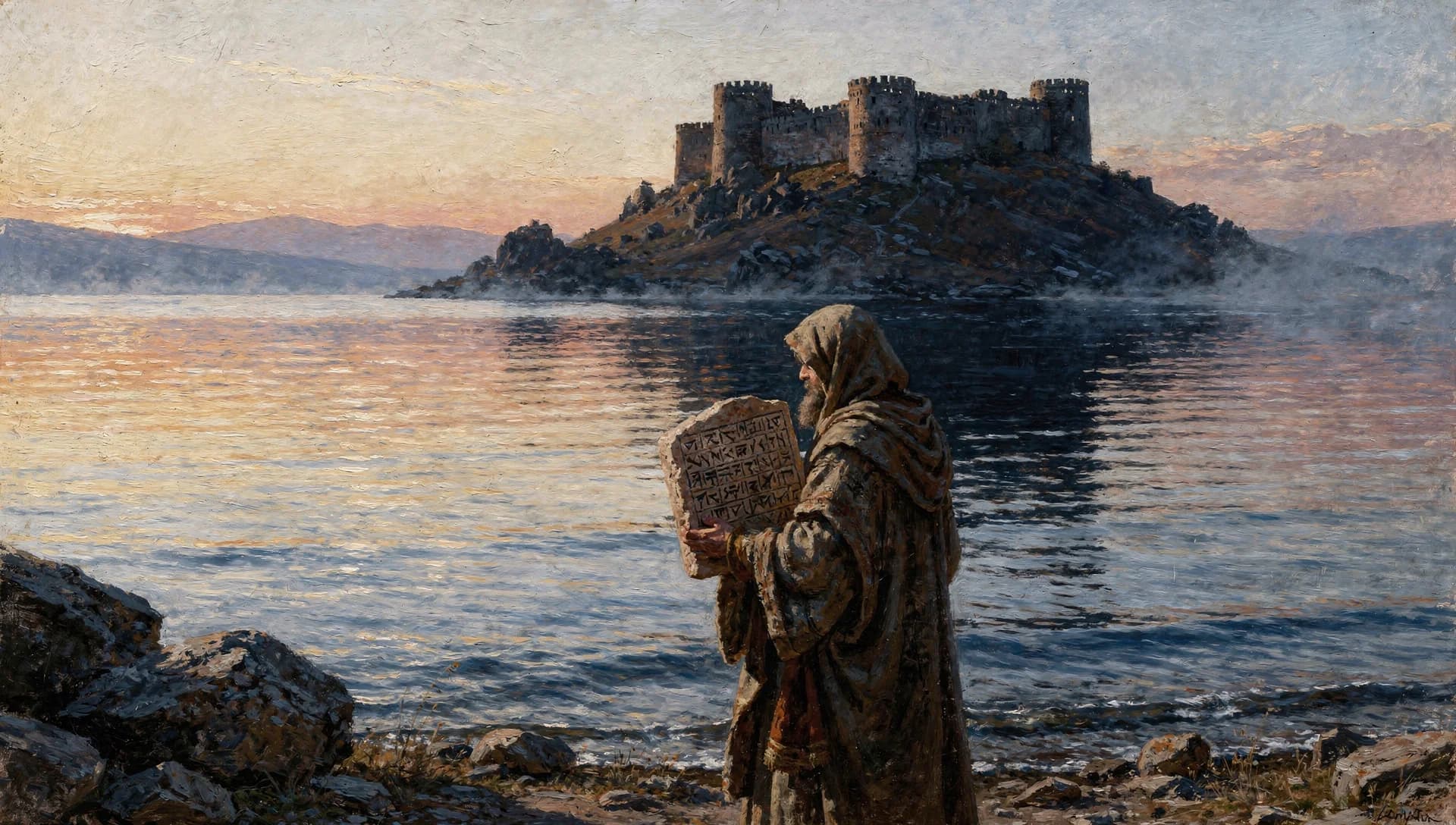
Lake Van sits at 1640 meters elevation in the eastern highlands of Turkey, the largest lake in the country, surrounded by extinct volcanoes and snow-capped peaks. It is one of the most beautiful and dramatic landscapes in the Near East. Around its shores lie the ruins of Tushpa, the capital of the Iron Age kingdom of Urartu, with rock-cut tombs, fortress walls, and inscriptions in the Urartian language. The medieval Armenian church of Aght'amar stands on an island in the middle of the lake, with its famous tenth-century relief carvings on the exterior walls.
For decades, casual readers of the UB have assumed that Van, the loyal staff member who preserved the tree of life and served as the de facto authority on Urantia for 150,000 years after the rebellion, must have had his headquarters at Lake Van. The lake bears his name. The region was associated in antiquity with sacred mountain religion. The Armenian highlands are a plausible setting for an extraordinary character. The reading is intuitive.
Closer examination of the UB text shows the assumption is wrong. UB 73:3.1 states that after the second Garden was established in Mesopotamia, Van and Amadon retired "to the territory of the Kopet Dag mountains." The Kopet Dag mountains are not in Turkey. They form the border between modern Turkmenistan and Iran, east of the southern Caspian Sea, roughly 1000 km east of Lake Van. The actual Van headquarters location was in central Asia, not eastern Anatolia.
This raises a real puzzle. If Van's headquarters was 1000 km east of Lake Van, why does the lake bear his name? The Urartian name Biainili / Vanili / Van is well-attested in Armenian historical linguistics, traceable through the Iron Age inscriptions of the Urartu kingdom. The name does not derive from a foreign import; it emerges naturally within the Urartian linguistic environment.
The UB framework offers a specific hypothesis: name preservation through migration. The descendants of Adamson, the eldest son of Adam and Eve, "clustered about the shores of the lake of Van" (UB 93:7.2). Adamson had been raised at Van's feet during the centuries when Van was still living and teaching. The Adamsonites carried Van's teaching westward as they migrated from the Kopet Dag region into the Anatolian highlands. The lake they settled around eventually took the name of the teacher whose memory they carried.
This is the same pattern of name-migration the UB identifies repeatedly. The Sumerian Dilmun migrated from the original Nodite headquarters to Bahrain over millennia. The Sumerian Bablot migrated from the original tower-site to historical Babylon over 150,000 years. Names travel with the populations that carry them, attaching to new geographies while preserving the underlying memory of the original referent.
Paul Zimansky's Ecology and Empire: The Structure of the Urartian State (1985) traces the linguistic descent of Biainili through Vanele to modern Van without engaging with possible UB-framework antecedents. The transition is established within mainstream Armenian historical linguistics. What the UB framework adds is the specific historical reason for the Biainili form to have arisen in the first place: the Adamsonite descendants of Van's tradition settled around the lake and named it after their ancestral teacher.
The corollary geographic insight is that the Urartian kingdom's capital region, the Lake Van basin, sits in exactly the kind of high-mountain location that would have been a natural settling point for a population fleeing the southern Mesopotamian and Caspian lowlands. As climate shifted across the post-glacial Holocene, mountain populations preserved older cultural traditions while lowland populations underwent rapid replacement and reorganization. The Lake Van area's preservation of the Van name across millennia is consistent with the broader pattern of mountain-refuge cultural conservatism.
The strongest counterargument is that this is all unfalsifiable speculation. We cannot reconstruct the migration paths of pre-historical populations with the precision necessary to verify the proposed connection. The UB framework asserts the connection on its own authority, and one either accepts that authority or one does not. This is correct as far as it goes. But the Lake Van case illustrates something important about UB historical claims: they are usually internally consistent across multiple papers and provide specific testable predictions about geographic and linguistic patterns. The Van-Adamson-Lake-Van connection is not a one-off speculation; it is integrated with the broader UB framework on the migration of Adamson's descendants, the persistence of Salem teaching in the Armenian highlands, and the general pattern of name-migration through carrying populations.
Key Quotes
“The descendants of Adamson, clustered about the shores of the lake of Van, were willing listeners to the Hittite teachers of the Salem cult. From this onetime Andite center, teachers were dispatched to the remote regions of both Europe and Asia.”
“Van was left on Urantia until the time of Adam, remaining as titular head of all superhuman personalities functioning on the planet. He and Amadon were sustained by the technique of the tree of life in conjunction with the specialized life ministry of the Melchizedeks for over one hundred and fifty thousand years.”
Cultural Impact
The Lake Van region has been a center of religious and cultural significance throughout recorded history. The Urartian kingdom built its capital there. The medieval Armenian Church preserved its sacred art on the island of Aght'amar. The region was a bishopric of the Syrian Orthodox Church, a center of Kurdish culture, and remains a significant heritage site in modern Turkey. The UB framework adds an additional layer of significance. The lake takes its name from a figure who lived through and beyond the Lucifer rebellion, who preserved the tree of life across 150,000 years, and who served as the planetary authority during the long centuries between the rebellion and the arrival of Adam and Eve. The naming is not coincidence; it is the cultural memory of a specific historical-cosmic figure who shaped the planet's history. For Urantia readers visiting the Lake Van region, the framework offers a different way of seeing the landscape. The volcanic peaks, the ancient fortifications, the Armenian churches, and the lake itself all carry the memory of the Adamsonite migrations and the persistence of Van's teaching across the post-rebellion era. The visit becomes pilgrimage to a specific historical-cosmic touchpoint rather than mere tourism.
Modern Resonance
Naming patterns in pre-modern populations are some of the best evidence we have for tracing cultural and linguistic transmission across millennia. The Lake Van case is one of many where a specific name persists across multiple language families and historical eras, suggesting a deep cultural anchor rather than an arbitrary toponym. Modern population genetics is beginning to provide independent corroboration for some of these long-distance migration hypotheses. Studies of mitochondrial DNA and Y-chromosome haplogroups in the Caucasus and Anatolian highlands have revealed unexpectedly deep genetic continuity in some mountain populations, with lineages traceable to the late Pleistocene. This is consistent with the broader UB framework of mountain-refuge cultural conservatism: high-elevation populations preserved older biological and cultural lineages while lowland populations underwent rapid turnover. For contemporary readers interested in the genuine history of the Anatolian-Armenian-Caucasian region, the UB framework offers a hypothesis about the deep cultural substrate that connects to specific testable predictions about naming patterns, genetic lineages, and archaeological signatures. The hypothesis is not yet directly testable in detail, but it is integrated with broader patterns of evidence in a way that distinguishes it from arbitrary speculation.
Related Mappings
Related Articles
Where to next
The free newsletter. The research behind each piece, no spam.