
The UR Prefix Across the Ancient Near East: Ur, Uruk, Urartu, Aram, Armenia, and the Nodite Name-Memory
A pattern of UR-prefixed place names runs across the ancient Near East: Ur, Uruk, Eridu, Urartu, Armenia, Iran, Iraq, Ararat, Aram. The Urantia Book locates the Nodite cultural core in this same geographic zone and documents continuous name-preservation across the post-rebellion Mesopotamian substrate. The UR prefix carries Nodite naming memory forward through the long cultural inheritance of the region.
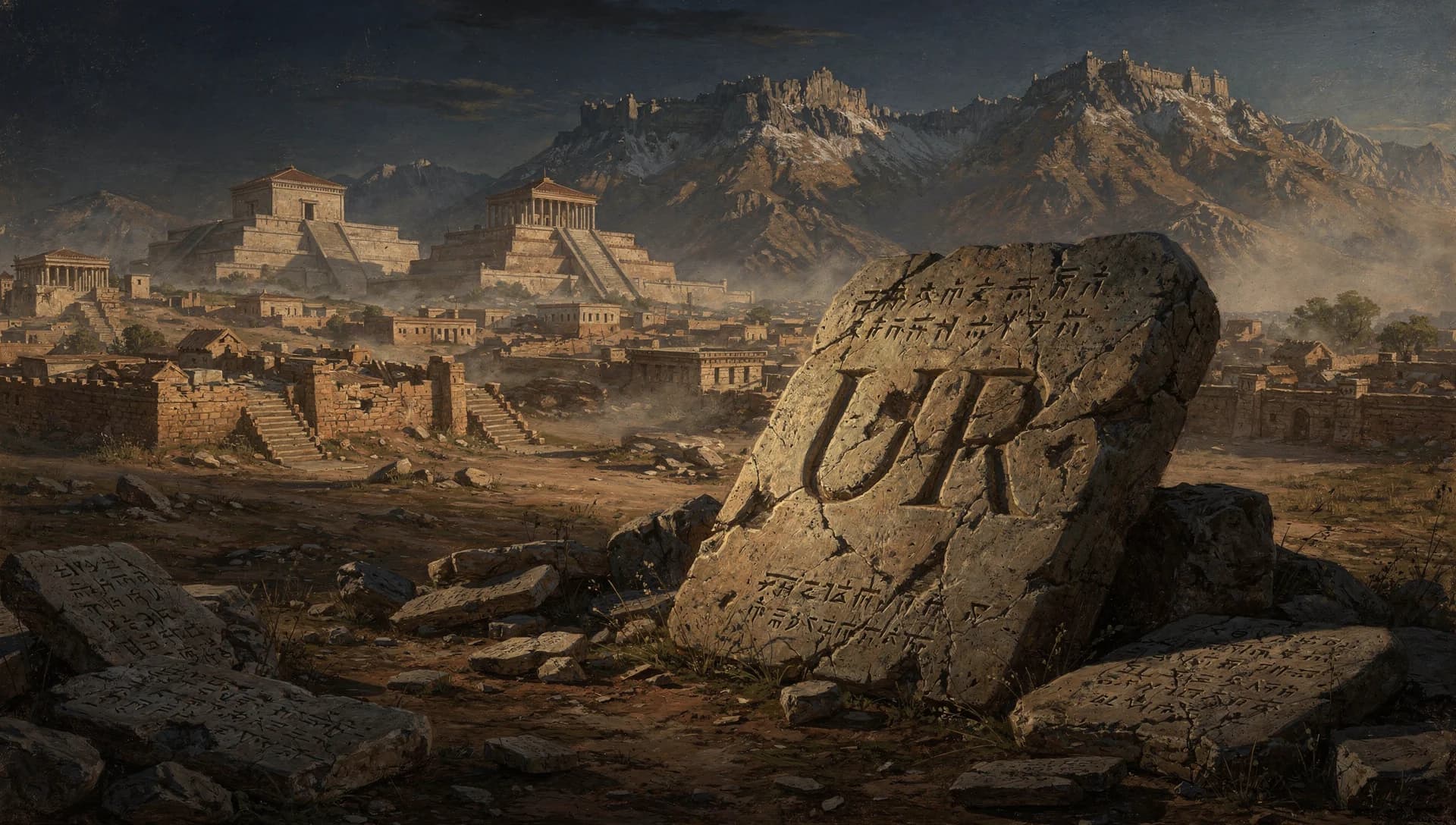
Ancient Nodite-era naming preserved in Near Eastern toponymy = Ur, Uruk, Urartu, Armenia, Iran, Iraq, Ararat, Aram, Eridu
This article expands on the decoder mapping. For the side-by-side card and quick reference, see the mapping page.
The UR Prefix Pattern
A pattern of UR-prefixed and AR-related place names runs across the ancient Near East. Ur of the Chaldees, the Sumerian city from which Abraham's family emigrated. Uruk, one of the great Sumerian centers and home of Gilgamesh. Eridu, the first city in Sumerian tradition, home of Enki and Ea. Urartu, the kingdom centered on Lake Van in eastern Anatolia from the ninth through seventh centuries BCE. Armenia, derived from Armenu and Aram. Iran, from Aryana. Iraq, from Uruk. Ararat, the mountain range where the Hebrew Noah's ark came to rest. Aram, the biblical ancestor of the Aramaic-speaking peoples. And the long Aramean line of personal and place names threaded through the wider region.
The geographic distribution of these UR and AR names tracks closely with the post-rebellion Nodite cultural zone that the Urantia Book documents.
What the Urantia Book Says
The Urantia Book records the Nodite presence across this region from the earliest period. After the submergence of Dalamatia, the Nodites moved to a new cultural headquarters in the Persian Gulf region.
"After the submergence of Dalamatia the Nodites moved north and east, presently founding the new city of Dilmun as their racial and cultural headquarters." (77:3.1)
The northern Nodite settlement in the Lake Van region is documented directly.
"4. The northern Nodites and Amadonites—the Vanites. This group arose prior to the Bablot conflict. These northernmost Nodites were descendants of those who had forsaken the leadership of Nod and his successors for that of Van and Amadon." (77:4.10)
The cultural continuity across the post-rebellion period is laid out across UB 77:4 (Nodite centers of civilization) and UB 78:8 (the later Sumerians). The Sumerians themselves preserved the older naming, sometimes confusing distinct sites because the names had carried forward across so many generations.
"The Egyptians called this city of ancient glory Dilmat, while the later Adamized Sumerians confused both the first and second Nodite cities with Dalamatia and called all three Dilmun. And already have archaeologists found these ancient Sumerian clay tablets which tell of this earthly paradise 'where the Gods first blessed mankind with the example of civilized and cultured life.'" (77:4.8)
What the Ancient Sources Say
The UR-prefixed place names are well attested in the cuneiform record. Ur of the Chaldees was excavated at Tell al-Muqayyar in southern Iraq, with Leonard Woolley's principal seasons running from 1922 to 1934. Uruk sits at modern Warka in southern Iraq, where German excavations have continued since 1913. Eridu, at Tell Abu Shahrain, is identified as the first Sumerian urban settlement. Urartu is documented through both Assyrian cuneiform records and the Urartian royal inscriptions of the Van region.
Conventional etymology derives Ur from Sumerian uru, meaning "city" or "settlement," with the prefix becoming a standard element in regional place-naming. The prefix then spreads across the Semitic and Sumerian cultural continuum into later toponymy. Paul Kriwaczek's Babylon: Mesopotamia and the Birth of Civilization (Thomas Dunne, 2010) traces the broader Mesopotamian toponymic continuity across successive political periods.
Urartu is the name the Assyrians used for the Van-region kingdom. The Urartian self-designation was Biainili, the source of the modern name Van. The biblical Ararat is the Hebrew rendering of Urartu, preserving the same mountain-range toponymy that the Genesis flood narrative names as the ark's resting place.
Aram appears in Genesis 10:22 to 23 as the biblical ancestor of the Aramean peoples. Aramaic served as the lingua franca of the ancient Near East across the first millennium BCE. The cluster of AR-derived names (Armenia, Aram, Ararat, Arabic) carries a shared root across the region.
Mainstream scholarship has been cautious about whether these UR and AR patterns represent genuine etymological continuity or coincidental similarity. The geographic concentration of the pattern within the Nodite cultural zone the Urantia Book identifies is what gives the continuity reading its weight.
Why This Mapping Matters
The UR and AR toponymic pattern across the ancient Near East reads, on the Urantia Book framework, as preserved naming memory traceable to the Nodite cultural substrate. Continuous Nodite presence across the Mesopotamian, Armenian, and Iranian zone supplied a stable naming tradition that persisted across one political turnover after another (Sumerian, Akkadian, Assyrian, Babylonian, Persian, Hellenistic, Arab).
The shared root running through Ur, Uruk, Urartu, Ararat, Aram, Armenia, Iran, and Iraq looks less like coincidence and more like genuine toponymic memory. Its geographic distribution lines up with the Nodite cultural zone that the Urantia Book documents in Papers 77 and 78.
Sources
- The Urantia Book, Paper 77 (The Midway Creatures), Paper 78 (The Violet Race After the Days of Adam). Urantia Foundation, first printing 1955. Cited passages: 77:3.1, 77:4.8, 77:4.10.
- Woolley, Leonard. Ur of the Chaldees. Penguin, 1929.
- Kriwaczek, Paul. Babylon: Mesopotamia and the Birth of Civilization. Thomas Dunne, 2010.
- Zimansky, Paul. Ancient Ararat: A Handbook of Urartian Studies. Delmar, 1998.
- Van De Mieroop, Marc. A History of the Ancient Near East. Third edition, Wiley-Blackwell, 2016.
- Lipinski, Edward. The Aramaeans: Their Ancient History, Culture, Religion. Peeters, 2000.
Confidence and Evidence
- Confidence: INFORMED SPECULATION
- Evidence rating: MODERATE
- Basis: The Urantia Book documents the Nodite cultural core across the specific Mesopotamian-Armenian geographic zone. The shared UR/AR toponymic root across the ancient Near East is archaeologically documented. The specific concentration of the pattern in the UB-identified Nodite zone supports the interpretation of preserved cultural-naming memory.
Related Decoder Articles
Byline: Derek Samaras | Urantia Book Network | April 2026
Connecting Articles
Three Elements, One Composition: Van, Fandor, and the Assyrian Palace Reliefs

The Longest Memory: Australian Aboriginal Dreamtime and the Primordial Teaching-Ancestors

The Final Adjudication: Ragnarok and the Pending Verdict

We Come From One: African First-Family Traditions and the Sangik Origin
The Newsletter
Get the research behind each piece
Free. New Urantia Book explorations, the sources behind the videos, and early looks. No spam, unsubscribe anytime.
Prefer video? Follow on YouTube and Facebook.
Delivered through Substack. You can also read past issues.