
We Come From One: African First-Family Traditions and the Sangik Origin
African traditional religions across the continent remember humanity descending from a single founding pair produced directly by the supreme creator. The Zulu uNkulunkulu, the Shilluk Juok, and parallel Bantu narratives all carry the same shape. The Urantia Book records the Sangik origin of the six colored races in a single Badonan family. Modern population genetics independently points to one African origin for Homo sapiens. Three witnesses, one story.
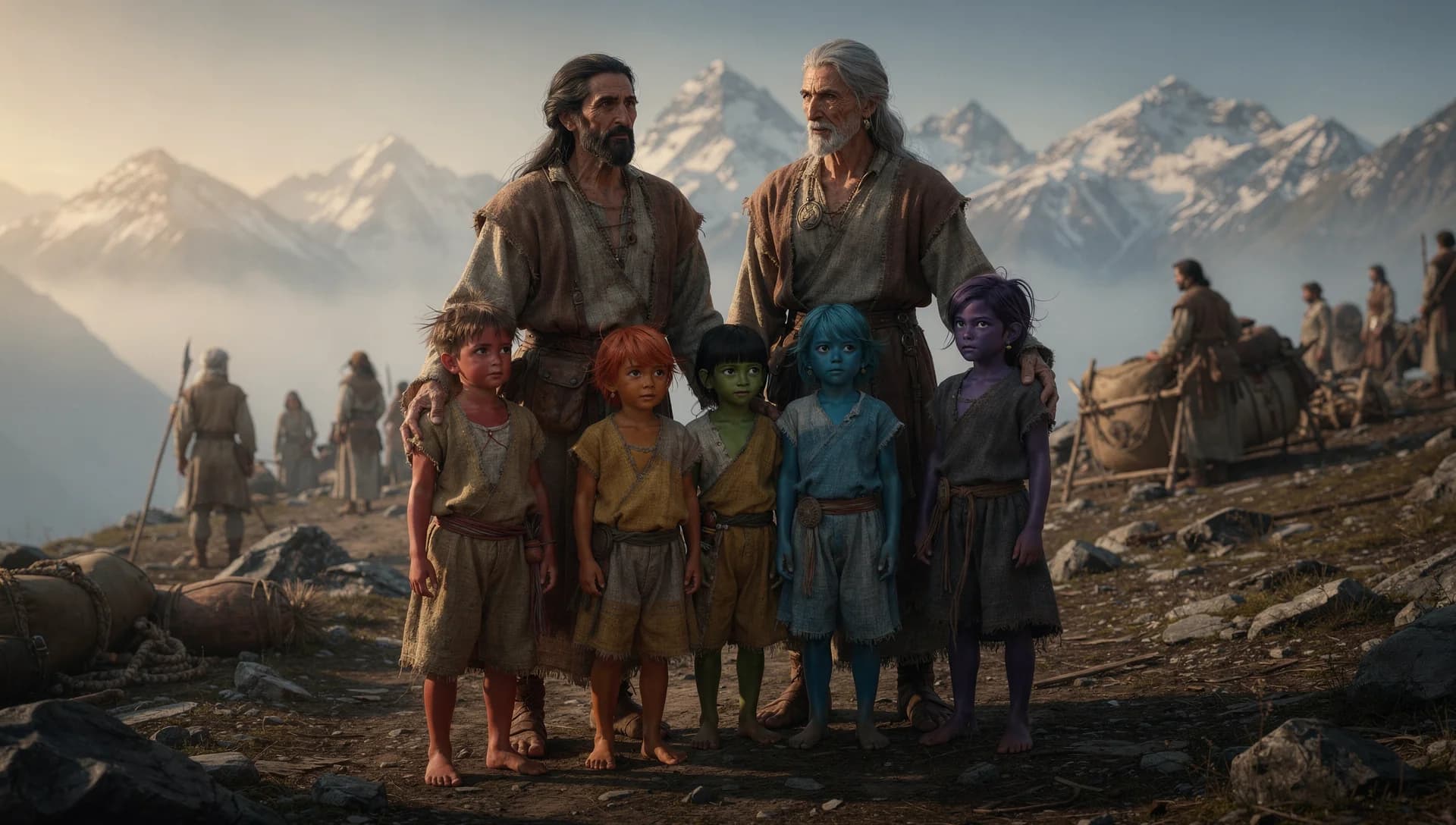
Sangik racial origins in a single Badonan family = African "first family" creation narratives (Zulu uNkulunkulu, Shilluk Juok)
This article expands on the decoder mapping. For the side-by-side card and quick reference, see the mapping page.
The First-Family Pattern
A consistent pattern runs through the traditional religions of sub-Saharan Africa. Humanity descends from a single founding pair, produced directly by the supreme creator at the beginning of things.
The Zulu remember uNkulunkulu, "the great-great-one," as both supreme creator and first ancestor. From him the reed-born primal couple emerged, and from that couple all people descend. The Shilluk of the upper White Nile trace humanity to Juok's creation of the first man, Nyikang. The Akan of Ghana tell of Nyame creating the first human pair. The Igbo remember Chukwu creating Eri and Nnamoku. The Bambara preserve Faro's creation of humanity from primordial paired seeds. Many Bantu traditions carry the same structure without naming the first ancestors: Mulungu (or Nzambi, Leza, Katonda) made the first man and woman, and everyone alive descends from them.
The shared features are easy to list. One supreme creator. One founding family or pair. A common descent for all of humanity from that origin. And, most often, a particular first home, identified with a mountain, a lake, or a sacred grove.
The Urantia Book offers the historical substrate that ties these traditions together.
What the Urantia Book Says
The Urantia Book records that all six Sangik colored races arose as simultaneous offspring within a single Badonan family. The text states directly:
"On an average evolutionary planet the six evolutionary races of color appear one by one; the red man is the first to evolve, and for ages he roams the world before the succeeding colored races make their appearance. The simultaneous emergence of all six races on Urantia, and in one family, was most unusual." (UB 64:6.1)
The dispersion of the six Sangik races from their Asian center of origin is documented at UB 64:7. The indigo race is named as the last of the Sangik peoples to migrate, and as the race that took possession of Africa:
"The last of the Sangik peoples to migrate from their center of race origin was the indigo man. About the time the green man was killing off the orange race in Egypt and greatly weakening himself in so doing, the great black exodus started south through Palestine along the coast; and later, when these physically strong indigo peoples overran Egypt, they wiped the green man out of existence by sheer force of numbers." (UB 64:7.14)
A single founding family, dispersing into geographically distinct branches: this is the broad shape that the African creation narratives also carry. The timelines differ. The Urantia Book places the Sangik origin around 500,000 years ago (UB 64:5.1), while modern genetics dates anatomically modern Homo sapiens to roughly 300,000 years ago, with mitochondrial Eve around 150,000 to 200,000 years ago. But the structural claim is the same on all three accounts: modern humanity descends from one originating family, located in Africa or adjacent Eurasia.
What the Ancient Sources Say
The Zulu creation account is preserved in nineteenth-century ethnography, especially Henry Callaway's The Religious System of the Amazulu (Folklore Society, 1870). Callaway recorded the tradition that uNkulunkulu created the first human beings from a bed of reeds, the umhlanga, in a particular place identified within Zulu ancestral territory. From that first pair, humanity multiplied.
The Shilluk account is documented in C. G. Seligman and Brenda Z. Seligman's Pagan Tribes of the Nilotic Sudan (Routledge, 1932) and in the later ethnographic work on Nilotic religion. Juok creates Nyikang as both primal ancestor and founding king. The Shilluk royal lineage descends directly from him, and the institution of kingship is read as the continuing presence of the first ancestor in the community.
The Akan, Igbo, Bambara, and broader Bantu traditions are surveyed comprehensively in John S. Mbiti's African Religions and Philosophy (Heinemann, 1969; second edition 1990). Mbiti shows the same shape across the continent: the supreme creator makes the first human pair, and all humanity comes from them.
Comparative scholarship has long debated whether this pattern reflects an indigenous African development, a universal religious instinct, or an inherited tradition that diffused. E. Bolaji Idowu's African Traditional Religion: A Definition (SCM Press, 1973) read the pattern as coherent African theology in its own right. Evan M. Zuesse's Ritual Cosmos (Ohio University Press, 1979) treated it within a comparative framework.
Modern population genetics adds an independent witness. The 1987 "mitochondrial Eve" paper by Allan Wilson and Rebecca Cann (Nature 325, 1987) established that all living humans share a matrilineal ancestor in Africa. Subsequent work (Stringer, Origin of Our Species, Allen Lane 2011; Reich, Who We Are and How We Got Here, Pantheon 2018) has refined but not overturned the picture: modern humans originated in sub-Saharan Africa roughly 200,000 to 300,000 years ago and dispersed globally from about 60,000 to 80,000 years ago.
The Urantia Book's claim places the founding family earlier in time and locates it in the Himalayan foothills rather than sub-Saharan Africa, so the geography and the dates do not line up exactly. But the central claim, that all of modern humanity descends from a single originating family, is the same across all three witnesses.
Why This Mapping Matters
The African creation narratives carry, in religious form, the same monogenetic claim that modern genetics later established through DNA analysis. The African traditions preserved this claim for millennia before molecular biology could test it.
The Urantia Book's framework holds both witnesses without forcing one to reject the other. The Sangik origin in a single Badonan family is a unified historical claim, consistent in shape with what the African traditions remember and with what genetics confirms.
There is also a geographic resonance. Africa is the continent where modern humans first emerged, on the genetic evidence. The African traditional preservation of the first-family creation narrative reads, on the Urantia Book framework, as a continuous cultural memory carried forward by the African population since before the global dispersion.
The variation between traditions, the reed-born pair among the Zulu, Nyikang as first man among the Shilluk, Eri and Nnamoku among the Igbo, is what you would expect from millennia of cultural and linguistic differentiation working on a shared inheritance.
The royal institution in some traditions reinforces the same shape. The Shilluk Nyikang as founding king whose presence continues in the kingship, the Akan asantehene, the Buganda kabaka, the Zulu royal lineage: each carries authority through descent from a first ancestor. The Urantia Book's account of the Dalamatian Prince's authority through his original staff has a similar logic, where political legitimacy traces back to a founding source.
The discoveries of mitochondrial Eve and Y-chromosome Adam were among the most significant shifts in twentieth-century biological anthropology. The African traditional religions had been carrying the same claim for thousands of years before science arrived at it. The Urantia Book offers the framework that ties all three together.
The mapping's practical significance is this: African first-family creation narratives are not folklore in the dismissive sense. They are continuous preservations of genuine population memory, reaching back to the actual single-family origin of the modern human species. The Urantia Book provides the framework that lets the African traditions and modern genetics speak with one voice.
Sources
- The Urantia Book, Paper 64 (The Evolutionary Races of Color). Urantia Foundation, first printing 1955. Cited passages: 64:6.1-3, 64:6.25, 64:7.13-14.
- Mbiti, John S. African Religions and Philosophy. Heinemann, 1969; second edition 1990.
- Callaway, Henry. The Religious System of the Amazulu. Folklore Society, 1870.
- Seligman, C. G. and Brenda Z. Seligman. Pagan Tribes of the Nilotic Sudan. Routledge, 1932.
- Idowu, E. Bolaji. African Traditional Religion: A Definition. SCM Press, 1973.
- Zuesse, Evan M. Ritual Cosmos: The Sanctification of Life in African Religions. Ohio University Press, 1979.
- Cann, Rebecca L., Mark Stoneking, and Allan C. Wilson. "Mitochondrial DNA and Human Evolution." Nature 325, 1987.
- Stringer, Chris. The Origin of Our Species. Allen Lane, 2011.
- Reich, David. Who We Are and How We Got Here: Ancient DNA and the New Science of the Human Past. Pantheon, 2018.
Confidence and Evidence
- Confidence: INFORMED SPECULATION
- Evidence rating: SUGGESTIVE
- Basis: The Urantia Book directly documents the Sangik origin of modern humanity in a single Badonan family at UB 64:6.1-3. African traditional religions consistently preserve the monogenetic origin pattern across the continent. Modern population genetics independently confirms sub-Saharan African origin and a monogenetic structure. The timeline and geography differ between the Urantia Book and modern genetics, which is why the rating is SUGGESTIVE rather than STRONG. The shared structural claim of single-family origin is the substance of the mapping.
Related Decoder Articles
- African High-God = Salem Monotheism
- Dogon Nommo = Saharan Indigo Civilization
- Adam and Eve = Violet Race Origins
Byline: Derek Samaras | Urantia Book Network | April 2026
Connecting Articles
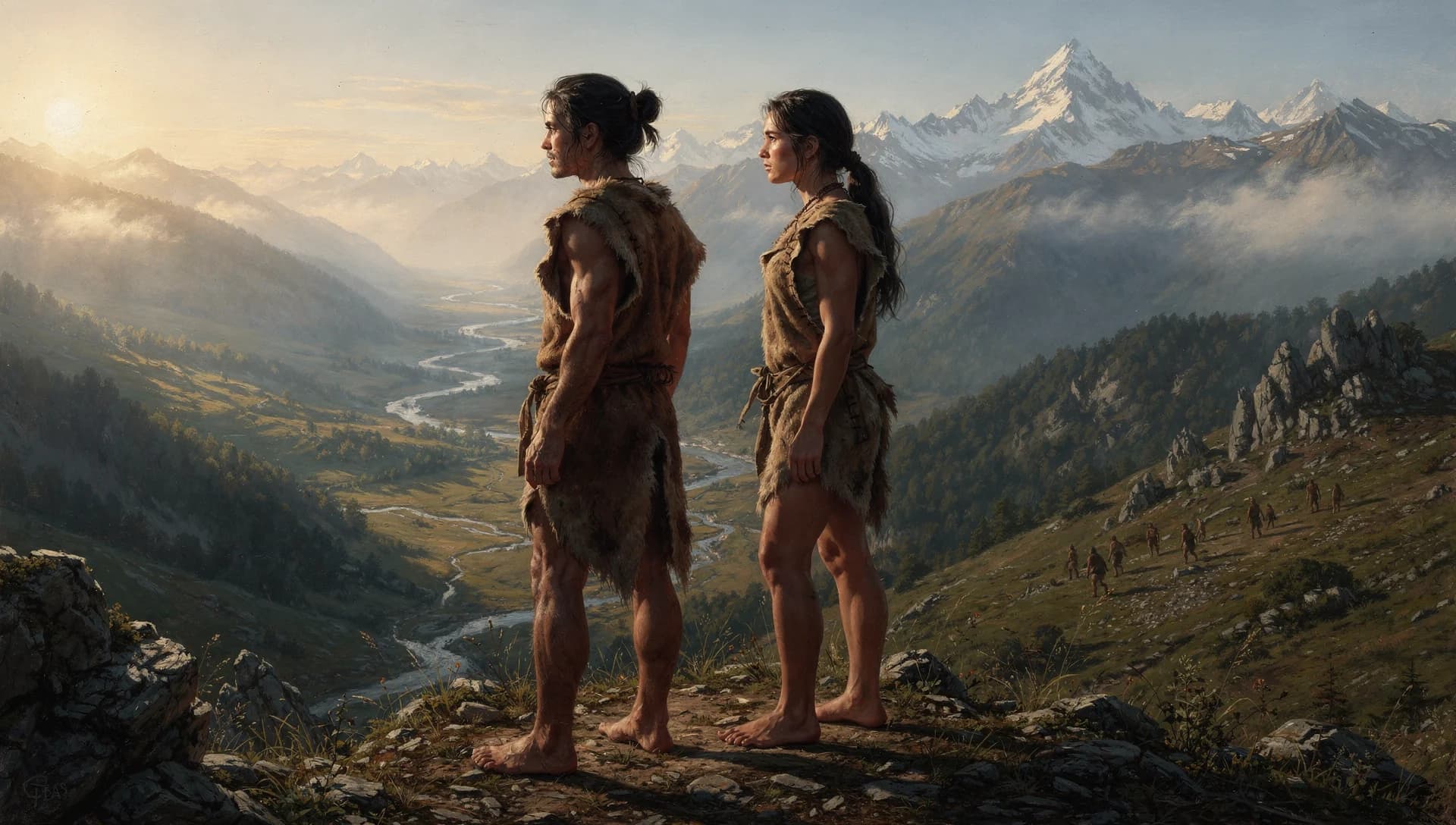
Humanity Came From the Mountains: Himalayan Origin Traditions and the Andonic Homeland
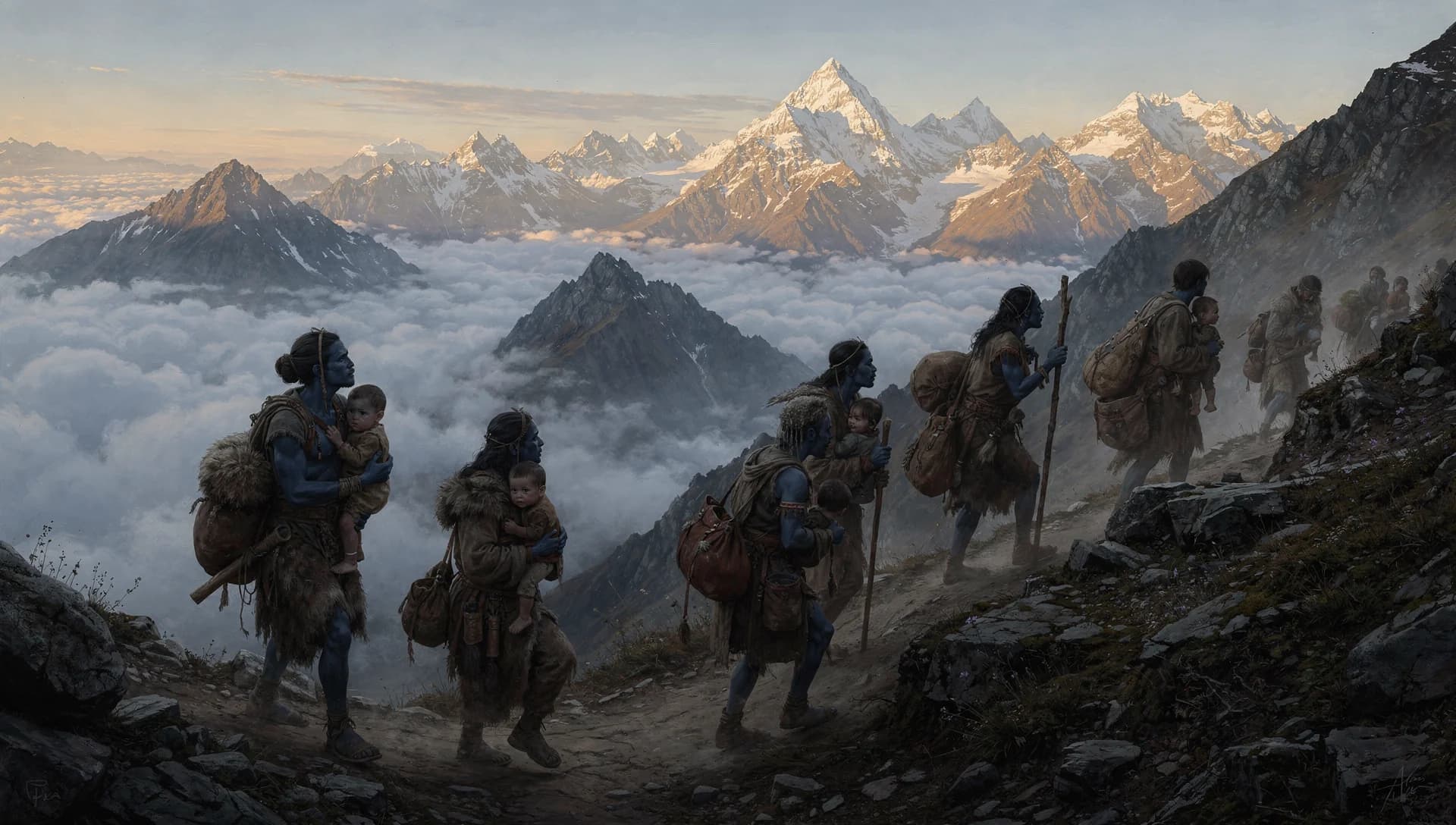
We Came From the North: Pan-African Origin Traditions and the Indigo Migration Path
The Longest Memory: Australian Aboriginal Dreamtime and the Primordial Teaching-Ancestors
The Final Adjudication: Ragnarok and the Pending Verdict
The Newsletter
Get the research behind each piece
Free. New Urantia Book explorations, the sources behind the videos, and early looks. No spam, unsubscribe anytime.
Prefer video? Follow on YouTube and Facebook.
Delivered through Substack. You can also read past issues.