
Sixty-Seven Children, Twelve Remembered: The Adamsonites and the Olympian Pantheon
Adamson and Ratta had sixty-seven children, every fourth one of a unique order and often invisible. The Greek tradition preserves a pantheon of twelve principal Olympians with dozens of minor demigods. The Urantia record supplies the historical substrate the Greek pantheon's peculiar structure has always pointed toward.
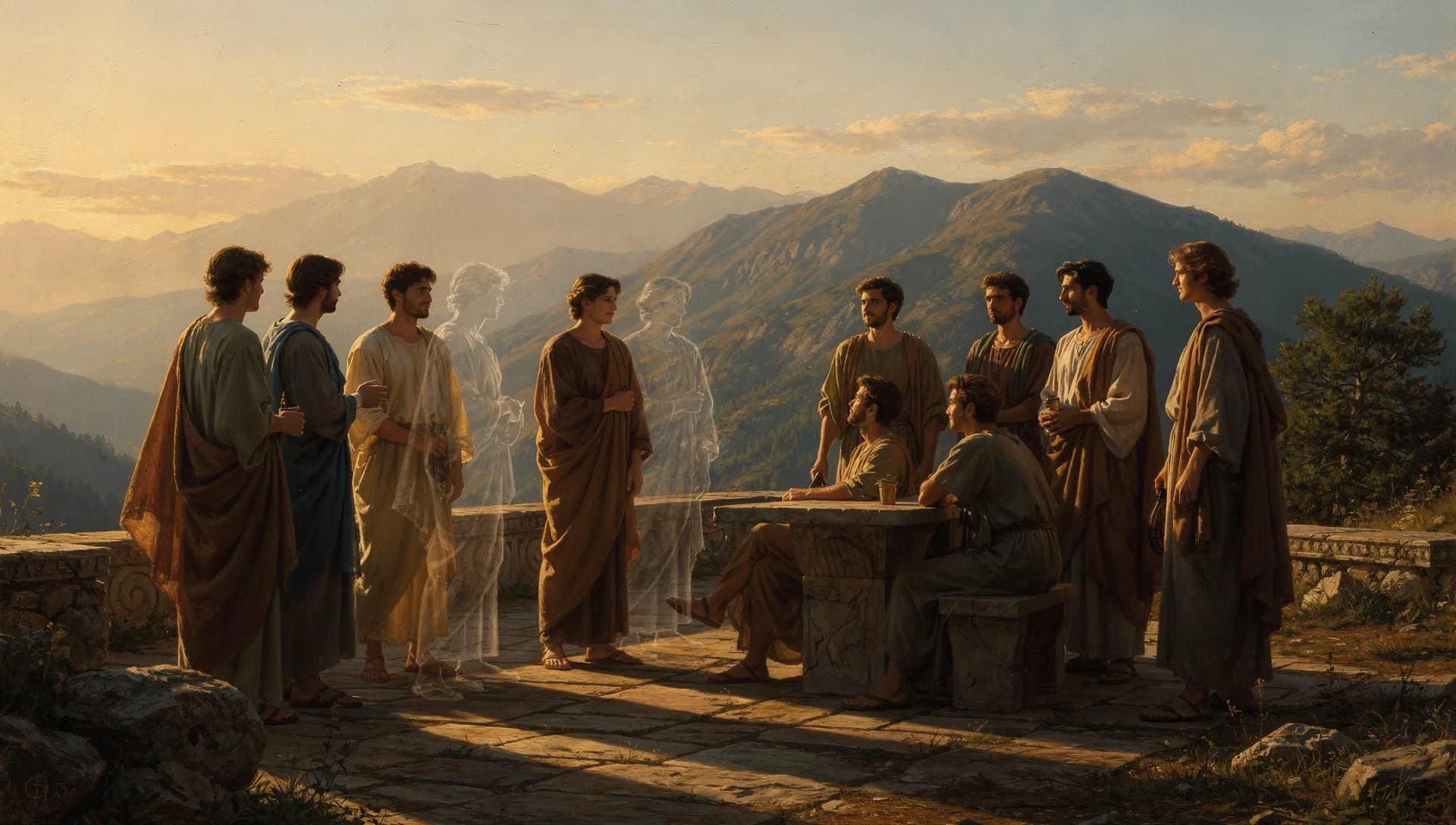
16 children of Adamson + Ratta = Olympian Gods: Zeus, Hera, Poseidon, etc.
This article expands on the decoder mapping. For the side-by-side card and quick reference, see the mapping page.
The Pantheon's Numerical Shape
Greek religion organizes its superhuman beings along an unusually precise numerical pattern. Twelve principal Olympians at the top: Zeus, Hera, Poseidon, Demeter, Apollo, Artemis, Ares, Aphrodite, Hephaestus, Athena, Hermes, Hestia or Dionysus. Beneath them a much larger set of secondary figures who are superhuman but lesser: the minor gods, the daimones, the heroes, the nymphs, the demigods. The boundary between fully divine and merely superhuman is porous throughout the tradition.
Three features of this structure are worth marking before the comparative material.
First, the specific count. Twelve principal figures is not a round mythological number in the way seven or three usually are. It is high enough to require individuation and low enough to remember. Greek pantheons elsewhere, Egyptian, Mesopotamian, Vedic, do not consistently organize themselves around twelve. The Olympian Twelve is a deliberate structural choice.
Second, the category of demigod. Greek religion maintained a robust theological space for beings who were part divine, part mortal. Heracles, Perseus, Theseus, and many named others occupy this space. Hesiod's Works and Days (lines 156-173) gives the schema: a whole race of hemitheoi, half-gods, who lived on earth in the age between the silver and iron generations.
Third, the invisibility feature. A recurring motif in Greek mythology is the god or demigod who can be present but unseen. Athena disguises herself and is known to Odysseus but invisible to his enemies. Hermes moves between worlds. The recurrent motif of a being whose superhuman quality includes the capacity to be present without being visible is distinctive to the Greek tradition among Mediterranean mythologies.
The Urantia Book records a historical event that matches these three structural features directly.
What the Urantia Book Says
Adamson and Ratta had sixty-seven children. The number is specific and the text takes a pointed interest in one subcategory:
"Adamson and Ratta had a family of sixty-seven children. They gave origin to a great line of the world’s leadership, but they did something more. It should be remembered that both of these beings were really superhuman. Every fourth child born to them was of a unique order. It was often invisible. Never in the world’s history had such a thing occurred." (UB 77:5.6)
Every fourth child of sixty-seven totals approximately sixteen or seventeen children of this unique invisible order. These were the ancestors of the secondary midwayers, and they formed a permanent superhuman population attached to the Adamsonite civilization, operating alongside the visible children and fully available to them:
"Adamson and Ratta thus had at their command this corps of marvelous helpers, who labored with them throughout their long lives to assist in the propagation of advanced truth and in the spread of higher standards of spiritual, intellectual, and physical living. And the results of this effort at world betterment never did become fully eclipsed by subsequent retrogressions." (UB 77:5.8)
Adamson lived nearly four hundred years. The Adamsonites maintained a high culture for seven thousand years, and the cultural substrate they created migrated westward and north:
"The Adamsonites maintained a high culture for almost seven thousand years from the times of Adamson and Ratta. Later on they became admixed with the neighboring Nodites and Andonites and were also included among the 'mighty men of old.' And some of the advances of that age persisted to become a latent part of the cultural potential which later blossomed into European civilization." (UB 77:5.9)
Two distinct groups therefore descend from the couple. The visible children (approximately fifty) who carried superhuman genetic material into the world's cultural stock. The invisible children (approximately sixteen or seventeen) who functioned as a permanent superhuman corps, progenitors of the secondary midwayers, operating on and influencing human civilization without themselves being directly visible to ordinary mortals.
What the Ancient Source Says
The canonical list of twelve Olympians appears in Homeric and Hesiodic poetry and is elaborated in later compilations. Walter Burkert's Greek Religion (Harvard University Press, 1985) treats the Twelve as a structural category established by the mid-archaic period, perhaps in connection with the Panhellenic sanctuaries. Ken Dowden's The Uses of Greek Mythology (Routledge, 1992) surveys the count across local pantheons and confirms that twelve is consistently present even when the members vary.
The demigod category is treated most fully in Gregory Nagy's The Best of the Achaeans (Johns Hopkins University Press, 1979) and in the essay collection Heroes of Myth and Legend, edited by Corinne Ondine Pache (Cambridge University Press, 2011). Hesiod's fourth age, the age of heroes (Works and Days 156-173), places this class of beings in a definite historical period: the generation that fought at Thebes and at Troy, long enough ago to be past memory, short enough ago to be treated as history rather than myth.
The invisibility motif is tracked in Jean-Pierre Vernant's Mortals and Immortals: Collected Essays (Princeton University Press, 1991). Vernant argues that Greek religion preserved a distinctive concept of superhuman presence as partial withdrawal rather than full absence, a theological position not well attested in comparative Mediterranean material.
Martin West's The East Face of Helicon (Oxford University Press, 1997) traces the origins of the Greek pantheon eastward. The Kumarbi Cycle and related Hurrian-Hittite material already structure a succession of divine generations, and West argues that the Greek Olympian tradition is a creative reception of this older Anatolian-Syrian theological repertoire. The transmission route runs through the same cultural corridor that connects the Kopet Dagh to the Aegean.
Why This Mapping Matters
The three structural features of the Greek pantheon, a count in the teens, a robust demigod category, and a theology of partial or invisible presence, do not derive from ordinary mythological universals. They are specific to the Greek tradition. The Urantia Book supplies a historical event that matches these three features: the sixty-seven Adamsonite children, a subset of whom were a unique invisible order, descended from a couple who founded a civilization of almost seven thousand years whose cultural substrate reached Europe.
The number is not a perfect match. Sixty-seven is not twelve. But the Urantia record provides the substrate. Of the fifty visible Adamsonite children, the mythologically active subset, the leaders and founders of the derivative peoples, would over time be distilled into the principal canonical figures of the civilizations that inherited the substrate. The larger number gradually telescopes to the memorable core of twelve. This is the normal pattern of how pantheons emerge from historical ancestor-memory: the generations of descendants compress to a paradigmatic set, usually in the low teens, that can be held in oral tradition across millennia.
The demigod category tracks even more precisely. The Greek hemitheoi are neither fully divine nor fully mortal, superhuman in ability but bound to earthly lives, producing descendants who eventually merge into the general human population. The Adamsonite children, superhuman due to the dual Adamic and corporeal-staff ancestry, living for centuries rather than millennia, producing descendants who gradually merged with the surrounding populations, are exactly the class of being the Greek demigod category preserves.
The invisibility motif is the cleanest match. Greek religion's unusual theology of superhuman beings who can be present but not directly seen is not explained by any feature of Mesopotamian or Egyptian religion. It is explained directly by the Urantia Book's account of the secondary midwayer-progenitor class: sixteen or seventeen of the Adamsonite children were literally often invisible, and they operated as a permanent superhuman corps attached to the civilization.
Sources
- The Urantia Book, Paper 77 (The Midway Creatures). Urantia Foundation, first printing 1955. Cited passages: 77:5.6, 77:5.8, 77:5.9.
- Hesiod. Theogony and Works and Days. Edition and commentary by M. L. West. Oxford University Press, 1966 and 1978.
- Burkert, Walter. Greek Religion: Archaic and Classical. Harvard University Press, 1985.
- Dowden, Ken. The Uses of Greek Mythology. Routledge, 1992.
- Nagy, Gregory. The Best of the Achaeans: Concepts of the Hero in Archaic Greek Poetry. Johns Hopkins University Press, 1979.
- Pache, Corinne Ondine, ed. Heroes of Myth and Legend. Cambridge University Press, 2011.
- Vernant, Jean-Pierre. Mortals and Immortals: Collected Essays. Edited by Froma I. Zeitlin. Princeton University Press, 1991.
- West, Martin L. The East Face of Helicon: West Asiatic Elements in Greek Poetry and Myth. Oxford University Press, 1997.
Confidence and Evidence
- Confidence: INFORMED SPECULATION
- Evidence rating: SUGGESTIVE to MODERATE
- Basis: Three structurally distinctive features of the Greek pantheon (count in the teens, demigod class, invisibility motif) match the Urantia record of the sixty-seven Adamsonite children and their subdivision. The euhemeristic logic is well-established in classical scholarship; the Urantia historical substrate is not a claim classical scholarship has access to.
Related Decoder Articles
- Adamson + Ratta = Cronus + Rhea, Titan Parents
- Van, Loyal Corporeal Staff Member = Enki / Ea
- The Nodites and the Nephilim
By Derek Samaras
Connecting Articles
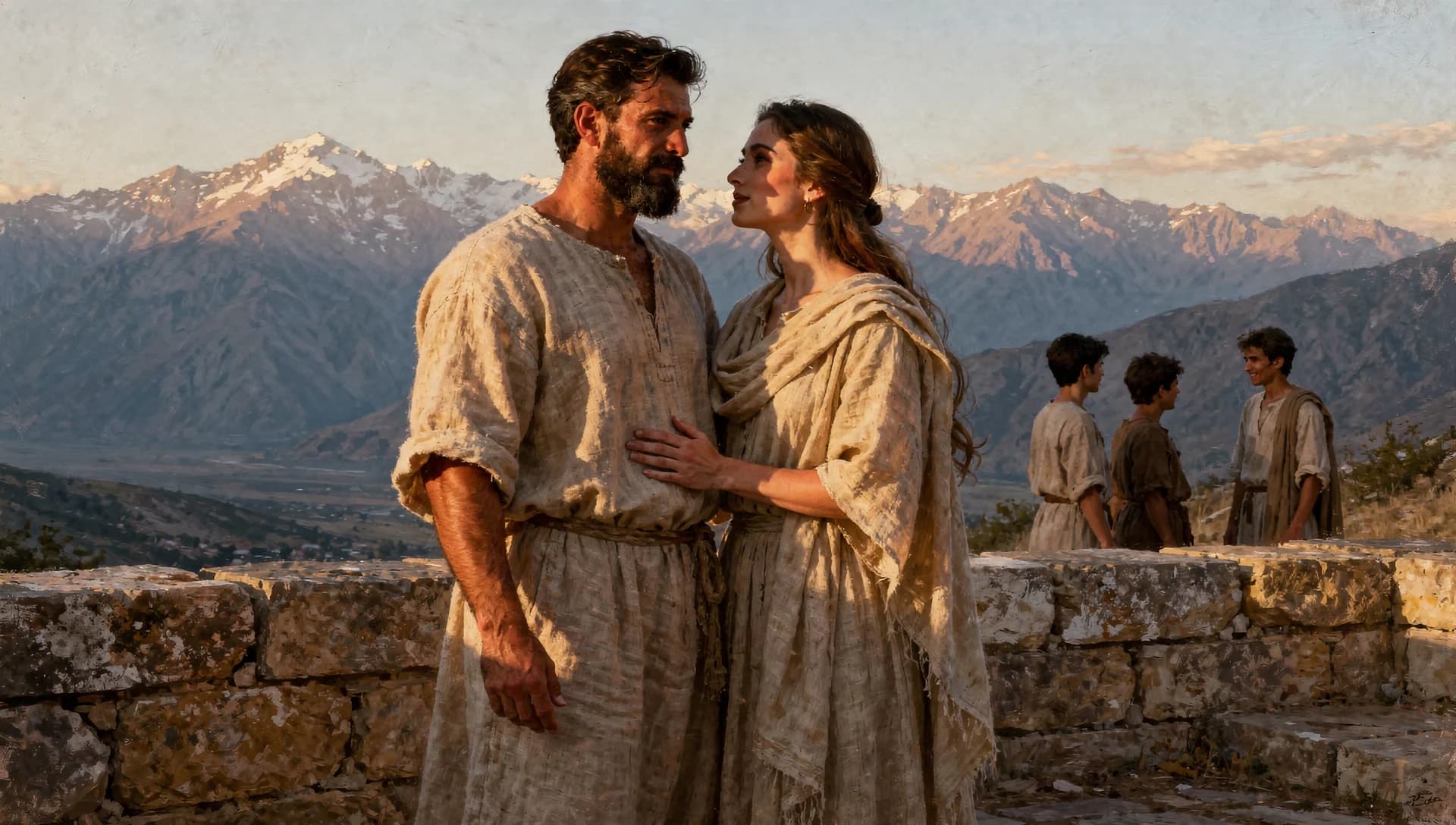
The Pre-Olympian Couple: Adamson and Ratta in the Greek Memory
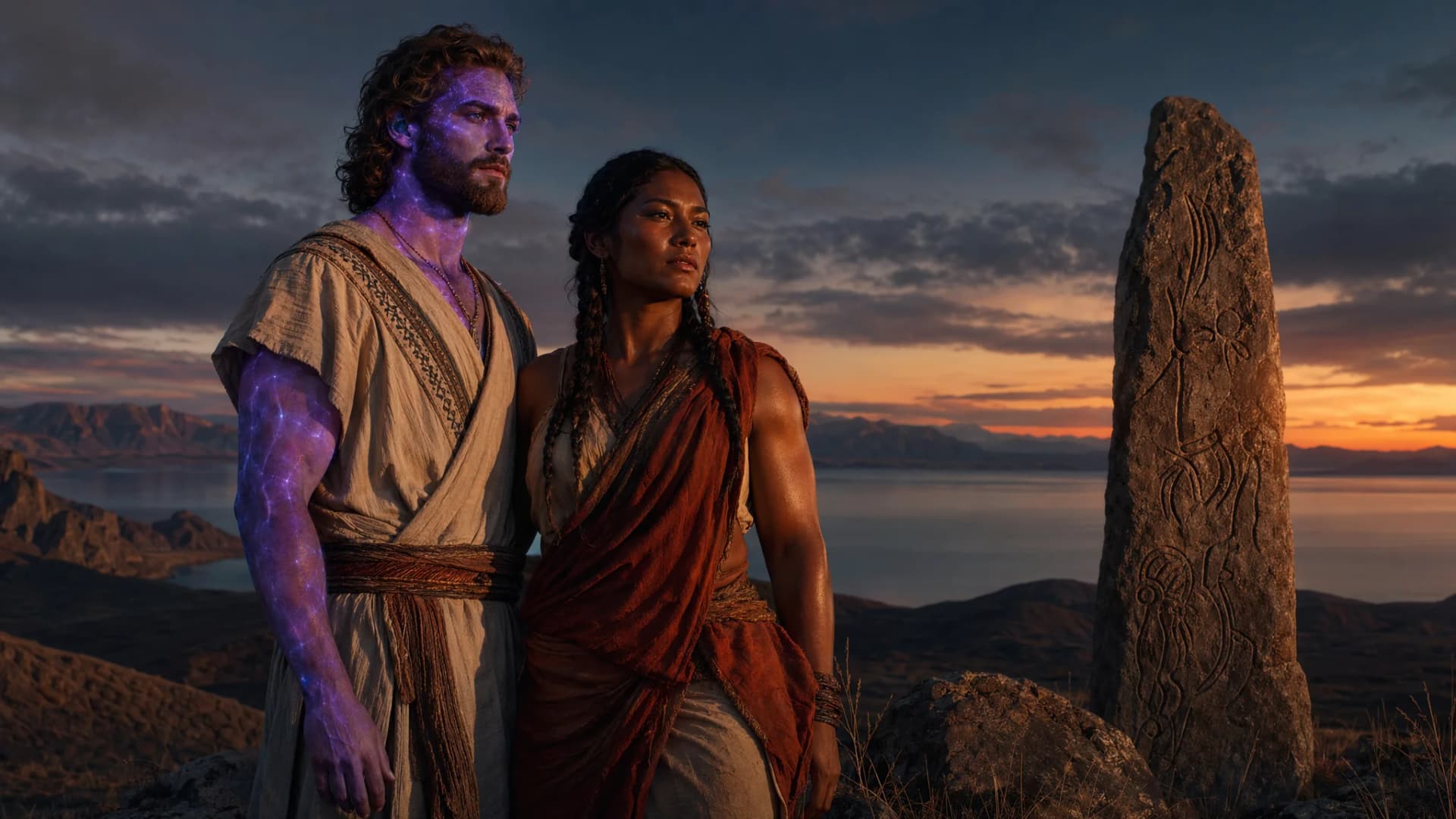
The Dark-Skinned Lord and His Beloved: Adamson, Ratta, and Krishna-Radha
The Bird That Carried the Hero: Adamson, Fandor, and the Hindu Garuda
The Sky Father Who Could Not Be Seen: Caligastia and the Greek Ouranos
The Newsletter
Get the research behind each piece
Free. New Urantia Book explorations, the sources behind the videos, and early looks. No spam, unsubscribe anytime.
Prefer video? Follow on YouTube and Facebook.
Delivered through Substack. You can also read past issues.