
The Longest Memory: Australian Aboriginal Dreamtime and the Primordial Teaching-Ancestors
Australian Aboriginal cosmology preserves the Dreamtime, the primordial era when ancestor-beings shaped the land, taught humans language and ceremony, and laid down the moral law. The Urantia Book documents the Sangik dispersion and the long oral preservation of pre-rebellion teaching content among peripheral populations. Recent linguistic research has shown that Aboriginal oral tradition preserves accurate memories of coastline inundation from 10,000 years ago, among the longest verifiable oral traditions on Earth.
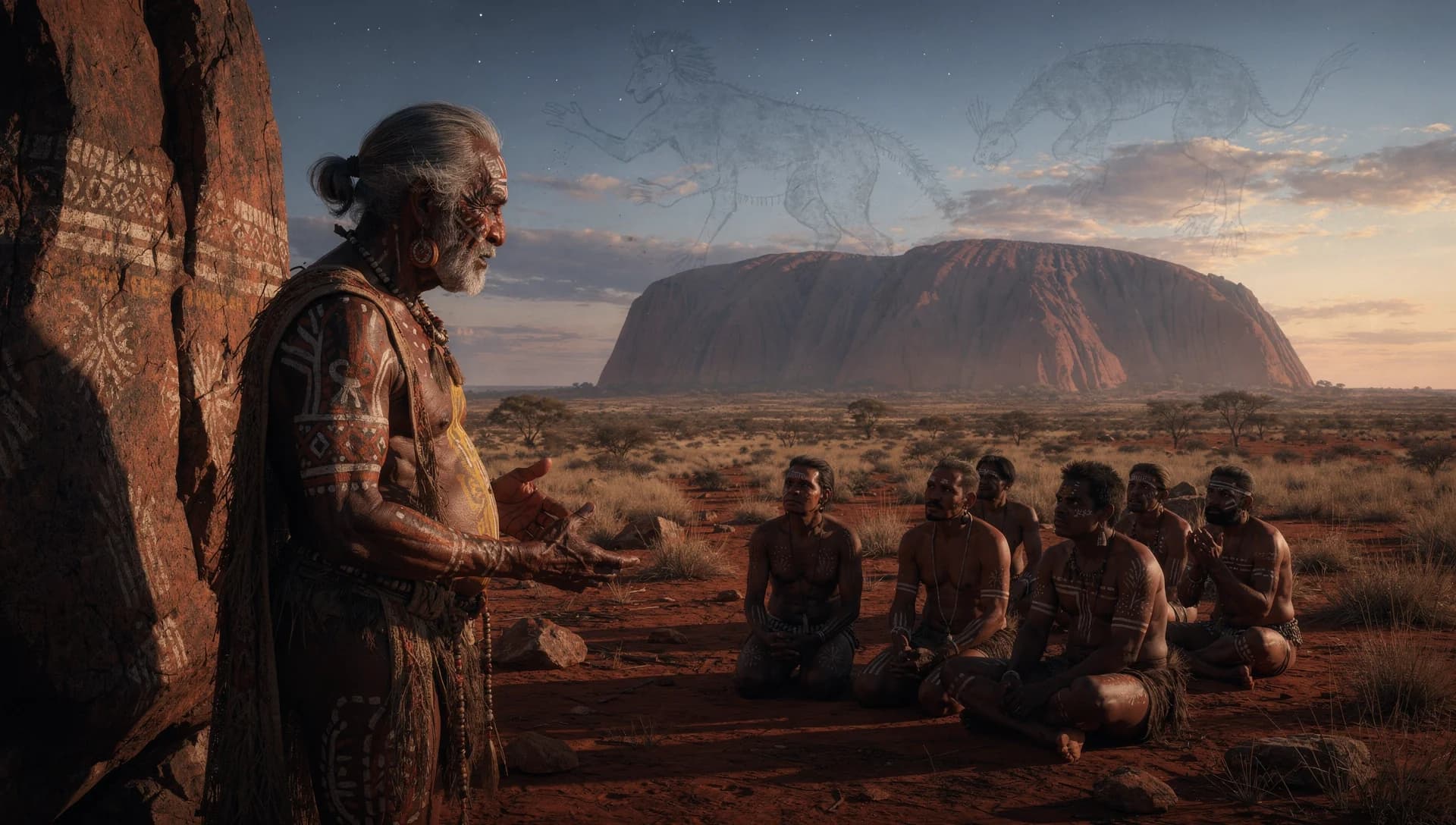
Sangik dispersion and primordial teaching-ancestor memory = Australian Aboriginal Dreamtime and the creator ancestors
This article expands on the decoder mapping. For the side-by-side card and quick reference, see the mapping page.
The Dreamtime Cosmology
Australian Aboriginal cosmology, carried forward through oral tradition, ceremony, and rock art, is organized around the Dreamtime. Different peoples call it by different names: the Dreaming in English, the Altjeringa among the Aranda, the Wongar among the Yolngu, the Ngurra Kutjungka among the Western Desert peoples. It is the primordial era when the ancestor-beings emerged from the undifferentiated substrate that preceded creation, traveled across the land and shaped it, set down the moral and social law by their example, and taught humanity the arts of life.
The shape is consistent across the continent. There is a distant high creator, named differently in each language. There are ancestor-beings who descend from that creator or rise out of the pre-creation ground. There are sacred sites that anchor what those ancestors did during the Dreamtime. There are ritual and ceremonial practices that preserve their teachings and re-enact them. And there is a moral and social law derived from the Dreamtime stories themselves.
The Urantia Book identifies the substrate that this cosmology preserves.
What the Urantia Book Says
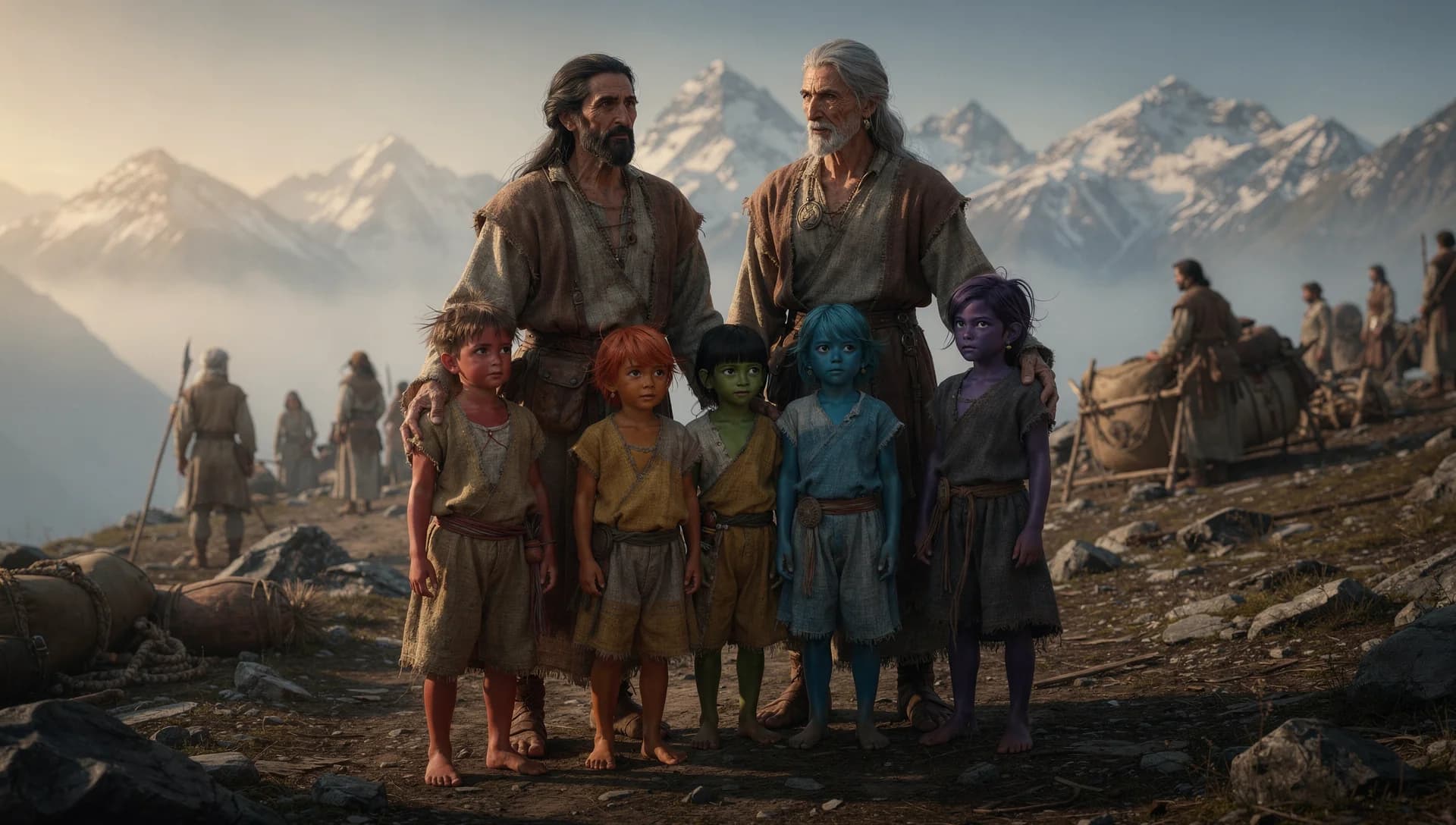
The Urantia Book records that the six Sangik races dispersed from a Himalayan-foothills origin and spread across the continents over the 500,000 years that followed (64:5.1). Particular racial streams reached particular zones. The Aboriginal Australian inheritance carries early racial content that long predates the cultural elaborations layered onto other parts of the world.
The teaching tradition established at Dalamatia before the rebellion (UB 66:5, the ten councils of the Prince's staff that laid down the basic content of human civilization) would have reached the Aboriginal populations through the broad pre-rebellion diffusion the Urantia Book describes. The Prince's one hundred corporeal staff were organized for service in ten autonomous councils of ten members each, with each council devoted to a basic field of human endeavor (66:5.1).
The ten councils are named at UB 66:5.2-13: the Council on Food and Material Welfare, the Board of Animal Domestication and Utilization, the Advisers Regarding the Conquest of Predatory Animals, the Faculty on Dissemination and Conservation of Knowledge, the Commission on Industry and Trade, the College of Revealed Religion, the Guardians of Health and Life, the Planetary Council on Art and Science, the Governors of Advanced Tribal Relations, and the Supreme Court of Tribal Co-ordination and Racial Co-operation.
The Aboriginal Dreamtime preserves a parallel institutional shape. Different ancestor-beings teach different domains of life. Each domain is preserved through its own ceremonial line. The whole structure is held together by a formal initiatory pedagogy that mirrors the way the Dalamatia school was organized.
The Urantia Book also notes a pattern that bears on Aboriginal Australia directly. Peripheral populations, sitting at the edges of later migration streams and isolated from the cultural disruptions that followed the rebellion, tend to preserve earlier content for far longer than central populations do. Central populations get overlaid by wave after wave of post-rebellion and post-Adamic developments. The Aboriginal Australian situation, roughly 50,000 to 65,000 years of largely isolated continental development, is exactly the kind of peripheral context where early material would be expected to survive.
What the Ancient Sources Say
The Dreamtime is documented across the full span of Australian Aboriginal scholarship. W.E.H. Stanner's The Dreaming and Other Essays (Australian National University Press, 1953; reprinted Black Inc., 2010) established the modern scholarly framing of the Dreaming as a sophisticated cosmology rather than primitive mythology. Stanner showed three things in particular: the Dreaming is temporally complex (it is at once a pre-cosmic past, a present ritual reality, and an ongoing future creation), it is geographically concrete (bound to particular sacred sites across the continent), and it is morally authoritative (its stories establish the normative social and ritual order).
T.G.H. Strehlow's Songs of Central Australia (Angus and Robertson, 1971) documented the Aranda Dreamtime with close attention to the song-cycle as a preservation mechanism. The Aranda carry extended song-cycles that trace the journeys of particular ancestor-beings across the central Australian landscape, with detailed geographic accuracy and elaborate chronological depth.
Howard Morphy's Aboriginal Art (Phaidon, 1998) treats the Yolngu tradition of Arnhem Land, particularly the relationship among cosmology, ritual, and artistic production. Morphy describes how Yolngu ancestor-beings are tied to particular clan territories and how their associated content is preserved through initiatory ceremony.
The question of whether Aboriginal oral tradition can actually preserve accurate content over deep time has been answered in recent linguistic work. Patrick D. Nunn and Nicholas J. Reid's "Aboriginal Memories of Inundation of the Australian Coast Dating from More than 7000 Years Ago" (Australian Geographer 47, 2016) documented twenty-one distinct Aboriginal oral traditions that preserve accurate geographic memory of coastline inundation during the post-glacial sea-level rise roughly 7,000 to 11,000 years ago. The accuracy of these traditions across that span is among the longest verifiable oral preservation documented in any world culture.
The structural features that recur across widely separated Aboriginal language groups point to a shared inheritance rather than parallel independent invention. Across the continent the same pattern appears: ancestor-beings emerging from pre-creation and entering manifest form, creative journeys that shape the land, instruction that establishes the moral and ritual order, sacred sites that memorialize what the ancestors did, and an initiatory ceremonial system that carries the content forward.
Bill Gammage's The Biggest Estate on Earth: How Aborigines Made Australia (Allen and Unwin, 2011) documents the sophisticated land management and fire ecology that the Dreamtime cosmology integrated with practical landscape practice. Gammage's evidence of continental-scale coordinated burning across the Aboriginal population implies a level of institutional organization that lines up with the kind of structure the Urantia Book describes at Dalamatia.
Why This Mapping Matters
The longevity of Aboriginal oral preservation matters for the broader question of how ancient cultural content reaches us at all. The Urantia Book describes substantial pre-rebellion and pre-Adamic teaching (Dalamatia, the elevated Adamic inheritance, the Salem-era monotheistic seeding) that mainstream archaeology and historical linguistics typically assume could not have survived through oral tradition alone over such long spans.
The Nunn and Reid 2016 results push that assumption back hard. If Australian oral traditions can preserve accurate geographic content across 10,000 years, then comparable longevity is plausible elsewhere. That gives us the actual transmission mechanism the Urantia Book's account requires.
The Aboriginal Dreamtime preserves an institutional teaching-ancestor structure that closely parallels the Dalamatia school described at UB 66:5. Different ancestors teach different cultural domains. The teaching is preserved by initiatory ceremony. The whole tradition is anchored to specific sacred sites on the land. These features fit the picture of continuous preservation of pre-rebellion Dalamatian content across the long Aboriginal isolation.
That isolation is the key. The Aboriginal population reached Australia roughly 50,000 to 65,000 years ago, crossing the Sundaland and Sahul corridors when sea levels were low in the late Pleistocene. From then until European contact, the continent remained largely outside the Old World migration streams. Fifty millennia of continuous isolation is about as good a preservation environment as exists on Earth for pre-rebellion and pre-Adamic content that other populations would have lost to later disruption.
The land-management evidence Gammage assembles is practical proof of institutional-scale coordinated activity. Continental-scale fire and land management, sustained across tens of thousands of years, is far more elaborate than the standard hunter-gatherer picture allows. That kind of organization is consistent with preserved Dalamatian institutional content rather than with independent local development of the same practices.
Stanner's emphasis on moral authority matters here too. The Dreamtime establishes the moral, social, and ritual order through the example of the ancestors. That morally authoritative teaching-ancestor structure is the same kind of moral revelation the Urantia Book attributes to the Dalamatian tradition, in particular Hap's presentation of the Father's Way and the seven commandments at UB 66:7.8. The Aboriginal preservation of morally authoritative ancestor teaching is, on this reading, a direct continuation of the original Dalamatian moral substrate.
The practical upshot for Aboriginal Australian studies is this. The Dreamtime should not be read primarily as an isolated indigenous development. It is, on the Urantia Book framework, the longest-preserved continuation of the pre-rebellion teaching-ancestor tradition that originally seeded Urantia. Fifty thousand years of continuous Aboriginal preservation is the most direct pathway from the Dalamatian substrate into the contemporary ethnographic record. That makes the Aboriginal Dreamtime one of the most valuable windows we have into the original cultural and religious teaching on this world.
Sources
- The Urantia Book, Paper 64 (The Evolutionary Races of Color), Paper 66 (The Planetary Prince's Staff). Urantia Foundation, first printing 1955. Cited passages: 64:7 (racial dispersions), 66:5.1-14 (ten councils).
- Stanner, W.E.H. The Dreaming and Other Essays. Australian National University Press, 1953; reprinted Black Inc., 2010.
- Strehlow, T.G.H. Songs of Central Australia. Angus and Robertson, 1971.
- Morphy, Howard. Aboriginal Art. Phaidon, 1998.
- Nunn, Patrick D. and Nicholas J. Reid. "Aboriginal Memories of Inundation of the Australian Coast Dating from More than 7000 Years Ago." Australian Geographer 47, no. 1, 2016.
- Gammage, Bill. The Biggest Estate on Earth: How Aborigines Made Australia. Allen and Unwin, 2011.
- Berndt, Ronald M. and Catherine H. Berndt. The World of the First Australians. Smith, 1964; revised Aboriginal Studies Press, 1988.
- Elkin, A.P. The Australian Aborigines. Angus and Robertson, 1938; revised 1974.
Confidence and Evidence
- Confidence: INFORMED SPECULATION
- Evidence rating: SUGGESTIVE
- Basis: The Urantia Book documents the Sangik dispersion and the Dalamatian institutional teaching-ancestor structure. The Aboriginal Dreamtime preserves a parallel institutional structure across 50,000 years of continental isolation. The Nunn and Reid 2016 documentation of verified 10,000-year oral-tradition accuracy substantially supports the plausibility of long-range cultural preservation. The continent-wide structural consistency across widely separated language groups points to a shared pre-dispersal inheritance.
Related Decoder Articles
Byline: Derek Samaras | Urantia Book Network | April 2026
Connecting Articles
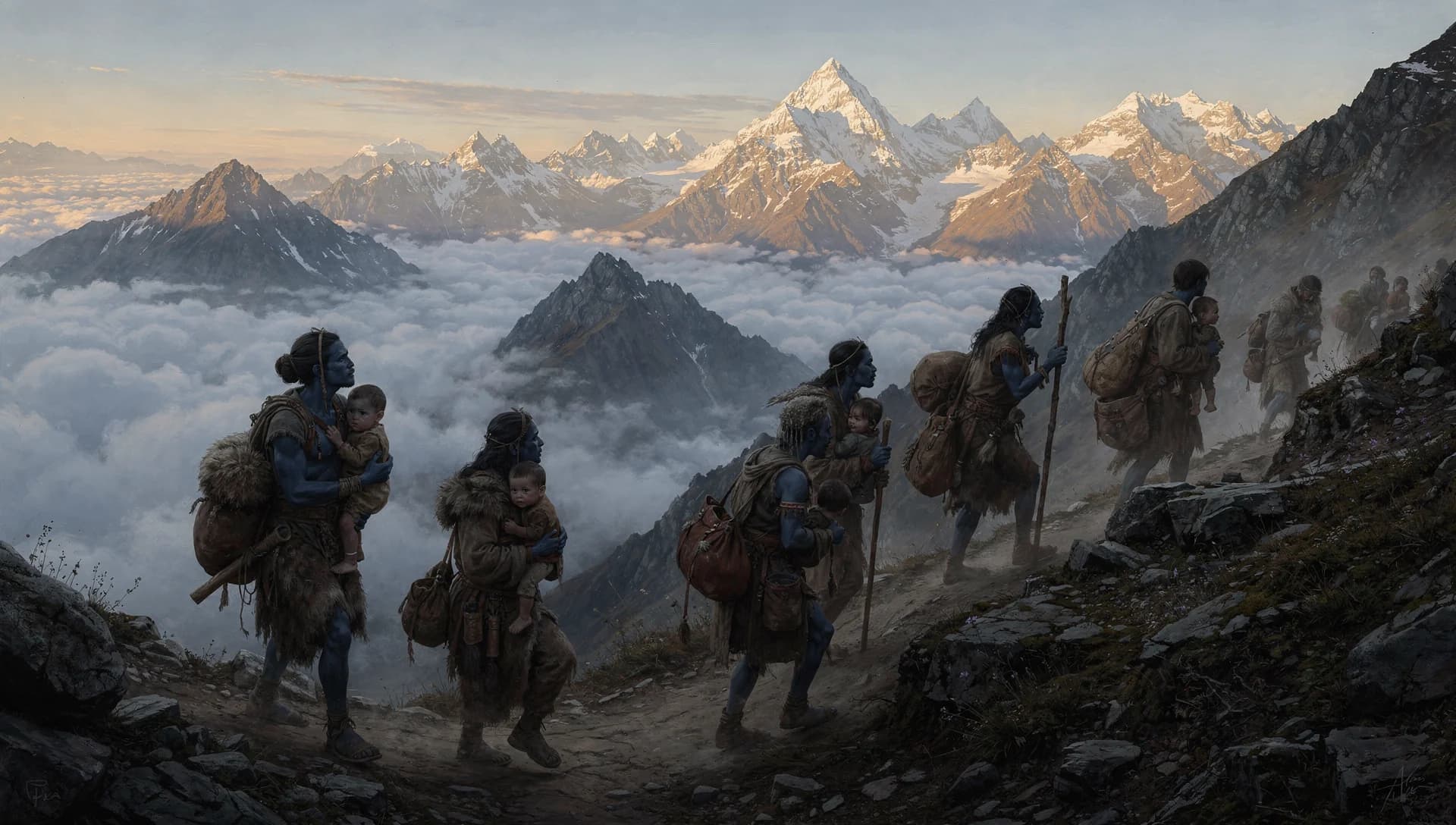
We Came From the North: Pan-African Origin Traditions and the Indigo Migration Path
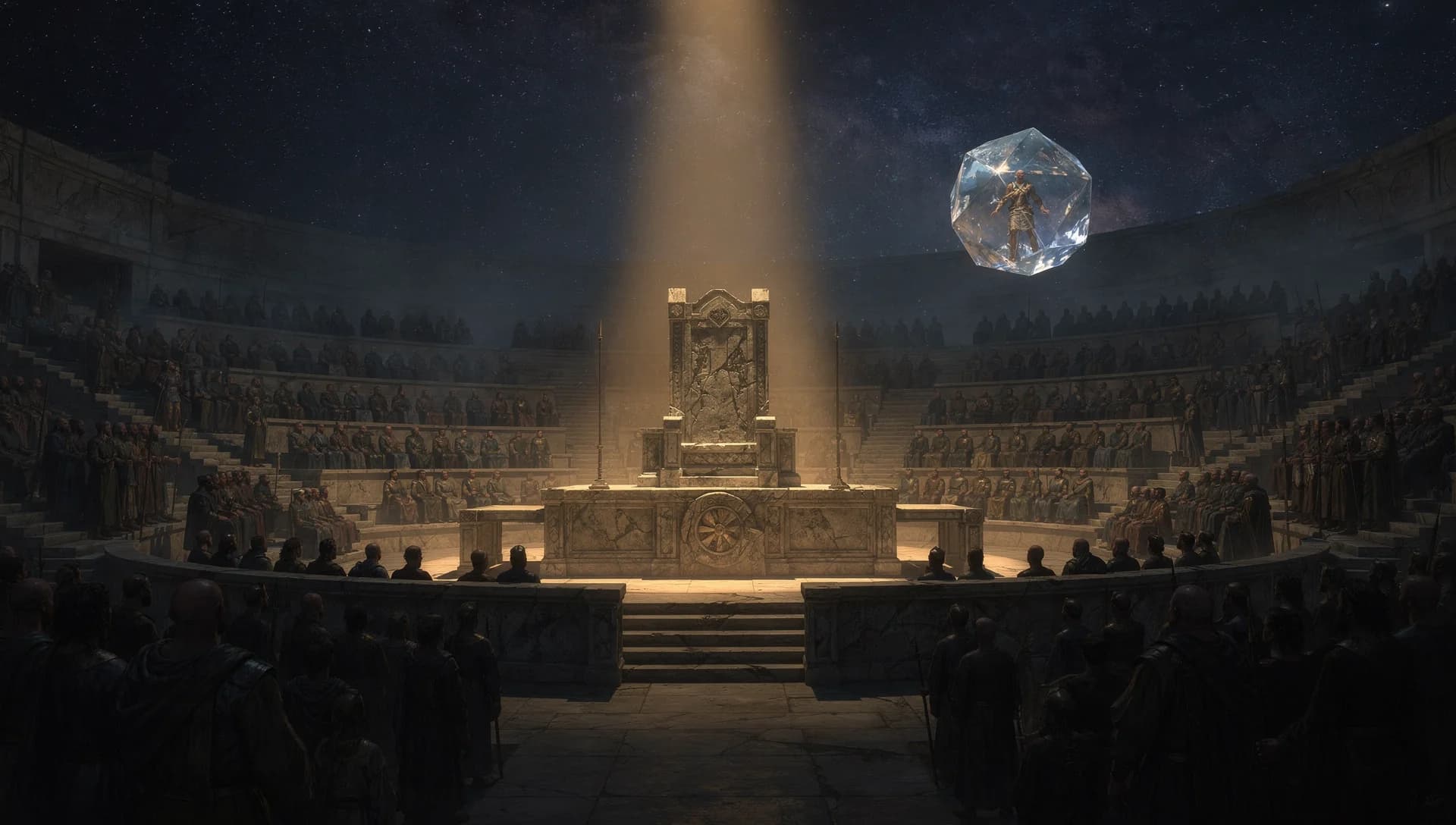
The Final Adjudication: Ragnarok and the Pending Verdict
We Come From One: African First-Family Traditions and the Sangik Origin
The Sky God Who Withdrew: African High-God Traditions and the Salem Teaching Layer
The Newsletter
Get the research behind each piece
Free. New Urantia Book explorations, the sources behind the videos, and early looks. No spam, unsubscribe anytime.
Prefer video? Follow on YouTube and Facebook.
Delivered through Substack. You can also read past issues.