
The 132 Sailors and the Feathered Serpent: Was Quetzalcoatl an Andite Memory?
Mesoamerican tradition from Aztec through Maya is often summarized as remembering a bearded, civilizing teacher who came from the east and left promising to return. The Urantia Book never names Quetzalcoatl, but it says: "One hundred and thirty-two of this race, embarking in a fleet of small boats from Japan, eventually reached South America" (78:5.7). We read the tradition as a possible echo of that voyage, and we set out what counts against the reading.
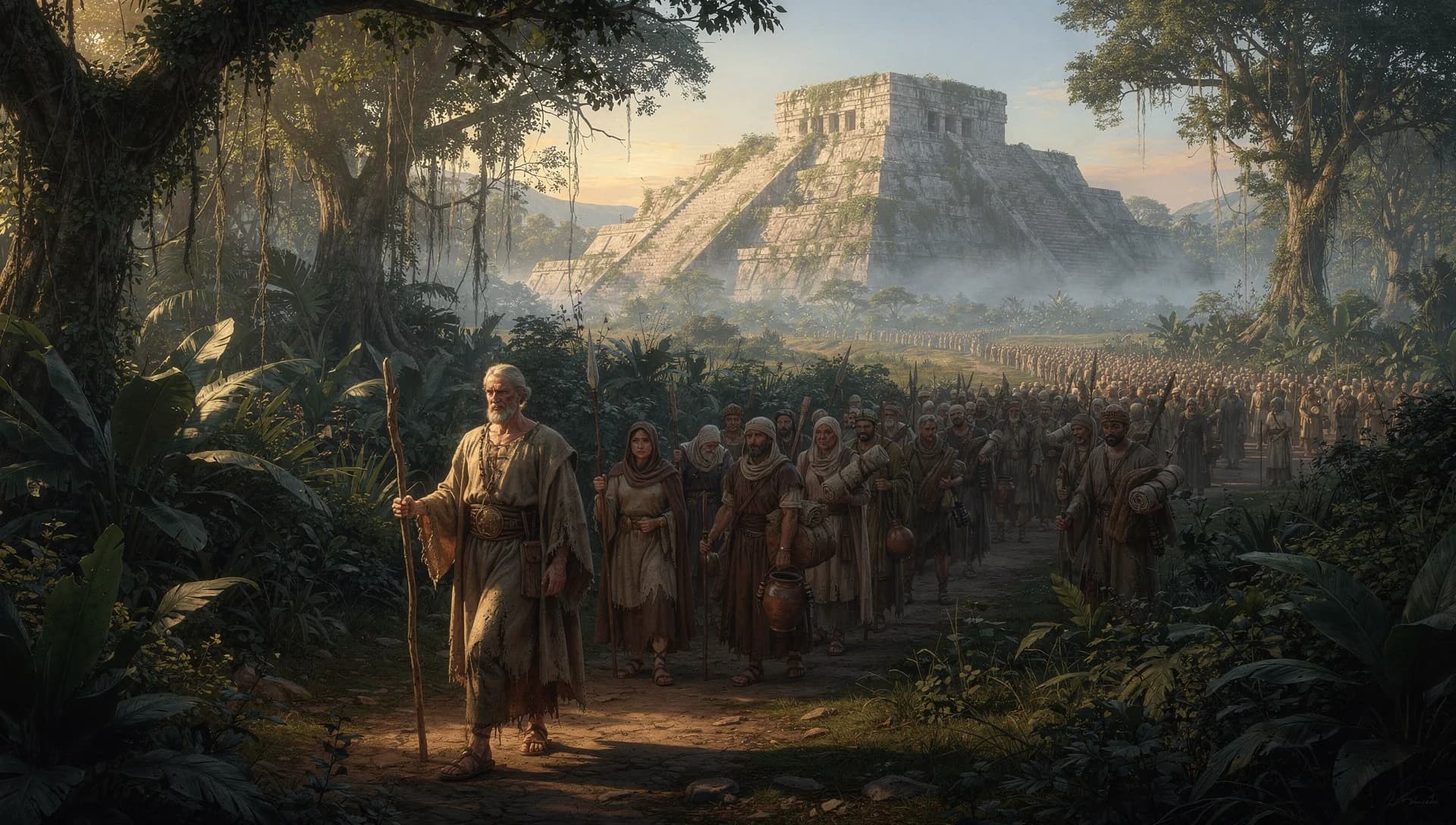
The 132 Andite Sailors = Quetzalcoatl / Kukulkan
This article expands on the decoder mapping. For the side-by-side card and quick reference, see the mapping page.
The Teacher Who Arrived from the East
When Hernán Cortés landed on the Mexican coast in 1519, the story goes, the Aztec emperor Moctezuma II took him, at least for a while, for the returning Quetzalcoatl. The accounts in the Florentine Codex, Sahagún's sixteenth-century compilation, describe Moctezuma's first approach: gifts, courtesy, hesitation. Many historians now doubt the story, which comes from sources written after the conquest; we have not checked it against those sources. What is not in doubt is that Mesoamerica had old traditions of Quetzalcoatl, a feathered serpent and a culture-bringer.
That tradition is not unique to the Aztecs. It is commonly described as appearing across Mesoamerica. Kukulkan, the "feathered serpent" in Maya, is the same figure under a different name. Viracocha, the bearded white creator-god of the Incas, is a closely related figure in the Andean tradition to the south. In the usual summary all three share a core biography: a bearded teacher, sometimes described as fair, arrived from the east, taught agriculture, calendar-keeping, stone-working and moral law, ruled for a period as a culture-bringer and law-giver, and then departed, leaving a promise of return. How much of the description as fair and bearded is pre-conquest and how much was shaped after it is debated.
Sahagún's Florentine Codex, Book III, is the main early source for the Aztec version. Summaries of it describe Quetzalcoatl as a bearded, chaste priest-ruler and lawgiver who taught the arts of civilization. That is a summary, not a quotation; we have not checked it against the Codex.
The Maya Kukulkan tradition preserves the same figure with the same attributes. The Chilam Balam texts record his arrival at Chichén Itzá, his transformation of the city, and his departure by sea. Jacques Lafaye's Quetzalcoatl and Guadalupe (1974) and David Carrasco's Quetzalcoatl and the Irony of Empire (1982) are standard academic treatments; we have not checked them for the statements here.
Who was this man? The mainstream academic position is that Quetzalcoatl is a mythological figure whose historical referent, if any, cannot be identified. There have been speculations: a ninth-century Toltec ruler named Ce Acatl Topiltzin Quetzalcoatl, a generic culture-hero archetype, a symbolic figure for the morning star. In our reading none of these accounts fully explains the description (bearded, sometimes fair), the arrival from the east, or the memory of a bounded teaching period followed by departure with a promise of return.
We read the Urantia Book as offering a historical candidate. The book itself never names Quetzalcoatl, Kukulkan or Viracocha; the link is ours.
The 132 Andite Sailors
The book tells of the 132 in a single paragraph of Paper 78:
"One hundred and thirty-two of this race, embarking in a fleet of small boats from Japan, eventually reached South America and by intermarriage with the natives of the Andes established the ancestry of the later rulers of the Incas. They crossed the Pacific by easy stages, tarrying on the many islands they found along the way. The islands of the Polynesian group were both more numerous and larger then than now, and these Andite sailors, together with some who followed them, biologically modified the native groups in transit. Many flourishing centers of civilization grew up on these now submerged lands as a result of Andite penetration. Easter Island was long a religious and administrative center of one of these lost groups." (UB 78:5.7)
The passage is dense with specifics: a number, a departure point, a route and a destination. Of Japan the book says elsewhere: "From time to time small groups made their way into Japan, Formosa, the East Indies, and southern China, though very few entered southern China by the coastal route" (UB 78:5.6). Of the Japanese it says: "The ancestors of the Japanese people were not driven off the mainland until 12,000 B.C., when they were dislodged by a powerful southern-coastwise thrust of the northern Chinese tribes" (UB 79:6.3). The book gives no date and no landing site for the 132 (UB 78:5.7, 79:5.9). That the voyage belongs to the Andite migrations, which the book dates "from about 15,000 to 6000 B.C." (UB 78:3.9), is our reading.
The book defines the Andites: "The Andite races were the primary blends of the pure-line violet race and the Nodites plus the evolutionary peoples" (UB 78:4.1). Of the violet race it says: "Adam and his offspring had blue eyes, and the violet peoples were characterized by fair complexions and light hair color—yellow, red, and brown" (UB 76:4.1). But the passage at 78:5.7 gives no physical description of the 132, and it says nothing of what they taught. Of the Andites in general the book says: "And to every nation to which they journeyed, they contributed humor, art, adventure, music, and manufacture" (UB 78:5.8), and "They were skillful domesticators of animals and expert agriculturists" (UB 78:5.8). That the 132 carried such knowledge to the Americas is our reading.
Paper 79 speaks of the civilizations of the Americas:
"The red and the yellow races are the only human stocks that ever achieved a high degree of civilization apart from the influences of the Andites." (UB 79:5.8)
"These civilizations were evolutionary products of the Sangiks, notwithstanding that traces of Andite blood reached Peru." (UB 79:5.9)
The book's own words count against part of our reading. It says the red and yellow races reached high civilization "apart from the influences of the Andites" (UB 79:5.8), and it places the only Andite trace in Peru, not in Mexico or Central America, where the Quetzalcoatl and Kukulkan traditions belong.
The book does name the founders of those civilizations. The same paragraph 79:5.8 goes on: "In Mexico, Central America, and in the mountains of South America the later and more enduring civilizations were founded by a race predominantly red but containing a considerable admixture of the yellow, orange, and blue." Paper 64 tells how that race formed:
"These tribes were accompanied by three small groups of mixed ancestry, the largest of these being a combination of the orange and blue races. These three groups never fully fraternized with the red man and early journeyed southward to Mexico and Central America, where they were later joined by a small group of mixed yellows and reds. These peoples all intermarried and founded a new and amalgamated race, one which was much less warlike than the pure-line red men. Within five thousand years this amalgamated race broke up into three groups, establishing the civilizations respectively of Mexico, Central America, and South America. The South American offshoot did receive a faint touch of the blood of Adam." (UB 64:7.5)
At the close of the Sangik migrations the book adds: "An amalgamated race of rather superior potential occupies the highlands of South America" (UB 64:7.16). So on the book's account Mesoamerica was built by an amalgamated red, yellow, orange and blue race, with no violet or Andite blood; the Adamic strain appears only in the south, as "a faint touch of the blood of Adam" (UB 64:7.5) and "traces of Andite blood" in Peru (UB 79:5.9). Of the orange race the book says: "The outstanding characteristic of this race was their peculiar urge to build, to build anything and everything, even to the piling up of vast mounds of stone just to see which tribe could build the largest mound" (UB 64:6.10). That this urge lives on in the stone platforms and pyramids of Mesoamerica is our reading; the book does not connect them.
Why the Mesoamerican Tradition Would Remember Him This Way
In our reading, if one hundred and thirty-two culturally advanced sailors arrived in the Andes during the Andite migrations, married into the local population, and contributed their knowledge of agriculture, metallurgy, calendar-keeping, and civil administration, the Indigenous memory of this event would depend on how well their descendants preserved the original biographical details over the following eight thousand years.
Memory over eight thousand years is imperfect but not empty. What would be kept is the most distinctive features: appearance, arrival from the east, teaching delivered as a package, and the end of the teaching period (departure with a promise of return, the standard memory-form for "they are no longer with us"). In our reading these features appear in the Quetzalcoatl, Kukulkan and Viracocha traditions.
The book itself names an American leader whose return was awaited, and he is not one of the 132. Of great leaders it says "their return is always expected by their respective groups", and it lists them: "In central Asia the tribesmen still look for the return of Genghis Khan; in Tibet, China, and India it is Buddha; in Islam it is Mohammed; among the Amerinds it was Hesunanin Onamonalonton" (UB 92:5.6). Onamonalonton lived about sixty-five thousand years ago and "maintained his headquarters among the great redwood trees of California" (UB 64:6.7). So the promise of return has a candidate in the book's own words, far older than any Andite voyage. Whether the Mesoamerican expectation descends from him, from the 132, or from neither is our question; the book does not connect Quetzalcoatl with either.
The Viracocha tradition in the Andean region is especially telling. Viracocha is the bearded creator-god of the Incas, associated with the pre-Incan Tiahuanaco culture that dominated the Andean highlands centuries before the Inca rise. Pedro de Cieza de León, writing in the mid-sixteenth century, recorded local traditions of Viracocha as a tall white man who taught the people and departed by way of the sea; we give his account in summary and have not checked the wording. The book describes none of these traits in the 132, so the match is with our reading of them, not with the book's words.
The Easter Island reference in the UB passage is another point of contact. Rapa Nui has the famous moai, the undeciphered rongorongo script, and an oral tradition of two peoples, the "long-ears" and the "short-ears". The book says "Easter Island was long a religious and administrative center of one of these lost groups" (UB 78:5.7). The present record does not support that long history: the settlement of Rapa Nui is estimated at AD 1150 to 1280 (as cited by Moreno-Mayar et al. 2024, Nature). The contact between Polynesia and the Americas that genetics has dated falls at about AD 1200 and runs the other way, from the Americas into Polynesia (Ioannidis et al. 2020, Nature; Moreno-Mayar et al. 2024). These findings do not show a voyage from Japan across the whole Pacific, which is the voyage the book describes.
The Fringe Interpretation Problem
The "white gods from the east" tradition is uncomfortable territory for modern readers. In the twentieth century, it was frequently invoked by racist and colonial ideologies to deny Indigenous Mesoamerican civilizational achievements. "They must have been taught by Europeans" was used to strip credit for Aztec, Maya, and Inca cultural accomplishments from the peoples who actually lived there.
Our reading is different in important ways. The 132 Andite sailors were not European in any modern sense. The book defines the Andites as "the primary blends of the pure-line violet race and the Nodites plus the evolutionary peoples" (78:4.1). Their arrival in the Andes did not replace or dominate the Indigenous populations; they reached South America "by intermarriage with the natives of the Andes" (78:5.7) and the resulting civilization was a genuine fusion, with the Indigenous base contributing far more to the final product than the tiny Andite input could have produced on its own. The book says these civilizations "were evolutionary products of the Sangiks, notwithstanding that traces of Andite blood reached Peru" (79:5.9).
The reading preserves the historical specificity of the Mesoamerican Quetzalcoatl tradition without lending it to the racist interpretations it has been subjected to. In our reading these were not "white gods" in the modern racial sense. They were a small group of Andite descendants whose cultural contribution, if our reading holds, was real but modest, and whose memory was kept in the mythological idiom available to their descendants.
What the 132 Carried
Of the Andites the book says: "They were skillful domesticators of animals and expert agriculturists" (78:5.8). In our reading they also carried metallurgy, astronomy, calendrical science, writing and stone-working; the book does not list those for the 132. The Mesoamerican achievement in these domains has long been studied as a puzzle. The Maya Long Count calendar, with its base-date of 3114 BCE and its accurate eclipse predictions, is cognitively remarkable. The Teotihuacán pyramid complex requires engineering knowledge of stone and astronomy that has no clear local precursor. The agricultural domestication of maize, squash, beans, and dozens of other crops is a sophisticated achievement whose origins in the archaeological record remain partly obscure.
In our reading the 132 provide a candidate answer to where Mesoamerican sophistication came from. The book's own answer is different: "These civilizations were evolutionary products of the Sangiks, notwithstanding that traces of Andite blood reached Peru" (79:5.9). So our reading of the 132 must rest on the Andes, where the book places Andite blood, and not on Mexico or Central America. For Mexico and Central America the book's answer is the amalgamated red, yellow, orange and blue race of 64:7.5 and 79:5.8, and in our reading the orange urge to build (64:6.10) is part of what that race brought to its stonework.
Why This Matters
The confidence rating on this mapping is INFORMED SPECULATION, and the evidence rating on the card is MODERATE: the story fits, but it is not backed scientifically. In our reading the specificity of the UB detail (132 sailors, from Japan, to South America, by way of the Pacific islands) combined with the traditions of teacher-gods arriving from the east makes one of the most distinctive euhemerist candidates in world mythology. The evidence set out above counts against it.
Most mythological figures have debated historical referents. Zeus might be an idealization of an Indo-European sky-father. Odin might be an idealized warrior-king. These identifications are loose. The 132-sailor identification has a precise number and a named route, but no date (78:5.7, 79:5.9). If our reading is right, the Andean tradition of Viracocha, and perhaps the Mesoamerican traditions of Quetzalcoatl and Kukulkan, keep the memory of a specific migration for which no archaeological or genetic trace has yet been found.
If the story of Moctezuma's hesitation before Cortés is true, which many historians doubt, it would fit this reading: a court acting on an old memory of teachers who had once arrived from the east and promised to return. That remains our reading, not a finding.
A Note on the Feathered Serpent
One question the decoder mapping does not fully resolve is why the memory of these sailors became encoded in serpent iconography. The UB addresses both dragon and serpent symbolism, but not in a way that connects directly to the 132 sailors.
Paper 53:1.6 is explicit that dragon imagery is symbolic: "The dragon eventually became the symbolic representation of all these evil personages." In the UB's cosmology, the dragon is a symbol for the rebel leaders of the Lucifer rebellion, not a literal creature.
Of serpent worship the book says: "The Chinese worship of the dragon is a survival of the snake cults" (85:3.3). It carries the serpent to the Americas too: "From Arabia on through India to the snake dance of the Moqui tribe of red men the serpent has been revered" (88:1.5). In our reading the feathered serpent of Mesoamerica is that ancient serpent reverence raised, over millennia, into the most sophisticated symbolic vocabulary these cultures had.
Whether the 132 Andite sailors contributed to that symbolic vocabulary, or whether the "Quetzalcoatl" identity was grafted onto an existing serpent-god tradition by their descendants, the UB does not say. The decoder mapping rests on the cultural and biographical parallels, not on a claimed UB source for the feathers or the scales.
Sources
- The Urantia Book, Paper 53, 53:1.6; Paper 64, 64:6.7, 64:6.10, 64:7.5, 64:7.16; Paper 76, 76:4.1; Paper 78, 78:3.9, 78:4.1, 78:5.6, 78:5.7, 78:5.8; Paper 79, 79:5.8, 79:5.9, 79:6.3; Paper 85, 85:3.3; Paper 88, 88:1.5; Paper 92, 92:5.6.
- Ioannidis, A. G. et al. 2020. Native American gene flow into Polynesia predating Easter Island settlement. Nature 583:572.
- Moreno-Mayar, J. V. et al. 2024. Ancient Rapanui genomes reveal resilience and pre-European contact with the Americas. Nature 633:389.
- Sahagún, Bernardino de. Florentine Codex: General History of the Things of New Spain. Trans. Anderson and Dibble, University of Utah Press, 1950-1982.
- Lafaye, Jacques. Quetzalcoatl and Guadalupe: The Formation of Mexican National Consciousness, 1531-1813. University of Chicago Press, 1974.
- Carrasco, David. Quetzalcoatl and the Irony of Empire: Myths and Prophecies in the Aztec Tradition. University of Chicago Press, 1982.
- Cieza de León, Pedro de. The Second Part of the Chronicle of Peru (1553).
- Kirch, Patrick V. On the Road of the Winds: An Archaeological History of the Pacific Islands Before European Contact. University of California Press, 2000.
- Chilam Balam of Chumayel. English: Roys, The Book of Chilam Balam of Chumayel, 1933.
Confidence rating: INFORMED SPECULATION. Evidence rating: MODERATE. The decoder methodology, evidence ratings, and full mapping table live at /decoder.
For the broader Andite migration story, see The Andite Emergence. For other pre-Columbian cross-cultural connections, see the Mesoamerican and Pacific sections of the decoder.
Byline: Derek Samaras | Urantia Book Network | April 2026
Connecting Articles
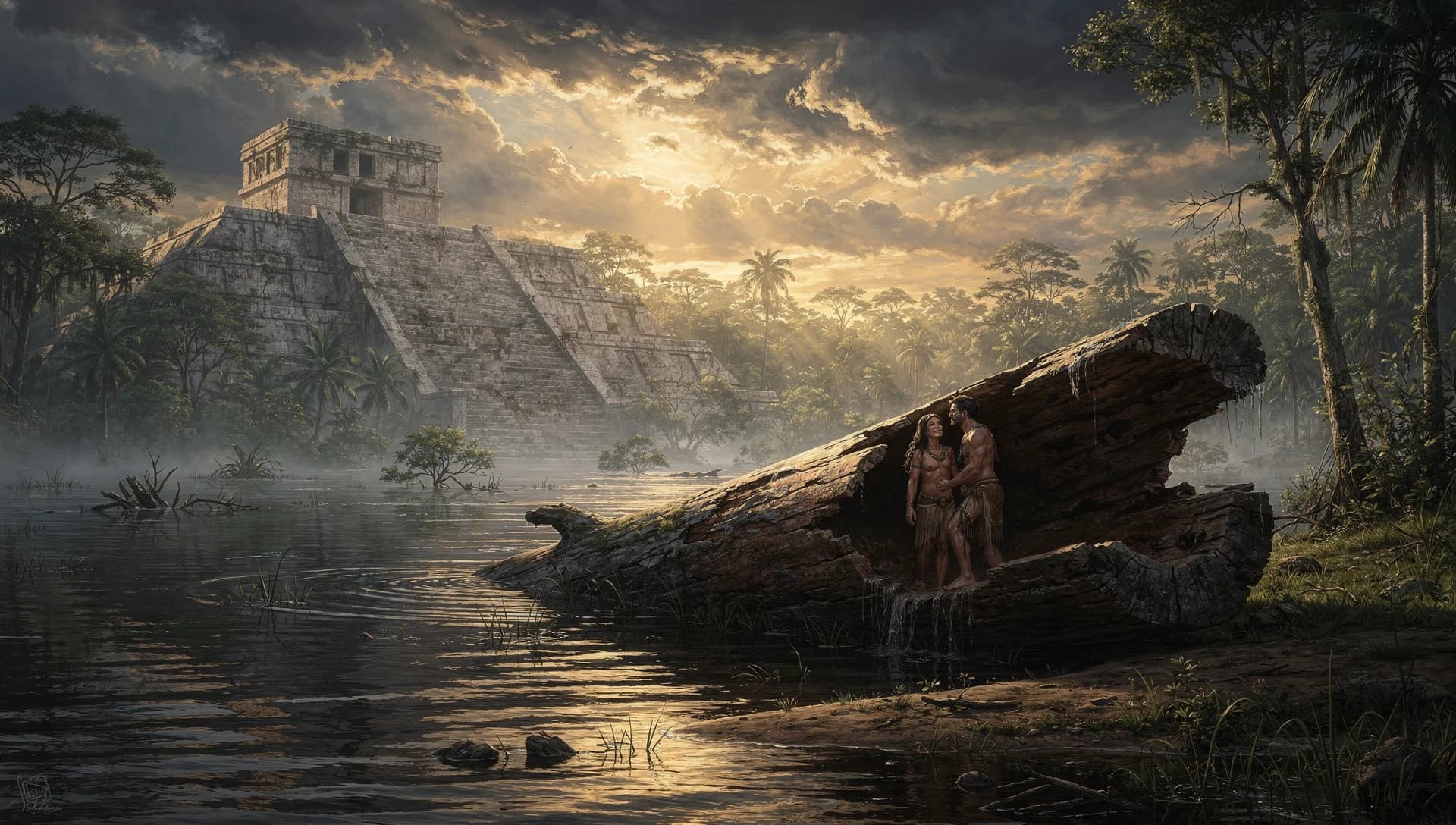
Five Suns and Many Floods: Mesoamerican Flood Cycles and the Urantia Record
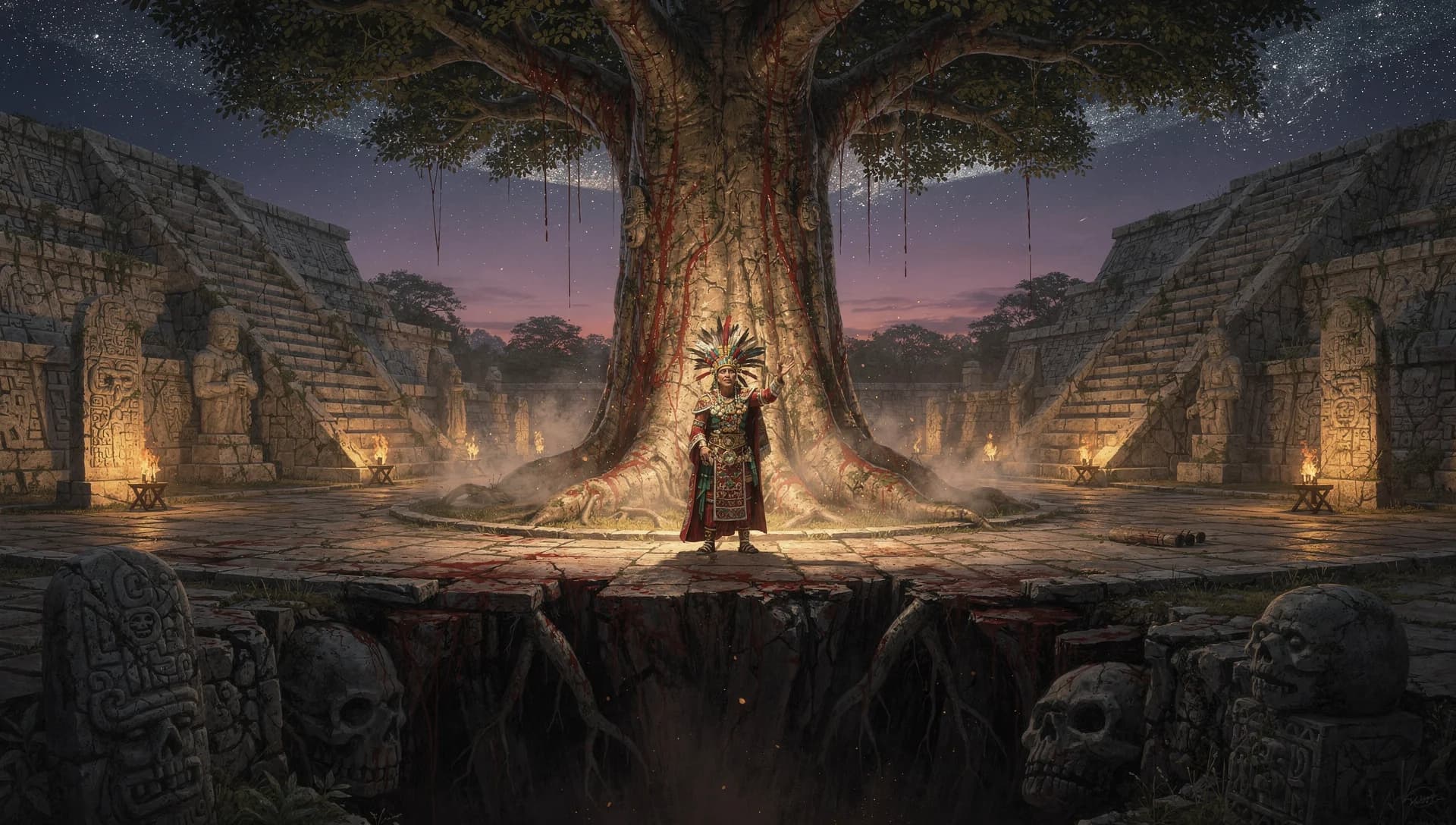
The Tree at the Center of the World: Maya Ceiba Yaxche' and the Tree of Life
The Cosmic Brothers: Quetzalcoatl, Tezcatlipoca, and the Staff-Rebellion Pattern
The Longest Memory: Australian Aboriginal Dreamtime and the Primordial Teaching-Ancestors
The Newsletter
Get the research behind each piece
Free. New Urantia Book explorations, the sources behind the videos, and early looks. No spam, unsubscribe anytime.
Prefer video? Follow on YouTube and Facebook.
Delivered through Substack. You can also read past issues.