
 Mythic
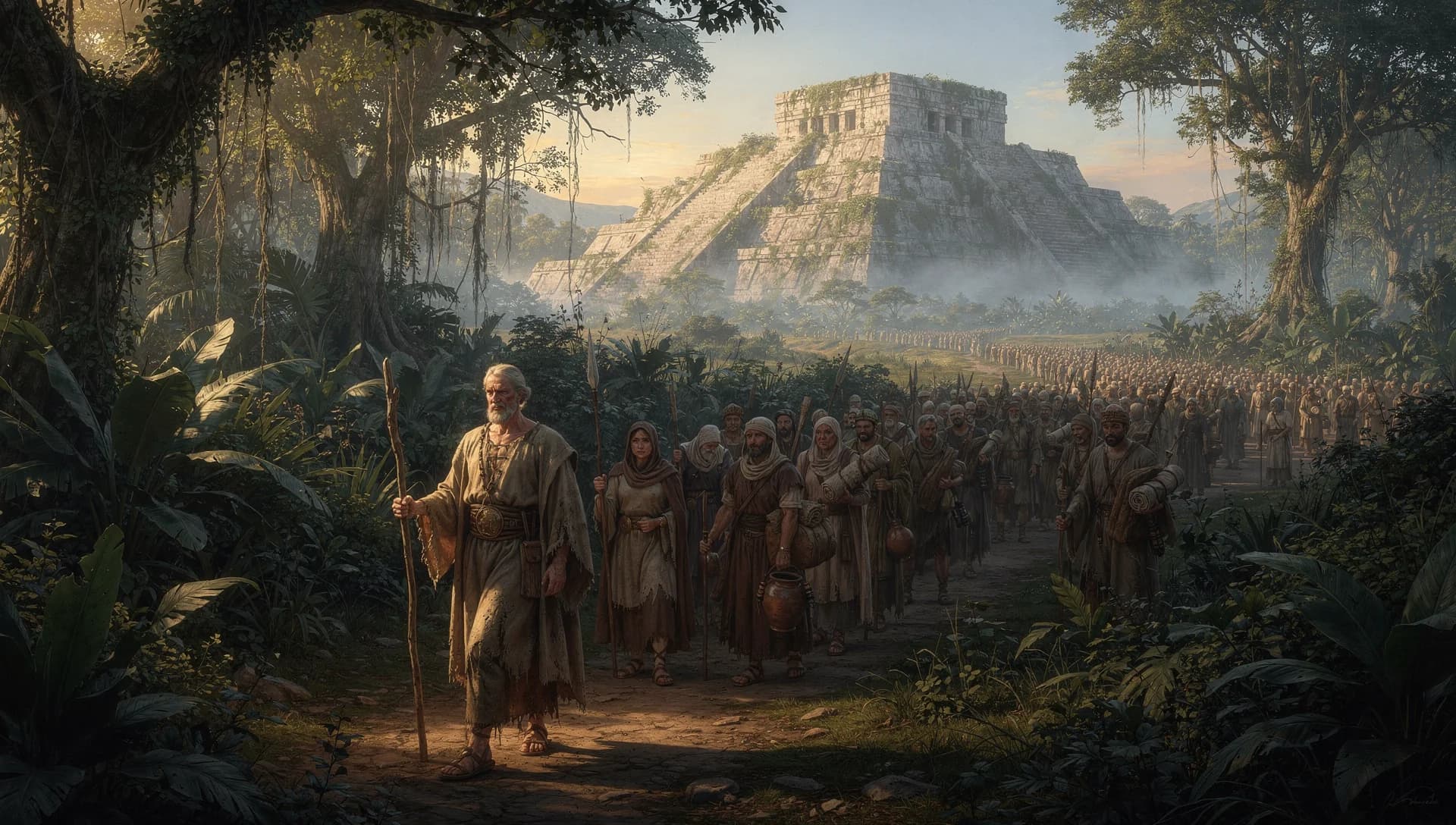
Quetzalcoatl / Kukulkan, the bearded culture-bringer remembered as arriving from the east
 UB
UBThe 132 Andite sailors who crossed the Pacific from Japan to South America
Full Article
Read the deep-dive article on this connection
The 132 Andite sailors who crossed the Pacific from Japan to South America = Quetzalcoatl / Kukulkan, the bearded culture-bringer remembered as arriving from the east
The Connection
The Urantia Book never names Quetzalcoatl, Kukulkan or Viracocha; the link is ours. The book says: "One hundred and thirty-two of this race, embarking in a fleet of small boats from Japan, eventually reached South America and by intermarriage with the natives of the Andes established the ancestry of the later rulers of the Incas" (78:5.7). It gives no physical description of the 132, no date and no landing site (78:5.7, 79:5.9). Mesoamerican tradition is often summarized as remembering a bearded culture-bringer, sometimes described as fair, who arrived from the east, taught the arts of civilization and left promising to return; how much of that description is pre-conquest is debated. We read the tradition as a possible echo of the voyage. The book counts against part of the reading: it places the only Andite trace in Peru (79:5.9), not in Mexico or Central America. There it names other founders: "In Mexico, Central America, and in the mountains of South America the later and more enduring civilizations were founded by a race predominantly red but containing a considerable admixture of the yellow, orange, and blue" (79:5.8; the race is described at 64:7.5).
UB Citation
UB 78:5.7, 79:5.8, 79:5.9, 64:7.5
Academic Source
Sahagún, Florentine Codex (1569); Lafaye, Quetzalcoatl and Guadalupe (1974); Carrasco, Quetzalcoatl and the Irony of Empire (1982); Ioannidis et al. 2020, Nature 583:572; Moreno-Mayar et al. 2024, Nature 633:389
Historical Evidence(Moderate evidence)
Summaries of Sahagún's Florentine Codex (Book III) describe Quetzalcoatl as a bearded, chaste priest-ruler and lawgiver who taught the arts of civilization; we have not checked them against the Codex. Many historians doubt the story that Moctezuma took Cortés for the returning god. Lafaye (1974) and Carrasco (1982) are standard treatments; we have not checked them for these statements. The book gives the 132 no date (78:5.7, 79:5.9); that they belong to the Andite migrations, "from about 15,000 to 6000 B.C." (78:3.9), is our reading. The contact between Polynesia and the Americas that genetics has dated falls at about AD 1200 and runs from the Americas into Polynesia (Ioannidis et al. 2020, Nature; Moreno-Mayar et al. 2024, Nature). No trace of a voyage from Japan has been found. The story fits, but it is not backed scientifically.
Deep Dive
When Hernán Cortés landed on the Mexican coast in 1519, the story goes, the Aztec emperor Moctezuma II took him, at least for a while, for the returning Quetzalcoatl. Many historians now doubt the story, which comes from sources written after the conquest; we have not checked it against those sources. What is not in doubt is that Mesoamerica had old traditions of Quetzalcoatl, a feathered serpent and a culture-bringer.
Kukulkan, the "feathered serpent" in Maya, is the same figure under a different name. Viracocha, the bearded creator-god of the Incas, is a closely related figure in the Andean tradition to the south. In the usual summary all three share a core biography: a bearded teacher, sometimes described as fair, arrived from the east, taught agriculture, calendar-keeping, stone-working and moral law, and then departed, leaving a promise of return. How much of the description as fair and bearded is pre-conquest and how much was shaped after it is debated.
The mainstream academic position is that Quetzalcoatl is a mythological figure whose historical referent, if any, cannot be identified. Proposals include a Toltec ruler named Ce Acatl Topiltzin Quetzalcoatl, a generic culture-hero archetype, and a symbol of the morning star. We read the Urantia Book as offering a historical candidate. The book itself never names Quetzalcoatl, Kukulkan or Viracocha; the link is ours.
The book tells of the 132 in a single paragraph: "One hundred and thirty-two of this race, embarking in a fleet of small boats from Japan, eventually reached South America and by intermarriage with the natives of the Andes established the ancestry of the later rulers of the Incas. They crossed the Pacific by easy stages, tarrying on the many islands they found along the way" (78:5.7). The book gives no date and no landing site for the 132 (78:5.7, 79:5.9). That the voyage belongs to the Andite migrations, which the book dates "from about 15,000 to 6000 B.C." (78:3.9), is our reading. The passage gives no physical description of the 132 and says nothing of what they taught. Of the Andites in general the book says: "They were skillful domesticators of animals and expert agriculturists" (78:5.8). That the 132 carried such knowledge to the Americas is our reading.
The book's own words count against part of the reading. It says: "The red and the yellow races are the only human stocks that ever achieved a high degree of civilization apart from the influences of the Andites" (79:5.8), and: "These civilizations were evolutionary products of the Sangiks, notwithstanding that traces of Andite blood reached Peru" (79:5.9). It places the only Andite trace in Peru, not in Mexico or Central America, where the Quetzalcoatl and Kukulkan traditions belong. So our reading must rest on the Andes and on Viracocha.
For Mexico and Central America the book names other founders. The red tribes crossed with "three small groups of mixed ancestry, the largest of these being a combination of the orange and blue races. These three groups never fully fraternized with the red man and early journeyed southward to Mexico and Central America, where they were later joined by a small group of mixed yellows and reds" (64:7.5). That amalgamated race founded the civilizations of Mexico, Central America and South America, and "The South American offshoot did receive a faint touch of the blood of Adam" (64:7.5). Of the orange race the book says: "The outstanding characteristic of this race was their peculiar urge to build, to build anything and everything, even to the piling up of vast mounds of stone just to see which tribe could build the largest mound" (64:6.10). That this urge lives on in the stonework of Mesoamerica is our reading; the book does not connect them.
The present record does not show the voyage. The book says "Easter Island was long a religious and administrative center of one of these lost groups" (78:5.7), but the settlement of Rapa Nui is estimated at AD 1150 to 1280 (as cited by Moreno-Mayar et al. 2024, Nature). The contact between Polynesia and the Americas that genetics has dated falls at about AD 1200 and runs the other way, from the Americas into Polynesia (Ioannidis et al. 2020, Nature; Moreno-Mayar et al. 2024). These findings do not show a voyage from Japan across the whole Pacific, which is the voyage the book describes.
The book itself names an American leader whose return was awaited, and he is not one of the 132: "In central Asia the tribesmen still look for the return of Genghis Khan; in Tibet, China, and India it is Buddha; in Islam it is Mohammed; among the Amerinds it was Hesunanin Onamonalonton" (92:5.6). Onamonalonton lived about sixty-five thousand years ago and "maintained his headquarters among the great redwood trees of California" (64:6.7). The book connects Quetzalcoatl with neither.
The evidence rating is MODERATE: the story fits, but it is not backed scientifically. If our reading is right, the Andean tradition of Viracocha, and perhaps the Mesoamerican traditions of Quetzalcoatl and Kukulkan, keep the memory of a specific migration for which no archaeological or genetic trace has yet been found.
Key Quotes
“One hundred and thirty-two of this race, embarking in a fleet of small boats from Japan, eventually reached South America and by intermarriage with the natives of the Andes established the ancestry of the later rulers of the Incas. They crossed the Pacific by easy stages, tarrying on the many islands they found along the way. The islands of the Polynesian group were both more numerous and larger then than now, and these Andite sailors, together with some who followed them, biologically modified the native groups in transit.”
“These civilizations were evolutionary products of the Sangiks, notwithstanding that traces of Andite blood reached Peru. Excepting the Eskimos in North America and a few Polynesian Andites in South America, the peoples of the Western Hemisphere had no contact with the rest of the world until the end of the first millennium after Christ.”
Cultural Impact
The story that Cortés was received as the returning god has been a fixture of conquest historiography for nearly five hundred years, and many historians now treat it as partly a post-conquest construction. The "white gods from the east" motif was also invoked by racist and colonial ideologies to deny Indigenous achievement, and it has fed alternative-history speculation about pre-Columbian contact. Our reading is different in important ways. The book defines the Andites as "the primary blends of the pure-line violet race and the Nodites plus the evolutionary peoples" (78:4.1); they were not European in any modern sense. They reached South America "by intermarriage with the natives of the Andes" (78:5.7), and the book says these civilizations "were evolutionary products of the Sangiks" (79:5.9). In our reading the Indigenous base contributed far more than a small Andite input could have, and the credit for the civilizations of the Americas stays with the peoples who built them.
Modern Resonance
In contemporary Mexican cultural identity, Quetzalcoatl has been reclaimed as a figure of Indigenous heritage rather than as the harbinger of conquest, by muralists, intellectuals and writers from José Vasconcelos through Octavio Paz. Our reading does not take that heritage away. On the book's account the civilizations of the Americas were "evolutionary products of the Sangiks" (79:5.9). If the 132 left any memory, in our reading it would be a small strand in the Andean tradition, woven into a civilization that was Indigenous in its making.
Related Mappings
Post-rebellion flood memory (Dalamatia submergence, Eden submergence, regional floods)
= Aztec, Maya, and K'iche' flood cycles (Popol Vuh; the Five Suns)
Teaching-pair pattern: a god of wisdom and his brother or rival
= Quetzalcoatl and Tezcatlipoca, cosmic brothers who contest creation
Sacred tree at the center of the world, carrying blood, water, and spirit
= The Maya Ceiba Yaxche', the World Tree at the center of the cosmos
Amadonite and Sethite priesthoods preserving astronomical knowledge
= Maya calendrical and astronomical priesthood
Related Articles
Where to next
The free newsletter. The research behind each piece, no spam.