
The Cosmic Brothers: Quetzalcoatl, Tezcatlipoca, and the Staff-Rebellion Pattern
Mesoamerican mythology preserves one of its most distinctive structural features in the ongoing opposition between Quetzalcoatl and Tezcatlipoca: cosmic brothers whose contest shapes the world's creation and destruction. The Urantia Book documents the specific historical pattern: the Caligastia staff's loyal and rebel factions, preserved across multiple world traditions as paired teaching figures whose cooperation and conflict structures cosmic history.
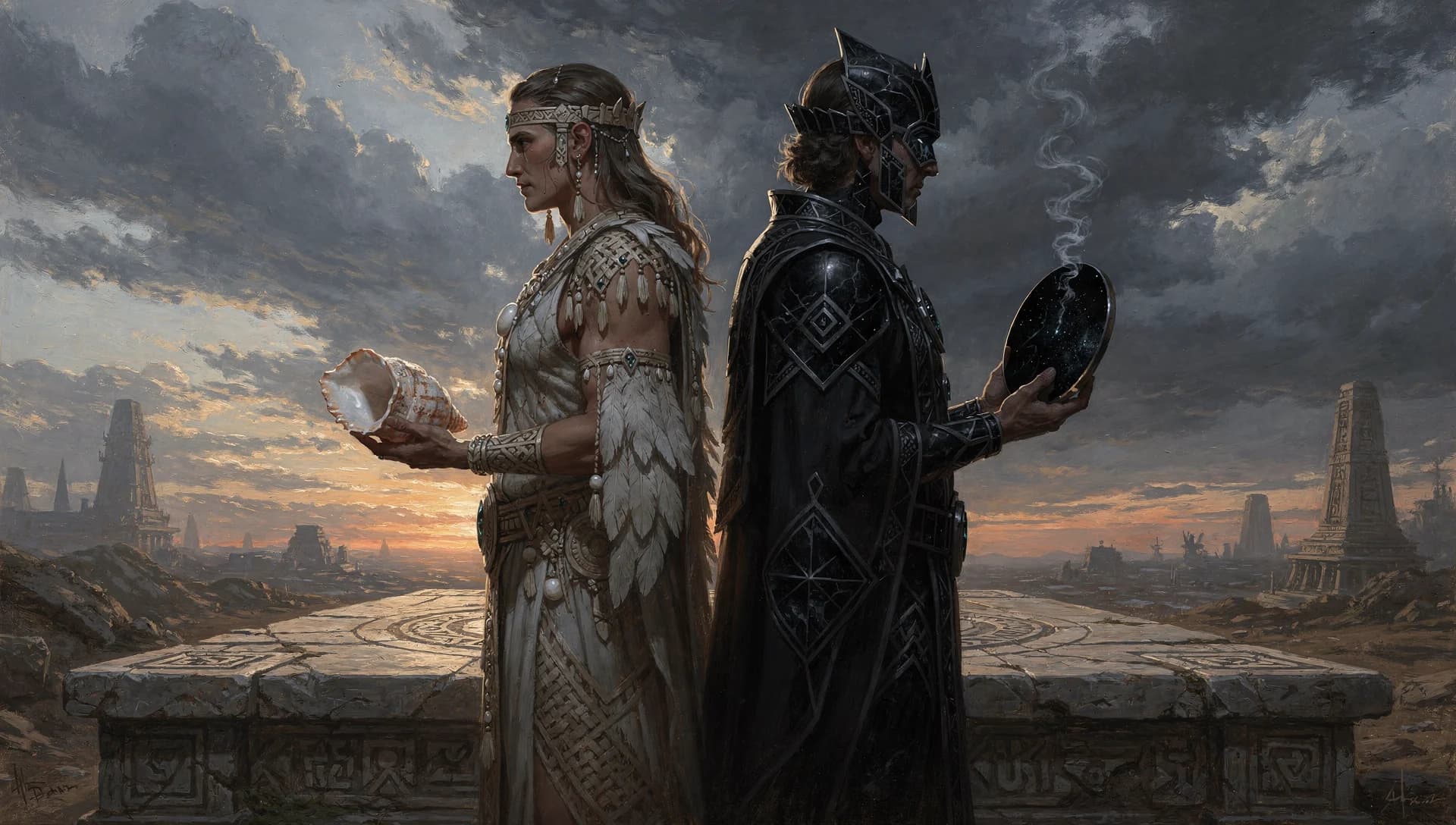
Teaching-pair pattern: a god of wisdom and his brother or rival = Quetzalcoatl and Tezcatlipoca, cosmic brothers who contest creation
This article expands on the decoder mapping. For the side-by-side card and quick reference, see the mapping page.
The Brothers Who Cannot Stop Fighting
Mesoamerican mythology preserves, across Aztec, Toltec, and Maya traditions, a distinct structural feature: two principal divine figures in ongoing cosmic opposition. Quetzalcoatl (the Feathered Serpent) is the culture-bringer, the civilization-teacher, the providential god associated with wisdom, crafts, and life. Tezcatlipoca (the Smoking Mirror) is his cosmic opponent, associated with conflict, sorcery, night, and destruction. The two are brothers in the Aztec tradition, born of the same primordial parents, yet their relationship is defined by opposition rather than alliance.
The specific structural features of this opposition include: simultaneous cosmic origin (both present at creation), ongoing contestation (repeated cycles of conflict across world-ages), moral ambiguity (neither is purely good or purely evil), and eventual displacement (Quetzalcoatl's departure and Tezcatlipoca's dominance). The pattern is more complex than a simple good-vs-evil dualism; it is a pattern of cosmic brothers in ongoing productive-destructive tension.
The Urantia Book documents the historical substrate that this pattern preserves.
What the Urantia Book Says
The Caligastia staff's original unified structure is described in Paper 66:
"The one hundred were organized for service in ten autonomous councils of ten members each. When two or more of these ten councils met in joint session, such liaison gatherings were presided over by Daligastia." (UB 66:5.1)
The rebellion split is described in Paper 67:
"Upon the outbreak of rebellion, loyal cherubim and seraphim, with the aid of three faithful midwayers, assumed the custody of the tree of life and permitted only the forty loyalists of the staff and their associated modified mortals to partake of the fruit and leaves of this energy plant." (UB 67:3.5)
"The sixty members of the planetary staff who went into rebellion chose Nod as their leader. They worked wholeheartedly for the rebel Prince but soon discovered that they were deprived of the sustenance of the system life circuits." (UB 67:4.2)
The teaching pair structure the staff had before the rebellion is described in Paper 66:5.1-31. Ten councils of ten members, each with its own functional responsibilities (food, animals, education, industry, religion, health, art, tribes, and the supreme court). Each council operated as a functional unit. Multiple councils routinely worked in paired-leadership configurations, with the supreme court (led by Van) coordinating across the specializations.
When the rebellion split the staff, the specific pattern produced was: Van's loyal faction continuing the original teaching responsibility versus Nod's rebel faction pursuing a parallel but divergent civilization. The two factions were structurally paired (same origin, same initial training, same functional capacities) but ongoing-opposed (different loyalties, different civilizational trajectories).
The subsequent cultural memory of this staff-split pattern was carried into multiple world traditions. The companion Sumerian Enki-Enlil mapping (Enki as loyal wisdom-god, Enlil as ruling authority-god in ongoing tension), the Norse Aesir-Vanir mapping (two divine factions whose war structures cosmic history), and the Greek Prometheus-Zeus pattern (Prometheus as loyal civilizing teacher against Zeus as supreme authority) all preserve the basic staff-split structure in culturally specific forms.
The Mesoamerican Quetzalcoatl-Tezcatlipoca pairing preserves the same structural pattern in the specifically Mesoamerican cosmological framework. Quetzalcoatl's features (culture-bringer, civilization-teacher, provider of abundance, eventually displaced) correspond to Van's features in the Urantia substrate. Tezcatlipoca's features (conflict-associated, sorcery-associated, dominant after Quetzalcoatl's departure) correspond to the rebel-faction features in the Urantia substrate.
The migration of 132 Andite sailors that reached the Americas (treated in the companion 132-Andite-Quetzalcoatl decoder article) would have carried this memory of the staff split as part of the cultural inheritance transmitted from the Old World Adamic-Andite substrate. The Mesoamerican tradition's preservation of the teaching-pair pattern is therefore consistent with the historical transmission the Urantia Book documents.
What the Ancient Sources Say
The Quetzalcoatl-Tezcatlipoca opposition is documented extensively across Mesoamerican sources. The principal textual witnesses include the Aztec Codex Chimalpopoca (especially the Leyenda de los Soles section), the Florentine Codex of Bernardino de Sahagún, Diego Durán's Historia de las Indias de Nueva España, and the various Toltec and Maya traditions that fed into the Aztec compilation.
The specific features of the opposition include:
First, shared primordial origin. Both figures descend from the primordial divine couple (Ometecuhtli and Omecihuatl in Nahua tradition), typically as brothers or closely related figures. They are not unrelated opposed principles; they are kin.
Second, paired functional domains. Quetzalcoatl governs wisdom, crafts, agriculture, the morning star, the priesthood. Tezcatlipoca governs sorcery, war, night, the jaguar, rulership. Each domain has its own ritual expression; the two figures are not symmetrical but occupy different functional positions.
Third, repeated cyclic conflict. The Aztec Five Suns tradition places the two figures in ongoing contest across successive world-ages. Quetzalcoatl presides over some ages; Tezcatlipoca over others. The specific transitions between ages typically involve their conflict as the mechanism of cosmic destruction and renewal.
Fourth, the Toltec and Aztec narrative of Quetzalcoatl's departure. In the Toltec tradition, Quetzalcoatl (identified with the historical Topiltzin Quetzalcoatl of Tula, approximately 900-1000 CE) was displaced through the sorceries of Tezcatlipoca, departed eastward across the sea, and was prophesied to return. The Spanish conquistadors' arrival in 1519 CE coincided with the Aztec calendrical year (1 Reed, Ce Acatl) associated with Quetzalcoatl's prophesied return, which shaped the Aztec response to the Spanish arrival.
Karl Taube's The Major Gods of Ancient Yucatan (Dumbarton Oaks, 1992) and Aztec and Maya Myths (British Museum Press, 1993) document the Quetzalcoatl-Tezcatlipoca tradition comprehensively. Davíd Carrasco's Quetzalcoatl and the Irony of Empire (University of Chicago Press, 1982) treats the historical and theological dimensions. Richard Townsend's The Aztecs (Thames & Hudson, 2009) provides the accessible general treatment.
The scholarly question of what the Quetzalcoatl-Tezcatlipoca pattern represents has generated substantial interpretive literature. Some scholars treat the pattern as a form of Mesoamerican dualism comparable to Zoroastrian good-vs-evil dualism. Others treat it as a complementary-opposition structure (like yang-yin) in which the two figures together constitute the cosmic whole. A third reading treats the pattern as euhemeristic preservation of real historical conflict between culture-founding figures.
The Urantia Book's framework aligns with the euhemeristic reading while specifying the historical substrate. The staff rebellion split produced the pattern of culture teacher against rebel authority that the Quetzalcoatl-Tezcatlipoca tradition preserves. The Mesoamerican preservation carries this pattern across millennia of cultural transmission in the Americas, where it crystallized into the Mesoamerican theological framework.
Why This Mapping Matters
The scholarly puzzle of the Quetzalcoatl-Tezcatlipoca pattern has been why Mesoamerican tradition preserves a complex structure of opposed brothers rather than the simpler pattern of a high god against a chaos monster of most world mythologies. The answer, on the Urantia framework, is that the Mesoamerican tradition is preserving memory of a specific historical event of that kind (the staff rebellion split) rather than a generic mythological universal.
This has specific interpretive consequences. The Mesoamerican flood cycles (treated in the companion decoder article), the Quetzalcoatl-Tezcatlipoca pattern, and the broader Mesoamerican cosmological framework together constitute one of the more structurally elaborate preservations of the Urantia-documented historical substrate in any world religious tradition. The Americas received the Old World substrate through the red race migration, preserved it across 85,000 years of cultural isolation, and developed it into the Mesoamerican religious framework we now study.
The mapping's significance is that it places Mesoamerican religion alongside the Old World traditions (Sumerian Enki-Enlil, Norse Aesir-Vanir, Greek Prometheus-Zeus) as a preservation of the staff split. The Mesoamerican preservation has its own distinctive features (the feathered serpent iconography, the Tezcatlipoca sorcery attributes, the Five Suns cosmological framework) but the underlying structural pattern is the same.
The identification of Quetzalcoatl with a loyal figure and Tezcatlipoca with a rebel figure has implications for reading Mesoamerican religious history. The repeated return of Quetzalcoatl (the morning star rises each dawn, Topiltzin is prophesied to return, Venus appears each 584 days) preserves memory of the loyal faction's continued effectiveness despite apparent defeat. The Tezcatlipoca dominance (his royal association, his cult at Tenochtitlan's imperial center) preserves memory of the rebel faction's political success in its own historical environment. The cosmic justice the Mesoamerican tradition anticipates (Quetzalcoatl's return, the defeat of Tezcatlipoca at the end of the Fifth Sun) preserves memory of the eventual resolution the Urantia framework identifies as the pending Lucifer adjudication (treated in the companion decoder articles).
Reading the Mesoamerican tradition through this framework reveals a genuinely sophisticated and structurally accurate cosmological preservation rather than a mythological construction requiring demythologization. The Mesoamerican system preserves what it preserves because the events it preserves are real historical realities.
Sources
- The Urantia Book, Paper 66 (The Planetary Prince's Staff), Paper 67 (The Planetary Rebellion). Urantia Foundation, first printing 1955. Cited passages: 66:5.1-31, 67:2.2, 67:3.5, 67:4.1-2.
- Sahagún, Bernardino de. Florentine Codex: General History of the Things of New Spain. Translated by Arthur J. O. Anderson and Charles E. Dibble, University of Utah Press, 1950-1982.
- Popol Vuh. Translated by Dennis Tedlock, revised edition, Simon & Schuster, 1996.
- Taube, Karl. The Major Gods of Ancient Yucatan. Dumbarton Oaks, 1992.
- Taube, Karl. Aztec and Maya Myths. British Museum Press, 1993.
- Carrasco, Davíd. Quetzalcoatl and the Irony of Empire: Myths and Prophecies in the Aztec Tradition. University of Chicago Press, 1982.
- Townsend, Richard F. The Aztecs. Third edition, Thames & Hudson, 2009.
- León-Portilla, Miguel. Aztec Thought and Culture: A Study of the Ancient Nahuatl Mind. University of Oklahoma Press, 1963.
Confidence and Evidence
- Confidence: INFORMED SPECULATION
- Evidence rating: MODERATE to STRONG
- Basis: The Urantia Book documents the staff rebellion split in detail (Paper 67:3.5, 67:4.1-2) as a specific historical event producing a distinct pattern of loyalist against rebel. The Mesoamerican Quetzalcoatl-Tezcatlipoca pattern preserves the same structural features (shared origin, paired functional domains, ongoing cyclic conflict, eventual resolution). The transmission via the red race migration and the subsequent 132 Andite contact provides the historical pathway.
Related Decoder Articles
- The 132 Andite Sailors = Quetzalcoatl
- The Staff Split = Aesir-Vanir War
- Van, Loyal Corporeal Staff Member = Enki / Ea
By Derek Samaras
Connecting Articles
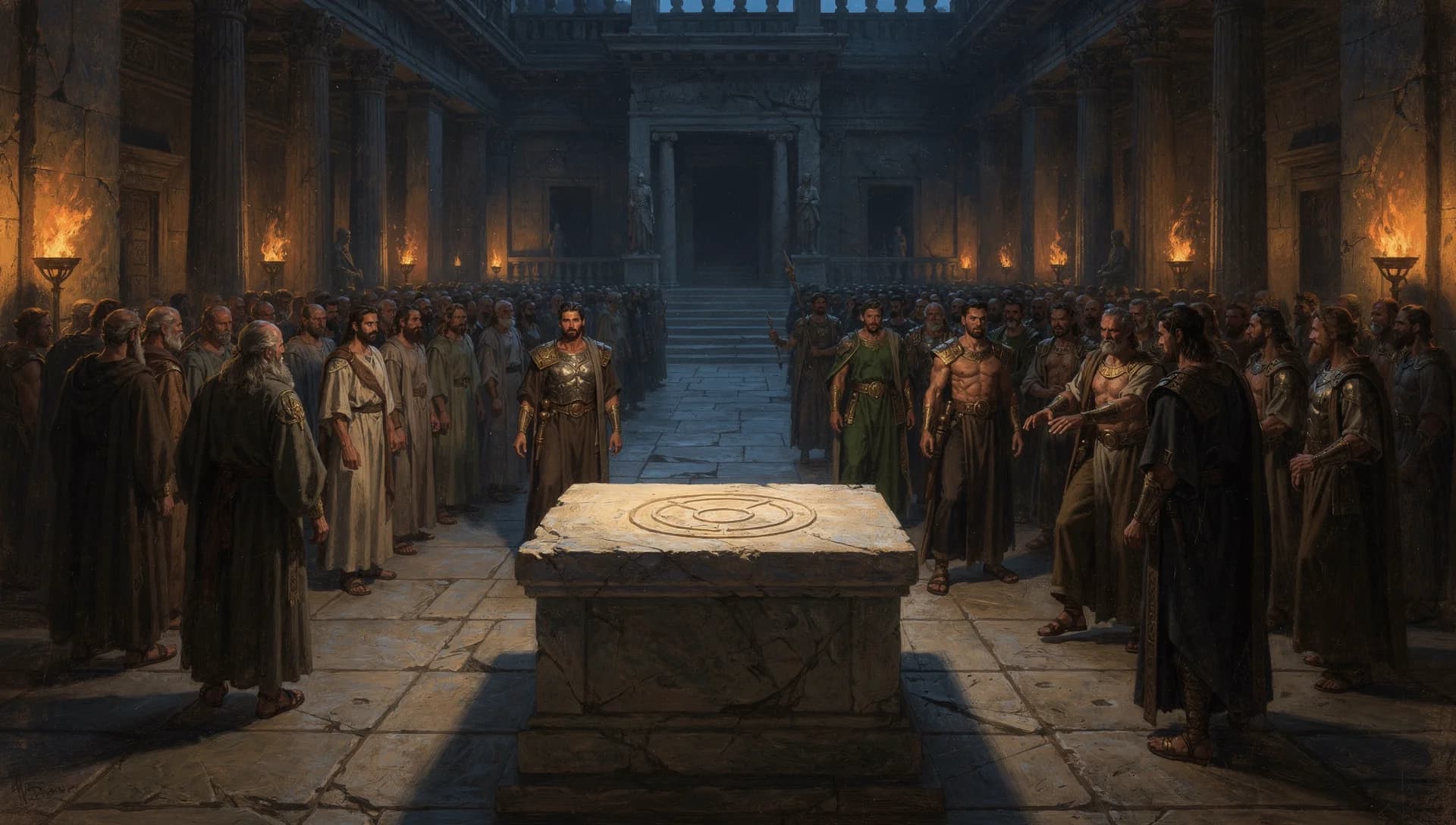
The First War Among the Gods: The Staff Split and the Aesir-Vanir Conflict
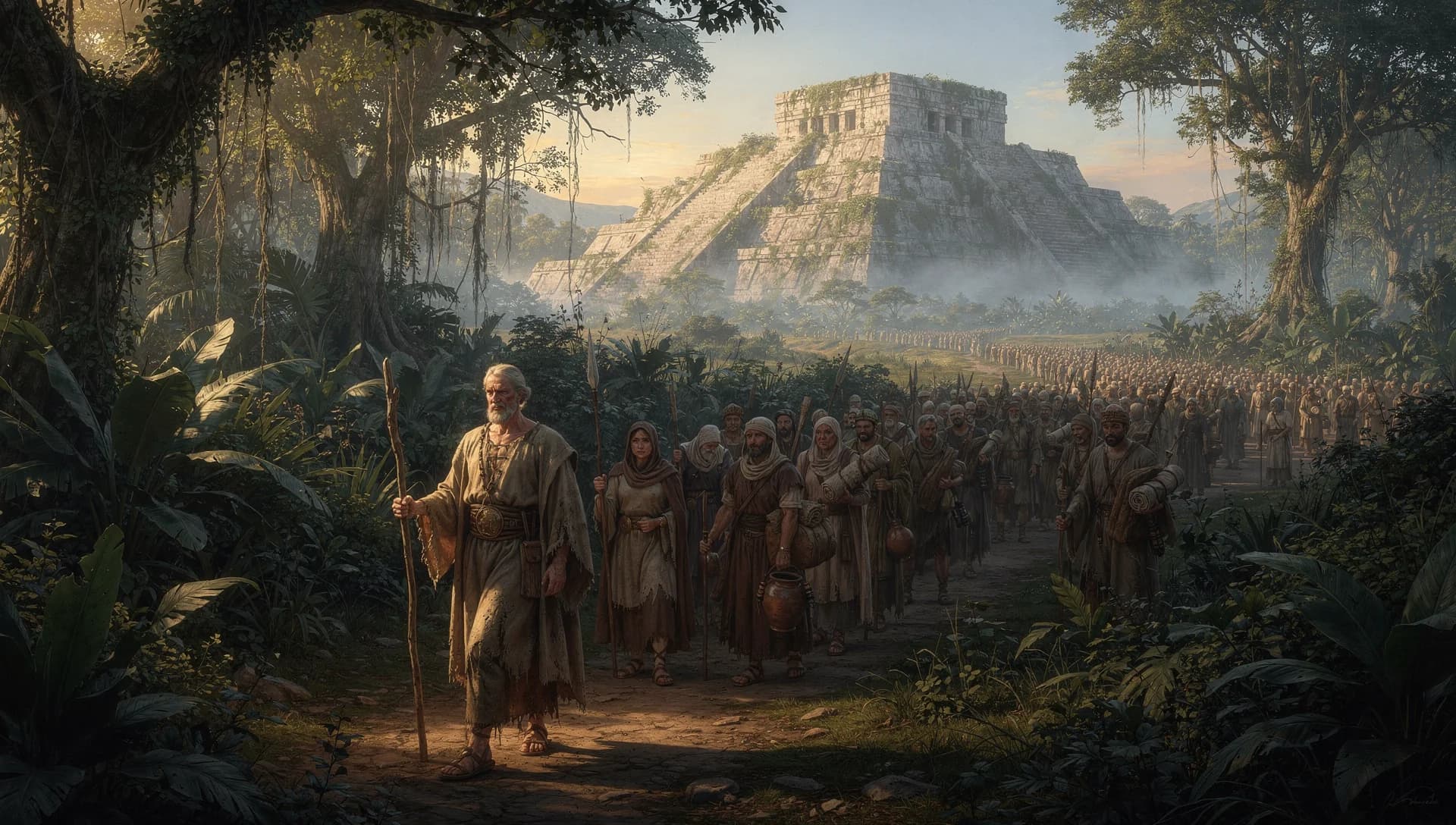
The 132 Sailors and the Feathered Serpent: Was Quetzalcoatl an Andite Memory?
The Longest Memory: Australian Aboriginal Dreamtime and the Primordial Teaching-Ancestors
The Final Adjudication: Ragnarok and the Pending Verdict
The Newsletter
Get the research behind each piece
Free. New Urantia Book explorations, the sources behind the videos, and early looks. No spam, unsubscribe anytime.
Prefer video? Follow on YouTube and Facebook.
Delivered through Substack. You can also read past issues.