
The Andite Emergence
Look at the anomalies long enough and a pattern emerges. One population, one biological and technical lineage, moving across the earth over tens of thousands of years and leaving behind an unmistakable footprint at every stop. That population is what the Urantia Book calls the Andites.

THE ANDITE EMERGENCE
Tracing the Genetic, Material, and Spiritual Record of a Planetary Upgrade
Derek Samaras
Urantia Book Network
Prologue: The Anomalies That Will Not Stay Quiet
Look at the anomalies long enough and a pattern emerges. Deep in the Taklamakan Desert of western China, perfectly preserved mummies surface from the sand. They are not who mainstream archaeology expected. Popular accounts describe them as tall, long-skulled, red-haired and Caucasian in feature, some buried in woven plaid; we have not checked those descriptions against the excavation reports, and a 2021 genetic study counts against reading them as newcomers (see Part VIII). Thousands of miles away, the ruined cities of Harappa and Mohenjo-Daro rise out of the Indus plain fully formed around 3000 BCE, complete with standardized kiln-fired bricks, integrated sewage systems, and hydraulic engineering sophistication that would not be matched in Europe for another two thousand years. On Easter Island, a culture that should have no material connection to the ancient Near East carves hundreds of massive stone heads with elongated skulls and stares them out across the open Pacific.
Mainstream archaeology calls these things coincidences. Regional inventions. Isolated miracles of human ingenuity. These explanations are not wrong because they are dishonest. They are wrong because they are working with an incomplete dataset, one that by disciplinary convention excludes the single most information-dense historical source available for this period.
That source is The Urantia Book, specifically Papers 77 through 80. Paper 78 gives its own span: "This paper depicts the planetary history of the violet race, beginning soon after the default of Adam, about 35,000 B.C., and extending down through its amalgamation with the Nodite and Sangik races, about 15,000 B.C., to form the Andite peoples and on to its final disappearance from the Mesopotamian homelands, about 2000 B.C." (78:0.2) We know of no fuller account of human prehistory for this period in any document. In our reading, when you lay the physical record alongside that framework, what forms is not a collection of coincidences. It is a coherent, traceable, planetary-scale history. One population, one biological and technical lineage, moving across the earth over tens of thousands of years and leaving behind an unmistakable footprint at every stop.
That population is what the Urantia Book calls the Andites. And once you understand who they were, where they came from, and what they built, you cannot unsee them in the record.
In our reading these are not disconnected anomalies. They are the as-built footprints of a single, hyper-advanced population that upgraded this planet. Imperfectly. Tragically. But they built it. We are the evidence that it worked.
Part I: Who Were the Andites?
The Triple Synthesis
The Andites were not a naturally evolved ethnic group. They were a biological synthesis forged over tens of thousands of years in the Mesopotamian basin Mesopotamia and the highland zones surrounding it, and they carried the genetic inheritance of three distinct streams of humanity. Understanding this synthesis is the prerequisite for everything that follows. In our reading, the hydraulic engineering, the megalithic tradition, the Smith Guild metallurgy, the mythological encoding and the spiritual transmission chain all trace back to the genetic and institutional combination that the Andite synthesis represented.
Stream One: The Nodite Base
The first and oldest stream was the Nodite base. The book tells their origin in these words. "About five hundred thousand years ago and concurrent with the appearance of the six colored or Sangik races, Caligastia, the Planetary Prince, arrived on Urantia" (66:0.2). His staff of one hundred "were chosen by Caligastia from over 785,000 ascendant citizens of Jerusem who volunteered for embarkation on the Urantia adventure" (66:2.4). "The headquarters of the Planetary Prince was situated in the Persian Gulf region of those days, in the district corresponding to later Mesopotamia" (66:3.1). "From the arrival of Prince Caligastia, planetary civilization progressed in a fairly normal manner for almost three hundred thousand years" (66:8.3). Then came the rebellion: "The sixty members of the planetary staff who went into rebellion chose Nod as their leader" (67:4.2). "Their descendants were long known as the Nodites, and their dwelling place as “the land of Nod.”" (67:4.2) And "These Nodites had freely mated with the Sangik races and had left behind an able progeny" (73:1.6).
In our reading their descendants carried exceptional physical stature, extraordinary bone density, high-order cranial capacity, and an institutional memory encoded deep in hereditary guild traditions. The book shows the inheritance in one man. Of the Nodite Cano, whom Eve met in the first garden, it says: "Eve had never before met the beautiful and enthusiastic Cano—and he was a magnificent specimen of the survival of the superior physique and outstanding intellect of his remote progenitors of the Prince’s staff" (75:3.8). It also notes that "even their stature came to be magnified by tradition" (77:2.3). The book itself makes the link to Genesis: "The Nephilim (Nodites) were on earth in those days" (77:2.3). It says more broadly that "much of your subsequent mythology grew out of the garbled legends of these early days when these members of the Prince’s staff were repersonalized on Urantia as supermen" (66:4.1). We read the Titans of Greek mythology and the Anunnaki in their rebellious aspect as further memories of the same people. They are not mythological creatures. They are a real population with a real genealogy, and in our interpretation their institutional inheritance is the origin point of the technical traditions we are about to trace from continent to continent.
Here, in the vicinity of Lake Van and the southern Caspian Sea region, the Nodites mingled and mixed with the Amadonites, and they were numbered among the “mighty men of old.” (73:1.6)
Stream Two: The Adamic Violet Race
The second stream was the Adamic, or Violet Race. The book dates their coming: "ADAM AND EVE arrived on Urantia, from the year A.D. 1934, 37,848 years ago" (74:0.1). By our arithmetic that is 35,914 BCE. It calls them "the biologic uplifters to Urantia" (74:0.1). It is precise about their stature: "Material Sons vary in height from eight to ten feet" (51:1.3), and these two "were a little more than eight feet in height" (74:1.1). Of their children it says: "Adam and his offspring had blue eyes, and the violet peoples were characterized by fair complexions and light hair color—yellow, red, and brown" (76:4.1).
It is sometimes said that the genetic record meets this timeline. On the evidence we checked, it does not. The mutation near the OCA2 gene that produces blue eyes was identified by Eiberg et al. (2008), and the team dated the common ancestor of blue-eyed people to about 6,000 to 10,000 years ago, as the University of Copenhagen and the journal Science reported in 2008 (the paper's abstract gives no date). That is more than twenty-five thousand years after the book's date for Adam and Eve, so the two do not meet.
Stream Three: The Andonite Foundation
The third stream was the Andonite foundation, the original human beings of this world, descended from Andon and Fonta. The book dates the first pair: "From the year A.D. 1934 back to the birth of the first two human beings is just 993,419 years" (62:5.1). In our reading the Andonites, rugged, adaptive, and widely dispersed across Eurasia, were the biological substrate upon which every subsequent human development was built. Their contribution to the Andite synthesis was resilience: the Andonite stock grounded the more elevated Adamic and Nodite endowments in the biological robustness necessary for planetary-scale survival and migration.
The Crystallization Point: Adamson and Ratta
The crystallization of these three streams into the Andite race was not a single event but a process spanning millennia. The book defines the Andites: "The Andite races were the primary blends of the pure-line violet race and the Nodites plus the evolutionary peoples" (78:4.1). It dates the blend to the violet race's "amalgamation with the Nodite and Sangik races, about 15,000 B.C., to form the Andite peoples" (78:0.2). The three streams above are our way of naming those parts. But within this broad synthesis, one center stands out for its concentration and purity. The book calls Adamson "the first-born of the violet race of Urantia" (77:5.1) and places his center "in the region east of the southern end of the Caspian Sea, near the Kopet Dagh" (77:5.10). He was "this eldest son of Adam" (77:5.2). In our reading he maintained the biological and institutional inheritance of the Edenic program in the highlands against the entropic pull of the surrounding populations.
Of his partner the book says: "This woman, Ratta, said that her ancestors were all descendants of two of the fallen staff of the Prince" (77:5.5). "She was the last of her race, having no living brothers or sisters" (77:5.5). In our reading their union concentrated all three streams in a single lineage, some twenty thousand years before the wider blend the book dates to about 15,000 B.C. (78:0.2). Of their descendants the book says that "there successively arose at various periods four diverse cultures respectively fostered by four different groups of Adamson’s descendants" (77:5.10). "It was the second of these groups which migrated westward to Greece and the islands of the Mediterranean" (77:5.10). "The residue of Adamson’s descendants migrated north and west to enter Europe with the blended stock of the last Andite wave coming out of Mesopotamia" (77:5.10). The Greek line is followed in Part VI. The book gives Thor a history of his own, as a northern commander later worshiped: "Thor, the victorious commander of the armies of the north in the final battle of the Somme, became the hero of the northern white tribes and later on was revered as a god by some of them" (80:5.4). It does not make him a descendant of Adamson (77:5.10, 80:5.4, 85:6.4). In our reading Thor's hammer that shattered flint is a memory of technological asymmetry preserved in the folk tradition of people who witnessed it.
What the Skull Record Shows
The Andites carried two distinct cranial signatures depending on which lineage dominated in a given individual. The pure Nodite-Adamic line produced a dolichocephalic skull, long and narrow, with prominent brow ridges and a strong jaw. The Andonite-Adamic blend produced a broader, rounder profile.
In our reading both skull types appear where the UB framework would lead us to expect them. The Tarim Basin mummies in western China are dolichocephalic. Zhang et al. (2021) found that the oldest of them had only local ancestry, which counts against our reading of them as Andites (see Part VIII). They are tall, over six feet in a period when average male stature in the region was considerably shorter, and they are buried with woven tartan textiles with no Chinese developmental antecedent.
In our reading the Moai statues of Easter Island belong with them. Their long heads and faces echo, to our eye, the Nodite-Adamic signature; we have measured nothing. The people who carved those faces knew what they looked like. They were carving their own ancestry into volcanic tuff at the terminal end of the longest oceanic migration in human prehistory, and they wanted the record to survive them.
Part II: The Engineering Identity
Ang's Council and Our Reading of the Global Hydraulic Grid
Everything in this part that ties a water system to the Andites is our interpretation, not a statement of The Urantia Book. In our reading, the most archaeologically identifiable mark the Andites left on the ancient world is not genetic. It is hydraulic. The book does connect their forebears and their remnants with water. It says that "For thousands of years the sons of Adam labored along the rivers of Mesopotamia, working out their irrigation and flood-control problems to the south" (78:2.1). Of the Sumerians, "the remnants of the Andites who dwelt about the mouth of the river on the Persian Gulf" (78:8.5), it says they had "their extensive system of military canals, which were an adjunct to their irrigation scheme of interconnecting pools" (78:8.5). Of the council on food and material welfare, presided over by Ang, it says, "They taught well digging, spring control, and irrigation" (66:5.2), and it speaks of "the three hundred thousand years which intervened between their arrival on Urantia and those tragic days when Caligastia threw in his lot with the rebel Lucifer" (66:7.19). That these teachings passed down to the Nodites and the Andites as a hereditary tradition, and that the underground systems described below descend from them, is our interpretation. The book says in general terms that "Only among the Nodites and the Amadonites was there persistence of the traditions of Dalamatia and the culture of the Planetary Prince" (73:1.2), and that the Sumerians "clung to the ancient traditions of Dalamatia" (78:8.1). It does not say that those traditions included water works, and it names none of the systems described below.
In our interpretation the exile from Eden deepened the tradition. The book says of the move to Mesopotamia: "Now were the Adamites compelled to wrest a living from unprepared soil and to cope with the realities of life in the face of the natural hostilities and incompatibilities of mortal existence" (76:1.4). "They found the first garden partially prepared for them, but the second had to be created by the labor of their own hands and in the “sweat of their faces.”" (76:1.4) In our interpretation the surface canal tradition of Sumer was the first response, and the move to subterranean engineering came as Andite descendants settled in progressively more arid zones. On that reading the default of Eden is the origin story of the qanat. The book does not say this, and on one point it runs the other way: it says that "By 8000 B.C. the slowly increasing aridity of the highland regions of central Asia began to drive the Andites to the river bottoms and the seashores" (79:1.3), not deeper into the dry lands.
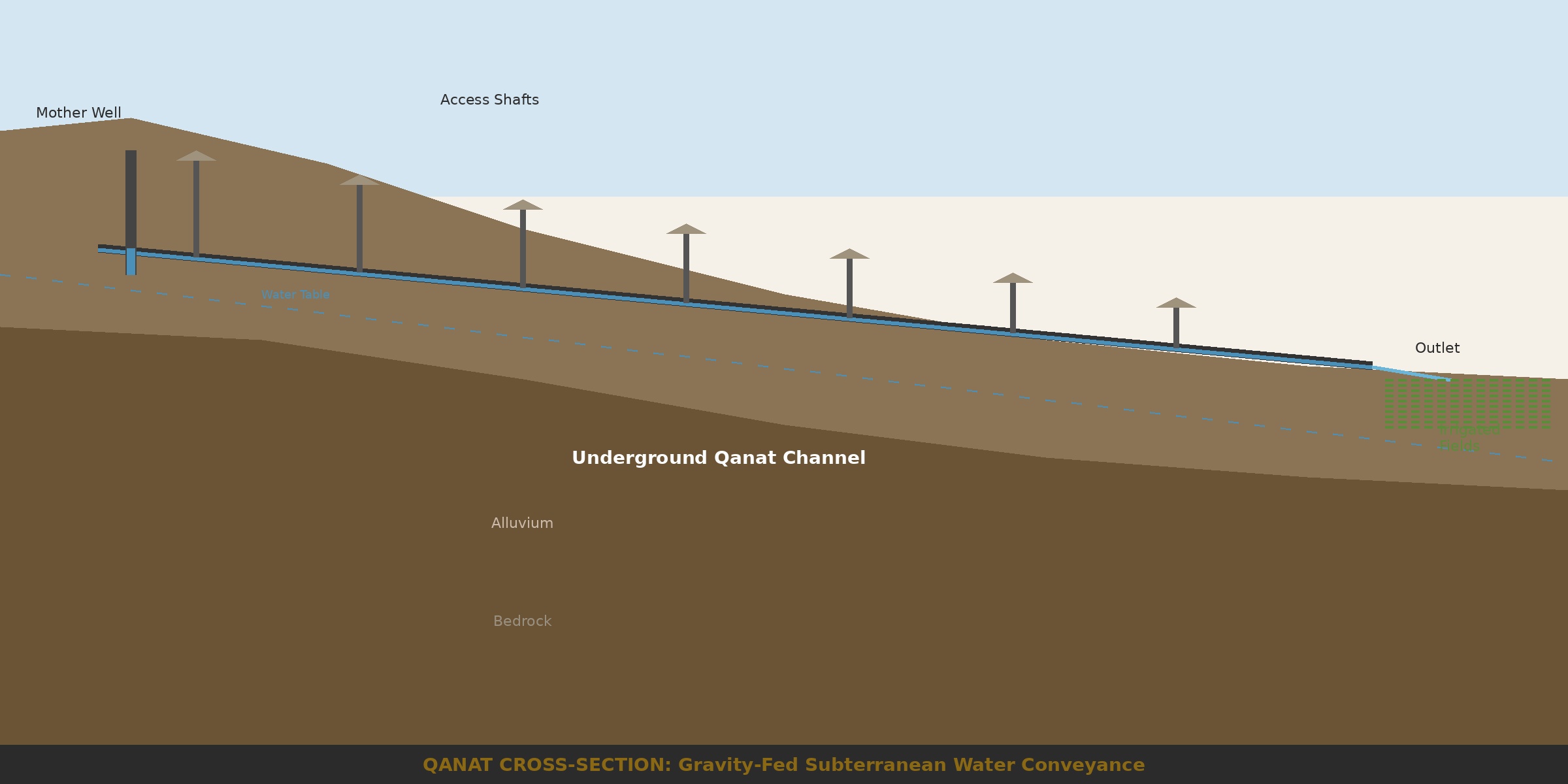
Figure 1: Qanat engineering cross-section. A gently sloping underground tunnel taps a mountain aquifer at the mother well and conveys water by gravity to the outlet, with zero surface exposure. Vertical shafts enable construction and maintenance. In our interpretation this continues the "well digging, spring control, and irrigation" taught by the council Ang presided over (66:5.2); the book does not describe this system.
The core engineering principle is consistent across every continent where it appears: a gently sloping underground tunnel, dug at a precise gradient, taps into a high-altitude aquifer at an uphill mother well and conveys water entirely by gravity to a downhill outlet, with zero aboveground exposure to evaporation. No pump. No power. Just the physics of gradient and gravity, maintained across miles of subterranean gallery dug through rock. That is not a technology you stumble onto. It requires prior knowledge of subsurface geology, precise surface survey, the construction of a precisely sloped tunnel through rock, and the organizational capacity to maintain an annual inspection and maintenance workforce. In our interpretation those competencies go back to the "well digging, spring control, and irrigation" taught by the council Ang presided over (66:5.2); the book does not say that these skills were handed down.
One Principle Under Seven Names: Our Reading
In Persia and Central Asia this system is called the qanat. In Afghanistan, the karez. In Morocco, the khettara. In Algeria, the foggara. In Spain, the viajes de agua. In Japan, the mambo. In Peru, the puquios. We group these systems together as one engineering principle; that grouping is ours. Published scholarship explains at least part of this spread by historical diffusion, with no Andites in it. Barnes and Fleming (1991) write that Islamic engineers built such systems in Iberia, and that the Spaniards carried the technology to Mexico and the Andes from the middle of the sixteenth century. Proulx (1999), summarizing their argument, adds that the Arabs carried the technology from Iran to northern Africa and eventually to Spain. The Andite dispersal hypothesis offered here is our interpretation, not a statement of The Urantia Book. The book names none of the systems listed here, and it does not trace any of them to the Andites.
| Tradition | Region | Operating Principle | Date | Corridor |
|---|---|---|---|---|
| Qanat | Iran / Central Asia | Sloped underground gallery + mother well | No dated source read | Heartland Origin |
| Karez | Afghanistan / Xinjiang | Grouped by us with the qanat | Oldest dated Turpan systems 790 to 1755 CE (Mächtle et al. 2019); an older age is untested | Eastward Surge |
| Khettara | Morocco / Sahara | Gravity-fed subterranean gallery | No dated source read | Saharan Push |
| Foggara | Algeria / Libya | Gallery + convection-cooling shafts | No dated source read | Saharan Push |
| Viajes de Agua | Spain / Iberia | Subterranean spring-fed channels | No dated source read | Western Wave |
| Puquio | Peru (Nasca) | Funnel-shaped ojos + underground gallery | Nasca Phase 5, about 540 to 610 CE (Proulx 1999), disputed | Our speculation only. Not in the book |
| Mambo | Japan | Subterranean channel + surface outlets | No dated source read | Eastward Surge Terminal |
Table 1: Underground water systems that we group together as one engineering principle under seven regional names. The Corridor column is our interpretation, and The Urantia Book names none of these systems. Only the karez and puquio rows carry a dated source. For the other five rows we have read no dated source, and the diffusion account cited above (Barnes and Fleming 1991; Proulx 1999) credits the systems of Iberia to Islamic engineers and has the Arabs carry the technology to northern Africa. The puquio row is our speculation only: the first puquios are placed as early as Nasca Phase 5 (Schreiber and Lancho Rojas 1995), which Proulx (1999) ties to droughts dated 540 to 560 and 570 to 610 CE, by our arithmetic more than three thousand years after the arrival this article proposes for the 132. Barnes and Fleming (1991) report documentary evidence that Spaniards built and managed many puquios; Schreiber and Lancho Rojas (1995) hold that the puquios were almost certainly in use by the Inka conquest of the late fifteenth century.
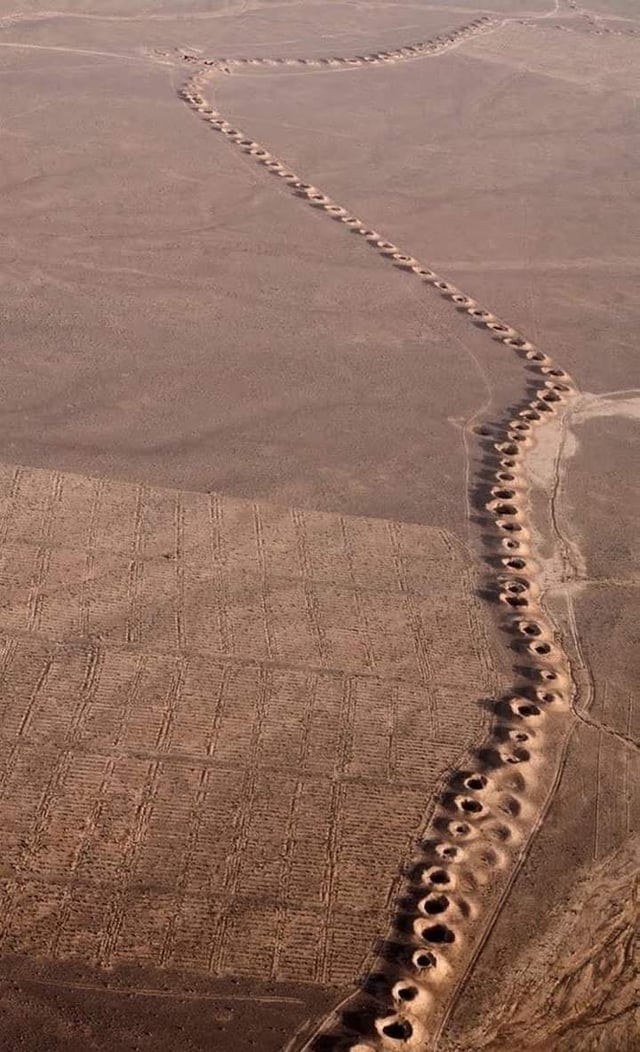
Figure 2: A Persian qanat line seen from above. Each circular mound marks a vertical maintenance shaft descending to the underground gallery. The adjacent grid of cultivated fields is sustained entirely by subterranean water conveyance from a mountain aquifer miles away, by gravity alone. In our interpretation this continues the "well digging, spring control, and irrigation" taught by the council Ang presided over (66:5.2) and was carried by the Andite dispersal; the book does not describe this system.
The Tarim Basin: Our Reading and Its Limits
Our case for hydraulic transmission leans most heavily on the Tarim Basin region of western China, where the mummies described in the Prologue were buried. In Turpan, also in Xinjiang, the karez, a subterranean water system, works on the principle we group with the qanat. In our interpretation the engineering protocol was not invented twice but was carried east by the people whose remains lie in the sand nearby. The Urantia Book mentions neither the karez nor the mummies. It does place Andites here: "The Tarim valley was the easternmost outpost of the true Andite culture" (79:1.2). But the same paragraph says, "In those days the Tarim region was a fertile land; the rainfall was plentiful" (79:1.2), and it adds, "This civilization perished when the rain winds shifted to the southeast" (79:1.2). On our reading of those sentences the book's Tarim Andites lived with plentiful rain, and their civilization did not outlast the drying of the region. That counts against our reading of the karez as their work.
In our reading the presence of the karez in the same region as those burials points to one people carrying one technology to one place. That reading is ours, and the evidence against it deserves equal weight. Zhang et al. (2021, Nature 599:256) analyzed 13 individuals from the Tarim Basin, dated to about 2100 to 1700 BCE, the earliest human remains yet found in southern Xinjiang, and found that they had only local ancestry and descended from a genetically isolated local population. The age of the Turpan karez also counts against our reading. Mächtle et al. (2019) dated eight karez systems by radiocarbon and found that the oldest of them originated in what the authors call the Uyghurian Huihe period, 790 to 1755 CE, and are at least 600 years old. By our arithmetic the earliest of those dates falls more than 2,400 years after the latest of the Tarim individuals. The authors add that hypotheses of a much older age still await testing on other karez systems.
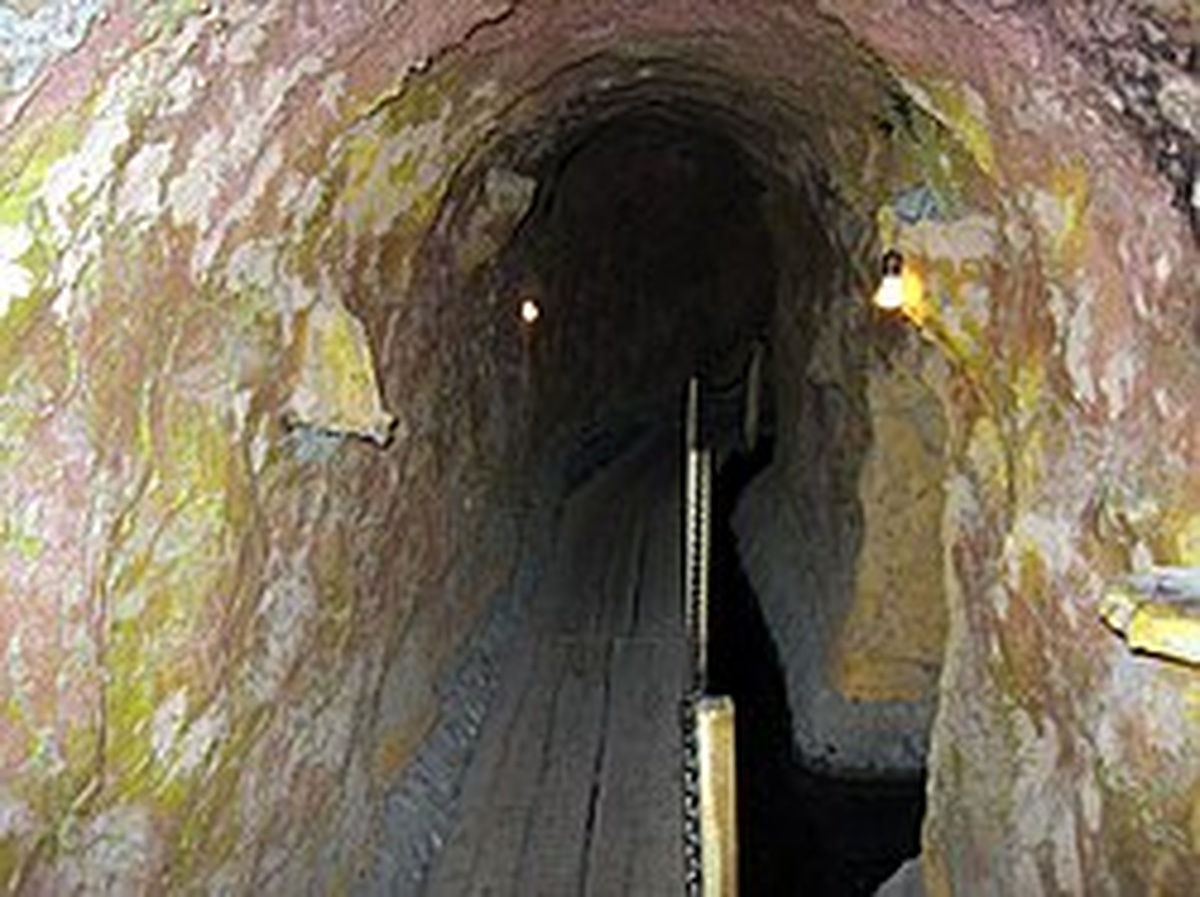
Figure 3: Interior of a Turpan karez gallery in Xinjiang, China. We group it with the Iranian qanat as one engineering principle. Calling this the end of an Andite corridor, and calling the Tarim Basin mummies Andite, is our interpretation; the book mentions neither the karez nor the mummies.
Harappa and Mohenjo-Daro: The Cities That Arrived Already Knowing How
The Indus Valley civilization has puzzled archaeologists for a century. Harappa and Mohenjo-Daro appear in the record around 3000 BCE with no local developmental phase adequate to explain the sophistication of their mature urban form. While earlier phases exist at sites like Mehrgarh and Kot Diji, the leap to the full Harappan civilization, with standardized kiln-fired bricks consistent across hundreds of miles, integrated public baths fed by fresh water and drained by covered sewage channels, private household wells, and a street grid laid out with professional survey precision, remains anomalous in scale and speed. The Urantia Book does not name Harappa or Mohenjo-Daro, but it credits the culture of India in part to the priests of the Second Garden Garden of Eden.
It says: "The superior culture and religious leanings of the peoples of India date from the early times of Dravidian domination and are due, in part, to the fact that so many of the Sethite priesthood entered India, both in the earlier Andite and in the later Aryan invasions" (79:3.3). It places the Dravidian centers where the cities stand: "The Dravidian centers of culture were located in the river valleys, principally of the Indus and Ganges" (79:3.6). And it says: "The Dravidians were among the earliest peoples to build cities and to engage in an extensive export and import business, both by land and sea" (79:3.7). We read Harappa and Mohenjo-Daro as cities of that civilization.
The absence of a developmental record is not a gap in the evidence. It is itself evidence of a people who brought their knowledge with them rather than developing it locally. The Indus Valley cities decline around 1900 BCE. The book gives no date for their end (79:3.1 to 79:3.8), but it names two losses in India. One is the submergence of the Andites: "And but for the complete submergence of the Andites by the peoples of the south, this destiny would probably have been realized" (79:3.5). The other is religious: "Of all civilizations, the Vedic-Aryan paid the most terrible price for its rejection of the Salem gospel" (94:2.4). In our interpretation these explain the fall of the Indus cities, and the engineering collapses with the people who carried it.
Part III: The Megalithic Blast Radius
When You Sort the Stones by Date, They Stop Being Anomalies
The global megalithic tradition has generated more alternative archaeology speculation than almost any other body of evidence in the ancient record. The problem is not that the conventional explanations are wrong to assert human agency. The problem is that they cannot account for the coordination, the precision, or the distribution pattern.
The distribution pattern is the key. When the construction dates of major megalithic traditions are mapped against geography, not against culture or language family but against geography and date, they do not scatter randomly. They describe a directional expansion radiating outward from a single origin zone in the Anatolian and Mesopotamian heartland, with later dates as distance from the origin point increases.
Gobekli Tepe dates to about 9,000 BCE (Toohey et al. 2024), and Karahan Tepe to the same age. These are not isolated sites. In our reading they are a regional tradition, the T-pillar geometric alignment curriculum of the Nodite mason guilds at maximum concentration before the Andite diaspora began distributing that knowledge. No significant residential occupation was identified at either site in initial excavations, though more recent work has suggested possible year-round habitation. In our reading their primary function was ceremonial and educational, not domestic: teaching centers, not ordinary settlements. The Tower of Jericho dates to approximately 8,000 BCE, an eight-meter stone tower in the Levant at a period when the surrounding region should not be capable of producing it. Nabta Playa in the Sahara dates to approximately 7,000 BCE, an astronomical stone circle built by cattle-herding populations; in our reading the Andites were then teaching astronomical and hydraulic techniques to the peoples of the region. Carnac in Brittany dates to approximately 4,500 BCE, and Newgrange to approximately 3,200 BCE; these dates for Jericho, Nabta Playa, Carnac and Newgrange are the conventional ones, not checked here. Stonehenge was begun about 2,900 BCE (Toohey et al. 2024). The book's own word on the great stones of Europe is this: "The European white races were energetic builders, delighting to set up great stones as tokens to the sun, much as did their later-day descendants at Stonehenge" (80:9.13). In the book those white races are the blend of the blue men and the Andites.
And then there is Callacpuma.
Callacpuma: The Linchpin of the Americas Argument
In the Andean highlands of northern Peru, a circular plaza formed by two concentric walls of megalithic stones was built around 2,750 BCE (Toohey et al. 2024; see note 4). We treat it as the linchpin of our Americas dispersal hypothesis, so it deserves full forensic treatment, the evidence against us included.
The study that dated the plaza reports that its construction method, large megalithic stones set upright and free-standing, was previously unreported in the Andes and differs from the region's other monumental circular plazas (Toohey et al. 2024). The same study says the builders may have started experimenting with food production but were probably still fairly mobile hunter-gatherers. Toohey et al. (2024) place the construction of Stonehenge at about 2,900 BCE, about 150 years before the date they report for Callacpuma. We read the two circles as one geometric principle; that reading is ours. Callacpuma is not without antecedents: the same study calls the plaza a possible early offshoot of the emerging Andean tradition of sunken circular plazas. And the book says:
One hundred and thirty-two of this race, embarking in a fleet of small boats from Japan, eventually reached South America and by intermarriage with the natives of the Andes established the ancestry of the later rulers of the Incas. They crossed the Pacific by easy stages, tarrying on the many islands they found along the way. (78:5.7)
Here the book's record ends and this article's inference begins. The Urantia Book gives no date and names no landing site for the 132 (78:5.7). It sets their voyage inside its account of the Andite migrations, of which it says: "The migratory conquests of the Andites continued on down to their final dispersions, from 8000 to 6000 B.C." (78:5.8) And it limits the crossing to this one group: "But of the Andites who navigated the Pacific of long ago none but the one hundred and thirty-two ever reached the mainland of the Americas" (78:5.7). The link to Callacpuma is our hypothesis, not the book's claim. We propose that the megalithic plaza, dated by radiocarbon to about 2,750 BCE (Toohey et al. 2024; see note 4), could be the architectural signature of Andite navigators or their descendants, deploying the geometric blueprint traced in this section. The evidence against our hypothesis deserves equal weight. The book itself counts against it. Of the civilizations founded "In Mexico, Central America, and in the mountains of South America" (79:5.8) it says, "These civilizations were evolutionary products of the Sangiks, notwithstanding that traces of Andite blood reached Peru" (79:5.9). By our reading of the book's dates, a landing near 2,750 BCE would also come more than three thousand years after the final Andite dispersions, "from 8000 to 6000 B.C." (78:5.8); that gap is our arithmetic, not a date in the book. The study that dated the plaza speaks of its builders as Cajamarca groups and calls the plaza a possible early offshoot of an emerging Andean tradition of sunken circular plazas, with Sechin Bajo an early example at about 3,300 BCE (Toohey et al. 2024). The contact between Polynesians and Native Americans that genetics can date falls at about 1,200 CE, with Native American ancestry flowing into Polynesia (Ioannidis et al. 2020, Nature 583:572), almost four thousand years after Callacpuma. That finding does not confirm the crossing described in 78:5.7 either: its date is far later and its direction is the reverse.
This is not a spacecraft distribution pattern. A spacecraft distribution would leave no geographic footprint, no time gradient, no corridors with transitional sites. What we read in the megalithic record is a walking and sailing distribution pattern, a transmitted technical tradition moving with a migrating population. Toohey et al. (2024) give about 9,000 BCE for Gobekli Tepe in Turkey, about 2,900 BCE for Stonehenge in England, and about 2,750 BCE for Callacpuma. If our Callacpuma hypothesis holds, the arc from the first to the last spans about 6,250 years; that figure is our arithmetic.
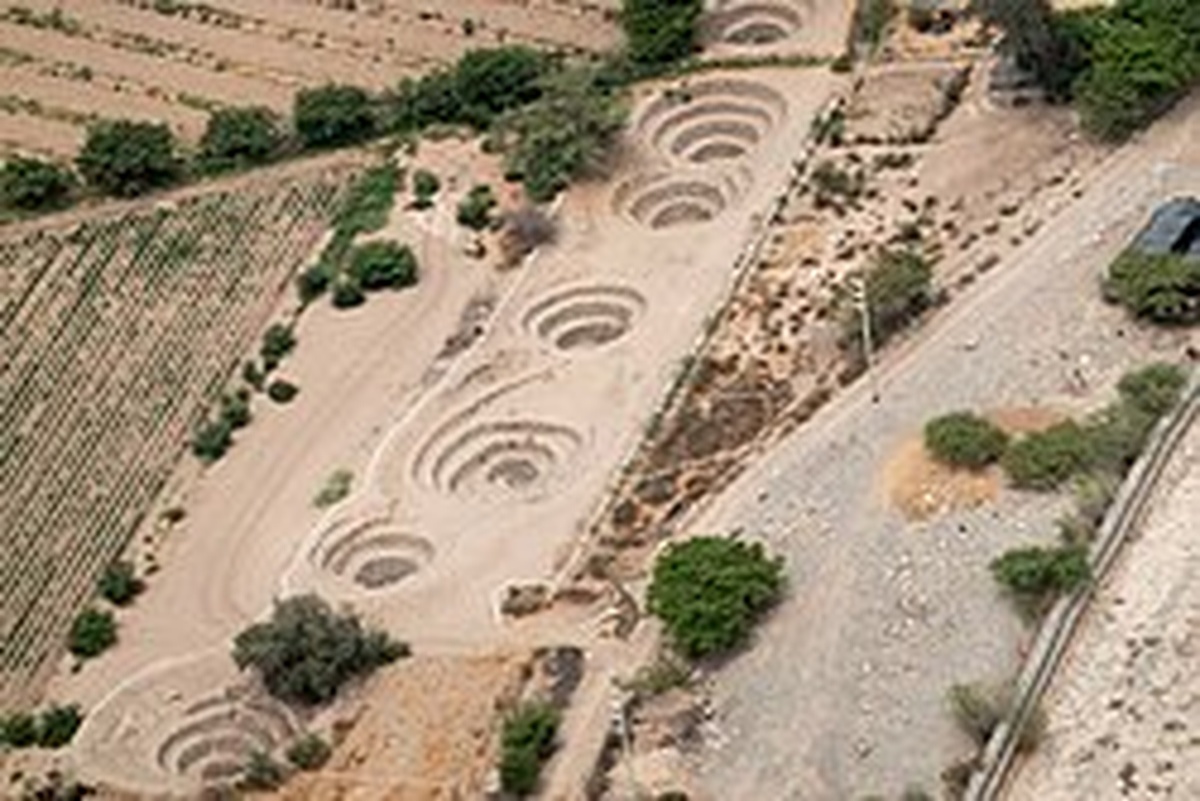
Figure 4: Aerial view of the Cantalloc aqueducts near Nazca, Peru. The ojos (access shafts), seen here with spiral ramps, descend to the underground puquio gallery, giving access for cleaning and bringing air and light to the gallery (Proulx 1999). Proulx (1999) notes that several ojos, such as those visited by tourists at this site (his spelling is Cantalloq), have been rebuilt in recent years with spiral cobblestone ramps, and that it is not certain the ancient Nasca people built each ojo so elaborately. Part V offers our interpretation of these structures as an engineering memory encoded in the Neolithic spiral, a reading that is not found in The Urantia Book. We group the puquio with the Iranian qanat as one engineering principle; that grouping is also ours.
Part IV: The Smith Guild and the Artifacts of a Vanishing Race
The Nodite Institutional Memory and the Bronze Age
The Nodite contribution to the Andite synthesis was not only physical. It was institutional. The book says: "The one hundred were organized for service in ten autonomous councils of ten members each" (66:5.1). They taught "throughout the three hundred thousand years which intervened between their arrival on Urantia and those tragic days when Caligastia threw in his lot with the rebel Lucifer" (66:7.19). Five of the councils, in our grouping, served the technical arts. The book names them "The council on food and material welfare" under Ang (66:5.2), "The board of animal domestication and utilization" under Bon (66:5.4), "The faculty on dissemination and conservation of knowledge" under Fad (66:5.9), "The commission on industry and trade" under Nod (66:5.11), and "The planetary council on art and science" under Mek (66:5.23).
Of Mek's council the book says: "This corps did much to improve the industrial technique of early man and to elevate his concepts of beauty" (66:5.23). In our interpretation that technical teaching is the institutional origin of the metallurgical tradition we call the Smith Guilds, carried by the Nodites into the Andite synthesis. The book's own roll call suggests the line ran through Nod's commission rather than Mek's council: "The council of art and science remained loyal in its entirety" (67:4.1), while "Nod and all of the commission on industry and trade joined Caligastia" (67:4.1), and of that commission it says, "Every form of primitive manufacture was encouraged by this corps" (66:5.11). In our reading, three hundred thousand years of such teaching, encoded into the hereditary knowledge of the Nodite descendants, is what the Smith Guilds were carrying when the Andites dispersed globally.
In our reading the Varna Necropolis on the Black Sea coast of Bulgaria, dated to approximately 4,500 BCE, is the earliest archaeological expression of the Smith Guild tradition in the Western Wave corridor. Its gold is commonly reported at about six kilograms in all, finely worked; we have not checked these figures against the excavation reports, and the judgment that such work implies a trained tradition is ours. In our interpretation the BMAC civilization centered on Gonur Tepe in Turkmenistan represents the accessible archaeological surface of the Adamsonite headquarters, which the book places "near the Kopet Dagh" (77:5.10). Of bronze the book says: "The discovery of mixing copper and tin to make bronze was made by one of the Adamsonites of Turkestan whose highland copper mine happened to be located alongside a tin deposit" (81:3.5). The Proto-Indo-European language family, whose reconstruction consistently places its origin in the Pontic-Caspian and Central Asian highland zone, is in our reading the linguistic legacy of the same population. The book says: "The so-called Aryan mother tongue was in process of formation in the highlands of Turkestan; it was a blend of the Andonic dialect of that region with the language of the Adamsonites and later Andites" (78:5.3).
The Sanxingdui Masks and the Phenotypic Portrait
The Smith Guild tradition carried not just technical knowledge but an artistic memory, an aesthetic that appears with remarkable consistency at the terminal points of every migration corridor. The large-eyed, fine-featured aesthetic that characterizes the Andite artistic tradition is not a universal human preference. It is a phenotypic portrait. The Smith Guild artists encoded their own appearance in every medium they mastered.
In Sumer, the large-eyed votive statues show the same exaggerated wide-set eye treatment that appears in the Dogu clay figures of Jomon Japan and in the Sanxingdui bronze masks of Sichuan, China. The Sanxingdui tradition, dating to approximately 1,200 to 1,000 BCE, appears in the Chinese archaeological record without local developmental antecedent, the standard complaint about all Andite-adjacent anomalies, and features bronze casting at a technical sophistication that implies transmission from a trained metallurgical tradition rather than local development.
Those masks with their dramatically enlarged wide-set eyes confuse every classification system that tries to fit them into a regional developmental sequence. They are not confusing once you understand the Andite aesthetic. Wherever the Smith Guilds traveled, from Sumer to Bulgaria to Jomon Japan to Sichuan, they encoded the same phenotypic memory. The large eyes, the fine features, the distinctive skull profile: these are the faces of the people who built the hydraulic systems, who cut the megaliths, who forged the gold. They wanted to be remembered accurately, and in the medium of art they controlled, they made sure they were.
Part V: The Spiral
A Symbol with Two Memories
Everything in this part that ties the spiral, the concentric circle or a water system to Eden or to the Andites is our interpretation. The Urantia Book does not mention the Neolithic spiral, the qanat, or the puquio.
We regard the Neolithic spiral as one of the most widely distributed symbols in the archaeological record. It appears at Newgrange in Ireland, at Kilmartin Glen in Scotland, at the Tarxien Temples in Malta, and at other sites that, in our reading, follow the Andite migration corridors. We also see it in the spiral ramps of the Nazca puquio access shafts in Peru, although Proulx (1999) notes that several of those shafts have been rebuilt in recent years with spiral ramps and that it is not certain the ancient Nasca people built them so. In our reading the distribution is not universal but follows those corridors. We have no survey of spiral sites to cite for that, so it stands as our impression and not as a measured result.
The conventional explanation for the spiral's distribution is aesthetic universalism, the idea that the spiral is a natural form human pattern-recognition tends to produce across cultures. We think that explanation is weakened if the distribution follows the corridors, since a universal aesthetic tendency should produce a universal distribution. That the spiral's distribution matches the Andite migration perimeter is our reading, and we have not tested it against a full survey of sites.
We read the spiral as encoding two simultaneous layers of civilizational memory, both originating in the same historical trauma of the Adamic Default.
Layer One: The Concentric Paradise
The book describes the plan of Eden:
"At the center of the Edenic peninsula was the exquisite stone temple of the Universal Father, the sacred shrine of the Garden. To the north the administrative headquarters was established; to the south were built the homes for the workers and their families; to the west was provided the allotment of ground for the proposed schools of the educational system of the expected Son, while in the “east of Eden” were built the domiciles intended for the promised Son and his immediate offspring. The architectural plans for Eden provided homes and abundant land for one million human beings." (73:5.1)
Van "proposed, eighty-three years before the arrival of Adam and Eve, that they devote themselves to the proclamation of their advent and to the preparation of a garden home for their reception" (73:2.2), and "In the preparation of the Garden only volunteer laborers were employed" (73:4.4). This center-outward arrangement is what this article interprets as the Edenic blueprint preserved in the concentric geometry of later megalithic sites. It reappears at Gobekli Tepe's T-pillar rings, at Stonehenge's concentric henges, at Callacpuma's circular megaliths, and in compressed form at Newgrange's Triple Spiral. When a population that once knew the concentric paradise of Eden attempts to encode that memory across generations of oral transmission and artistic compression, the concentric circle simplifies and dynamizes into the spiral, which encodes the same relational geometry in a single continuous line.
Layer Two: The Qanat Access Shaft
The second layer, in our reading, is the engineering memory. In our reading, when the Adamic Default drove the exile into more arid zones, the engineering response was to go down into the earth to find the water the surface no longer provided. The book does not say this; its words are that the Adamites were "compelled to wrest a living from unprepared soil" (76:1.4). Proulx (1999) describes the puquio access shafts at Nazca as funnel-shaped holes that gave access to the water, let workers in for the yearly cleaning, and brought air and light to the galleries. In our reading the spiral ramps of some of these shafts resemble the spiral carved at Newgrange. The evidence against our reading deserves equal weight. Proulx writes that several ojos, such as those at Cantalloc (his spelling is Cantalloq), have been rebuilt in recent years with spiral cobblestone ramps, and that it is not certain the ancient Nasca people built each ojo so elaborately. By the dates in Table 1 the first puquios are also thousands of years younger than the Newgrange tomb, which the Heritage Ireland page for Bru na Boinne dates to about 3200 BC; by our arithmetic the gap is more than 3,700 years.
To our eye the Cup and Ring marks at Kilmartin Glen in Scotland, viewed from directly above, resemble the plan view of a qanat shaft system: the circle at center as the mother well, the rings radiating outward as the gallery network, the spiral connecting them as the descent path into the earth. We read these as the engineering schematics of the technology that, in our interpretation, sustained the Andite civilization in the arid zones it occupied, encoded in rock by people who no longer built qanats but had not yet forgotten what the pattern meant.
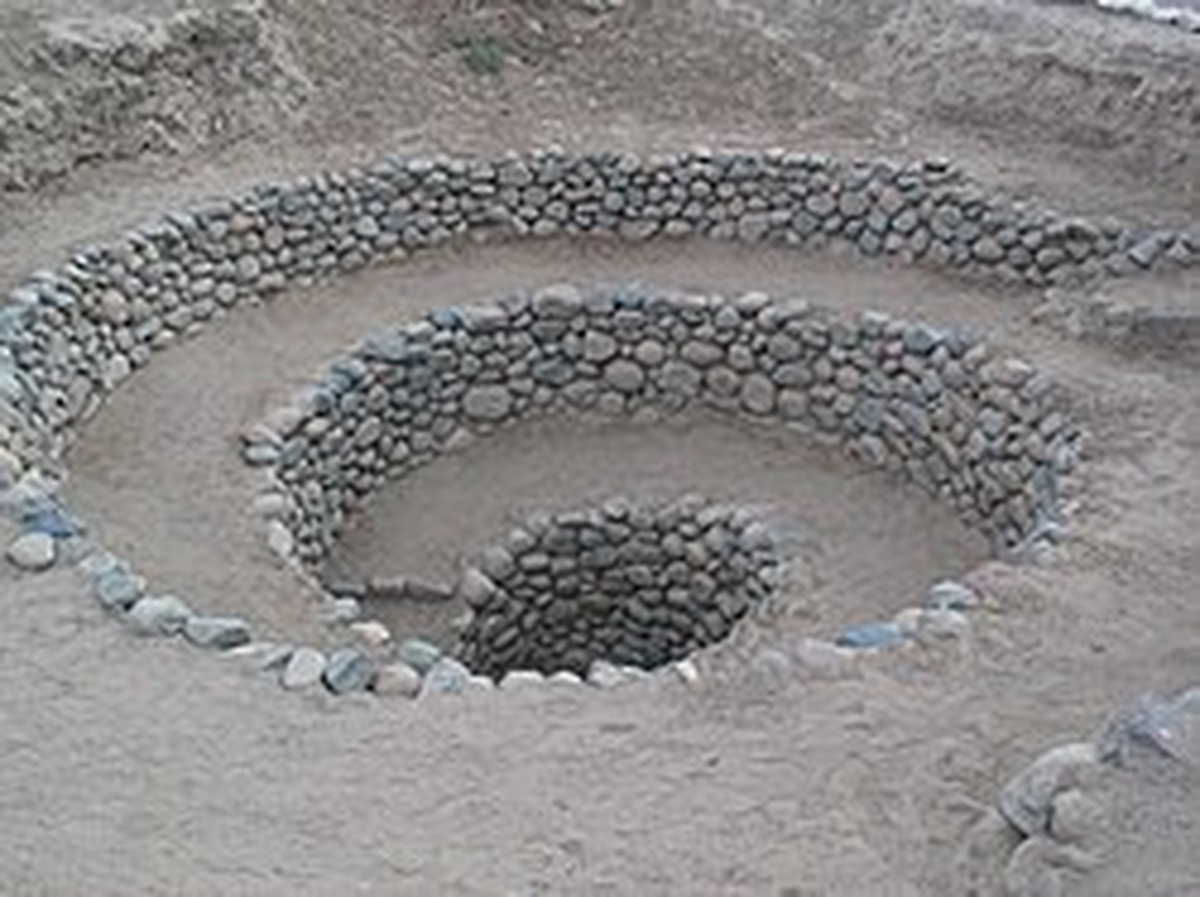
Figure 5: A Nazca puquio access shaft (ojo) seen from above. Stone-lined concentric rings descend into the subterranean gallery. Proulx (1999) notes that several ojos have been rebuilt in recent years with spiral cobblestone ramps, and that it is not certain the ancient Nasca people built each ojo so elaborately; we have not confirmed whether the ojo in this photograph is one of them. Compare this structure to the Cup and Ring petroglyphs at Kilmartin Glen and the Triple Spiral at Newgrange. In our interpretation, which is not found in The Urantia Book, the spiral encodes both the concentric paradise of Eden and the subterranean engineering that replaced it.
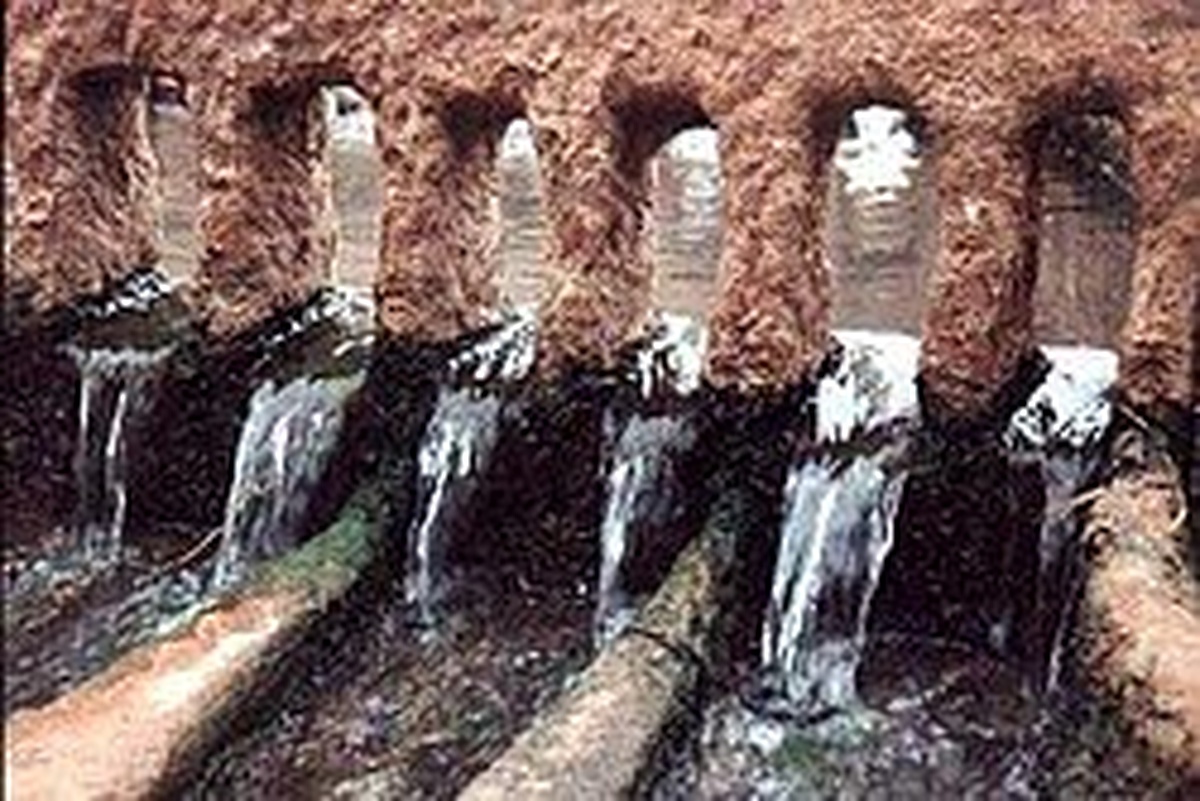
Figure 6: Foggara outlet in Algeria, Saharan Push corridor. Water emerges from the subterranean gallery through multiple arched outlets, which we group with the Iranian qanat as one engineering principle. That the Andites carried this technology across North Africa is our interpretation, and Proulx (1999), summarizing Barnes and Fleming (1991), has the Arabs carrying it from Iran to northern Africa. The book makes no prediction about this technology. It says that "only a few teachers and traders ever penetrated farther south in Africa than the headwaters of the Nile" and that "Later on, mixed Andites and Egyptians followed down both the east and west coasts of Africa well below the equator" (78:5.5).
In our interpretation the spiral encodes both memories simultaneously: the concentric paradise that was lost and the subterranean engineering built to compensate for the loss. On that reading both memories originate in the same civilizational trauma. Layer One is what the Andite lineage came from. Layer Two is what it did to survive without it. Carry that interpretation to Newgrange on December 21st, when the winter solstice sun enters the passage and illuminates the Triple Spiral at the back of the chamber, and you are watching an annual ceremony that simultaneously commemorated the concentric paradise these people's ancestors knew and the subterranean source they found in its place.
Part VI: Mythology as Degraded History
The Sumerian Encoding
The Urantia Book says that "these Sumerians of the coastal regions were the last of the Andites in Mesopotamia" (78:8.1). In our reading that is precisely why their mythological tradition is the most structurally intact archive of the events described in this article. The book names none of the Sumerian gods; the correspondences below are ours. When the UB's personages are laid alongside the Sumerian pantheon, we read the correspondence as structural rather than symbolic or allegorical. In our reading every major figure in the Sumerian divine hierarchy corresponds to a specific historical personage in the UB's account, with the correspondence extending to their roles, their relationships to each other, and the moral valence attributed to them in the tradition.
| Sumerian Figure | UB Personage (our mapping) | In the Book's Words |
|---|---|---|
| An (sky-father supreme) | Caligastia, the Planetary Prince | "About five hundred thousand years ago and concurrent with the appearance of the six colored or Sangik races, Caligastia, the Planetary Prince, arrived on Urantia" (66:0.2) |
| Anunnaki (from heaven to earth) | The one hundred of the Prince's staff | "chosen by Caligastia from over 785,000 ascendant citizens of Jerusem" (66:2.4); "literal bodies consisting of flesh and blood but also attuned to the life circuits of the system" (66:2.5) |
| Igigi (those who observe) | The one hundred Andonites | "the one hundred Andonites contributed their human germ plasm to the members of the Prince’s staff" (66:4.15) |
| Nephilim (the fallen ones) | The Nodites | "The Nephilim (Nodites) were on earth in those days" (77:2.3); "Their descendants were long known as the Nodites" (67:4.2) |
| Enki (water, wisdom, loyal) | Van | "chairman of the supreme council of co-ordination" (67:2.2); "Van and his entire court of co-ordination had remained loyal" (67:4.1); "for over one hundred and fifty thousand years" (67:6.4) |
| Enlil / En (storm, rebel authority) | Nod | "The sixty members of the planetary staff who went into rebellion chose Nod as their leader" (67:4.2) |
| Adapa (the first perfect man) | Adam | "the biologic uplifters to Urantia" (74:0.1) |
Table 2: The Sumerian mythological encoding, as we read it. The book names none of the Sumerian gods; the first two columns are our mapping, and the third gives the book's words about each personage.
Enki, the god of water and wisdom who is always loyal and guards the sacred knowledge, is Van. The book calls Van "chairman of the supreme council of co-ordination" (67:2.2), records that "Van and his entire court of co-ordination had remained loyal" (67:4.1), and says: "He and Amadon were sustained by the technique of the tree of life in conjunction with the specialized life ministry of the Melchizedeks for over one hundred and fifty thousand years" (67:6.4). In our reading that maps precisely onto Enki's mythological profile. Enki is always on humanity's side, and so, in our reading, was Van. The Sumerian oral tradition did not invent this alignment. It preserved it through hundreds of thousands of years of transmission, compressed and mythologized but structurally intact.
Enlil, the storm god who drives humanity from the garden and commands violent displacement, is Nod. The book says: "The sixty members of the planetary staff who went into rebellion chose Nod as their leader" (67:4.2). "After the fall of Dalamatia the disloyal staff migrated to the north and the east" (67:4.2). Before the rebellion Nod had led "The commission on industry and trade" (66:5.11). In our reading his descendants were aggressive, expansionist, and institutionally formidable, and the storm-god profile fits.
Thor, Krishna, and the Olympians
In our reading the same encoding process happened everywhere the Andites dispersed. The book itself describes one case of it: "Thor, the victorious commander of the armies of the north in the final battle of the Somme, became the hero of the northern white tribes and later on was revered as a god by some of them" (80:5.4). Elsewhere it calls him "Thor, a ghost hero who was also master of the lightning" (85:6.4). In the Norse tradition, we read Thor and the Aesir as the biological and institutional memory of the bronze-weaponed Andite warlords who pushed into Scandinavia through the Baltic Amber Route corridor. In our reading they were genuinely larger, stronger, and longer-lived than the indigenous Blue Man populations they encountered. They wielded bronze instruments when their neighbors used flint. The mythology did not invent these qualities. It preserved them, amplified through the inevitable attribution of supernatural qualities that attaches to any population sufficiently advanced relative to the one observing it.
In the Vedic tradition, Krishna's mount is the Garuda bird, a giant flying creature of enormous intelligence, fierce loyalty, and extraordinary power. In our reading the Garuda is the fandor. The book says: "Bon’s group were successful in training the great fandors as passenger birds, but they became extinct more than thirty thousand years ago" (66:5.6). In India the Garuda persisted as the vehicle of Vishnu, the preserver of cosmic order, precisely the functional role the Fandor played in the Dalamatian administrative program. In Sumer the same bird is the Anzu. In North America it is the Thunderbird. One animal, encoded into at least five separate mythological traditions on four separate continents, remembered differently in each but recognizable across all of them once you know what you are looking at.
The Sato mission to Greece is one of the most precisely documented events in the entire dispersal record:
"Almost two thousand years after the settlement of Crete a group of the tall descendants of Adamson made their way over the northern islands to Greece, coming almost directly from their highland home north of Mesopotamia. These progenitors of the Greeks were led westward by Sato, a direct descendant of Adamson and Ratta." (80:7.3)
"The group which finally settled in Greece consisted of three hundred and seventy-five of the selected and superior people comprising the end of the second civilization of the Adamsonites" (80:7.4). Mainstream history cannot explain why Athens and its surrounding culture produced such an anomalous explosion of philosophy, mathematics, and art relative to contemporary European populations. The book gives its explanation: "All the art and genius of these latter people is a direct legacy of the posterity of Adamson, the first son of Adam and Eve, and his extraordinary second wife, a daughter descended in an unbroken line from the pure Nodite staff of Prince Caligastia" (80:7.5). And it adds: "No wonder the Greeks had mythological traditions that they were directly descended from gods and superhuman beings" (80:7.5). In our reading the Titans and the Olympians are the cultural memory of those people.
Part VII: The Madagascar Limit
What an Absence May Suggest: Our Reading
In our reading, one telling feature of the physical record is not where the Andites appeared but where they did not. The Urantia Book draws the boundary in Africa in these words:
But only a few teachers and traders ever penetrated farther south in Africa than the headwaters of the Nile. Later on, mixed Andites and Egyptians followed down both the east and west coasts of Africa well below the equator, but they did not reach Madagascar. (78:5.5)
In our interpretation this boundary gives some weight to an absence. If qanat-type hydraulic systems arose by independent invention wherever conditions called for them, we would expect them in the arid parts of sub-Saharan Africa and in Madagascar as well. Whether they are in fact absent there we have not confirmed from any survey, so this argument stands as our reading and not as a confirmed result. The book names none of these water systems.
| Region | Arid Zone? | Qanat Tradition? | Megalith Precision? | Explanation |
|---|---|---|---|---|
| Iran / Central Asia | Yes | Yes | Yes | Heartland origin |
| North Africa / Sahara | Yes | Yes | Yes | Our reading: Saharan Push. The book says: "They contributed considerably to the northern groups of the Saharan Sangik peoples" (78:5.5). |
| Iberia / Atlantic Europe | Partial | Yes | Yes | Western Wave terminal |
| Sub-Saharan Africa | Yes | No | No | Not outside the book's account: "only a few teachers and traders ever penetrated farther south in Africa than the headwaters of the Nile", and "Later on, mixed Andites and Egyptians followed down both the east and west coasts of Africa well below the equator" (78:5.5). Reading the absence as evidence is our interpretation. |
| Madagascar | Yes | No | No | Of the mixed Andites and Egyptians the book says "they did not reach Madagascar" (78:5.5). Reading the absence of these systems as a match is our interpretation. |
| Andean South America | Yes | Yes (puquios, placed in the sixth century CE or later; see Table 1) | Yes | The book says the 132 "eventually reached South America and by intermarriage with the natives of the Andes established the ancestry of the later rulers of the Incas" (78:5.7). Tying puquios or megaliths to them is our speculation, and the puquio dates in Table 1 count against it. |
Table 3: The Madagascar Limit. The reading of these systems as an Andite footprint is our interpretation; the book names none of the water systems. The Yes and No cells are our own assessment, with no survey cited. The Andean row is our speculation and is not counted as confirmation.
In our reading the two boundaries agree: the technologies we attribute to the Andites thin out where the book's account of their migrations thins out. That is a reading of ours, not a confirmation. The book names none of these water systems, and it says that "mixed Andites and Egyptians followed down both the east and west coasts of Africa well below the equator" (78:5.5).
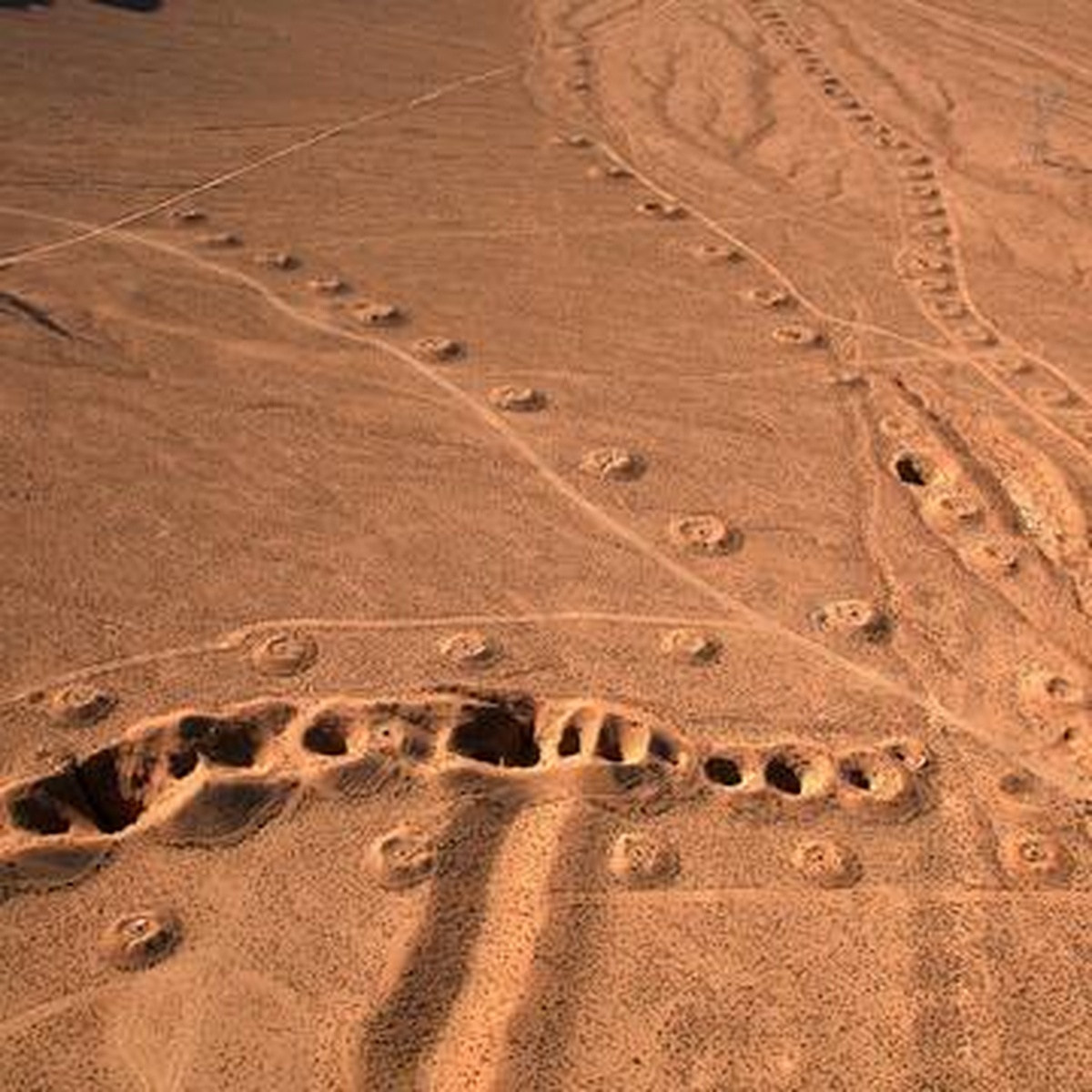
Figure 7: Aerial view of Persian qanat shaft lines. "The Persian Qanat" was inscribed as a UNESCO World Heritage property in 2016. Each circular depression marks a vertical maintenance shaft descending to the underground gallery. Multiple qanat lines run in parallel, forming an engineered water distribution grid across otherwise uninhabitable desert. That this infrastructure stops where the book's account of the Andite migrations stops is our reading; the book makes no prediction about it.
Part VIII: The Genetic Record in the Modern World
The Tarim Basin Mummies
The Tarim Basin mummies deserve extended attention because, in our reading, they are the most visually dramatic physical trace of the Andite presence; the genetic evidence set out below counts against that reading. Excavated from sites across the Tarim Basin in China's Xinjiang region, with the most significant concentrations near the Hotan oasis and the Cherchen site, these individuals confound every classification system that tries to assign them to a known ancient Chinese or Central Asian population.
Popular accounts describe them as tall, some over six feet, Caucasian in cranial and facial form, with red, auburn or blond hair preserved by the dry basin, and some buried in woven plaid. We have not checked these descriptions against the excavation reports; Mallory and Mair (2000) is the standard account. In our reading their long skulls are the dolichocephalic profile of the Nodite-Adamic lineage. A 2021 Nature study found that the oldest Tarim mummies, dated to about 2100 to 1700 BCE, had only local ancestry and descended from a genetically isolated local population (Zhang et al. 2021). Its authors say their results do not support the earlier hypotheses that the mummies descended from the Afanasievo or originated in the Bactria-Margiana Archaeological Complex or the Inner Asian Mountain Corridor cultures. That finding counts against our reading of the mummies as incoming Andites, and it is stated here with the same prominence as that reading. The book calls the Tarim valley "the easternmost outpost of the true Andite culture" (79:1.2). The name Eastward Surge is ours; the book does not use it.
In our interpretation they are Andites of the Eastward Surge, buried in the desert their people irrigated. Of the Tarim valley the book says, "Here they built their settlements" (79:1.2), but it does not mention the mummies, and the finding of Zhang et al. (2021) counts against our reading.
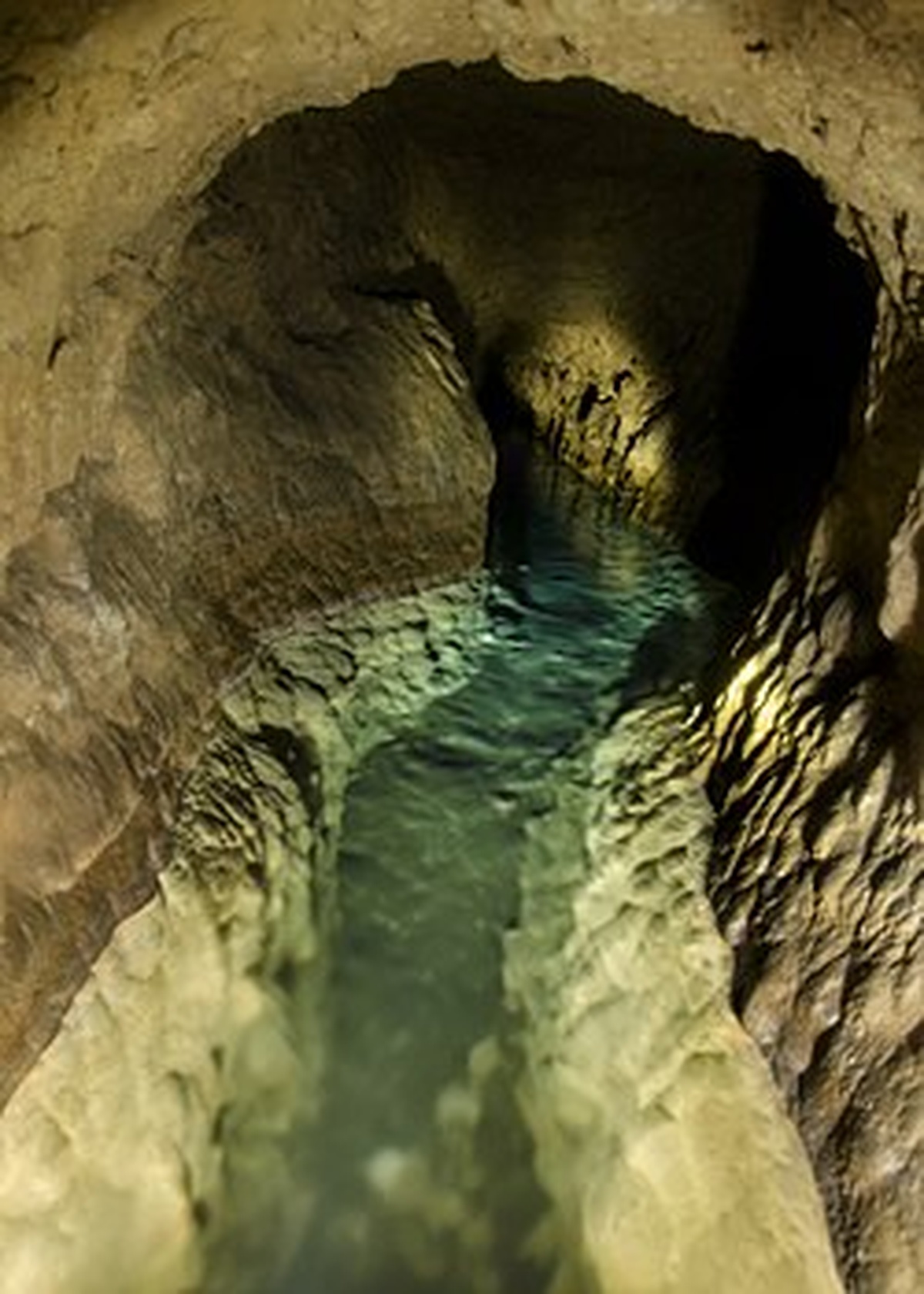
Figure 8: Interior of the Gonabad (Qasabeh) qanat channel, Iran, part of the UNESCO property "The Persian Qanat". It is usually dated to the Achaemenid period, about 2,500 to 2,700 years ago; its deepest mother well is reported at about 300 meters and its galleries at about 33 kilometers in all (secondary sources, not the UNESCO file). In our interpretation the engineering principle continues the "well digging, spring control, and irrigation" taught by the council Ang presided over (66:5.2); the book does not describe this system.
What We Carry
The book traces the violet race "on to its final disappearance from the Mesopotamian homelands, about 2000 B.C." (78:0.2). In our reading the distinct biological lineage then ceased to exist as a separate people, but the genetic legacy was distributed into every race it touched. The book says: "By 12,000 B.C. three quarters of the Andite stock of the world was resident in northern and eastern Europe" (78:5.4). In our reading that stock seeded what would eventually produce European civilization. The blue-eye mutation is common in the European populations that, in our reading, the Andite corridors reached, but its discoverers date it to about 6,000 to 10,000 years ago, long after the book's Adam (see Part I). That long skulls in burial records follow the Andite corridors is our impression; we have not measured it.
These are readings, not proofs. The one genetic date we checked, that of the blue-eye mutation, does not meet the book's date for Adam, and the skull pattern is an impression, not a measured result. What would test the reading is a survey of dated skulls and ancient genomes along the corridors, set beside the book's dates.
Part IX: The Spiritual Inheritance
What the Andites Were Actually Building Toward
The full scope of the Andite story is not only material. This is the part of the argument that distinguishes a UB-grounded analysis from any secular archaeological treatment of the same evidence. The technical achievements, the hydraulic engineering, the metallurgy, the megalithic construction, the genetic dispersal, none of it was an end in itself. All of it was operating in service of a larger planetary purpose: the biological and cultural preparation of the human races of this world for successive revelations, and ultimately for the personal bestowal of the Creator Son.
The Dalamatian teachers worked "throughout the three hundred thousand years which intervened between their arrival on Urantia and those tragic days when Caligastia threw in his lot with the rebel Lucifer" (66:7.19). In our reading they were readying the evolutionary races for later revelations. The book traces one line of that preparation: "Hap presented the early races with a moral law" (66:7.8). "The seven commandments promulgated by Melchizedek were patterned along the lines of the ancient Dalamatian supreme law and very much resembled the seven commands taught in the first and second Edens" (93:4.6). "The seven commandments of Dalamatia and Eden, as well as the ten injunctions of the Hebrews, were definite taboos, all expressed in the same negative form as were the most ancient prohibitions" (89:1.4). In our reading the transmission chain runs from about five hundred thousand years ago to the present through traceable institutional links.
The Tragedy of Eden and the Engineering Imperative
It is worth pausing on the Adamic Default because it is the hinge point that turned the Andite story into what it became. The book says that "it did not occur to her that any danger would attach to the increasingly private and confidential visits she was enjoying with a certain Nodite leader named Serapatatia" (75:2.4). "The whole affair developed so gradually and naturally that she was taken unawares" (75:2.4). The UB is unusually compassionate in its treatment of both Adam and Eve here. In our reading Eve was deceived, not rebellious. Of Adam it says: "Adam was not beguiled; he knew exactly what he was about; he deliberately chose to share the fate of Eve" (75:5.2). "He loved his mate with a supermortal affection, and the thought of the possibility of a lonely vigil on Urantia without her was more than he could endure" (75:5.2).
The book says: "Adam and Eve did fall from their high estate of material sonship down to the lowly status of mortal man" (75:8.1). "Adam lived for 530 years; he died of what might be termed old age" (76:5.5). "His physical mechanism simply wore out; the process of disintegration gradually gained on the process of repair, and the inevitable end came" (76:5.5). But before he died, in our interpretation, the exile from Eden had already set in motion the engineering imperative that shaped what came after. The book says: "They found the first garden partially prepared for them, but the second had to be created by the labor of their own hands" (76:1.4). In our interpretation, as the Andite line moved into progressively more arid zones, that gap between what the land offered and what survival required drove the development of the deep subterranean hydraulic tradition. On that reading the default of Eden is the origin story of the qanat. The book does not mention the qanat.
The Salem Mission and the Long View
The book says: "It was 1,973 years before the birth of Jesus that Machiventa was bestowed upon the human races of Urantia" (93:2.1). In our reading the Andite civilization had by then been in terminal dispersal for thousands of years. The pure genetic line was diluting. The institutional knowledge was becoming ritual, then myth, then legend. The book says: "Revealed truth was threatened with extinction during the millenniums which followed the miscarriage of the Adamic mission on Urantia" (93:1.1). "About 3000 B.C. the concept of God had grown very hazy in the minds of men" (93:1.1). The Melchizedek receivers "petitioned the Most Highs of Edentia that some provision be made for maintaining the light of truth on Urantia" (93:1.2). Of the covenant with Abraham the book says that it "represents the great Urantian agreement between divinity and humanity whereby God agrees to do everything; man only agrees to believe God’s promises and follow his instructions" (93:6.4). The believers at Salem accepted "the Melchizedek covenant with the Most High, which bestows the favor of God on my faith, not on sacrifices and burnt offerings" (93:4.3).
In our interpretation the qanat is not just a water delivery system, the concentric circle is not just an architectural preference, and the Smith Guilds are not just technical institutions. We read them all as expressions of the same drive: a superhuman-derived population attempting to stabilize, organize, and elevate a world that had been severed from its normal developmental support systems by the Lucifer Rebellion, working with whatever biological, institutional, and material tools they had available across a span of time that makes all of recorded history look like a footnote. One program. 500,000 years. Still running.
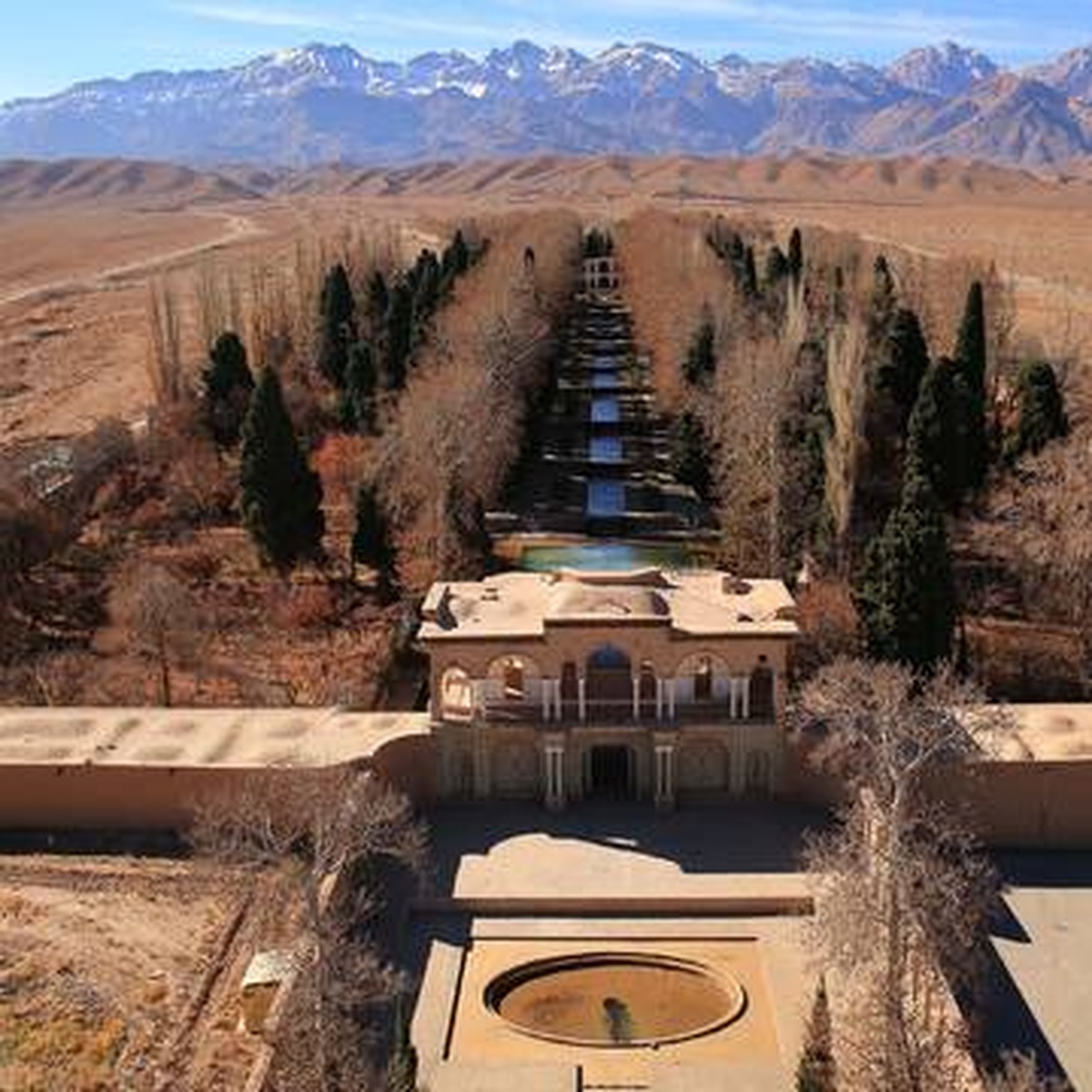
Figure 9: A qanat-fed garden in the highlands near the Kopet Dagh range, Iran. Water from the mountain aquifer sustains terraced gardens in an otherwise arid landscape. In our interpretation this garden echoes the Adamsonite headquarters, which the book places "near the Kopet Dagh" (77:5.10) and where, it says, a high culture was maintained "for almost seven thousand years" (77:5.9). The book does not mention the qanat.
Conclusion: We Are the Evidence
What happened to the Andites is what always happens when a superior lineage disperses into a larger population. The genetics dilute. The institutions degrade. The guild knowledge becomes ritual, then myth, then legend, then silence. The book traces the violet race to "its final disappearance from the Mesopotamian homelands, about 2000 B.C." (78:0.2). By the time Machiventa Melchizedek materialized at Salem, the Andite civilization had already been in terminal dispersal for millennia.
In our interpretation the infrastructure that carries their inheritance is still here, although the systems we point to are far younger than the Andites themselves. The qanat at Gonabad in Iran, constructed thousands of years ago, still flows today, still delivering water by gravity from the mountain aquifer to the village outlet, still operating, in our interpretation, on a principle that goes back to the "well digging, spring control, and irrigation" taught by the council Ang presided over (66:5.2). The spiral carved at Newgrange still catches the winter solstice light every December 21st, and in our reading it still encodes both the memory of Eden and the subterranean water that replaced it. The Moai still face back across the ocean their ancestors crossed. The Garuda still flies in Indian iconography, still serving as the vehicle of the cosmic preserver, still carrying the memory of a bird that went extinct more than thirty thousand years ago.
In our reading we do not study the Andites as a chapter of ancient history. We live in the civilization they designed. The standardized brick, the alphabetic writing system, the urban sanitation grid, the agricultural calendar, the ethical transmission of the universal fatherhood of God: all of it traces back, in our reading, through the migration corridors of the Andite dispersal to the ten councils of Dalamatia, under a planetary program that was trying to do something remarkable. The book places their headquarters "in the Persian Gulf region of those days" (66:3.1) and dates the Prince's arrival "About five hundred thousand years ago" (66:0.2).
In our reading, it worked. Imperfectly, tragically, in ways no one intended, through a rebellion that shattered the original plan, through a default that exiled the biological uplifters from their prepared paradise into unprepared soil, through the systematic dilution of the finest genetic endowment this planet has ever carried into the general evolutionary population. It worked through all of that. The faith-covenant concept survived. The hydraulic infrastructure sustained civilizations. The guild knowledge built the cities. The prophet chain reached the Universal Father. The Creator Son came.
The Tarim Basin mummies are sleeping in the desert that, in our reading, their people irrigated. The megalithic circles are still aligned to the solstices they were built to mark. The qanats are still flowing. The spirals are still carved in the stone at the edge of the Atlantic, and we read them as still encoding both memories: we came from a concentric paradise, and we found the water underground.
In our reading we are the evidence that the program worked. And we are only now, in the early centuries of the fifth epochal revelation, beginning to read the record correctly.
The full planetary timeline is mapped interactively. All 174 sites across 500,000 years, from Dalamatia to the Salem missionary network, with migration corridors, race-type filters, and UB citation pop-ups for every location. Explore the map.
Notes
1. All Urantia Book citations in this article are verified against The Urantia Book, Standard Reference Text (Urantia Foundation, 1955; text identification UF-ENG-001-1955-1.22). Paper and section references follow standard UB citation format.
2. The OCA2 blue-eye mutation was identified by Eiberg et al. (2008), Human Genetics 123(2):177-187. The paper's abstract gives no date; the team's dating of the common ancestor to about 6,000 to 10,000 years ago was reported by the University of Copenhagen and by Science ("Don't It Make Your Brown Eyes Blue?", 2008). It does not meet the UB's date for Adam and Eve, "from the year A.D. 1934, 37,848 years ago" (74:0.1), which by our arithmetic is 35,914 BCE.
3. The Tarim Basin mummy genetic analysis draws on Mallory and Mair (2000), The Tarim Mummies (Thames and Hudson), and on Zhang et al. (2021), Nature 599:256, whose abstract reports that the Early to Middle Bronze Age Tarim individuals had only local ancestry and descended from a genetically isolated local population. That finding counts against our reading of the mummies as incoming Andites.
4. Callacpuma dating: Toohey et al. (2024) dated the initial construction of the megalithic circular plaza at Callacpuma, Cajamarca, Peru, with three radiocarbon samples whose average falls near 2,750 cal BCE, inside a calibrated range of 2,884 to 2,632 cal BCE. The Urantia Book gives no date and no site for the arrival of the 132 (78:5.7, 79:5.9). The book dates the final Andite dispersions "from 8000 to 6000 B.C." (78:5.8), and of the civilizations founded "In Mexico, Central America, and in the mountains of South America" (79:5.8) it says: "These civilizations were evolutionary products of the Sangiks, notwithstanding that traces of Andite blood reached Peru" (79:5.9). Both points count against our hypothesis. The link between the 132 and Callacpuma is our hypothesis, and the date serves as a working estimate for that hypothesis only.
5. Klaus Schmidt's excavation reports from Gobekli Tepe (Schmidt, 2006, Sie bauten die ersten Tempel, C.H. Beck) confirm the absence of residential occupation and the astronomical alignment precision cited in Part III.
6. The Sumerian encoding analysis in Part VI draws structural rather than linguistic correspondences. No claim is made that the Sumerian scribal tradition had direct knowledge of the UB framework. The claim is that the structural profile of the divine figures in the Sumerian tradition corresponds to the structural roles of the UB personages, consistent with the hypothesis that the Sumerian tradition preserved degraded cultural memory of historical events.
7. UB 80:7.3 to 80:7.5 on the Sato mission: "The group which finally settled in Greece consisted of three hundred and seventy-five of the selected and superior people comprising the end of the second civilization of the Adamsonites" (80:7.4). Of their achievement the book says: "All the art and genius of these latter people is a direct legacy of the posterity of Adamson" (80:7.5).
Primary Sources
The Urantia Book. Urantia Foundation, Chicago, 1955. Standard Reference Text UF-ENG-001-1955-1.22. Primary papers consulted: 51, 62, 66, 67, 73, 74, 75, 76, 77, 78, 79, 80, 81, 85, 89, 93, 94.
Corroborating Archaeological and Scientific Sources
Eiberg, H. et al. (2008). Blue eye color in humans may be caused by a perfectly associated founder mutation in a regulatory element located within the HERC2 gene inhibiting OCA2 expression. Human Genetics, 123(2), 177-187.
Mallory, J.P. and Mair, V.H. (2000). The Tarim Mummies: Ancient China and the Mystery of the Earliest Peoples from the West. Thames and Hudson, London.
Schmidt, K. (2006). Sie bauten die ersten Tempel: Das ratselhafte Heiligtum der Steinzeitjager. C.H. Beck, Munich.
Possehl, G.L. (2002). The Indus Civilization: A Contemporary Perspective. AltaMira Press.
Wulff, H.E. (1968). The Qanats of Iran. Scientific American, 218(4), 94-105.
Angelakis, A.N., Chiotis, E., Eslamian, S., and Weingartner, H., eds. (2016). Underground Aqueducts Handbook. CRC Press, Boca Raton, Florida.
Schreiber, K.J. and Lancho Rojas, J. (2003). Irrigation and Society in the Peruvian Desert: The Puquios of Nasca. Lexington Books, Lanham, Maryland.
Schreiber, K.J. and Lancho Rojas, J. (1995). The Puquios of Nasca. Latin American Antiquity, 6(3), 229-254.
Barnes, M. and Fleming, D. (1991). Filtration-Gallery Irrigation in the Spanish New World. Latin American Antiquity, 2(1), 48-68.
Proulx, D.A. (1999). Nasca Puquios and Aqueducts. English text of a chapter first published in German in Rickenbach, J., ed., Nasca: Geheimnisvolle Zeichen im Alten Peru, 89-96. Museum Rietberg, Zurich.
Toohey, J.L., Murphy, M.S., Chirinos Ogata, P., Stagg, S.G., and Garcia-Putnam, A. (2024). A monumental stone plaza at 4750 B.P. in the Cajamarca Valley of Peru. Science Advances, 10(7), eadl0572.
Ioannidis, A.G. et al. (2020). Native American gene flow into Polynesia predating Easter Island settlement. Nature, 583(7817), 572-577.
Zhang, F. et al. (2021). The genomic origins of the Bronze Age Tarim Basin mummies. Nature, 599(7884), 256-261.
Mächtle, B., Hecht, S., Manke, N., Kromer, B., Lindauer, S., Li, C.-S., Li, Y., Wang, X., and Bubenzer, O. (2019). The Age and Origin of Karez Systems of Silk Road Oases around Turpan, Xinjiang, P.R. of China. In Socio-Environmental Dynamics along the Historical Silk Road, 359-378. Springer International Publishing.
Samaras, D. (2025). Andite Civilization: A Comprehensive Archaeological, Genealogical, and Theological Study, Version 3.0. Urantia Book Network Production Bible.
Derek Samaras | Urantia Book Network
Connecting Articles


The Newsletter
Get the research behind each piece
Free. New Urantia Book explorations, the sources behind the videos, and early looks. No spam, unsubscribe anytime.
Prefer video? Follow on YouTube and Facebook.
Delivered through Substack. You can also read past issues.