
 Mythic
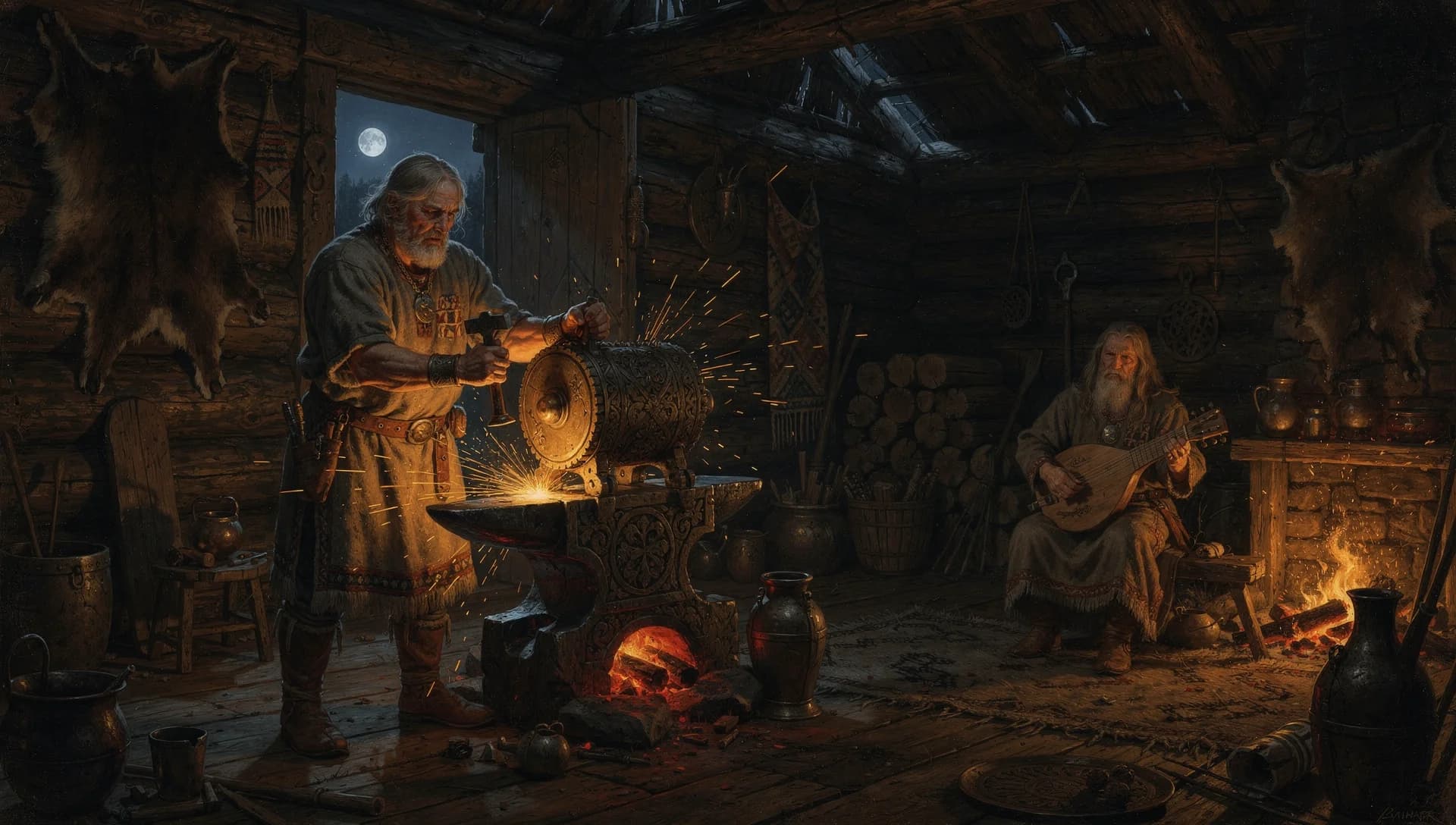
Ilmarinen, the eternal smith of the Finnish Kalevala
 UB
UBVan, the loyal wise counselor remembered in craftsman-hero traditions
Full Article
Read the deep-dive article on this connection
Van, the loyal wise counselor remembered in craftsman-hero traditions = Ilmarinen, the eternal smith of the Finnish Kalevala
The Connection
The Kalevala, the Finnish national epic compiled by Elias Lönnrot from oral tradition, features Ilmarinen the eternal smith who forges the sky itself and the magical Sampo, a mill that produces endless grain, salt, and gold. Ilmarinen is paired with Väinämöinen the wise singer, the pair serving as civilizational culture-heroes across the epic. The pattern (superhuman craftsman and superhuman wise counselor who together establish the conditions of civilized life) matches the corporeal-staff division of labor the UB describes: craft councils and wisdom councils as two pillars of the Prince's civilizational teaching.
UB Citation
Academic Source
Lönnrot, Kalevala (1849); DuBois, Finnish Folk Poetry and the Kalevala (1995)
Historical Evidence(Suggestive evidence)
Thomas DuBois traced the Kalevala's content to pre-Christian Finno-Ugric oral tradition, older than the Christian-era compilation and preserving elements of genuinely ancient Baltic-region belief. Ilmarinen's pairing with Väinämöinen preserves a standard Indo-European "craftsman and sage" culture-hero duo, also seen in Hephaestus/Prometheus, Tvashtar/Brihaspati, and the Ibn Rushd/Ibn Sina Arabic pairing. The UB's organized-teaching model of civilization arriving as a structured package through superhuman teachers is the underlying pattern.
Deep Dive
In 1835, the Finnish doctor and folklorist Elias Lönnrot published the first edition of the Kalevala, a national epic he had assembled from oral songs collected across the Finnish countryside. The expanded second edition (1849) ran to fifty cantos and over twenty-two thousand verses. The Kalevala became a foundational document of Finnish national identity and one of the most extensive recorded oral traditions in any European language.
At the heart of the Kalevala stands the pairing of Väinämöinen and Ilmarinen. Väinämöinen is the eternal singer, the wise old shaman whose songs shape the world, the sage-counselor whose words have creative power. Ilmarinen is the eternal smith, the craftsman who forges the dome of the heavens, who creates the magical Sampo (a mill that produces endless grain, salt, and gold), who rebuilds the moon and sun when they are stolen. The two are paired throughout the epic. Väinämöinen sings the songs that give power. Ilmarinen builds the objects that embody the songs.
The Kalevala draws on much older Finno-Ugric oral tradition. Thomas DuBois' Finnish Folk Poetry and the Kalevala (1995) traces the content to pre-Christian sources, with some elements preserving genuinely ancient Baltic-region belief from before the era of recorded history. The Kalevala is a late-recorded compilation, but the materials it compiles are old.
The Väinämöinen / Ilmarinen pairing is structurally identical to the standard Indo-European culture-hero duo: a wise sage paired with a master craftsman, together establishing the conditions of civilized life. The pattern appears in Greek religion (Prometheus the trickster-craftsman paired with the wise Athena), in Vedic religion (Brihaspati the priestly sage paired with Tvashtar the divine craftsman), in Norse religion (Odin the wise wanderer paired with the dwarven smiths who forge his spear and Thor's hammer), and in Egyptian religion (Thoth the scribe paired with Ptah the artificer).
The UB framework recognizes this widespread pattern as the cultural memory of the actual organized-teaching structure of the Prince's corporeal staff. UB 66:5.1-14 describes the staff as organized into ten autonomous councils of ten members each, including specifically a council of art and science (which preserved its loyalty during the rebellion, UB 67:4.1) and a commission on industry and trade (which defected with Nod). The staff was not a generic group of superhuman teachers but a structured division of labor with specialized functions.
The two preserved-loyal councils that map most directly onto the Väinämöinen / Ilmarinen pairing are the council of art and science (sage-knowledge) and what UB 66:5 calls the council on the conquest of predatory animals or related crafts. The structure of "wisdom-teacher paired with craft-teacher" reflects the underlying organizational structure of the original superhuman teaching mission. The pattern's persistence across so many Indo-European and other cultures is, on this reading, the cultural memory of how civilized life was actually delivered: as a structured package through paired specialized teachers.
Ilmarinen specifically maps onto the Vannic loyalist tradition. He is described as eternal, as having forged the dome of the heavens, as serving as a craftsman of objects with cosmic significance. The eternal-craftsman pattern fits the UB description of Van's long lifespan (over 150,000 years sustained by the tree of life, UB 67:6.4) and the loyal staff's role in preserving and transmitting the original civilizational teaching after the rebellion.
The Sampo is the most distinctive element of the Ilmarinen narrative. It is a magical mill that produces endless grain, salt, and gold. The narrative of its forging, theft, and partial recovery occupies multiple cantos of the Kalevala. The Sampo is sometimes interpreted by scholars as a symbolic representation of cosmic abundance or as a mythological refraction of a real ancient mill technology. The UB framework would suggest that the Sampo preserves the cultural memory of the corporeal staff's technological-agricultural innovations: the introduction of organized agriculture, irrigation, food preservation, and the abundance these technologies produced.
The strongest counterargument is that the Kalevala was compiled relatively late and reflects nineteenth-century romantic-nationalist concerns more than ancient Baltic religious tradition. This is partially true. Lönnrot's editorial choices shaped the final form of the epic. But the underlying oral materials are demonstrably much older, and the structural pattern of paired sage-and-craftsman culture heroes is so widespread across Indo-European and Finno-Ugric traditions that it cannot be reduced to nineteenth-century romanticism. The pattern preserves something real about how civilized life was originally delivered, and the UB organized-staff framework provides one candidate for what that something was.
Key Quotes
“When the final roll was called, the corporeal members of the Prince's staff were found to have aligned themselves as follows: Van and his entire court of co-ordination had remained loyal. Ang and three members of the food council had survived. ... Hap and the entire college of revealed religion remained loyal with Van and his noble band. Lut and the whole board of health were lost. The council of art and science remained loyal in its entirety.”
“Van was left on Urantia until the time of Adam, remaining as titular head of all superhuman personalities functioning on the planet. He and Amadon were sustained by the technique of the tree of life in conjunction with the specialized life ministry of the Melchizedeks for over one hundred and fifty thousand years.”
Cultural Impact
The Kalevala has had an outsized influence on world culture for a national epic from a small country. J.R.R. Tolkien drew heavily on Finnish mythology, particularly Quenya (one of his elvish languages) was modeled on Finnish phonology and the figure of Túrin Turambar in the Silmarillion is partially based on the Kalevala's Kullervo. The epic also influenced Wagner's Ring Cycle, which drew on a similar pool of Indo-European materials. The UB framework adds historical depth to this widespread cultural impact. The Kalevala's influence is not just aesthetic; the materials it preserves carry genuine memory of the original organized-teaching structure of civilized life. When Tolkien drew on Finnish mythology, he was drawing on a tradition that preserves, in distorted but recognizable form, the memory of how civilizational knowledge was actually delivered to early human populations. For Finnish-heritage readers, this framework offers a way to engage with the Kalevala that goes beyond romantic-nationalism. The epic preserves real historical memory, not just folk imagination. Väinämöinen and Ilmarinen are not just legendary figures but cultural memories of the kind of paired sage-and-craftsman teachers who actually delivered civilizational knowledge to early Baltic populations.
Modern Resonance
Contemporary Finnish-heritage and broader Baltic-region cultural movements have engaged extensively with the Kalevala as a source of identity and meaning. The Finnish national holiday Kalevala Day (February 28) is one of the most widely observed cultural celebrations in Finland. Annual Kalevala-related events occur in Karelia, in Estonia, and in expatriate Finnish communities worldwide. The UB framework offers these movements a way to deepen their engagement with the tradition. The Kalevala is not just a national-identity document; it is a witness to the organized-teaching origin of civilized life that is preserved in similar form across many cultures. Engaging with the Kalevala as such a witness, rather than merely as Finnish national heritage, opens it to larger conversations about the universal pattern of civilizational origin. For non-Finnish readers, the Kalevala offers one of the cleanest available illustrations of the universal "wise sage paired with master craftsman" pattern. Reading it alongside the Vedic Brihaspati and Tvashtar, the Greek Athena and Prometheus, the Norse Odin and the dwarven smiths, and the Egyptian Thoth and Ptah reveals how consistent this pairing is across cultures and how plausibly it preserves cultural memory of a real underlying teaching structure.
Related Mappings
Andite cavalry commanders crossing the Russian plains (~5000 BC)
= Perun, Slavic sky-and-thunder god with a hammer or axe
Nodite cultural memory preserved in the Russian and Turkestan reservoir
= Veles, Slavic god of cattle, wisdom, and the underworld
Universal pre-Christian cult of the Tree of Life (UB 85:2.4)
= Slavic "world tree" traditions; the sacred oak of Perun
Salem missionaries reaching "all Europe, even to the British Isles"
= Rod / Svarog, pre-Slavic creator high-god marginalized by later pantheon
Related Articles
Where to next
The free newsletter. The research behind each piece, no spam.