
 Mythic
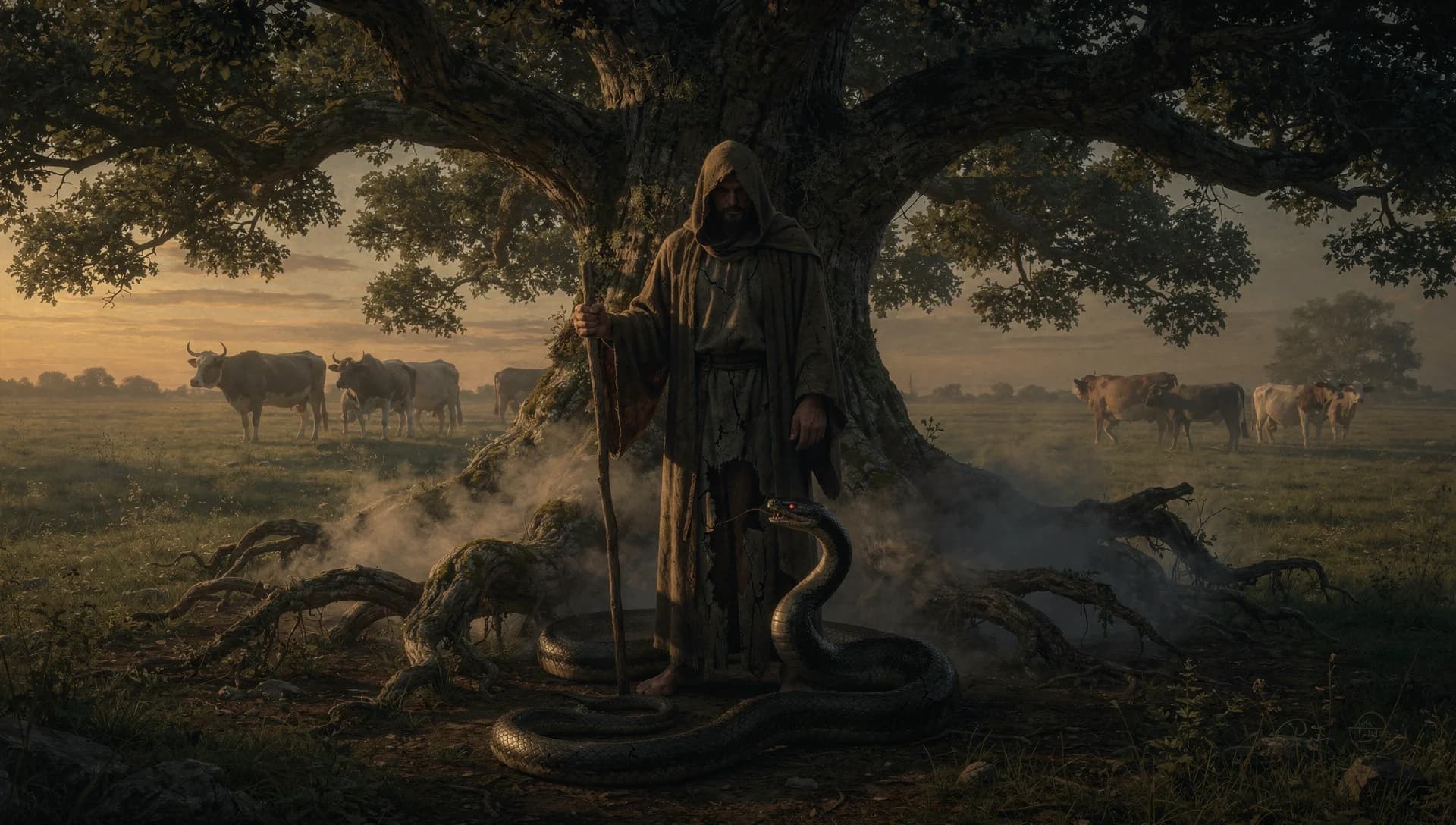
Veles, Slavic god of cattle, wisdom, and the underworld
 UB
UBNodite cultural memory preserved in the Russian and Turkestan reservoir
Full Article
Read the deep-dive article on this connection
Nodite cultural memory preserved in the Russian and Turkestan reservoir = Veles, Slavic god of cattle, wisdom, and the underworld
The Connection
The UB records that the lands of Russia and Turkestan were held by "a great reservoir of the Adamites mixed with Nodites, Andonites, and red and yellow Sangiks" before the Andite expansions. The Nodite stream carried the memory of the rebel faction of the Prince's staff: longer-lived, knowledge-bearing, associated with cattle, fertility, and the mysteries of what lay beneath the world. Veles is the Slavic god of cattle, poetry, hidden knowledge, and the subterranean dead, the dark counterpart of Perun. The split-pantheon structure (a sky warrior against a chthonic wisdom figure) mirrors the Van / Nod split at its root.
UB Citation
UB 78:3.5, 67:4.1-3
Academic Source
Ivanov & Toporov, Slavic Antiquities (1974); Jakobson, "Slavic Gods" (1949)
Historical Evidence(Moderate evidence)
Roman Jakobson identified Veles (Volos) as an Indo-European chthonic deity whose name is cognate with Vedic Vala and Hittite wellu-, "meadow of the dead." Ivanov and Toporov's Slavic Antiquities frames the Perun-Veles opposition as the central organizing myth of pre-Christian Slavic religion. The pattern of a bright sky-warrior set against a shadowy underworld figure associated with wealth and knowledge is the same structural opposition the UB describes between Van and Nod, and between Enki and Enlil in the Sumerian layer.
Deep Dive
Across pre-Christian Slavic religion runs a structural opposition that anchors the entire mythological system. On one side stands Perun, the bright sky-warrior, patron of warriors and oaths, wielder of the thunder-axe. On the other side stands Veles, the shadowy chthonic figure, patron of cattle, poetry, hidden wealth, and the dead. The two are perpetually in conflict. Perun chases Veles across the heavens. Veles steals cattle and hides them in the underworld. The seasonal cycles, the moral structure, and the ritual calendar all reflect this primordial opposition.
Roman Jakobson's 1949 article on Slavic gods identified the Perun-Veles structure as the central organizing principle of pre-Christian Slavic religion. Vyacheslav Ivanov and Vladimir Toporov's Slavic Antiquities (1974) extended this analysis, treating the Perun-Veles opposition as the Slavic reflex of the broader Indo-European thunder-god / serpent-figure structural pattern. The same opposition appears in Vedic religion (Indra vs. Vritra), Hittite religion (Tarhunt vs. Illuyanka), Greek religion (Zeus vs. Typhon), and Norse religion (Thor vs. Jormungandr).
The UB framework recognizes this widespread structural opposition as a real historical pattern, not just a mythological abstraction. The Lucifer rebellion produced a fundamental split in the Prince's corporeal staff: forty members remained loyal under Van's leadership, sixty defected with Caligastia, Daligastia, and Nod (UB 67:4.1). The two factions diverged sharply in character. The loyal faction emphasized worship of the unseen Father, ethical teaching, and obedience to universe authority. The rebel faction emphasized self-determination, immediate material rewards, and dramatic worldly accomplishment.
The post-rebellion descendants of the two factions retained these characteristic divergences. Van's descendants and disciples preserved the older teaching of one God, ethical obligation, and patient ascension. The Nodite descendants developed a more pragmatic, materialistic, often power-oriented culture, with strong emphasis on technology, trade, and political organization (UB 77:2 describes the Nodite cultural profile). The two streams existed in perpetual cultural tension across hundreds of thousands of years of post-rebellion history.
Veles, the chthonic Slavic deity, fits the Nodite cultural profile with surprising precision. He is the patron of cattle (the primary form of Nodite wealth in pastoral economies), poetry and hidden knowledge (preserving the technical-cultural inheritance the Nodites carried from the Prince's staff), and the underworld (the residence-of-the-dead, where cultural memory and ancestral wealth accumulate). The Slavic Veles is not a generic underworld god; he is a specific configuration of underworld-wealth-knowledge-cattle that matches the post-rebellion Nodite cultural profile far more closely than any generic chthonic-deity template would predict.
Perun, by contrast, fits the Vannic-loyal profile. He is the patron of warriors who defend the community, of oaths and contracts (the formal ethical-legal structures of organized society), of sky and thunder (the realm of the unseen Father whose authority Van's faction had defended). His opposition to Veles reflects the structural opposition between the loyal and rebel streams of Prince's-staff descent.
UB 78:3.5 places this Slavic substrate in geographic context: "The lands now called Russia and Turkestan were occupied throughout their southern stretches by a great reservoir of the Adamites mixed with Nodites, Andonites, and red and yellow Sangiks." The Slavic territories were a meeting-zone where multiple post-rebellion streams converged. The Perun-Veles opposition emerged within this convergence as the cultural memory of the broader split between loyal and rebel post-rebellion descent.
The structural parallel extends through other Indo-European traditions. The Sumerian Enki-Enlil opposition, with Enki as the wisdom-water-craft figure and Enlil as the sky-storm-administrative figure, preserves a similar split. The Norse Loki-Thor relationship, with Loki as the trickster-craftsman-shapeshifter and Thor as the thunder-warrior, preserves another version. Each Indo-European tradition has its own variant, but the underlying split-pantheon structure is consistent.
The strongest counterargument is the standard structuralist response: humans naturally produce mythological pairs in oppositional configuration, and the appearance of the pattern across many cultures reflects universal cognitive architecture rather than common historical descent. This is a coherent reading. It is also a reading that does not explain the specific consistency of the elements paired (always thunder vs. underworld-cattle-knowledge, never random other oppositions). The UB framework offers a specific historical reason for the consistency: a real historical split in the original superhuman teaching tradition, with the two streams preserving distinctive cultural profiles that recur recognizably across Indo-European cultures.
Key Quotes
“When the final roll was called, the corporeal members of the Prince's staff were found to have aligned themselves as follows: Van and his entire court of co-ordination had remained loyal. ... Nod and all of the commission on industry and trade joined Caligastia. ... Thus were forty out of the one hundred saved.”
“As the period of the early Adamic migrations ended, about 15,000 B.C., there were already more descendants of Adam in Europe and central Asia than anywhere else in the world, even than in Mesopotamia. The European blue races had been largely infiltrated. The lands now called Russia and Turkestan were occupied throughout their southern stretches by a great reservoir of the Adamites mixed with Nodites, Andonites, and red and yellow Sangiks.”
Cultural Impact
The structural opposition between bright sky-warrior and shadowy underworld figure has shaped pre-Christian Slavic religion, and through it Slavic folk culture, into the modern era. The Perun-Veles dichotomy survives in folk songs, in seasonal festivals, in the patterns of saint-veneration that Christianity overlaid on the older structure (St. Elijah absorbing Perun functions, St. Vlasi or St. Nicholas absorbing Veles functions in different regional variants). The UB framework treats this enduring structural opposition not as abstract mythological pattern but as the cultural memory of a real historical split. This reframing has practical implications for how we read the Slavic religious heritage. The opposition is not arbitrary; it preserves the memory of a specific divergence in superhuman teaching that occurred at the very beginning of organized human civilization. For Slavic-heritage readers, this framework offers a way to engage with the pre-Christian tradition that does not require choosing between dismissing it as primitive paganism (the conservative Christian response) or romanticizing it as authentic ancestral wisdom (the new-pagan response). The tradition preserves real historical memory of a split that affected the entire course of planetary religious history. It deserves to be read as such.
Modern Resonance
In contemporary Slavic neo-pagan movements, the Perun-Veles opposition is often interpreted in straightforwardly dualistic terms: light vs. dark, sky vs. earth, masculine vs. feminine. These readings have a long history but tend to flatten the more complex original structure. The UB framework offers a more nuanced reading. The opposition is not light vs. dark in any moral-cosmological sense; both Perun and Veles preserve genuine cultural memory and both have legitimate functions within the cosmic order. The opposition reflects two divergent ways of organizing post-rebellion human culture: the warrior-loyal-oath stream and the chthonic-wealth-knowledge stream. Both streams have value. Both preserve elements of the original Prince's-staff teaching. The opposition between them is not absolute moral conflict but the structural tension that persists in human cultures wherever the post-rebellion split has left its imprint. For contemporary readers, this reading offers a way to honor the structural complexity of pre-Christian religion without flattening it into easy dualisms. The Slavic Perun-Veles opposition is a cultural artifact of real historical depth, not a simple light-vs-dark mythology. Engaging with it on its own terms requires the kind of disciplined historical reading that the UB framework supplies.
Related Mappings
Andite cavalry commanders crossing the Russian plains (~5000 BC)
= Perun, Slavic sky-and-thunder god with a hammer or axe
Universal pre-Christian cult of the Tree of Life (UB 85:2.4)
= Slavic "world tree" traditions; the sacred oak of Perun
Salem missionaries reaching "all Europe, even to the British Isles"
= Rod / Svarog, pre-Slavic creator high-god marginalized by later pantheon
Van, the loyal wise counselor remembered in craftsman-hero traditions
= Ilmarinen, the eternal smith of the Finnish Kalevala
Related Articles
Where to next
The free newsletter. The research behind each piece, no spam.