
 Mythic
Rod / Svarog, pre-Slavic creator high-god marginalized by later pantheon
 UB
UBSalem missionaries reaching "all Europe, even to the British Isles"
Full Article
Read the deep-dive article on this connection
Salem missionaries reaching "all Europe, even to the British Isles" = Rod / Svarog, pre-Slavic creator high-god marginalized by later pantheon
The Connection
The UB states that after Machiventa's incarnation, Salem missionaries "penetrated all Europe," carrying the teaching of one God to peoples who previously had only tribal gods. Rod, the oldest named Slavic deity, appears in the earliest Slavic sources as a primordial creator, then fades from worship as the warrior and agricultural gods take center stage. Svarog plays the same role: an older "heavenly father" who recedes behind his sons. The Salem pattern appears repeatedly across Indo-European religions: a monotheistic layer once present, slowly overlaid by polytheism.
UB Citation
UB 93:7.2, 94:0.1
Academic Source
Vasmer, Russisches etymologisches Wörterbuch (1950); Rybakov, Paganism of the Ancient Slavs (1981)
Historical Evidence(Suggestive evidence)
Boris Rybakov argued that Rod represented an early "monolithic" Slavic concept of divinity that predated the polytheistic pantheon and was progressively fragmented into the later gods. The Russian Primary Chronicle and 12th-century Christian polemics against Rod worship suggest his cult survived longest among peasant populations least touched by princely religion. This fits the Salem pattern: a monotheistic seed planted into a polytheistic field, surviving as an old-layer "creator" before being replaced by more immediate tribal deities.
Deep Dive
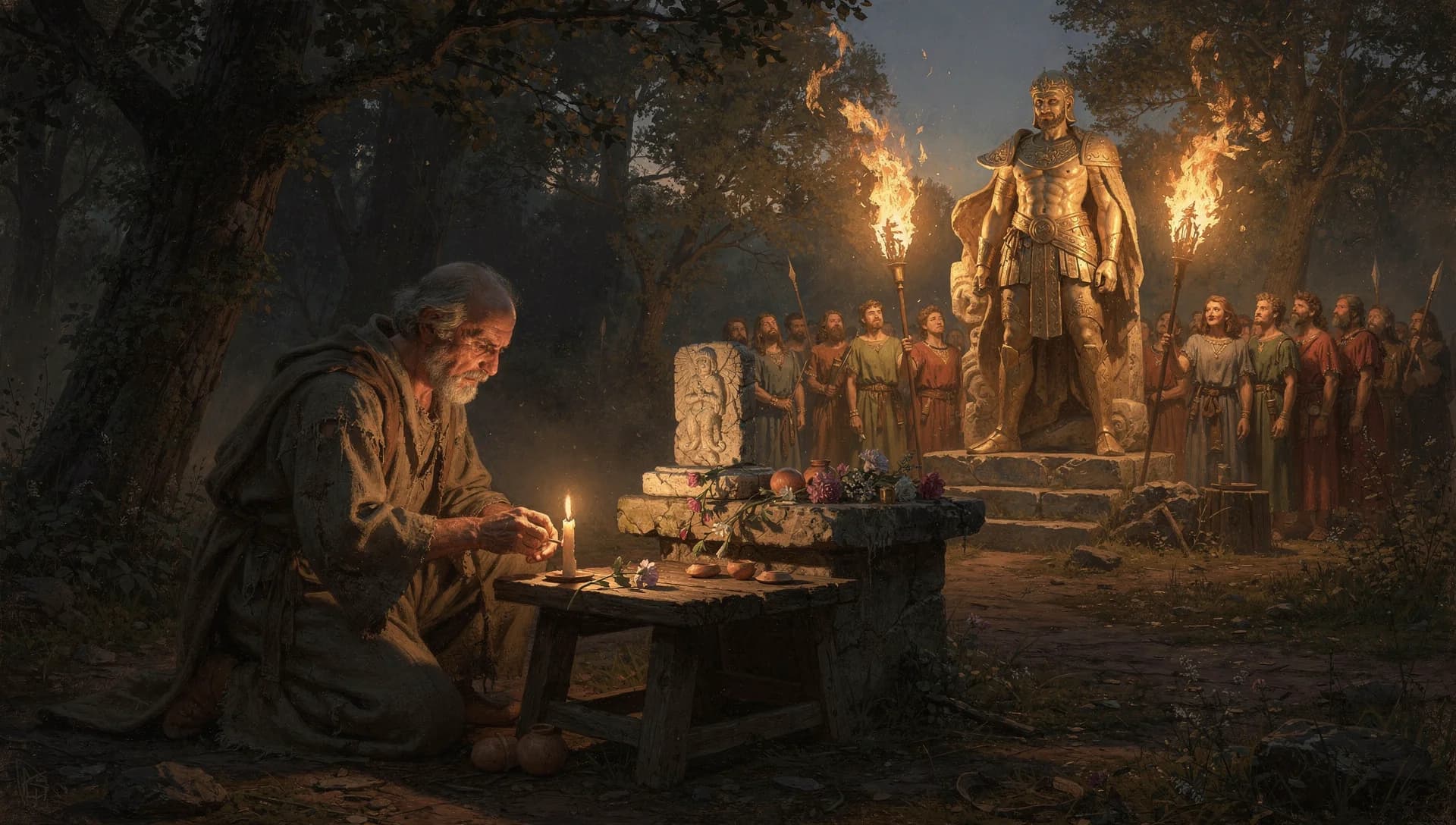
Buried in the early Slavic textual record, beneath the more visible warriors and weather-gods, lies a curious figure named Rod. He is the oldest named Slavic deity. He is described in the early sources as a creator and as the source of all life. He receives offerings of bread and cheese, the primal foods of agricultural life. He is associated with female ancestral spirits called the Rozhanitsy, who attend childbirth and assign destiny. And then, somewhere in the historical transition from primary creator to fragmented pantheon, he fades.
By the time Vladimir of Kiev establishes his hilltop pantheon in 980 CE, Rod is no longer a major figure in princely religion. Perun, Veles, Mokosh, Dazhbog, Stribog, and Khors dominate the official cult. Rod survives in folk practice, particularly among rural peasant populations, and twelfth-century Christian polemics against rural superstition specifically target Rod-and-Rozhanitsy veneration as a persistent pagan survival. The pattern is clear: an older, more universal creator-figure recedes behind a more specialized warrior-and-trade pantheon as Slavic society becomes more politically organized.
Boris Rybakov's Paganism of the Ancient Slavs (1981) made the strongest scholarly case for Rod as an early Slavic creator-deity who predated the developed polytheistic pantheon. Rybakov argued that Rod represented a "monolithic" earlier conception of divinity that was progressively fragmented as Slavic society became more stratified and the religious system became more complex. The fragmentation produced the developed pantheon with its specialized functions; Rod survived as the older, less specialized substrate.
Svarog plays a similar role in some sources. He is described as a heavenly father associated with smithing and the celestial fire. His son Svarozhich is sometimes identified as the actual sun god, with Svarog himself receding into the older creator role. The pattern of "older heavenly father whose more active sons take center stage" is widespread in Indo-European religion and may represent the same underlying phenomenon.
The UB framework treats this pattern as the residue of Salem missionary teaching. UB 93:7.2 places Salem missionaries in northern Europe directly: "Salem missionaries penetrated all Europe, even to the British Isles." The Slavic territories were within the missionary reach, and the Salem teaching of one God would have entered the cultural substrate during the second millennium BCE through Adamic, Andite, and Salem-missionary transmissions.
The pattern of Salem-teaching reception that the UB describes elsewhere fits the Rod / Svarog phenomenon precisely. UB 93:7 and 94 describe the recurring pattern: Salem missionaries arrived with a teaching of one universal Creator-God who could be approached by faith. The teaching was initially received with enthusiasm but tended to be progressively diluted as it encountered established polytheistic traditions. The original monotheistic core often survived as an upper-layer creator-figure who became progressively remote from active religious practice, while more accessible specialized deities took over the immediate religious functions.
This is exactly the Rod / Svarog pattern. An older creator-figure exists in the substrate. He is the original recipient of the Salem-teaching imprint. Over centuries, as the teaching is absorbed into the surrounding polytheism, the creator-figure becomes increasingly remote and his functions are progressively absorbed by more specialized gods. By the time of historical attestation, the creator-figure is recognizable only as a residual fact in folk tradition, surviving most strongly among populations least exposed to the elite religious institutions.
The same pattern appears across many traditions the UB analyzes. The Hindu Brahman is increasingly remote behind the active Vishnu, Shiva, and Devi cults. The Chinese Shang Di / Tian recedes behind the Confucian-bureaucratic pantheon. The African high gods (Olodumare, Nyame, Mulungu) recede behind ancestral spirits and intermediaries. In each case, the UB identifies the residual creator-figure as the cultural memory of original Salem-monotheistic teaching, progressively diluted but never fully erased.
The strongest counterargument is that the Rod / Svarog pattern can be explained without Salem-missionary appeal. Mainstream historical-religion scholarship treats the pattern as a natural development within the structural dynamics of polytheistic systems: older creator-figures naturally recede as more active specialized gods emerge, regardless of the historical origin of the system. This is a coherent reading. But it does not explain why so many Indo-European and other traditions show the specific pattern of "older creator-figure with universal-monotheistic features receding behind specialized polytheism." The repetition across cultures suggests a common cause, and the UB Salem-missionary framework provides one candidate for what that common cause might be.
Key Quotes
“Salem missionaries penetrated all Europe, even to the British Isles.”
“THE early teachers of the Salem religion penetrated to the remotest tribes of Africa and Eurasia, ever preaching Machiventa's gospel of man's faith and trust in the one universal God as the only price of obtaining divine favor.”
Cultural Impact
The recovery of Rod as a major figure in pre-Christian Slavic religion has been a significant project of post-Soviet scholarship. Soviet-era materialist constraints discouraged engagement with the more theologically loaded aspects of Slavic paganism, but the post-1990 period has seen extensive reconstruction work. Rybakov's earlier framework has been extended and refined by later scholars working with greater interpretive freedom. The contemporary Slavic Native Faith movements (Rodnovery in Russian, Slavic Native Faith in English-language sources) have made Rod a central theological figure, often interpreting him as the supreme creator from whom the developed pantheon derives. This interpretation is consistent with both Rybakov's scholarly reconstruction and the UB Salem-missionary framework, though the Native Faith movements typically do not engage with the latter. The cultural impact of recovering Rod as a major figure is significant. It reframes pre-Christian Slavic religion as having a genuine creator-God tradition, not just an inarticulate polytheism. This reframing has practical consequences for how Slavic-heritage Christians can engage with their pre-Christian heritage: it is not a complete rupture from monotheistic theology but a partial preservation of an earlier monotheistic teaching that the surrounding polytheism progressively obscured.
Modern Resonance
In the contemporary religious landscape of Eastern Europe, the Rod tradition has become one node in a complex conversation about national identity, religious heritage, and the relationship between Christianity and pre-Christian traditions. Russian Orthodox conservatives often dismiss Rodnovery as a fringe revival of paganism. Russian Orthodox liberals sometimes engage with it more sympathetically as a recovery of authentic ancestral heritage. Ukrainian Orthodox traditions have their own variants of these debates. The UB framework offers a way to navigate these debates that neither dismisses Rod nor weaponizes him. Rod represents the cultural memory of a real Salem-missionary teaching that reached the Slavic territories during the second millennium BCE. This teaching was not Christian in any explicit sense, but it shared with later Christianity the recognition of one universal Creator-God who could be approached by faith. The historical relationship between Rod-veneration and later Christian monotheism is one of partial-continuity rather than radical rupture. For contemporary readers, this framework offers a way to honor the Rod tradition as preserving genuine religious memory without making it into a banner for anti-Christian cultural politics. The tradition belongs to the deep history of Slavic spiritual life, and the deep history includes both the Rod-stratum and the later Christian developments. Both are part of the genuine inheritance.
Related Mappings
Andite cavalry commanders crossing the Russian plains (~5000 BC)
= Perun, Slavic sky-and-thunder god with a hammer or axe
Nodite cultural memory preserved in the Russian and Turkestan reservoir
= Veles, Slavic god of cattle, wisdom, and the underworld
Universal pre-Christian cult of the Tree of Life (UB 85:2.4)
= Slavic "world tree" traditions; the sacred oak of Perun
Van, the loyal wise counselor remembered in craftsman-hero traditions
= Ilmarinen, the eternal smith of the Finnish Kalevala
Related Articles
Where to next
The free newsletter. The research behind each piece, no spam.