
 Mythic
Perun, Slavic sky-and-thunder god with a hammer or axe
 UB
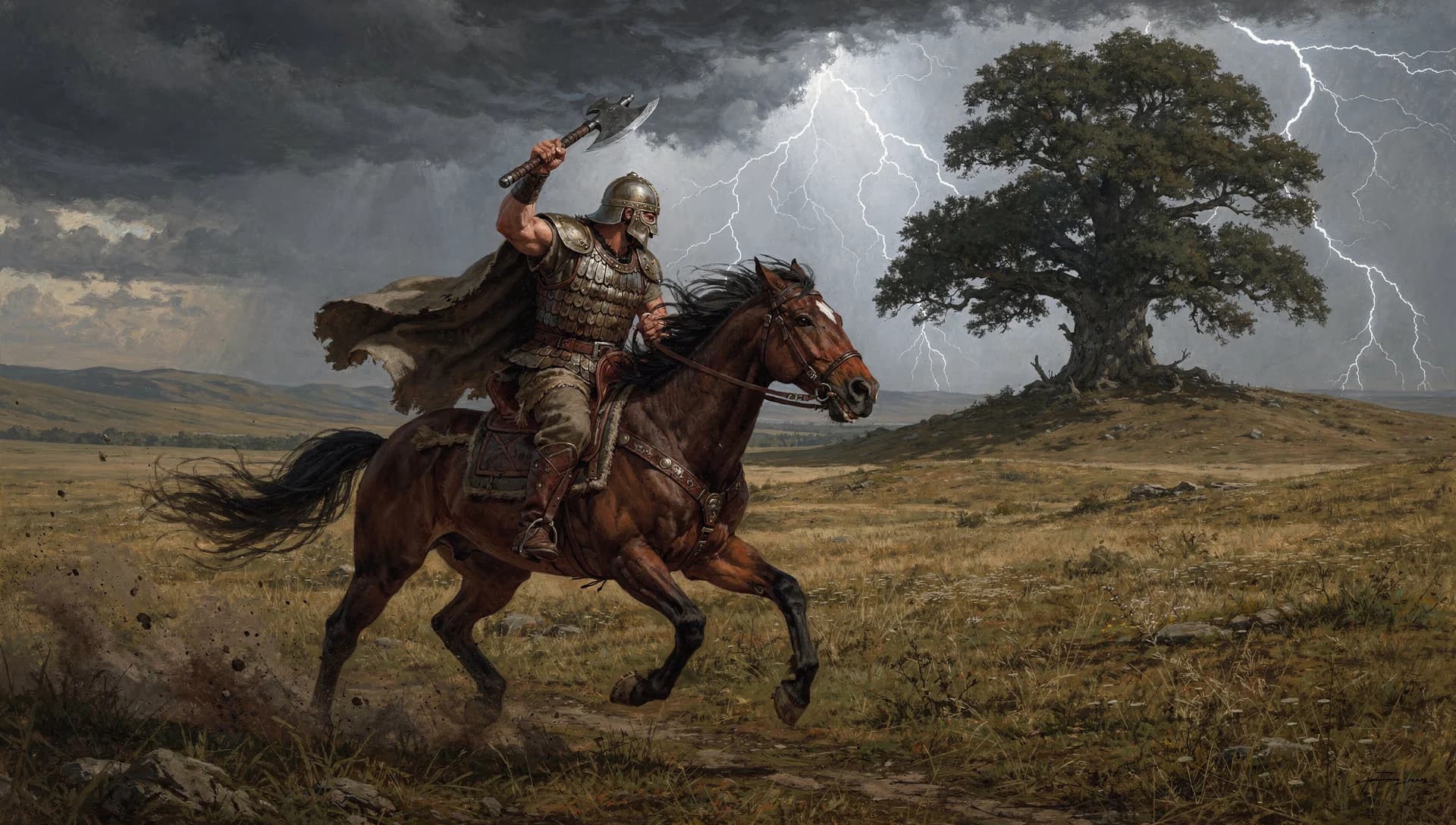
UBAndite cavalry commanders crossing the Russian plains (~5000 BC)
Full Article
Read the deep-dive article on this connection
Andite cavalry commanders crossing the Russian plains (~5000 BC) = Perun, Slavic sky-and-thunder god with a hammer or axe
The Connection
The UB states explicitly that the hard-riding Andite horsemen "moved westward across the Russian plains, absorbing the best of the blue man and exterminating the worst" between 6000 and 5000 BCE, and that Thor, "the victorious commander of the armies of the north," was "later revered as a god." Perun, the Slavic and Baltic sky-warrior who wields a hammer or thunder-axe from horseback, sits in the same Indo-European lineage. If Thor is a historical Andite commander remembered as a god, the structurally identical thunder-rider of the Slavs is a plausible cousin memory of the same migration stream.
UB Citation
UB 80:4.5, 80:5.4
Academic Source
Ivanov & Toporov, Issledovaniya v oblasti slavyanskikh drevnostey (1974); Gimbutas, The Balts (1963)
Historical Evidence(Moderate evidence)
Vyacheslav Ivanov and Vladimir Toporov reconstructed the "Basic Slavic Myth" in which Perun, the sky-god, battles Veles from a chariot drawn through the heavens, a structural twin of the Vedic Indra and the Norse Thor. Marija Gimbutas documented the Baltic Perkūnas, the Lithuanian cognate, as an Indo-European thunder-god arriving from the east. The Andite invasion corridor the UB identifies (Volga, Don, Russian plains) is the same corridor historical linguistics identifies for the spread of the Indo-European thunder-god myth.
Deep Dive
In 980 CE, the prince Vladimir of Kiev, before his conversion to Christianity nine years later, established an open-air pantheon on a hill above the Dnieper River. The chief idol was Perun, with a silver head and a golden mustache. Perun was the Slavic sky-and-thunder god, wielder of an axe or hammer, patron of warriors and oaths, the figure to whom Russian princes swore on the eve of battle. Vladimir's Perun was the apex of a long Slavic religious tradition that the Russian Primary Chronicle preserves in fragments.
Perun did not arise in isolation. He sits at one node of a vast Indo-European thunder-god network. The Vedic Indra, the Norse Thor, the Greek Zeus, the Hittite Teshub, the Lithuanian Perkūnas, and the Celtic Taranis are all manifestations of the same underlying figure: a sky-warrior wielding a thunder-weapon, riding a celestial chariot or horse, fighting cosmic enemies, providing rain to fertilize the earth. The structural consistency across Indo-European cultures led Vyacheslav Ivanov and Vladimir Toporov to reconstruct what they called the "Basic Slavic Myth" or, more broadly, the "Basic Indo-European Myth": the thunder-god's combat with a chthonic serpent figure, often associated with cattle, water, or the underworld.
The mainstream historical-linguistic account treats this network as evidence of a Proto-Indo-European religious heritage, with the thunder-god figure inherited from a Proto-Indo-European cultural matrix located in the Pontic-Caspian steppe (Marija Gimbutas' kurgan hypothesis) or in Anatolia (Colin Renfrew's Anatolian hypothesis). Whichever geographic origin one favors, the spread of the thunder-god across Eurasia is treated as a major component of the Indo-European linguistic and cultural diffusion.
The UB framework intersects this account in an interesting way. UB 80:5.4 identifies Thor specifically: "Thor, the victorious commander of the armies of the north in the final battle of the Somme, became the hero of the northern white tribes and later on was revered as a god by some of them." The UB does not claim Thor was originally a god; it claims Thor was a historical Andite military commander who won a decisive battle and was later apotheosized. UB 80:4.5 places this commander within the broader Andite cavalry expansion: "the hard-riding Andite horsemen made their appearance in the sixth and seventh millenniums before Christ. As they moved westward across the Russian plains, absorbing the best of the blue man and exterminating the worst, they became blended into one people."
If Thor was a historical Andite commander, the structural twin gods of the Indo-European thunder-network may also be historical figures. Perun, the Slavic counterpart, is structurally identical to Thor: same hammer or axe, same association with sky and thunder, same role as patron of warriors. The UB framework would suggest Perun, like Thor, descends from a historical Andite cavalry commander whose memory was apotheosized within the Slavic tradition.
The geographic correlation is striking. The UB places the Andite cavalry expansion across "the Russian plains" exactly the same corridor through which historical linguistics traces the Indo-European spread. The Volga and Don river valleys, the Pontic-Caspian steppe region, and the Carpathian foothills are the territory where both the UB-described Andite expansion and the historically-attested Indo-European spread occurred. The two accounts describe the same geographic phenomenon from different angles: the UB describes the named individuals (Thor, by implication Perun and others) and the linguistic-cultural account describes the broader pattern.
Boris Rybakov's Paganism of the Ancient Slavs (1981) traces Perun back through earlier Slavic religious strata to a pre-Christian Indo-European inheritance. Roman Jakobson's 1949 article on Slavic gods identified the Perun-Veles opposition as the central organizing structure of pre-Christian Slavic religion. Marija Gimbutas' work on the Baltic Perkūnas, the closest cognate, established the linguistic descent of the name from a Proto-Indo-European root meaning roughly "to strike."
The strongest counterargument to the Andite-Perun connection is that we cannot directly identify a specific historical commander. Thor is named in the UB, Perun is not. The Andite-Perun connection is thus an extension of the UB framework to a figure the UB does not specifically discuss, based on structural analogy with Thor. This is a real limitation. The defense is that the structural analogy is exact, the geographic correlation is precise, and the chronological window matches. Within the UB framework, treating Perun as a historical Andite commander follows necessarily from the established treatment of Thor.
The cumulative effect is to dignify pre-Christian Slavic religion as preserving genuine historical memory rather than abstract sky-worship. Perun was not just a thunder-symbol; he was the cultural memory of a specific historical figure who arrived from the east, won battles, organized peoples, and was remembered for centuries.
Key Quotes
“The whole inhabited world, outside of China and the Euphrates region, had made very limited cultural progress for ten thousand years when the hard-riding Andite horsemen made their appearance in the sixth and seventh millenniums before Christ. As they moved westward across the Russian plains, absorbing the best of the blue man and exterminating the worst, they became blended into one people.”
“Thor, the victorious commander of the armies of the north in the final battle of the Somme, became the hero of the northern white tribes and later on was revered as a god by some of them.”
Cultural Impact
Slavic paganism was suppressed but not eliminated by Christianization in the tenth and eleventh centuries. Perun-worship persisted in folk traditions across Russia, Ukraine, Belarus, Poland, and the Balkans well into the modern era, often masked under saint-veneration (St. Elijah absorbed many Perun functions in Russian Orthodox tradition). The dvoeverie ("dual faith") phenomenon, well documented by Linda Ivanits in Russian Folk Belief (1989), preserved Perun, Veles, and other figures within ostensibly Christian observance. The UB framework adds historical depth to this preserved tradition. Perun was not merely a fading pagan god being absorbed into Christian iconography; he was the cultural memory of a real historical figure whose feat of organizing the Slavic territories had been preserved across millennia. The persistence of Perun-veneration in folk tradition was the persistence of historical memory rather than mere superstition. For contemporary Slavic neo-pagan movements (the Rodnovery tradition is particularly active in Russia and Ukraine), the UB framework offers a different way to think about what the revival is reconstructing. It is not just abstract pre-Christian sky-worship but the cultural memory of specific historical Andite-era events that shaped Slavic identity. This framing connects the religious revival to genuine historical memory rather than treating it as ahistorical mysticism.
Modern Resonance
Russian and Ukrainian cultural identity have been bitterly contested over the past three years, with the war reshaping how both societies relate to their pre-Christian heritage. The Perun figure has been mobilized by various political-religious factions on both sides of the conflict, with Russian Rodnovery using Perun as a symbol of warrior-strength and Ukrainian neo-pagans using Perun as a symbol of Ukrainian distinctiveness from Russian Orthodox identity. The UB framework offers a way to think about Perun that does not align with either of these political mobilizations. Perun is the cultural memory of a real Andite-era commander whose work organized the broader Slavic-Russian territories before the divisions of the modern era existed. He belongs to all the Slavic peoples equally, as a figure of their shared deep history rather than as a partisan symbol. This framing has practical importance in an era when religious symbols are weaponized for political purposes. Recovering the historical depth of Perun, treating him as the memory of a specific Andite-era figure rather than as a generic warrior-symbol, restores a measure of dignity to the original tradition that political mobilization tends to erode. The UB framework does this not by denying the contemporary political significance but by anchoring the figure in a deeper historical reality that the contemporary political uses cannot fully control.
Related Mappings
Nodite cultural memory preserved in the Russian and Turkestan reservoir
= Veles, Slavic god of cattle, wisdom, and the underworld
Universal pre-Christian cult of the Tree of Life (UB 85:2.4)
= Slavic "world tree" traditions; the sacred oak of Perun
Salem missionaries reaching "all Europe, even to the British Isles"
= Rod / Svarog, pre-Slavic creator high-god marginalized by later pantheon
Van, the loyal wise counselor remembered in craftsman-hero traditions
= Ilmarinen, the eternal smith of the Finnish Kalevala
Related Articles
Where to next
The free newsletter. The research behind each piece, no spam.