
 Mythic
Slavic "world tree" traditions; the sacred oak of Perun
 UB
UBUniversal pre-Christian cult of the Tree of Life (UB 85:2.4)
Full Article
Read the deep-dive article on this connection
Universal pre-Christian cult of the Tree of Life (UB 85:2.4) = Slavic "world tree" traditions; the sacred oak of Perun
The Connection
The UB says directly that "there once existed a universal cult of the tree of life" across all human religions except China, and specifically names "the inhabitants of India and eastern Russia" as people who preserved tree veneration. Pre-Christian Slavic religion is built around sacred groves and a cosmic world-tree, with Perun's oak as its central liturgical focus. The Slavic tree cult is a direct reflex of the older universal tradition the UB anchors in Van's 150,000-year stewardship of the Tree of Life.
UB Citation
UB 85:2.4, 66:4.13, 73:6
Academic Source
Ivakhiv, "Nature and Ethnicity in East European Paganism" (2005); Gimbutas, The Slavs (1971)
Historical Evidence(Moderate evidence)
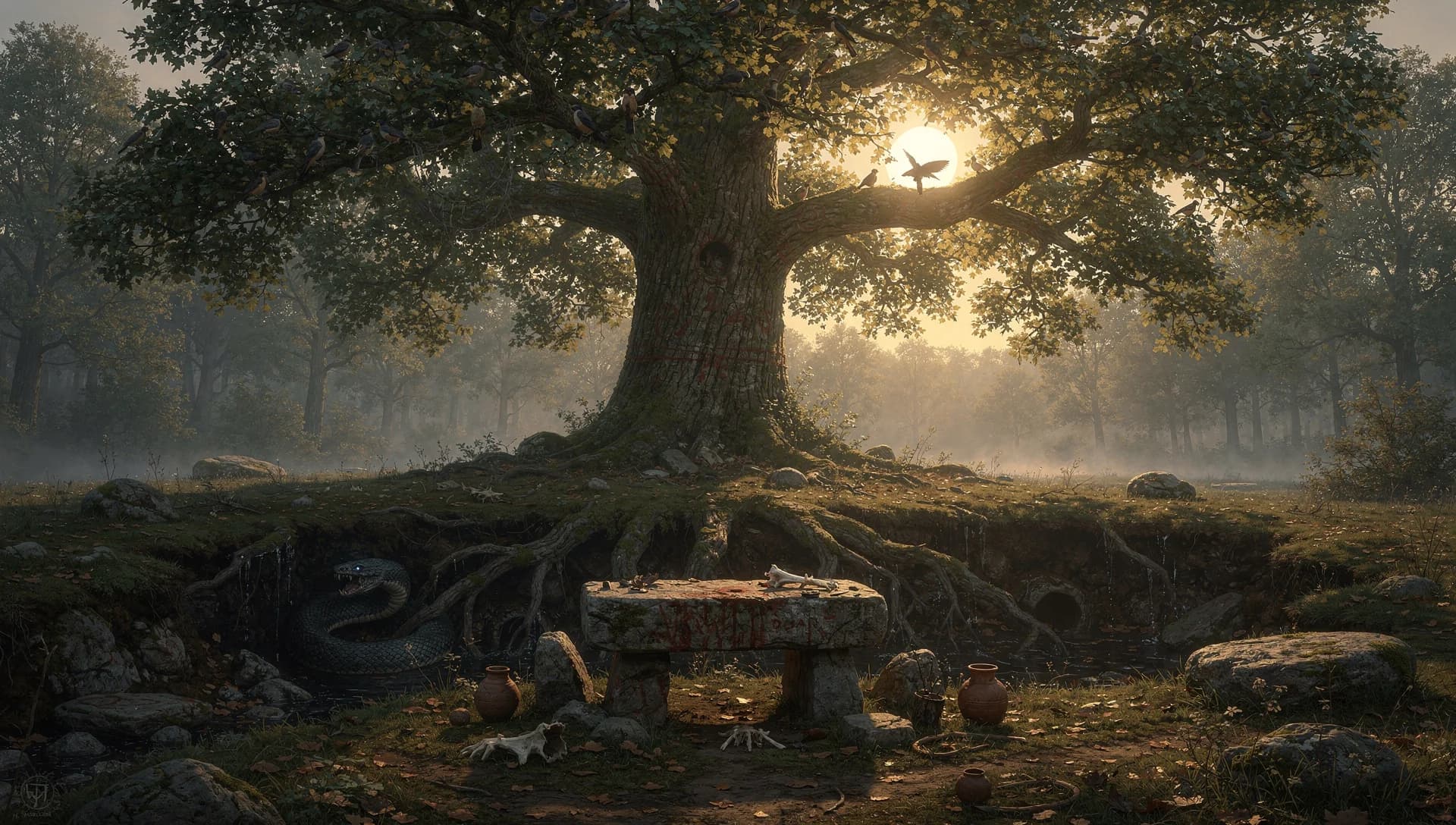
Marija Gimbutas documented the sacred oak as the ritual center of pre-Christian Slavic worship, with Perun described as "he who dwells in the oak." Russian folkloric tradition preserves the Dub, the primordial world-tree at the center of the cosmos, with a serpent coiled at its roots and a falcon in its branches. The three-level world tree (underworld roots, middle-world trunk, heavenly crown) matches the Assyrian Sacred Tree iconography that the UB connects to Van and the Tree of Life in the Sumerian section.
Deep Dive
In Russian folk tradition, the Dub stands at the center of the cosmos. It is the great oak whose roots reach down into the underworld, whose trunk supports the middle realm where humans live, and whose crown rises into the heavens where the gods dwell. A serpent coils at its roots. A falcon perches in its branches. The Dub is the axis of the world, the place where the three cosmic realms meet, the central pillar of pre-Christian Slavic cosmology.
The Dub is one of the clearest examples of the universal cosmic-tree pattern that UB 85:2.4 identifies: "Except in China, there once existed a universal cult of the *tree of life.*" The Slavic Dub fits the pattern with three-element precision: bird in the crown, serpent at the roots, divine or royal figure at the trunk (Perun, in the Slavic case, was described in folk tradition as "he who dwells in the oak"). The same three-element structure appears in the Norse Yggdrasil, the Sumerian huluppu, the Maya Yaxche, and the Assyrian Sacred Tree.
Pre-Christian Slavic religious practice centered on sacred groves, called gaj or kapishche depending on regional variant. These were enclosed areas of forest where rituals were performed, oaths were sworn, and offerings were made. The central feature of the grove was usually a single great oak, often centuries old, often marked by visible scars from lightning strikes (interpreted as Perun's touch). Marija Gimbutas' work on Slavic religion documented the grove-cult pattern across the Slavic territories, from the Baltic to the Balkans.
The Russian Primary Chronicle, written in the early twelfth century, preserves multiple references to oak-veneration as the central practice of pre-Christian Slavic religion. The chronicle records ritual oak-felling as part of the Christianization process: when the Orthodox church established its authority over a region, the sacred oaks were cut down as a public symbolic statement that the old religion had been superseded. The persistence of folk-tradition references to the Dub long after these official suppressions indicates how deeply the cult had penetrated popular religious consciousness.
The UB framework places this Slavic oak-cult within the universal Tree of Life tradition. The original Tree of Life was a real botanical entity at Dalamatia, transferred to the first Garden by Van, lost when the Garden submerged. The cultural memory of the tree spread outward with the post-rebellion populations. As the memory reached the Slavic territories through Adamic, Andite, and Salem-missionary transmissions, it attached to the most impressive and enduring tree native to the region, the oak. The Slavic Dub is the oak-instantiation of the underlying Tree of Life memory.
The specific three-element structure (bird in crown, serpent at roots) preserves the original iconography with remarkable fidelity. The serpent at the roots is the cultural memory of the Caligastia rebellion attempting to corrupt the tree, an episode preserved in iconographically related form in Genesis 3 (the serpent in the Garden) and the Sumerian Adapa narrative. The bird in the crown is the cultural memory of seraphic ministry attending the tree. The divine figure at the trunk (Perun in Slavic, the king at Palenque, Odin at Yggdrasil) is the cultural memory of the custodial superhuman figure who guarded the tree.
Boris Rybakov's Paganism of the Ancient Slavs (1981) documents the Dub tradition with extensive ethnographic and folkloric evidence. Rybakov was working within Soviet-era materialist constraints that made him reluctant to engage with universalist comparative-religion claims, but his collected evidence is robust and supports the underlying pattern. Adrian Ivakhiv's "Nature and Ethnicity in East European Paganism" (2005) updated the analysis with attention to the contemporary neo-pagan revival.
The strongest counterargument is the standard environmental-determinist response: oak-veneration is a natural response to the actual ecological dominance of oak forests in Slavic territories, requiring no Tree of Life memory to explain it. This is partially true. Oak forests were indeed ecologically central to the Slavic territories, and any folk tradition emerging in this environment would naturally focus on oak. But the specific three-element iconographic structure (serpent-roots, bird-crown, divine-trunk) is not predicted by environmental determinism. It is predicted by Tree of Life cultural-memory diffusion. The structural specificity is what distinguishes the universal-Tree-of-Life reading from the merely-ecological reading.
Key Quotes
“Except in China, there once existed a universal cult of the tree of life.”
“These antidotal complements of the Satania life currents were derived from the fruit of the tree of life, a shrub of Edentia which was sent to Urantia by the Most Highs of Norlatiadek at the time of Caligastia's arrival. In the days of Dalamatia this tree grew in the central courtyard of the temple of the unseen Father.”
Cultural Impact
The Slavic oak-cult left a deep imprint on the cultural and physical landscape of Eastern Europe. Even after Christianization, sacred groves persisted as ritual sites, often with specific oak trees venerated by local populations. The Stelmuze Oak in Lithuania, the Granit Oak in Bulgaria, the Tsar-Dub in Russia, and similar specimens across the Slavic territories are still cultural landmarks today, treated with a residual reverence that exceeds standard heritage-tree status. The UB framework offers a deeper reading of these venerated trees. They are not just impressive specimens of botanical heritage; they are the latest iterations of an oak-veneration tradition that ultimately descends from cultural memory of the original Tree of Life at Dalamatia. The reverence is not arbitrary; it is the persistence of a real historical memory that has attached itself across millennia to a succession of physical referents. For environmental conservation movements in the Slavic territories, this framework offers a theological foundation for protecting old-growth oak forests. The trees are not just ecological resources; they are the cultural successors of a sacred tradition reaching back to the very beginning of organized human religious life. Their protection is not just environmentalism but the preservation of a deep cultural-religious heritage.
Modern Resonance
Contemporary Slavic neo-pagan movements have made oak-veneration a central practice in their reconstructed liturgies. The Rodnovery tradition in Russia and Ukraine, the Romuva tradition in Lithuania, and the Slavic Native Faith movements across the broader region all maintain ritual oak-veneration as a core practice. These movements have grown significantly over the past two decades, reflecting a broader cultural turn toward pre-Christian heritage. The UB framework offers a way to engage with these movements that neither dismisses them as ahistorical romanticism nor uncritically endorses their theological claims. The pre-Christian oak-cult preserved genuine historical memory of the universal Tree of Life tradition. The neo-pagan movements are reconstructing a real cultural inheritance, not inventing one. At the same time, the original referent of the tradition (the Tree of Life at Dalamatia) is no longer available, and the Christian-era symbolic reorganization is not simply an erasure of authentic tradition but a partial substitution that has its own legitimacy. For contemporary readers navigating these competing claims, the UB framework offers a third option. The pre-Christian tradition preserves real memory. The Christian tradition adds genuine theological insight. Neither is simply true and the other false. Both can be honored as parts of an ongoing human engagement with the underlying reality the original Tree of Life represented.
Related Mappings
Andite cavalry commanders crossing the Russian plains (~5000 BC)
= Perun, Slavic sky-and-thunder god with a hammer or axe
Nodite cultural memory preserved in the Russian and Turkestan reservoir
= Veles, Slavic god of cattle, wisdom, and the underworld
Salem missionaries reaching "all Europe, even to the British Isles"
= Rod / Svarog, pre-Slavic creator high-god marginalized by later pantheon
Van, the loyal wise counselor remembered in craftsman-hero traditions
= Ilmarinen, the eternal smith of the Finnish Kalevala
Related Articles
Where to next
The free newsletter. The research behind each piece, no spam.