
The Oak at the Center of the World: The Slavic Dub and the Universal Tree Cult
Pre-Christian Slavic religion was built around the Dub, the sacred oak at the center of the cosmos, with a serpent at its roots and a falcon in its branches. The Urantia Book names the inhabitants of India and eastern Russia among the peoples who carried forward the universal tree-of-life cult. The Slavic sacred oak is the eastern European preservation of the same Dalamatian inheritance that gave rise to Yggdrasil, the Maya Yaxche', and the Assyrian Sacred Tree.
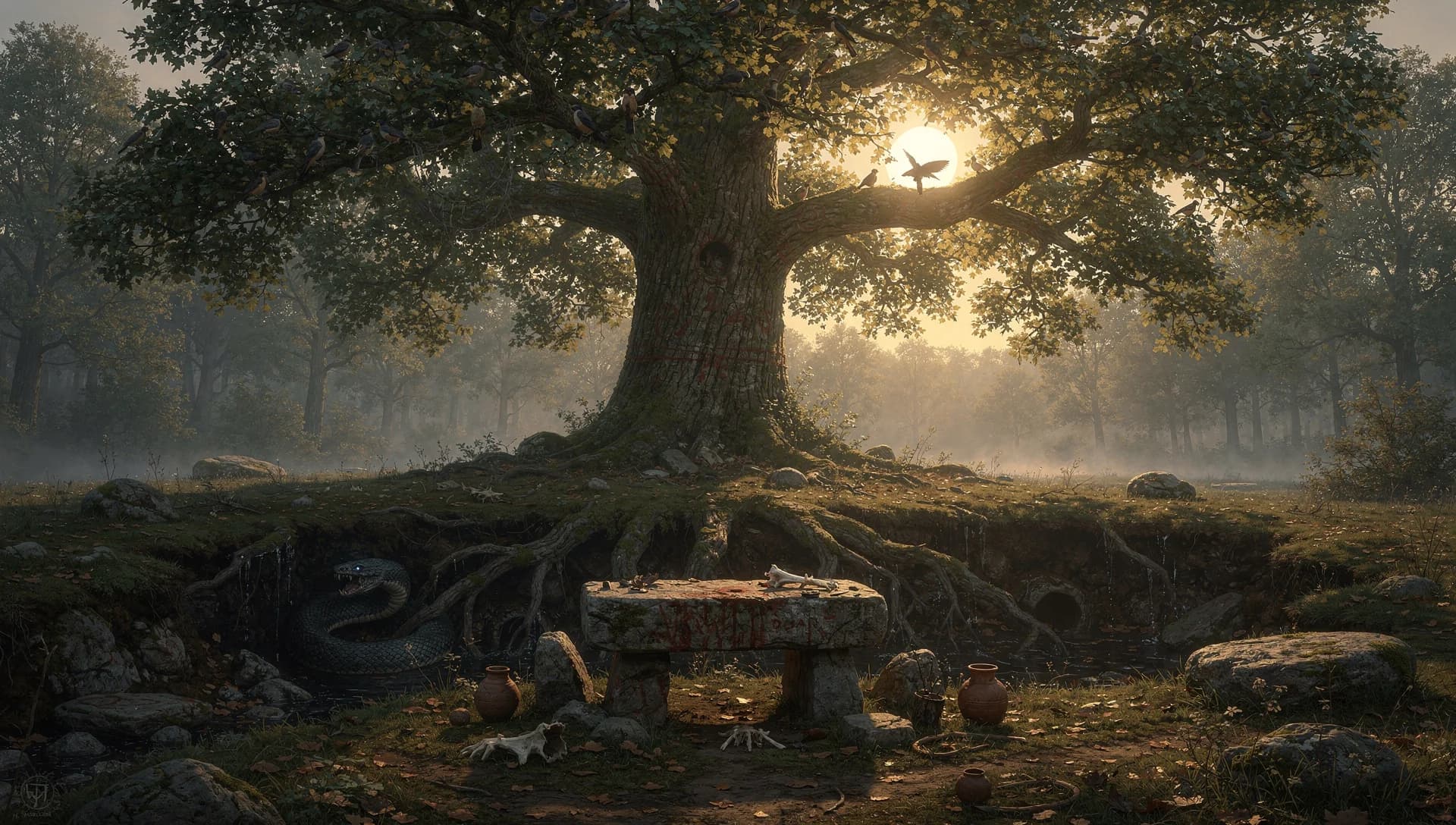
Universal tree-of-life cult = Slavic "world tree" traditions; the sacred oak of Perun
This article expands on the decoder mapping. For the side-by-side card and quick reference, see the mapping page.
The Slavic World Oak
Pre-Christian Slavic religion was built around sacred groves. Every Slavic tribe kept a central grove with one ancient oak at its heart. The tree was known across Slavic languages as the Dub (Russian Dub, Polish Dąb, Czech Dub, Serbian Hrast or Dub). It served as the focus of communal worship, the place where oaths were sworn, the site of funerary rites, and the dwelling of Perun, the sky and thunder god. "Perun is the one who dwells in the oak" is a formula that turns up across medieval Slavic sources.
Russian folklore preserves the image of a cosmic oak at the center of the world, the Dub-stoletni, the hundred-year oak. It rises from the underworld through the middle world into the heavens. A serpent coils at its roots. A falcon or eagle perches in its crown. A spring of living water flows from its base. The tree is the axis around which the world is organized.
The Urantia Book identifies the historical source.
What the Urantia Book Says
The Urantia Book documents a tree-of-life cult that was once nearly worldwide:
"Except in China, there once existed a universal cult of the tree of life." (UB 85:2.4 context; tree worship at 85:2.3)
It places Slavic and eastern European tree veneration within that broader pattern:
"The cults of tree worship are among the oldest religious groups. All early marriages were held under the trees, and when women desired children, they would sometimes be found out in the forest affectionately embracing a sturdy oak. Many plants and trees were venerated because of their real or fancied medicinal powers." (UB 85:2.3)
The historical origin of this cult lies in the actual Tree of Life at Dalamatia, recorded at UB 66:4.13 and treated at length in the companion Maya Ceiba article. The first Garden of Eden carried the tree forward as its central feature:
"The 'tree of the knowledge of good and evil' may be a figure of speech, a symbolic designation covering a multitude of human experiences, but the 'tree of life' was not a myth; it was real and for a long time was present on Urantia." (UB 73:6.3)
The Slavic line of inheritance runs through the mixed Adamic and Nodite populations of the Russian plains, which the Urantia Book describes at UB 78:3.5. The Adamic migration northward from the second garden carried the Edenic memory of the tree into the Russian, Ukrainian, and Polish populations. Over the following millennia it crystallized into the sacred oak tradition that pre-Christian Slavic religion preserved.
What the Ancient Sources Say
The Slavic sacred oak shows up across the full range of medieval and early modern Slavic sources. Helmold of Bosau's Chronicon Slavorum (twelfth century CE) describes the sacred grove at Prove, in what is now Mecklenburg, Germany: "That grove was the principal sanctuary of the entire province, and no one was permitted to enter it except the priest and those about to offer sacrifice." The grove was built around an ancient oak in which the deity Prove, a West Slavic cognate of Perun, was held to reside.
Ebbo's Vita Ottonis (twelfth century CE), describing Bishop Otto of Bamberg's Pomeranian mission of 1124 to 1128, records the destruction of a sacred oak at Stettin under which the Pomeranian Slavs worshipped. The Povest' vremennykh let (Russian Primary Chronicle, 1113 CE) describes Vladimir I's destruction of the Perun idol at Kiev in 988 CE and its ritual drowning in the Dnieper. The chronicle notes that subsequent Christianization campaigns targeted sacred oaks across the Russian territories for destruction.
Boris Rybakov's Yazychestvo drevnikh slavyan (1981) gathers the archaeological evidence for Slavic sacred oak veneration. The excavations at Peryn near Novgorod (ninth to tenth century CE) revealed a circular sacred precinct with a central post-hole for an oak cult statue, surrounded by eight ritual hearths arranged in a cosmic-wheel pattern. The Zbruch Idol (ninth to tenth century CE) depicts a four-faced cosmic pillar, with imagery articulating the three-world vertical structure: heavens above, middle world at the center, underworld below.
Marija Gimbutas's The Slavs (Praeger, 1971) documents how pre-Christian Slavic religion was organized around sacred groves and oak cult sites. Gimbutas reads the Slavic tree cult as preserving an older Indo-European inheritance, with parallels to the Baltic Ūsiņš tree veneration, the Germanic Irminsul, and the Vedic Ashvattha.
Russian folklore carries the same memory in the bylina cycle around the primordial Dub-stoletni, and in the peasant tradition of the Mat'-syra zemlya (Moist Mother Earth) whose fertility flows from the roots of the cosmic oak. When the sacred oak is integrated with Perun the sky-warrior and Veles the chthonic adversary, the result is the complete three-world cosmic structure that runs in parallel with the Norse Yggdrasil (eagle at the crown, Níðhöggr at the roots) and the Assyrian Sacred Tree.
The comparative question of how the Slavic world tree relates to other Indo-European and non-Indo-European world-tree traditions has been worked over at length. Jakobson's reconstruction, Rybakov's archaeological synthesis, and the wider comparative literature (Mircea Eliade, Patterns in Comparative Religion, Sheed and Ward, 1958) place the Slavic Dub squarely in the universal world-tree tradition that runs across Eurasia and the Americas. The Urantia Book's account, of a single Dalamatian Tree of Life carried forward through many cultural channels, gives a clean explanation for the structural parallels that turn up across these widely separated traditions.
Why This Mapping Matters
The Slavic world oak preserves the same three-element structure that the Urantia Book identifies across the global tree-of-life inheritance. A sacred tree at the center of the cosmos. A serpent at its roots. A bird in its crown. A divine or royal figure at its axis. What makes the Slavic version notable is how much of the structure it kept intact. The three-world vertical axis, the opposition of serpent against bird, and the pairing of sky-warrior deity against chthonic adversary all survived, where some other preservations simplified or lost them.
The Slavic tree cult is not an isolated eastern European development. It is the Slavic preservation of the same source the Urantia Book traces from the Dalamatian headquarters memory through the Edenic tradition and out into the post-Edenic dispersion. The mixed Adamic and Nodite populations of the Russian plains (UB 78:3.5) were the channel through which the tree-of-life tradition reached the proto-Slavic peoples, who then carried it forward across millennia of continuous forest-dwelling cultural life.
The choice of the oak itself is worth pausing over. The Urantia Book identifies the original Tree of Life as "a shrub of Edentia" (UB 66:4.13), not as an oak. The Slavic focus on the oak is a cultural adaptation. The oak was the most sacred, longest-lived, and most impressive tree of the European forest, so the Slavic imagination naturally fixed the cosmic tree-of-life memory onto the most cosmic-looking species in the local landscape. The same pattern shows up in every preservation. The Maya identified the tree with the ceiba. The Norse with the ash. The Hindu with the ashvattha-fig. Each culture mapped the abstract inheritance onto the most sacred tree it knew.
The institutional structure matters too. The Dalamatian headquarters centered on a temple complex with the Tree of Life at its heart (UB 66:4.13). What Slavic religion preserved was not only the symbol but the institution: a sacred grove with a central ancient oak as the focus of communal worship, tended by a dedicated priesthood. The Slavic zhrecy, organizing around grove ritual and passing the oak cult tradition down across generations, kept alive the institutional memory of the Dalamatian arrangement that the Urantia Book describes.
The identification of Perun with the oak preserves the same pattern of authority at the tree that the Maya tradition keeps (the king at the base of the world tree) and that the Hebrew Eden tradition keeps (the primal couple at the tree). The Slavic version casts that authority as the sky-warrior god, which fits the later Indo-European warrior-caste dominance of religious and political life. Underneath that, the older shape is intact. Authority stands at the tree, exactly as it did at Dalamatia and as it does in the Maya royal sarcophagus imagery.
Sources
- The Urantia Book, Paper 66 (The Planetary Prince's Staff), Paper 73 (The Garden of Eden), Paper 78 (The Violet Race After the Days of Adam), Paper 85 (The Origins of Worship). Urantia Foundation, first printing 1955. Cited passages: 66:4.13, 73:6.3, 78:3.5, 85:2.3-4.
- Rybakov, Boris. Yazychestvo drevnikh slavyan (Paganism of the Ancient Slavs). Nauka, 1981.
- Gimbutas, Marija. The Slavs. Praeger, 1971.
- Eliade, Mircea. Patterns in Comparative Religion. Sheed and Ward, 1958.
- Ivanov, Vyacheslav and Vladimir Toporov. Issledovaniya v oblasti slavyanskikh drevnostey. Nauka, Moscow, 1974.
- Helmold of Bosau. Chronicon Slavorum. Translated by Francis Joseph Tschan, Columbia University Press, 1935.
- Jakobson, Roman. "Slavic Gods." In Selected Writings VII, Mouton, 1985.
- Ivakhiv, Adrian. "Nature and Ethnicity in East European Paganism." Pomegranate: The International Journal of Pagan Studies 7, no. 2, 2005.
Confidence and Evidence
- Confidence: UB CONFIRMED
- Evidence rating: STRONG
- Basis: The Urantia Book names the universal tree-of-life cult at UB 85:2 and documents the actual historical Tree of Life at Dalamatia at 66:4.13. The Slavic sacred oak tradition preserves the structural features (cosmic-axis position, three-world vertical structure, serpent at roots and bird in crown, royal-deity association) that fit the common source. The Adamic and Nodite migration through the Russian plains supplies the transmission pathway.
Related Decoder Articles
Byline: Derek Samaras | Urantia Book Network | April 2026
Connecting Articles
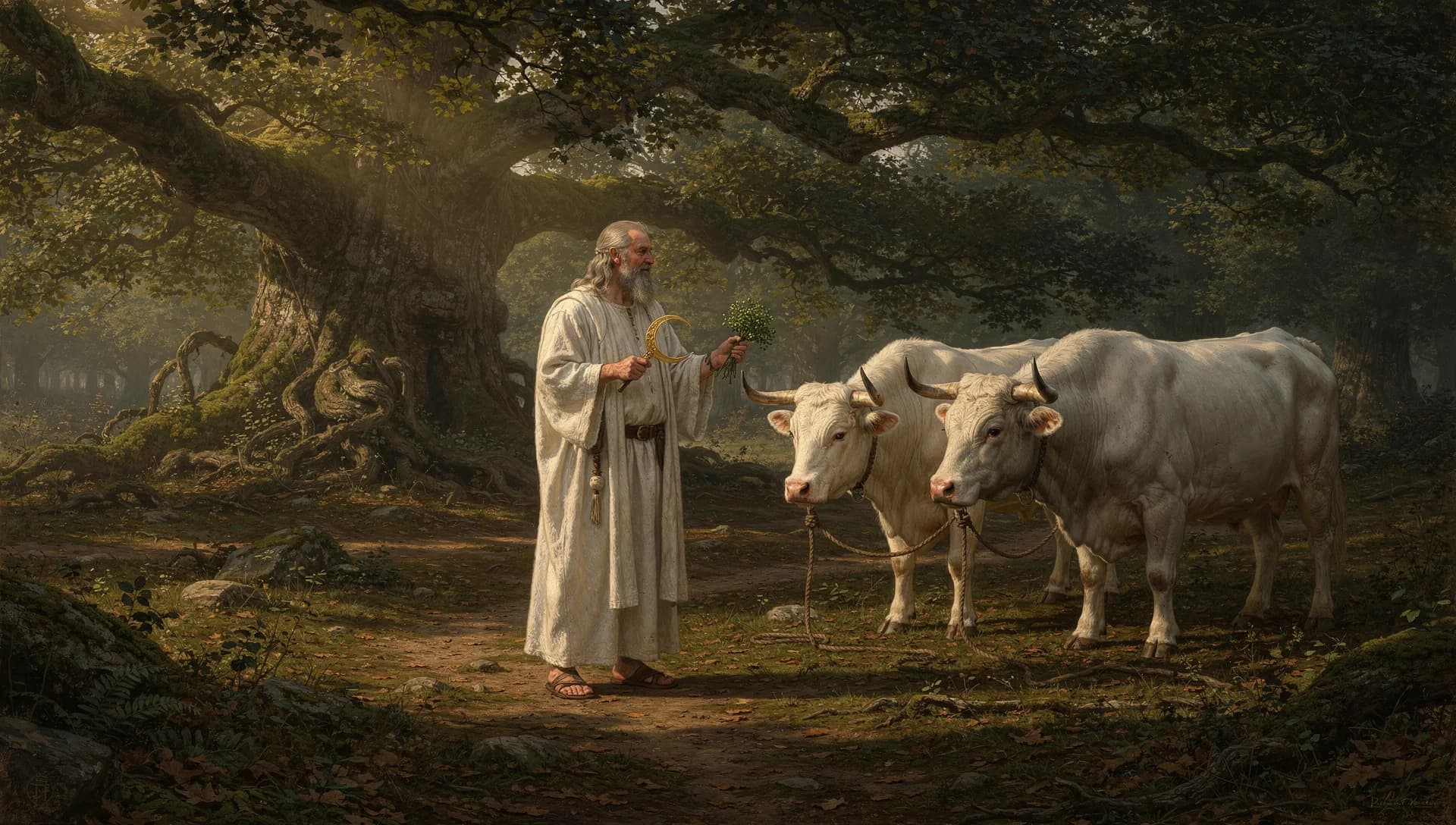
The Oak Priests: Druids, Sacred Groves, and the Universal Tree Cult
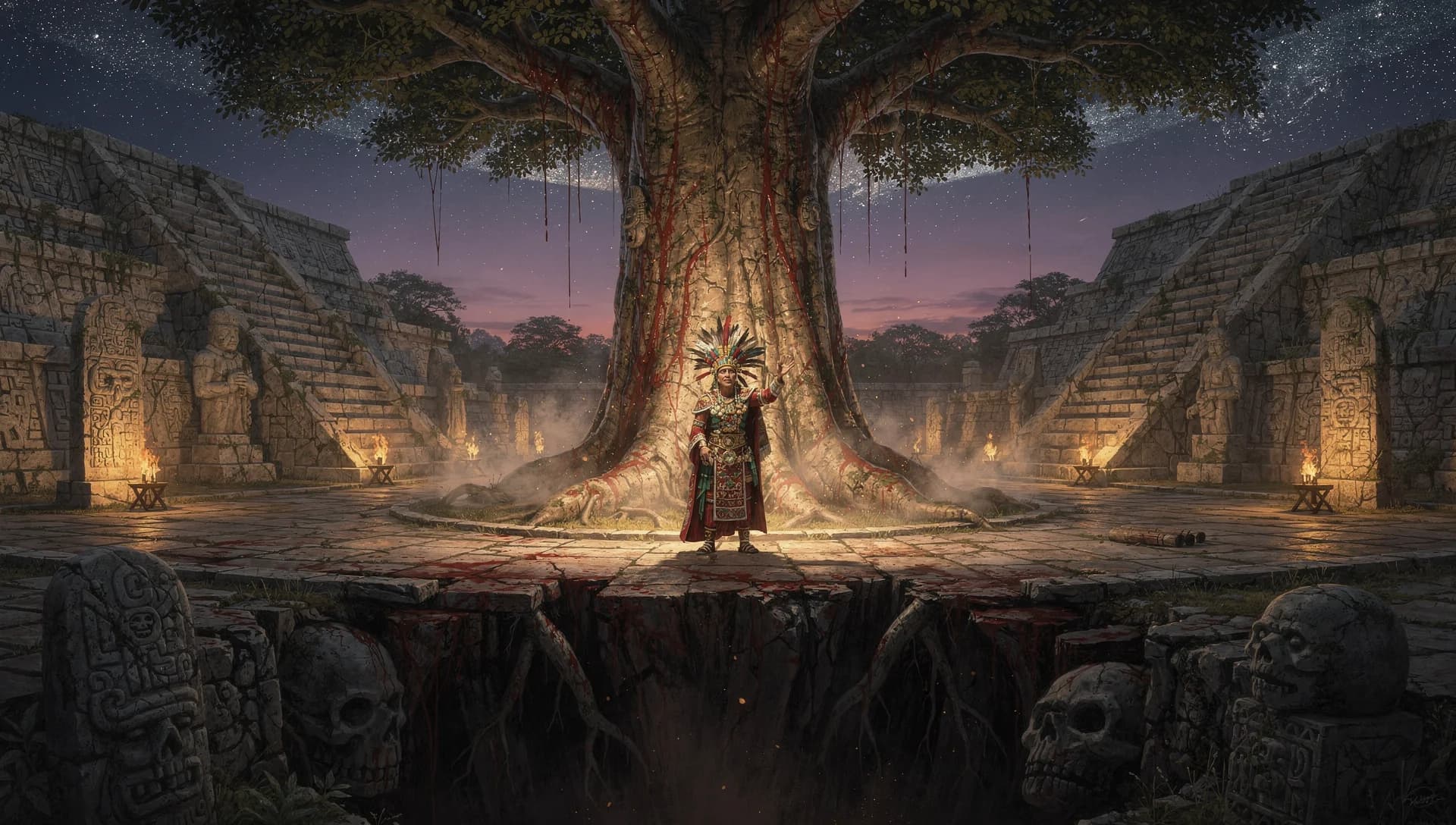
The Tree at the Center of the World: Maya Ceiba Yaxche' and the Tree of Life
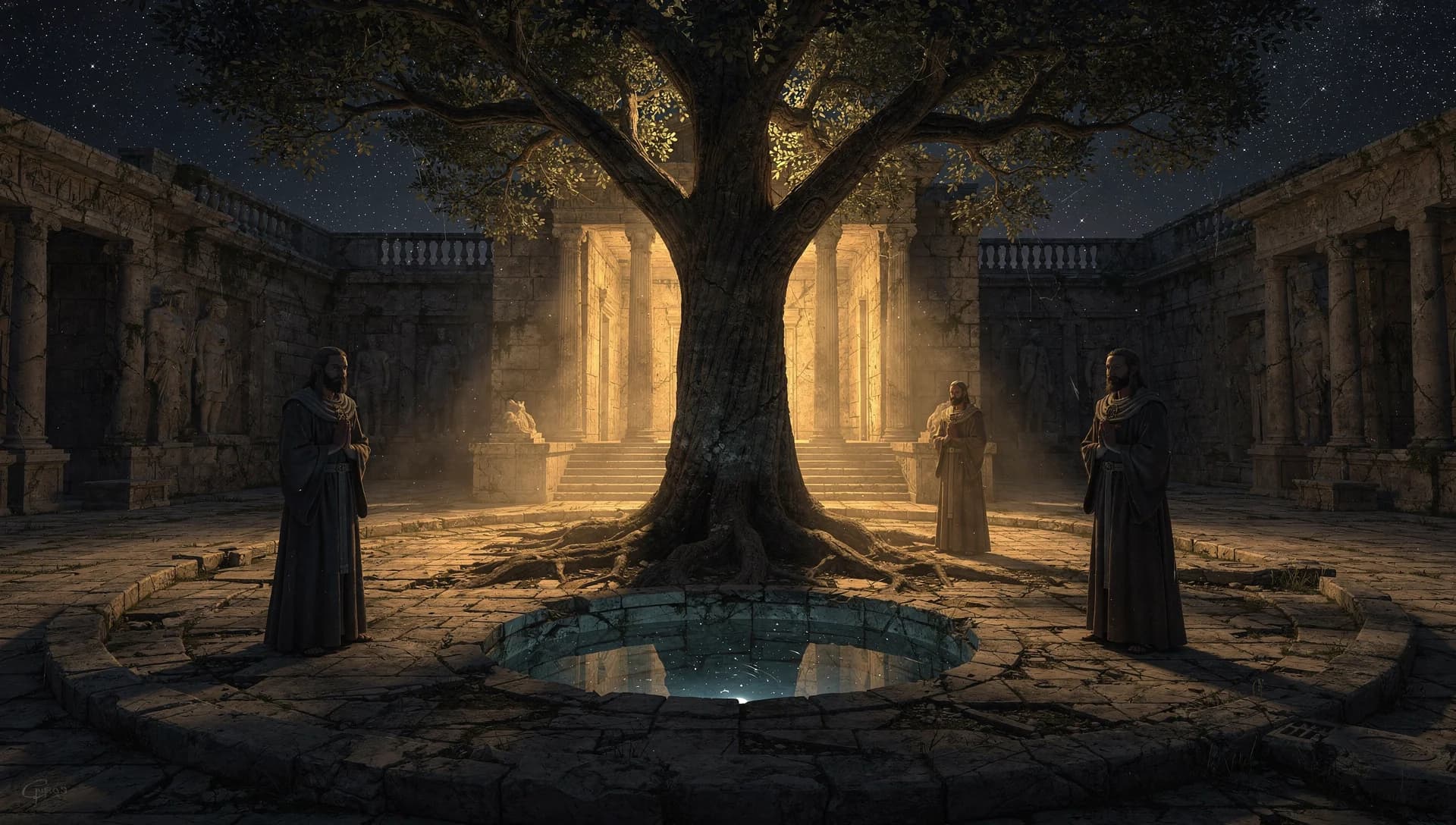
The Cosmic Tree: The Tree of Life and Norse Yggdrasil
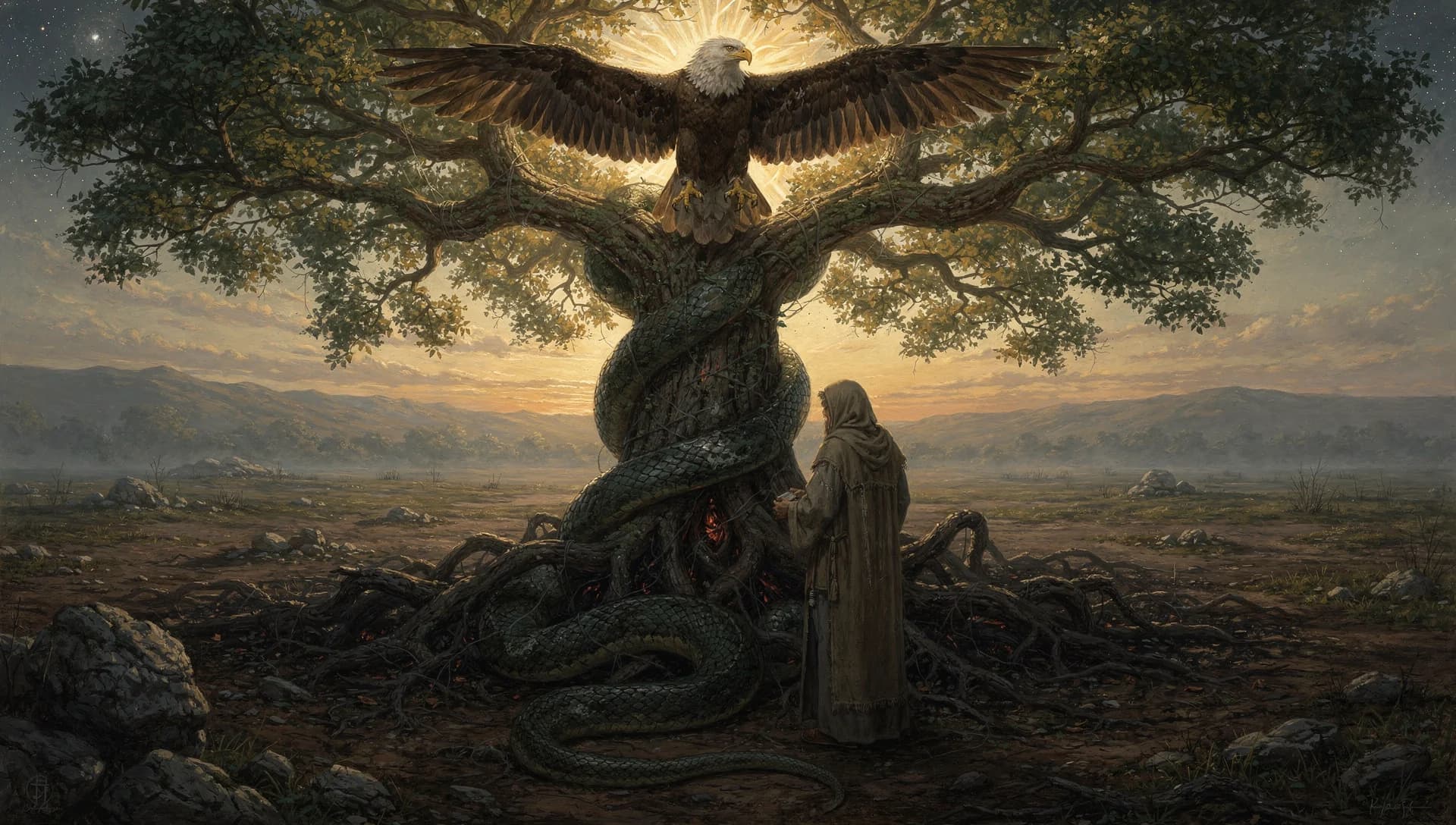
Bird in Crown, Serpent at Root: The Universal Tree of Life Cult Across World Cultures
The Newsletter
Get the research behind each piece
Free. New Urantia Book explorations, the sources behind the videos, and early looks. No spam, unsubscribe anytime.
Prefer video? Follow on YouTube and Facebook.
Delivered through Substack. You can also read past issues.