
 Mythic
Celtic sacred groves and the druid reverence for the oak (from which "druid" derives)
 UB
UBUniversal cult of the Tree of Life (UB 85:2.4)
Full Article
Read the deep-dive article on this connection
Universal cult of the Tree of Life (UB 85:2.4) = Celtic sacred groves and the druid reverence for the oak (from which "druid" derives)
The Connection
Pre-Christian Celtic religion centered on sacred groves (nemeton) and veneration of the oak. The term "druid" is etymologically connected to the Indo-European root for oak (*derw-, producing Greek drus, Celtic daur). Pliny the Elder's description of Druidic ritual emphasizes mistletoe gathered from a sacred oak on the sixth day of the moon. The UB states explicitly that "there once existed a universal cult of the tree of life" across all peoples. Celtic sacred-tree religion is a direct expression of that older universal tradition, transmitted through Indo-European migration corridors.
UB Citation
UB 85:2.4, 66:4.13
Academic Source
Pliny, Natural History XVI.95; Green, The World of the Druids (1997); Chadwick, The Druids (1966)
Historical Evidence(Moderate evidence)
Pliny the Elder's first-century description of Druidic sacred-oak ceremony (Natural History XVI.95) is the single best classical source on pre-Roman Celtic religion. Miranda Green documented the importance of the sacred grove across Celtic Europe, from Gallic nemeta to Irish fidnemed. Nora Chadwick's The Druids traced the oak association through linguistic evidence. The UB's claim of a universal Tree-of-Life cult anchors the Celtic evidence within the worldwide pattern, rather than treating it as an independent nature-religion development.
Deep Dive
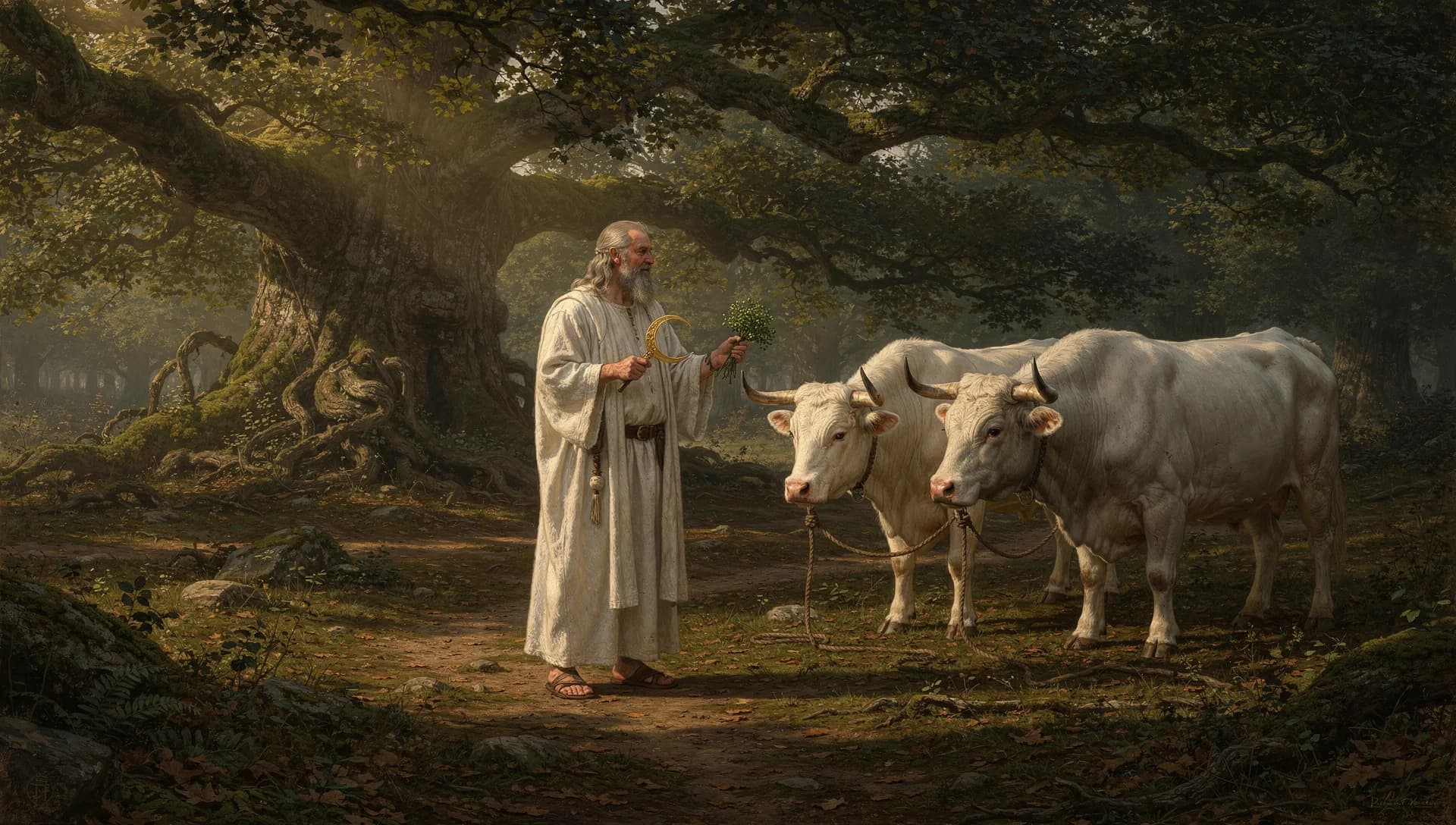
In Book XVI, Chapter 95 of his Natural History, Pliny the Elder, writing in the first century CE, preserved one of the few detailed Roman descriptions of Druidic religious ceremony. He described how the Druids gathered mistletoe from sacred oaks on the sixth day of the moon. A white-robed priest climbed the oak with a golden sickle. The mistletoe was caught in a white cloak as it fell. Two white bulls were sacrificed. The mistletoe was prepared as a potion that could cure infertility and serve as an antidote to all poisons. The whole ceremony took place in a sacred grove, deep in the forest, surrounded by the venerated oaks that gave the Druids their name.
The word "Druid" itself preserves the oak connection. The Indo-European root *derw- (oak, hard, true) gives Greek drus (oak), Old Irish daur (oak), Welsh derw (oaks), and the Druidic name itself. The "Druid" is etymologically "the oak-knower" or "the one who is true" (derived from the same root that produces "true" via the metaphor of oak-hardness). The oak is not incidental to Druidic religion; it is constitutive of it.
Miranda Green's The World of the Druids (1997) and Nora Chadwick's The Druids (1966) document the oak-veneration tradition across pre-Christian Celtic Europe. The Gallic word nemeton, the Irish fidnemed, the Welsh nemed all denote "sacred grove" or "sacred place," typically a forest clearing centered on one or more venerable oaks. Tacitus' Annals describes the Roman destruction of the great Druidic sacred grove on the island of Mona (Anglesey) in 60 or 61 CE: the Roman soldiers, after defeating the Britons, "felled their groves, sacred to their cruel rites." The destruction of sacred oaks was a deliberate Roman strategy for breaking Druidic religious power.
The UB framework places this Celtic oak-cult within the universal Tree of Life tradition. UB 85:2.4 states explicitly: "Except in China, there once existed a universal cult of the *tree of life.*" UB 66:4.13 identifies the original referent as a real plant: "the fruit of the tree of life" that grew in "the central courtyard of the temple of the unseen Father" at Dalamatia, "a shrub of Edentia which was sent to Urantia by the Most Highs of Norlatiadek at the time of Caligastia's arrival." UB 73:6.1 describes Van replanting the tree in "the center of the Garden temple."
The Celtic oak-cult is, on this reading, the Celtic instantiation of the universal Tree of Life memory. The original Tree of Life was a specific botanical entity at Dalamatia and the first Eden. As the cultural memory of this tree spread outward through Adamic, Andite, and Salem-missionary transmissions, it attached to whatever the most impressive tree of the local ecology was. In the Mediterranean and Near East, the cedar of Lebanon and the date palm received the iconographic projection. In the Northern European temperate forests, the oak received it. In the Slavic territories, also oak. In Hindu and Buddhist tradition, the pipal/Bodhi tree. In Mesoamerica, the ceiba.
The local botanical referent varied; the underlying iconographic structure (sacred tree at the center of cosmic order, served by priestly attendants, source of healing, ritual focal point) remained remarkably consistent because it was not just generic nature-veneration but the cultural memory of a specific original referent.
The Druidic sacred-grove practice preserves this memory with particular clarity. The grove was not just any forest; it was a specific consecrated place, accessed only through ritual procedure, centered on specific venerated trees, used for the most sacred ceremonies. The mistletoe-on-oak ceremony described by Pliny is explicitly a healing ritual: the mistletoe-potion cures infertility and serves as antidote to poison. The "tree of life" association is precisely a healing-and-immortality association: the original Tree of Life was a literal antidotal complement to the Satania life-currents (UB 66:4.13), and the cultural memory of healing-and-immortality function persisted through the Celtic mistletoe ceremony.
The strongest counterargument is that oak-veneration in Celtic territory is fully explainable by ecological-environmental factors: oaks were genuinely the most impressive native trees, and any culture rooted in oak-forest ecology would naturally develop oak-centered religious practice. This is partially true. Oak forests were indeed ecologically dominant in Celtic territories, and any folk tradition would naturally focus on oak.
But the specific iconographic structure (sacred grove, priestly attendants, mistletoe-immortality association, ritual purification, divine-healing function) is not predicted by environmental determinism. It is predicted by Tree of Life cultural-memory diffusion. The Celtic oak-cult preserves specific structural features that connect to the universal Tree of Life pattern, not just generic nature-religion features. This structural specificity distinguishes the universal-tradition reading from the merely-environmental reading.
Key Quotes
“Except in China, there once existed a universal cult of the tree of life.”
“These antidotal complements of the Satania life currents were derived from the fruit of the tree of life, a shrub of Edentia which was sent to Urantia by the Most Highs of Norlatiadek at the time of Caligastia's arrival. In the days of Dalamatia this tree grew in the central courtyard of the temple of the unseen Father, and it was the fruit of the tree of life that enabled the material and otherwise mortal beings of the Prince's staff to live on indefinitely as long as they had access to it.”
Cultural Impact
The Druidic tradition has been one of the most contested fields in Celtic studies. Roman sources are limited and often hostile (Caesar and Tacitus had political reasons to portray Druidism as barbaric). The Druids themselves left no written records. The medieval Irish and Welsh sources that preserve some Druidic material are heavily Christian-influenced. Reconstructing what pre-Roman Celtic religion actually was requires careful triangulation across these limited and sometimes contradictory sources. The UB framework offers a way to integrate the available evidence into a coherent picture. Druidic oak-veneration was not an isolated nature-religion development; it was the Celtic expression of the universal Tree of Life tradition that the UB documents across many cultures. Engaging with Druidism through this comparative framework provides a structural anchor that the limited primary sources do not by themselves supply. For contemporary Druidic and neo-Druidic movements (the Order of Bards, Ovates, and Druids; the Ancient Order of Druids; various Druidic Reconstruction efforts), the framework offers a way to engage with the tradition that connects it to global heritage rather than treating it as exclusively Celtic ethnic property. The oak-veneration tradition is genuinely Celtic, and it is also genuinely connected to the worldwide Tree of Life heritage. Both connections deserve recognition.
Modern Resonance
Contemporary environmental movements have increasingly drawn on Druidic and Celtic sacred-grove imagery in their work to protect old-growth forests. The recognition that pre-Christian European cultures venerated specific trees and groves provides theological grounding for contemporary forest-protection efforts in a way that purely secular environmentalism does not. The UB framework supports this contemporary engagement. The veneration of specific trees was not arbitrary primitive nature-worship; it was the persistence of cultural memory of an actual sacred plant that had played a real role in early human civilization. Old-growth oaks in modern Europe are not just impressive specimens of botanical heritage; they are the cultural successors of a venerable tradition that connects them to the universal Tree of Life heritage. For contemporary readers engaged with environmental concerns, this framework offers theological-historical depth that complements scientific-ecological reasoning. We protect ancient trees not just because they are biologically significant but because they participate in a tradition of sacred reverence that connects to deep cultural memory. The Druids understood something about the relationship between humanity and the great trees that contemporary ecology is rediscovering through different conceptual languages.
Related Mappings
The Adamic-Andite arrival pattern: superhuman teachers coming from the east
= Tuatha Dé Danann, the "People of the goddess Danu" who arrived in Ireland
Corporeal staff survivors whose memory became "wise counselor" figures
= Merlin / Myrddin, the prophetic wise counselor to kings
The first Garden of Eden, submerged under the eastern Mediterranean
= The Celtic Otherworld: Tír na nÓg, Hy-Brasil, Avalon: paradise beyond or beneath the sea
Salem missionaries reaching "even to the British Isles" after Melchizedek's incarnation
= Celtic high-god Dagda, "The Good God," father-figure of the Tuatha Dé Danann
Related Articles
Where to next
The free newsletter. The research behind each piece, no spam.