
The Oak Priests: Druids, Sacred Groves, and the Universal Tree Cult
The Celtic druids were the oak-priests whose very name derives from the Indo-European word for oak. Their ritual life centered on sacred groves and the gathering of mistletoe from the sacred oak. The Urantia Book records that a universal cult of the Tree of Life existed across the ancient world, preserved across cultures after the rebellion and the loss of the original cosmic-tree tradition.
Universal cult of the Tree of Life = Celtic sacred groves and the druid reverence for the oak (from which "druid" derives)
This article expands on the decoder mapping. For the side-by-side card and quick reference, see the mapping page.
The Priests Named for a Tree
The term "druid" itself is etymologically connected to the Indo-European root for oak: derw-, producing Greek drys, Old Irish daur, Welsh derwen. The connection is both phonological and semantic. The druids were the oak priests, the specialists in oak ritual and sacred grove practice.
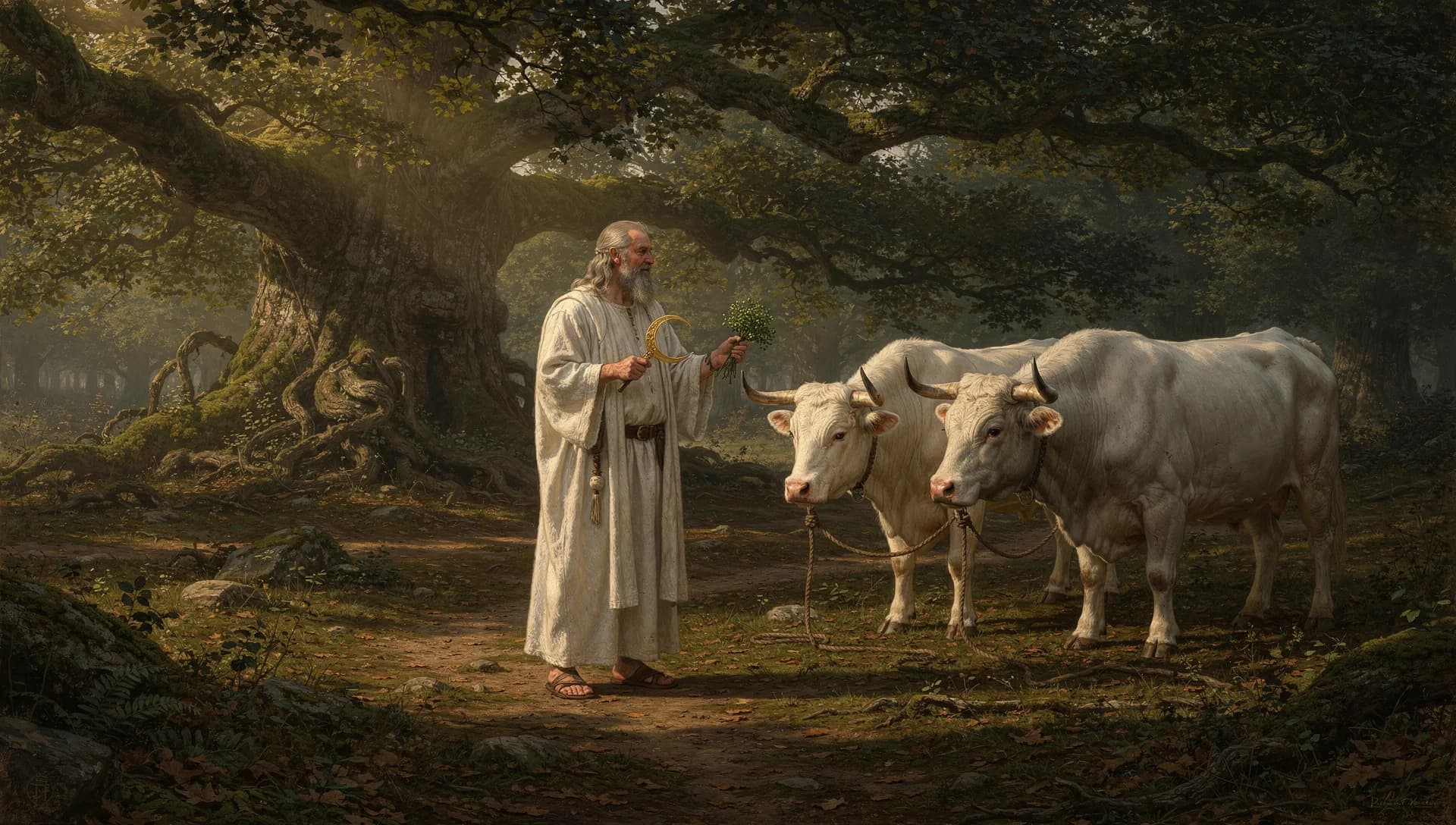
The Roman-era classical sources preserve detailed descriptions of druidic ritual practice. Pliny the Elder's Natural History Book XVI, chapter 95 describes the druidic gathering of mistletoe from a sacred oak on the sixth day of the moon, with precise ritual features: white-robed druid, golden sickle, two white bulls for sacrifice, mistletoe caught in a white cloak (never to touch the ground). The description is detailed enough to have generated substantial modern scholarly attention.
The Urantia Book provides the theological context in which this druidic practice is best understood.
What the Urantia Book Says
Paper 85 addresses the broader tree-worship phenomenon:
"The cults of tree worship are among the oldest religious groups. All early marriages were held under the trees, and when women desired children, they would sometimes be found out in the forest affectionately embracing a sturdy oak. Many plants and trees were venerated because of their real or fancied medicinal powers." (UB 85:2.3)
The Urantia statement connecting tree worship to the underlying cosmic tree tradition is compact:
"Except in China, there once existed a universal cult of the tree of life." (UB 85:2.4)
The broader context is supplied by the Urantia account of the actual historical Tree of Life (treated extensively in the companion decoder articles on Yggdrasil, the Huluppu Tree, and the Sumerian Tree). The tree was a physical botanical object, a shrub of Edentia placed at the center of the Father's temple in Dalamatia, sustained across more than 150,000 years by Van and Amadon at the highland retreat, transplanted to the Garden of Eden for Adam and Eve's use. The tree was lost after the Adamic default; the core was not permitted to be carried from Eden; the Nodites who later ate its fruit found it no longer functional for them (UB 73:6.7).
The "universal cult of the tree of life" that the Urantia Book names is the cultural residue of this historical reality. Cultures across the ancient world preserved, in local forms, memory of the cosmic tree whose fruit or leaves extended life for those with access. Each culture developed its own tree cult practices, preserving the structural memory while elaborating the ritual in terms that suited the place.
The Celtic druidic oak tradition is one cultural development of this universal substrate. The features the druidic tradition preserves (oak veneration, sacred grove ritual, mistletoe association, seasonal timing) are the Celtic shape taken by the underlying tree cult memory.
What the Ancient Sources Say
The classical sources on Celtic druidic practice are relatively limited but precise. Julius Caesar's De Bello Gallico Book VI describes the druids as preservers of ancient religious and legal knowledge, with twenty-year training requirements for full proficiency. Strabo (Geography IV.4) documents their tripartite role as religious specialists, natural philosophers, and judges. Pliny the Elder (Natural History XVI.95) describes the mistletoe-gathering ritual.
Pliny's passage is worth quoting in full:
"The druids, for so they call their magicians, hold nothing more sacred than the mistletoe and a tree on which it is growing, provided it is an oak. Groves of oaks are chosen by them on this account, and they perform none of their sacred rites without the use of the branches; and so it seems probable that even the priests themselves receive their name from the Greek word for that tree. The mistletoe, however, is found but rarely upon the oak; and when found, is gathered with due religious ceremony, if possible on the sixth day of the moon."
The features Pliny documents include: reverence for the oak, a sacred grove setting for all ritual, the mistletoe association, lunar calendrical timing, and a fixed ritual protocol (white robes, golden sickle, and never letting the cutting touch the ground).
Miranda Aldhouse-Green's Caesar's Druids (Yale University Press, 2010) and Ronald Hutton's Blood and Mistletoe: The History of the Druids in Britain (Yale University Press, 2009) document the modern scholarly reconstruction. The druidic tradition was substantially destroyed by Roman suppression (especially following the Roman attack on Anglesey in 60 CE) and by subsequent Christian displacement. Surviving evidence is limited but the core features (oak veneration, sacred groves, calendrical ritual) are consistently attested.
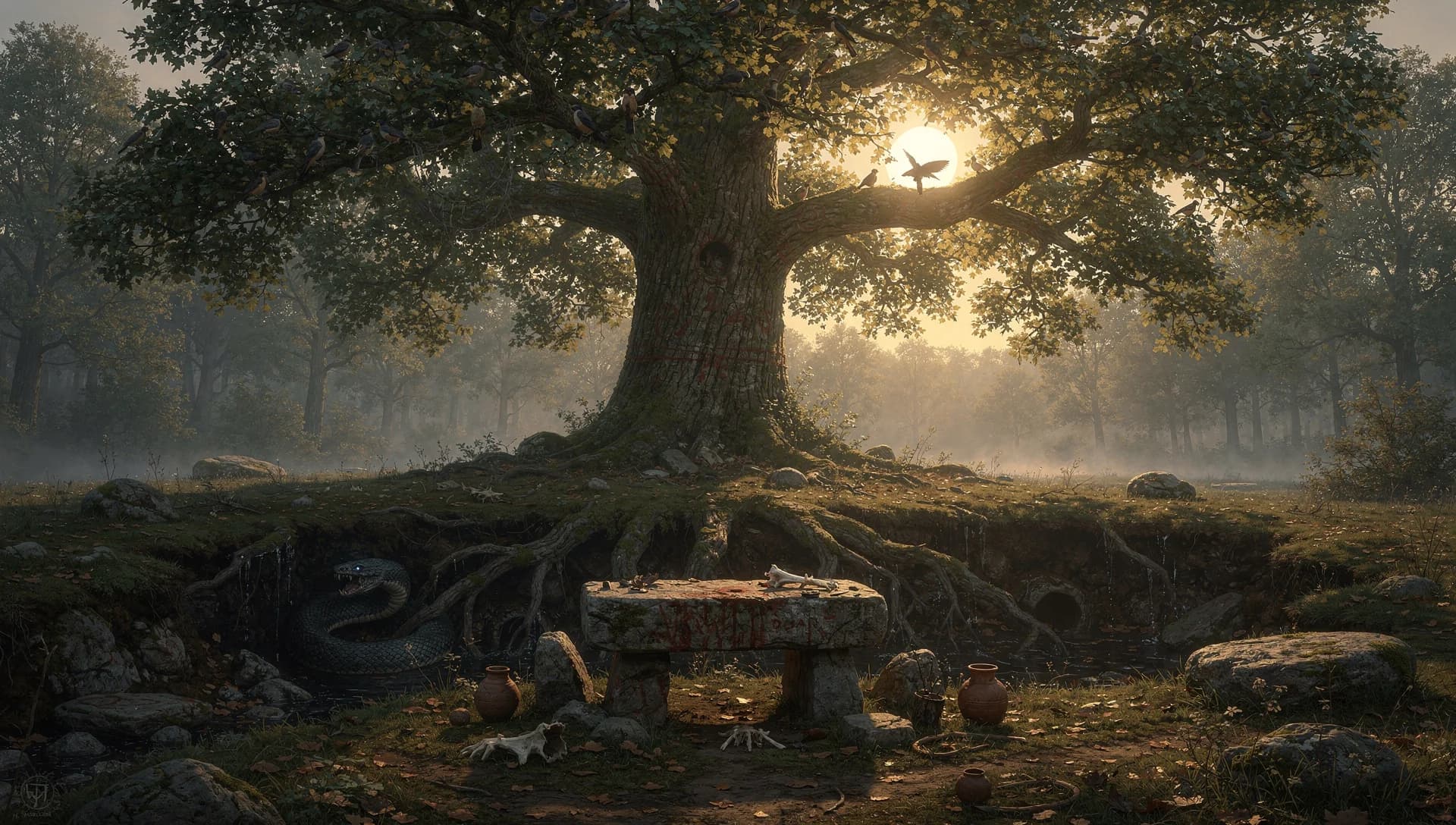
The broader sacred-grove (nemeton) tradition is extensively documented across Celtic Europe. Gallic nemeta, British groves, Irish fid-nemed, and Welsh sacred sites share structural features: grove location rather than a built temple, an emphasis on particular tree species (oak above all, but also yew and ash), ritual focus on individual trees rather than constructed altars, seasonal ritual calendar coordinated with solar and lunar observations.
The claim of a universal tree cult the Urantia Book makes can be checked against the cross-cultural distribution of tree-worship phenomena. James George Frazer's The Golden Bough (multiple volumes, 1890-1915) documented the cross-cultural prevalence of sacred tree traditions across Indo-European and broader Eurasian cultures. Mircea Eliade's The Sacred and the Profane (Harcourt, 1959) and Patterns in Comparative Religion (Sheed & Ward, 1958) catalogue the cross-cultural persistence of tree-worship motifs.
The scholarly observation is consistent: tree-worship traditions are widely distributed across world religious history with remarkable structural consistency, but the historical substrate producing this consistency has been debated. Some scholars (following Frazer) treat it as a generic nature-religion pattern emerging spontaneously from agricultural-season observation. Others (following Eliade) treat it as a phenomenological universal emerging from the experienced verticality of trees as axis-mundi symbols. The Urantia Book offers a third explanation: the universal tree cult preserves memory of a specific historical tree (the Dalamatian and Edenic Tree of Life) whose cultural legacy shaped the world's religious development.
Why This Mapping Matters
The scholarly question of why tree worship is so widely distributed with such consistent structural features has generated substantial literature without clear resolution. Independent parallel development is possible but does not explain the specificity of the shared features (the cosmic tree as axis mundi, the sacred fruit of immortality, the tree at the center of the world). The Urantia Book's identification of a specific historical substrate (the actual Tree of Life at the center of the Dalamatian administrative complex) explains that consistency.
The Celtic druidic tradition is one preservation of this substrate. The druids' focus on the oak carries the general tree cult content within a Celtic frame. The mistletoe association may preserve memory of the life-extending function of the original Tree of Life fruit, transposed onto mistletoe as an evergreen that survives the winter in Celtic country where the oak itself is deciduous.
The "tree of life" phrase itself carries real theological weight in the Urantia framework. The tree was literally a life-extending botanical reality, not a metaphor. Its cultural legacy across world religious traditions preserves the memory that there was, once, an actual tree whose fruit conferred something like immortality on those with access. The various downstream traditions (Norse Yggdrasil, Sumerian Huluppu, Hebrew Tree of Life, Celtic sacred oak, Hindu Aśvattha) all preserve fragments of this reality.
The mapping's significance for Celtic religious studies is direct. The druidic tradition should be read not primarily as an insular Indo-European development but as a western preservation of a universal tradition whose historical root is the Dalamatian Tree of Life. The druidic features (oak veneration, sacred groves, mistletoe ritual, calendrical timing) are local elaborations of the shared substrate.
The broader implication is that Celtic religion is not as isolated as it has sometimes been treated. The druids, the Tuatha Dé Danann, the Otherworld traditions, the Dagda, and the broader Celtic religious framework are all downstream of the same universal Salem-Dalamatian substrate that shaped world religious history. The Celtic preservations are culturally distinctive; the underlying historical reality is shared with traditions from Sumer to India to China.
Sources
- The Urantia Book, Paper 66 (The Planetary Prince's Staff), Paper 73 (The Garden of Eden), Paper 85 (The Origins of Worship). Urantia Foundation, first printing 1955. Cited passages: 66:4.13, 73:6.1-7, 85:2.3-5.
- Pliny the Elder. Natural History, Book XVI, Chapter 95. Loeb Classical Library, Harvard University Press, 1945.
- Caesar, Julius. The Gallic War, Book VI. Translated by H. J. Edwards, Loeb Classical Library, Harvard University Press, 1917.
- Strabo. Geography, Book IV. Loeb Classical Library, Harvard University Press, 1923.
- Aldhouse-Green, Miranda. Caesar's Druids: Story of an Ancient Priesthood. Yale University Press, 2010.
- Hutton, Ronald. Blood and Mistletoe: The History of the Druids in Britain. Yale University Press, 2009.
- Chadwick, Nora. The Druids. University of Wales Press, 1966.
- Frazer, James George. The Golden Bough: A Study in Magic and Religion. 12 volumes, Macmillan, 1890-1915.
- Eliade, Mircea. Patterns in Comparative Religion. Translated by Rosemary Sheed. Sheed & Ward, 1958.
Confidence and Evidence
- Confidence: INFORMED SPECULATION
- Evidence rating: MODERATE
- Basis: The Urantia Book names the universal tree-of-life cult directly in Paper 85:2. The Celtic druidic oak tradition is documented in Pliny and subsequent scholarship as a sacred tree religious framework with calendrical ritual. The cross-cultural persistence of tree-worship traditions is extensively documented but academic explanations for the consistency of shared features remain contested; the Urantia explanation of a common substrate is consistent with the structural data.
Related Decoder Articles
- Tree of Life, Sacred Shrub = Huluppu Tree
- Tree of Life = Norse Yggdrasil
- Dagda = Salem-Derived Celtic High God
By Derek Samaras
Connecting Articles
The Oak at the Center of the World: The Slavic Dub and the Universal Tree Cult
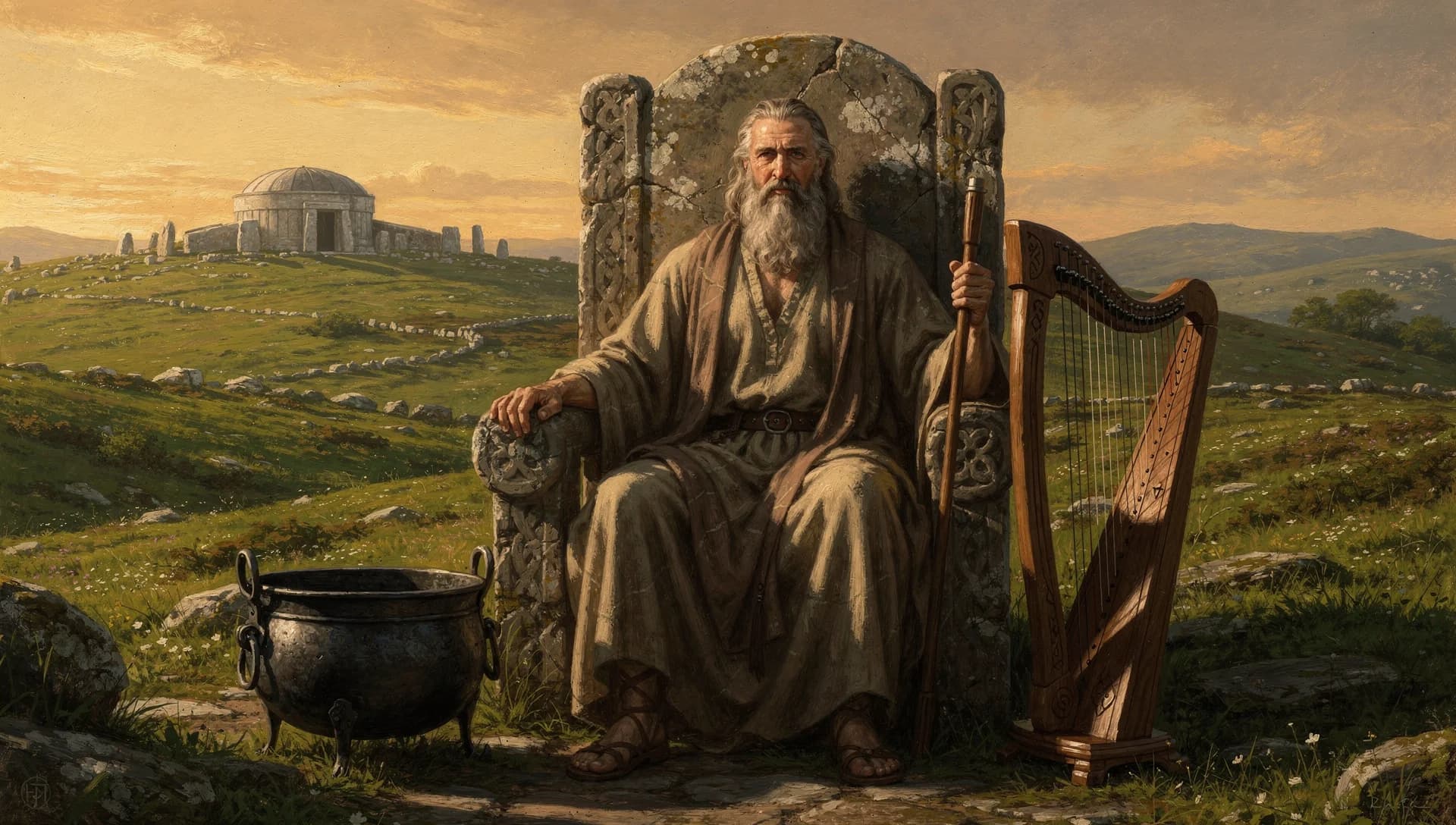
The Good God of Ireland: Dagda and the Salem High-God Imprint
The Tree at the Center of the World: Maya Ceiba Yaxche' and the Tree of Life
The Counselor Who Was Older Than the King: Merlin and the Wise Counselor Archetype
The Newsletter
Get the research behind each piece
Free. New Urantia Book explorations, the sources behind the videos, and early looks. No spam, unsubscribe anytime.
Prefer video? Follow on YouTube and Facebook.
Delivered through Substack. You can also read past issues.