
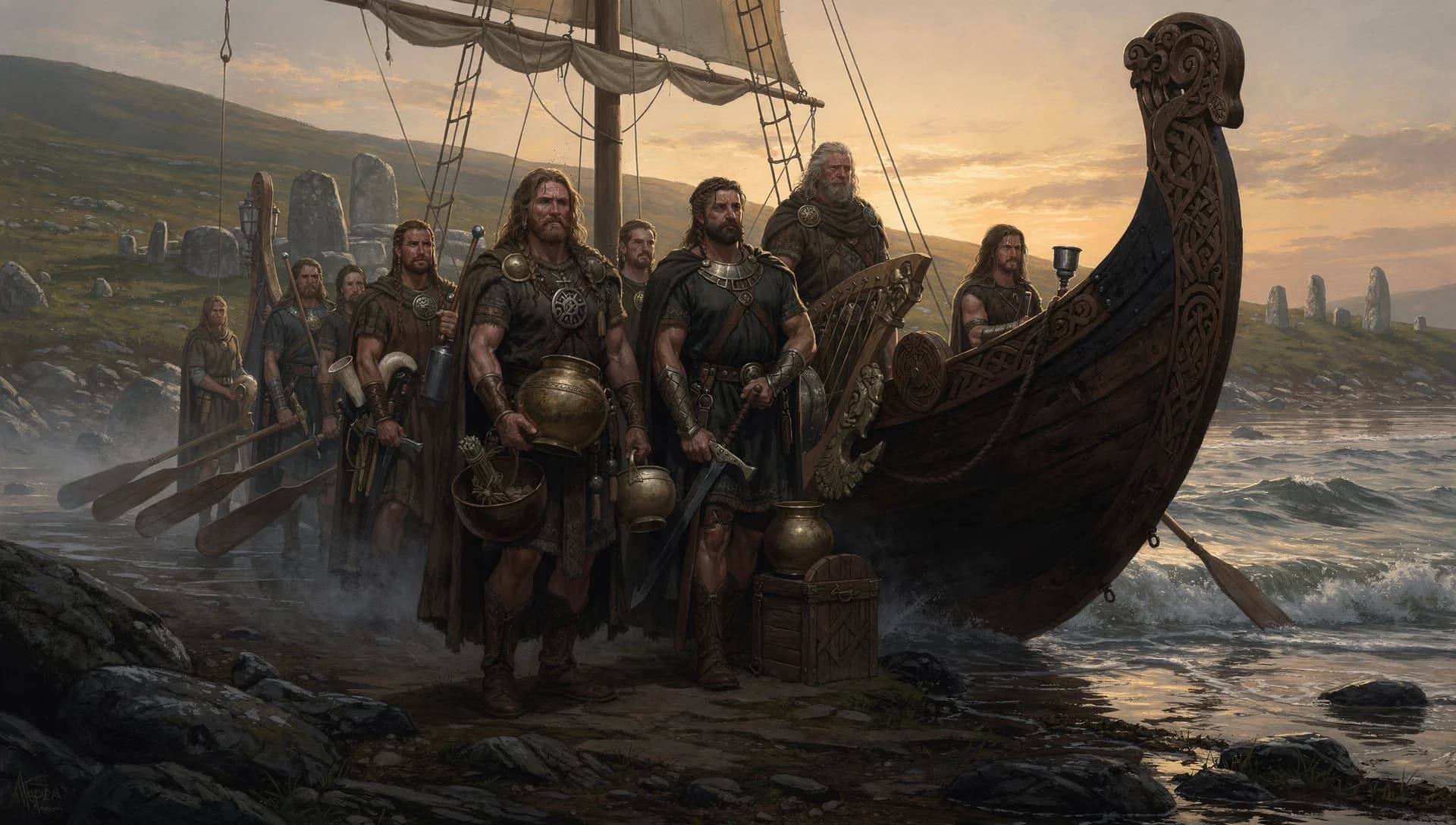
 Mythic
Tuatha Dé Danann, the "People of the goddess Danu" who arrived in Ireland
 UB
UBThe Adamic-Andite arrival pattern: superhuman teachers coming from the east
Full Article
Read the deep-dive article on this connection
The Adamic-Andite arrival pattern: superhuman teachers coming from the east = Tuatha Dé Danann, the "People of the goddess Danu" who arrived in Ireland
The Connection
Irish mythology preserves the arrival of the Tuatha Dé Danann, a race of superhuman beings who came to Ireland "from the north" or "from across the sea," bringing the four treasures (stone of destiny, spear, sword, cauldron), civilizing the land, reigning for a period, and eventually withdrawing into the Otherworld or under the hills when later peoples arrived. This is the Andite arrival pattern in Celtic dress: culturally advanced teachers from the east, a period of rule, cultural absorption into the incoming population, and eventual retreat into legend. The UB says that "Salem missionaries penetrated all Europe, even to the British Isles" (93:7.2), and that "By 5000 B.C. the evolving white races were dominant throughout all of northern Europe, including northern Germany, northern France, and the British Isles" (80:5.8).
UB Citation
UB 80:5.8, 93:7.2
Academic Source
Lebor Gabála Érenn (11th-12th century); MacCulloch, The Religion of the Ancient Celts (1911)
Historical Evidence(Moderate evidence)
The Lebor Gabála Érenn (the Book of Invasions) records the Tuatha Dé Danann as the fifth wave of settlers in Ireland, arriving with supernatural arts and technological advantage over the Fir Bolg. John A. MacCulloch documented the pattern across Celtic lands: a culturally advanced predecessor race remembered as partly divine and partly human. James MacKillop's Dictionary of Celtic Mythology notes the Tuatha Dé Danann's strong association with the Otherworld (sidhe, fairy mounds) as the place they withdrew to when displaced. The structural similarity to the UB's description of Adamite-Andite teachers arriving, ruling, blending, and fading into legend is direct.
Deep Dive
In an Irish manuscript compiled in the eleventh and twelfth centuries from much older oral and written sources, an extraordinary narrative is preserved. The Lebor Gabala Erenn, the Book of the Invasions of Ireland, records the successive waves of settlers who came to inhabit the island. There are six in the standard reckoning: the people of Cessair (drowned in the flood), the Partholonians (perished in plague), the Nemedians (oppressed by Fomorians and dispersed), the Fir Bolg (the people of bags), the Tuatha De Danann (the people of the goddess Danu), and finally the Milesians (the ancestors of the historical Irish).
The Tuatha De Danann are the most theologically loaded element of this sequence. They are described as a race of superhuman beings who arrived in Ireland from the north, sometimes from across the sea, sometimes from "four cities" of supernatural origin (Falias, Gorias, Findias, and Murias). They brought with them four sacred treasures: the Lia Fail (the Stone of Destiny), the Spear of Lugh, the Sword of Nuada, and the Cauldron of the Dagda. They displaced the Fir Bolg in the First Battle of Magh Tuireadh and established themselves as rulers. They later defeated the Fomorians (an earlier supernatural race) at the Second Battle of Magh Tuireadh. When the Milesians arrived, the Tuatha De Danann were defeated but not destroyed; they withdrew into the sidhe, the fairy mounds and barrow-tombs that dot the Irish landscape, where they continue to dwell as the Aos Si, the people of the mounds.
The Tuatha De Danann are clearly not ordinary humans in the Lebor Gabala account. They have supernatural abilities, magical artifacts, and a connection to the Otherworld that distinguishes them from both the earlier and later settlers. At the same time, they are not gods in the Greek sense; they are described as having births, deaths, and individual biographies. They occupy a category that scholarship has variously labeled as "fairy folk," "demi-gods," or "euhemerized deities."
John MacCulloch's The Religion of the Ancient Celts (1911) treated the Tuatha De Danann as the cultural memory of a historical pre-Celtic population that had been remembered in semi-divine terms as their actual identity faded. James MacKillop's Dictionary of Celtic Mythology (1998) summarized the modern scholarly position: the Tuatha De Danann are most plausibly read as a euhemerization of older Celtic gods, with the Lebor Gabala framework providing a quasi-historical narrative for what had originally been religious-cosmological content.
The UB framework offers a different reading. UB 80:5.8 places Andite arrivals in northern Europe by 5000 BCE: "By 5000 B.C. the evolving white races were dominant throughout all of northern Europe, including northern Germany, northern France, and the British Isles." UB 93:7.2 specifies that "Salem missionaries penetrated all Europe, even to the British Isles." The combination of Andite arrivals and Salem-missionary teaching reaching the British Isles in the third and second millennia BCE provides a specific historical context for what the Tuatha De Danann tradition might preserve.
The Tuatha De Danann arrival pattern matches the UB description of Adamite-Andite teaching arrival with structural precision. They came from the north or across the sea (consistent with arrivals from continental northern Europe). They brought superhuman teaching and magical-technological artifacts (consistent with the cultural-technological superiority that the Andites carried from their Adamic-Edenic inheritance). They established themselves as rulers for a period (consistent with the Andite-elite role in early European stratified societies). They blended with and were eventually replaced by later populations (consistent with the long-term integration of Andite descent into the broader European population through intermarriage). They withdrew into the Otherworld rather than disappearing entirely (consistent with the persistent cultural memory of the Andite contribution that the UB traces across centuries).
The four treasures of the Tuatha De Danann are particularly suggestive. The Stone of Destiny (Lia Fail) preserves the cultural memory of sacred-stone rituals associated with kingship, a pattern that appears across Indo-European traditions and probably traces back to original Adamic-Edenic ceremonial practice. The Spear of Lugh and the Sword of Nuada represent advanced metallurgy that the Andites would have brought. The Cauldron of the Dagda represents abundance-of-food, an agricultural-technological achievement that would have been part of the Andite teaching package. The four-treasures pattern matches the standard Andite-arrival pattern of bringing kingship-ritual, advanced metallurgy, and agricultural abundance.
The strongest counterargument is that the Lebor Gabala is a medieval Christian-influenced compilation that has been substantially shaped by biblical narrative patterns. The six-waves-of-settlement structure may reflect Genesis-derived patterns rather than authentic pre-Christian Irish tradition. The Tuatha De Danann themselves may be euhemerized older Celtic deities rather than memory of historical migrations.
The UB defense is that the Lebor Gabala demonstrably draws on much older Irish material that predates Christian compilation. The Cath Maige Tuired (Battle of Magh Tuireadh) preserves elements that scholarship dates to genuinely ancient Celtic tradition. The pattern of "supernatural predecessor race who taught civilization, was displaced, and withdrew into the Otherworld" is distinctive enough to require specific explanation, and the UB Andite-Adamic framework provides a candidate that mainstream euhemerization-of-deities theories do not adequately supply.
Key Quotes
“By 5000 B.C. the evolving white races were dominant throughout all of northern Europe, including northern Germany, northern France, and the British Isles. Central Europe was for some time controlled by the blue man and the round-headed Andonites. The latter were mainly situated in the Danube valley and were never entirely displaced by the Andites.”
“Salem missionaries penetrated all Europe, even to the British Isles. One group went by way of the Faroes to the Andonites of Iceland, while another traversed China and reached the Japanese of the eastern islands.”
Cultural Impact
The Tuatha De Danann tradition has been one of the most generative bodies of material in modern Celtic cultural revival. From W.B. Yeats' Celtic Twilight to contemporary fantasy literature, the figures of the Tuatha De Danann have been continually reimagined and redeployed. Lady Gregory's Gods and Fighting Men (1904) made the Tuatha De Danann accessible to a broad reading public. Modern scholarship has continued to engage with the tradition. The UB framework adds historical depth to this generative tradition. The Tuatha De Danann are not just imaginative figures from an Irish literary heritage; they preserve cultural memory of real Andite-Adamic historical arrivals in the British Isles. Engaging with them as such, rather than as purely literary or purely religious figures, restores their connection to the broader global pattern of post-Adamic civilizational development. For Irish-heritage and broader Celtic-heritage readers, the framework offers a way to engage with the Tuatha De Danann tradition that takes its historical content seriously. The tradition is not just a romantic Irish fancy; it preserves real memory of how civilizational teaching reached Ireland in the third and second millennia BCE. The Aos Si who continue to inhabit the sidhe in folk tradition are the cultural-memory descendants of real historical figures.
Modern Resonance
In contemporary Irish cultural life, the Tuatha De Danann tradition has been reclaimed in various ways. The Irish neo-pagan movement (variously called Druidic Order, Celtic Reconstructionism, and other names) engages with the Tuatha De Danann as authentically Celtic spiritual figures. Mainstream Irish cultural institutions (the National Folklore Collection, the Royal Irish Academy, various university Celtic Studies programs) treat the tradition as a major component of Irish cultural heritage. The UB framework offers a way to honor these contemporary engagements while connecting them to a global historical context. The Tuatha De Danann are genuinely Irish. They are also genuinely connected to the broader Andite-Adamic civilizational tradition that the UB documents across many cultures. Both connections deserve recognition. For non-Celtic readers, the Tuatha De Danann tradition offers one of the cleanest available examples of a "supernatural predecessor race" cultural memory in European literary tradition. Engaging with it through the UB framework reveals it as one node in a global pattern of cultural memory of post-Adamic civilizational arrivals, connecting Celtic heritage to the parallel traditions in Mesoamerica (Quetzalcoatl), Polynesia (the voyaging culture-heroes), and elsewhere.
Related Mappings
Corporeal staff survivors whose memory became "wise counselor" figures
= Merlin / Myrddin, the prophetic wise counselor to kings
The first Garden of Eden, submerged under the eastern Mediterranean
= The Celtic Otherworld: Tír na nÓg, Hy-Brasil, Avalon: paradise beyond or beneath the sea
Universal cult of the Tree of Life (UB 85:2.4)
= Celtic sacred groves and the druid reverence for the oak (from which "druid" derives)
Salem missionaries reaching "even to the British Isles" after Melchizedek's incarnation
= Celtic high-god Dagda, "The Good God," father-figure of the Tuatha Dé Danann
Related Articles
Where to next
The free newsletter. The research behind each piece, no spam.