
 Mythic
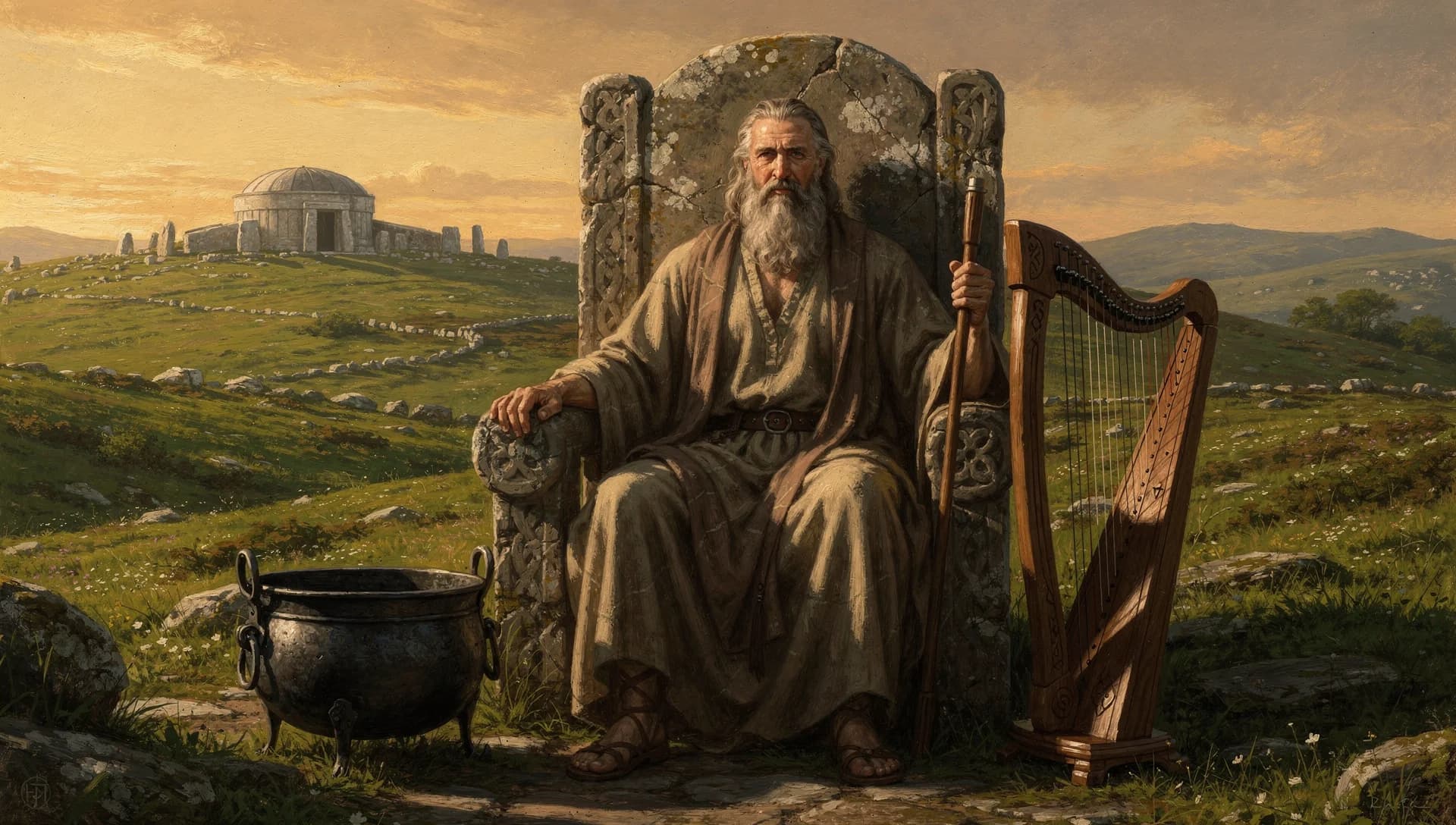
Celtic high-god Dagda, "The Good God," father-figure of the Tuatha Dé Danann
 UB
UBSalem missionaries reaching "even to the British Isles" after Melchizedek's incarnation
Full Article
Read the deep-dive article on this connection
Salem missionaries reaching "even to the British Isles" after Melchizedek's incarnation = Celtic high-god Dagda, "The Good God," father-figure of the Tuatha Dé Danann
The Connection
The Dagda ("The Good God," Dagod Mor) stands at the head of the Tuatha Dé Danann, the supernatural predecessor race in Irish cosmology. He is called the Eochaid Ollathair, "Eochaid the All-Father," and is associated with the cauldron of abundance, the harp that orders the seasons, and the staff that gives or takes life. The structural match to the Salem-Melchizedek pattern (a supreme father-figure associated with abundance, order, and moral life, teaching an incoming population) is direct. The UB places Salem missionaries in the British Isles specifically (93:7.2), giving a specific vector for the teaching's arrival.
UB Citation
UB 93:7.2, 94:0.1
Academic Source
Mac Cana, Celtic Mythology (1970); MacKillop, Dictionary of Celtic Mythology (1998)
Historical Evidence(Moderate evidence)
Proinsias Mac Cana identified the Dagda as "the paternal all-father of the Tuatha Dé Danann," fulfilling the high-god role in Irish cosmology. James MacKillop's Dictionary of Celtic Mythology catalogues the Dagda's "good" attributes (abundance, order, moral law) as distinctive within a pantheon that otherwise features more martial and tribal figures. The "good father who brings abundance and order" pattern has the fingerprint of Salem-missionary influence more than of indigenous polytheism, consistent with the UB's explicit claim that Salem teachers reached Britain.
Deep Dive
The Dagda stands at the head of the Tuatha De Danann in Irish cosmology. His name means "the Good God," from the Old Irish dag (good) and dia (god). He is also called Eochaid Ollathair, "Eochaid the All-Father," and Ruad Rofhessa, "Lord of Great Knowledge." He is described as bearing three sacred objects: a club that can both kill and revive, a cauldron of abundance that never empties, and a harp that orders the seasons through its music. He is depicted as a father-figure, a wise counselor, a generous patron of feasting and abundance, and the ultimate source of order in the Tuatha De Danann pantheon.
The Dagda differs in important ways from the more typical Indo-European tribal pantheons. He is not primarily a warrior-god (though he can fight when needed). He is not primarily a sky-storm-god (though he has some weather-associations). He is not primarily a chthonic-fertility-god (though he is associated with abundance). He is, distinctively, "the Good God," a moral-administrative figure whose primary function is the maintenance of order and the provision of abundance for all who serve under his rule.
Proinsias Mac Cana's Celtic Mythology (1970) identified the Dagda as "the paternal all-father of the Tuatha De Danann," fulfilling the high-god role within Irish cosmology. James MacKillop's Dictionary of Celtic Mythology (1998) catalogued the Dagda's distinctive "good" attributes: abundance, order, moral law, generative paternity. These attributes distinguish the Dagda from the more martial and tribal figures who otherwise populate the Tuatha De Danann (Lugh, the warrior-king; Nuada, the dispossessed king; Brigid, the patroness of poetry and smithing; the Morrigan, the war-goddess).
The "good father who brings abundance and order" pattern is distinctive. It does not fit the standard Indo-European war-god / fertility-goddess / sky-storm-god template that characterizes most pre-Christian European pantheons. It fits, instead, the Salem-monotheistic-teaching pattern. A supreme good-father who maintains cosmic order, provides abundance for those who serve under him, and stands as the ultimate moral authority is exactly what Salem missionary teaching would deposit in a culture that had not previously had such a figure.
UB 93:7.2 specifies that "Salem missionaries penetrated all Europe, even to the British Isles." UB 94:0.1 adds that "THE early teachers of the Salem religion penetrated to the remotest tribes of Africa and Eurasia, ever preaching Machiventa's gospel of man's faith and trust in the one universal God as the only price of obtaining divine favor." The Salem-missionary teaching reaching Ireland and Britain in the second millennium BCE provides the specific historical context for what the Dagda figure might preserve in cultural memory.
The structural match between the Dagda and the Salem-monotheistic teaching is precise. The Dagda is a supreme father-figure (matches the Universal Father teaching). He maintains cosmic order through his harp (matches the universal-order teaching). He provides abundance through his cauldron (matches the providential-abundance teaching). He combines life-giving and corrective functions through his club (matches the unified-divinity teaching that does not separate creator from judge). He stands at the head of the pantheon as the ultimate authority (matches the supreme-creator teaching).
The pattern of "originally monotheistic teaching becoming the high-god of an absorbed polytheistic system" is the standard Salem-missionary reception pattern that the UB describes across many cultures. The original supreme-creator teaching is received with enthusiasm. As it integrates with the existing religious environment, it becomes the highest figure of the developing pantheon while more accessible specialized deities take over the day-to-day religious functions. The Dagda is the Irish expression of this pattern.
The strongest counterargument is that the Dagda can be read as an indigenous Celtic father-god whose distinctive attributes reflect ordinary indigenous religious development without requiring Salem-missionary appeal. The Indo-European linguistic family does include sky-father figures (Sanskrit Dyaus Pitar, Greek Zeus Pater, Latin Jupiter Pater) that share the father-god structure, and the Dagda might simply be the Celtic descendant of this ancestral Indo-European sky-father.
The UB defense is that the Dagda's specific attributes (the moral-administrative emphasis, the abundance-provision emphasis, the goodness-and-order emphasis) are more pronounced in the Dagda than in the broader Indo-European sky-father pattern. The Dagda is not just a sky-father; he is specifically "the Good God" with strong moral-providential features that distinguish him from his Indo-European cognates. These distinguishing features fit the Salem-missionary-teaching reception pattern better than they fit the generic Indo-European sky-father inheritance.
The cumulative effect is to dignify the Dagda tradition as preserving real cultural memory of Salem-monotheistic teaching reaching Ireland in the second millennium BCE. The Dagda is not just a literary figure or a generic sky-father; he is the Irish reception of universal Salem-teaching that connects to the broader global pattern that the UB documents across many traditions.
Key Quotes
“Salem missionaries penetrated all Europe, even to the British Isles. One group went by way of the Faroes to the Andonites of Iceland, while another traversed China and reached the Japanese of the eastern islands.”
“THE early teachers of the Salem religion penetrated to the remotest tribes of Africa and Eurasia, ever preaching Machiventa's gospel of man's faith and trust in the one universal God as the only price of obtaining divine favor.”
Cultural Impact
The Dagda has been one of the central figures in the modern recovery of pre-Christian Irish religion. From W.B. Yeats' Celtic Twilight to Lady Gregory's Gods and Fighting Men to the work of contemporary Celtic Studies scholars, the Dagda has been continually reimagined and re-engaged. The character's combination of paternal benevolence and primal power has made him generative for both literary and religious appropriation. The UB framework offers a way to engage with the Dagda tradition that takes its theological depth seriously. The Dagda is not just a charming Irish father-god; he is the Irish reception of the universal Salem-monotheistic teaching that connects Ireland to the broader global heritage of supreme-creator religion. Engaging with him as such, rather than as an isolated regional deity, opens the Irish tradition to fuller comparative engagement. For contemporary Irish-heritage readers, the framework offers theological grounding for engagement with the pre-Christian Irish heritage that does not require choosing between Christian commitment and Celtic identity. The Dagda is a pre-Christian Irish reception of the same fundamental teaching about a supreme Creator-God that Christianity later carried into Ireland through different channels. Both are part of the genuine Irish religious heritage.
Modern Resonance
Contemporary Irish neo-pagan and Celtic Reconstructionist movements engage extensively with the Dagda as a primary religious figure. The Order of Bards, Ovates, and Druids includes Dagda-veneration in some of its liturgical practice. Various Celtic-Reconstruction movements have developed specific Dagda-worship practices. The UB framework offers a way to honor these contemporary engagements while connecting them to a global comparative context. The Dagda is genuinely Irish. He is also genuinely connected to the broader Salem-monotheistic teaching tradition. Both connections are real. Engaging with him within this larger framework dignifies the Irish tradition while connecting it to the universal heritage that the UB documents. For non-Irish readers, the Dagda offers one of the cleanest available examples of how Salem-monotheistic teaching can be received and absorbed within a polytheistic religious environment. The "Good God" attribute clusters distinctively with Salem-teaching reception across multiple traditions (the Slavic Rod, the Hindu Brahman, the African Olodumare and Mulungu, the Polynesian Io). The Dagda is the Celtic instantiation of this widespread pattern, and recognizing him as such reveals the structural consistency of the Salem-teaching reception pattern across cultures separated by enormous geographic distances.
Related Mappings
The Adamic-Andite arrival pattern: superhuman teachers coming from the east
= Tuatha Dé Danann, the "People of the goddess Danu" who arrived in Ireland
Corporeal staff survivors whose memory became "wise counselor" figures
= Merlin / Myrddin, the prophetic wise counselor to kings
The first Garden of Eden, submerged under the eastern Mediterranean
= The Celtic Otherworld: Tír na nÓg, Hy-Brasil, Avalon: paradise beyond or beneath the sea
Universal cult of the Tree of Life (UB 85:2.4)
= Celtic sacred groves and the druid reverence for the oak (from which "druid" derives)
Related Articles
Where to next
The free newsletter. The research behind each piece, no spam.