
 Mythic
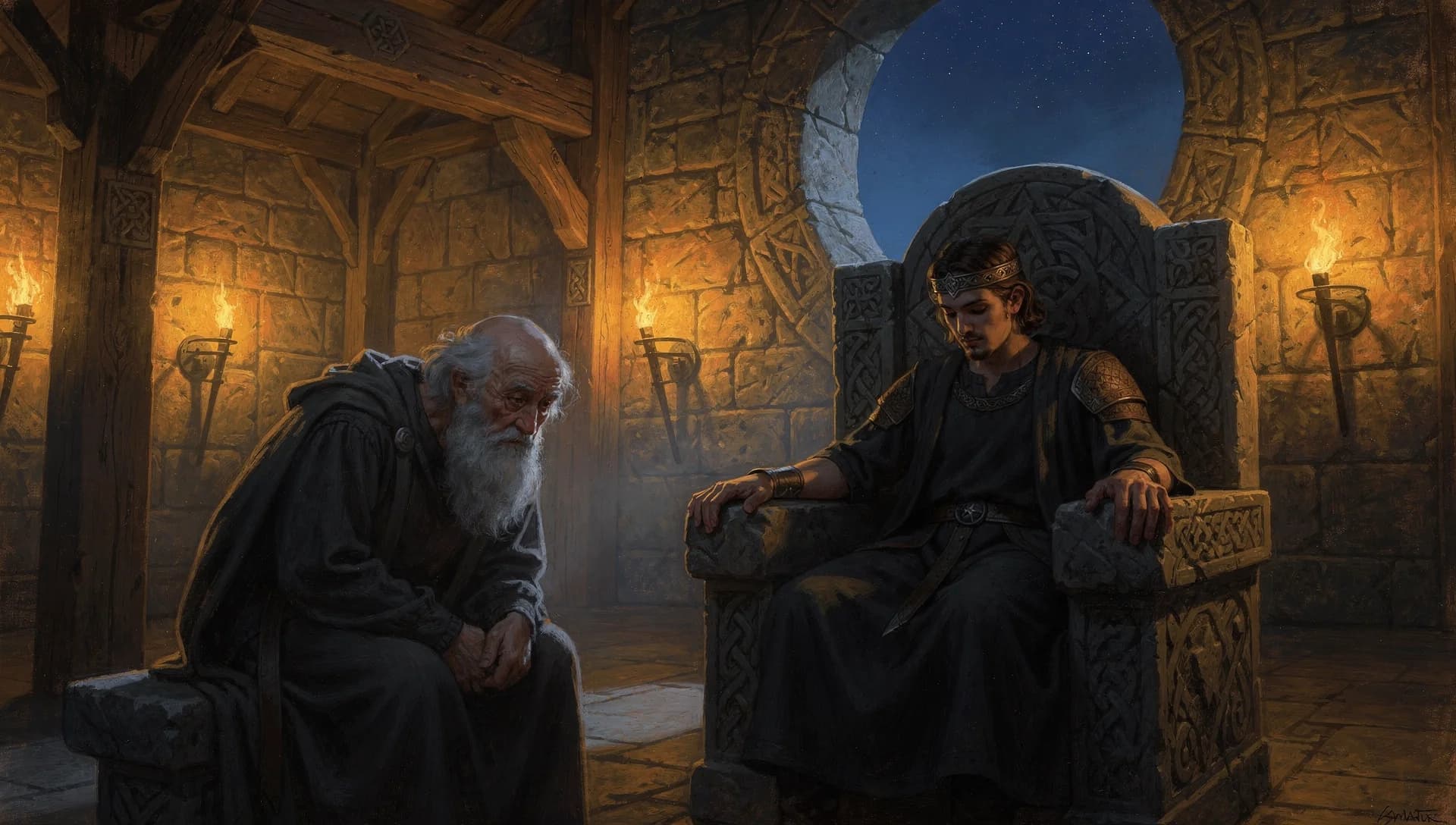
Merlin / Myrddin, the prophetic wise counselor to kings
 UB
UBCorporeal staff survivors whose memory became "wise counselor" figures
Full Article
Read the deep-dive article on this connection
Corporeal staff survivors whose memory became "wise counselor" figures = Merlin / Myrddin, the prophetic wise counselor to kings
The Connection
The Merlin/Myrddin figure of Welsh and later Arthurian tradition is a wise, long-lived advisor who stands outside normal human succession, sees the future, counsels kings, and disappears into nature or retreat rather than dying normally. This is structurally the Van pattern: a superhuman-lineage wise counselor whose role is not to rule but to guide, who outlasts the kings he serves, and whose disappearance is by translation rather than death. The Celtic bardic tradition preserves many such "wise-counselor" figures (Taliesin, Amergin), all in the same role.
UB Citation
UB 67:2.2, 67:6.4, 73:1.1
Academic Source
Geoffrey of Monmouth, Historia Regum Britanniae (c. 1136); Jarman, The Legend of Merlin (1960)
Historical Evidence(Moderate evidence)
Geoffrey of Monmouth's Historia Regum Britanniae and Vita Merlini preserve the Myrddin Wyllt tradition, a wise counselor whose biography includes prophecy, extraordinary longevity, and withdrawal into forest retreat rather than normal death. A.O.H. Jarman documented the deeper Welsh sources behind the Arthurian Merlin, including the Cyfoesi Myrddin, where Myrddin appears as a translated being. The "wise counselor outside normal succession" archetype is worldwide (Van, Enki, Hermes Trismegistus, Thoth) and appears to preserve a common underlying memory of the corporeal-staff role.
Deep Dive
The Merlin of late-medieval Arthurian romance is the most famous wise-counselor figure in Western literary tradition. He advises kings. He prophesies. He works magic. He stands outside normal human succession, neither marrying nor producing dynastic heirs in the normal way. He eventually withdraws from active counsel, either imprisoned in a tower of air by the enchantress Nimue or retiring to forest seclusion in his Welsh wilderness home.
The literary Merlin is a synthesis of multiple older traditions. Geoffrey of Monmouth's Historia Regum Britanniae (c. 1136) introduced Merlin to Anglo-Norman literary culture, drawing on earlier Welsh sources. Geoffrey's subsequent Vita Merlini (c. 1150) elaborated the figure with material from older Welsh legendary tradition. The deeper Welsh sources behind these compilations include the Cyfoesi Myrddin a Gwenddydd ei Chwaer (the Conversation of Myrddin and his Sister Gwenddydd) and the Afallennau (the Apple Trees), preserved in medieval Welsh manuscripts but drawing on much older oral tradition.
A.O.H. Jarman's The Legend of Merlin (1960) traced the Welsh sources behind the literary Arthurian Merlin. Jarman identified the figure of Myrddin Wyllt (Mad Merlin or Wild Merlin), a sixth-century Welsh prophetic figure who, after witnessing the horrors of the Battle of Arfderydd in 573 CE, retreated to madness and forest seclusion in the Caledonian Forest, where he prophesied future events and lived in extraordinary longevity. The Myrddin Wyllt material is older than the Geoffrey synthesis and represents an authentic Welsh tradition of the prophetic wise-counselor figure.
The structural pattern of the Welsh Myrddin Wyllt tradition is striking. The figure is a wise counselor who serves kings but stands outside normal political succession. He has access to prophetic knowledge that ordinary humans lack. He lives in extraordinary longevity, far beyond normal human spans. He does not die in the ordinary way; he withdraws into seclusion or is "translated" through some non-natural process. His role is to advise rather than to rule, to interpret rather than to act.
This structural pattern is identical to the UB description of Van. UB 67:6.4 describes Van as "left on Urantia until the time of Adam, remaining as titular head of all superhuman personalities functioning on the planet. He and Amadon were sustained by the technique of the tree of life in conjunction with the specialized life ministry of the Melchizedeks for over one hundred and fifty thousand years." Van does not die in the ordinary way; he is sustained by superhuman technique. He serves as titular head rather than as active ruler. He persists through enormous spans of time. His role is advisory and titular rather than executive.
The structural match between Van and the wise-counselor archetype that appears across many cultures is precise. The same archetype appears in Sumerian Enki (the wise counselor who saves humanity from the flood despite the official decree of the senior god Enlil). The same archetype appears in the Egyptian Thoth (the divine scribe and wisdom-counselor who stands outside normal divine succession). The same archetype appears in the Hellenistic Hermes Trismegistus (the thrice-great wise teacher who is neither fully god nor fully mortal). Across many cultures, the wise-counselor figure has the same structural features: extraordinary longevity, prophetic knowledge, advisory rather than ruling role, and non-ordinary departure from the world.
The UB framework treats this widespread archetype as cultural memory of the actual Van and his loyal staff. Van was a real corporeal-staff figure who survived the Lucifer rebellion, sustained himself across 150,000 years through the tree of life, and served as the titular planetary authority during the long centuries of the post-rebellion era. The cultural memory of this extraordinary figure spread outward through migration and tradition, attaching to local culture-hero figures in different traditions and producing the Merlin, Hermes Trismegistus, Enki, Thoth, and similar archetypes that recur across world cultures.
The Welsh Myrddin Wyllt tradition is one specific instantiation of this universal archetype. The historical sixth-century figure (if there was one) was apotheosized using cultural-memory templates that already existed in Celtic tradition. The templates traced ultimately to the Van memory carried by Andite-era and Salem-missionary teachers reaching Britain in the third and second millennia BCE. The historical Myrddin became, through this template-application, the latest instantiation of a wise-counselor tradition with deep roots.
The strongest counterargument is that the Merlin tradition can be fully explained as the literary apotheosis of a specific historical Welsh figure (the sixth-century Myrddin Wyllt) without invoking any deeper Van-archetype. This is a coherent reading. The post-573 CE legendary development of the Myrddin Wyllt material is well-attested.
The UB defense is that the literary apotheosis used templates that already existed before the historical Myrddin. The wise-counselor archetype with extraordinary longevity, prophetic knowledge, and non-ordinary departure is too widespread across cultures to be reduced to independent invention in each case. The Welsh Myrddin Wyllt material drew on templates that connected to the broader cross-cultural pattern, and the UB Van-archetype framework provides one coherent account of where those templates ultimately came from.
Key Quotes
“Van was left on Urantia until the time of Adam, remaining as titular head of all superhuman personalities functioning on the planet. He and Amadon were sustained by the technique of the tree of life in conjunction with the specialized life ministry of the Melchizedeks for over one hundred and fifty thousand years.”
“The presentation of this astounding demand was followed by the masterly appeal of Van, chairman of the supreme council of co-ordination. This distinguished administrator and able jurist branded the proposed course of Caligastia as an act bordering on planetary rebellion.”
Cultural Impact
The Merlin tradition has been one of the most generative figures in Western literary culture. From the Vulgate Cycle of medieval French Arthurian romance to Tennyson's Idylls of the King to T.H. White's The Once and Future King to contemporary fantasy literature, Merlin has been continually reimagined as the model of the wise advisor figure. The character has shaped Western expectations about what wisdom looks like, how it relates to political power, and how it endures across generations. The UB framework offers a way to engage with this generative tradition that takes its cultural depth seriously. Merlin is not just a literary invention; he is the Western literary expression of a universal wise-counselor archetype that preserves cultural memory of the actual Van and his loyal staff. The Merlin tradition's persistent generativity reflects the deep human resonance of the underlying archetype. For students of Western literature, this framework offers a way to read the Merlin tradition that connects it to global comparative patterns. Merlin is not just a Western figure; he is the Western expression of a universal pattern. Engaging with the tradition through this comparative lens enriches rather than diminishes the specifically Western literary inheritance.
Modern Resonance
In contemporary culture, the Merlin archetype continues to appear in various forms. From Dumbledore in the Harry Potter series to Gandalf in Tolkien's legendarium to Yoda in Star Wars, the wise old advisor figure remains one of the most generative archetypes in popular literature and film. These contemporary figures inherit from the Merlin tradition and through it from the broader cross-cultural wise-counselor archetype. The UB framework places these contemporary figures in deep historical context. They are not just imaginative inventions of contemporary authors; they are the latest expressions of a tradition that ultimately traces back to the actual Van of the post-rebellion era. The persistent appeal of the wise-counselor figure across centuries and across cultures reflects the genuine cultural memory of how superhuman wisdom-teaching actually functioned in the original civilizational mission. For contemporary readers, this framework offers a way to engage with the wise-counselor figures of popular culture that connects them to genuine historical depth. Gandalf and Yoda are not just charming inventions; they are echoes of a real tradition that preserves memory of real superhuman teachers who once worked with humanity. Engaging with them as such, rather than as mere literary devices, enriches the experience of contemporary fantasy and mythology.
Related Mappings
The Adamic-Andite arrival pattern: superhuman teachers coming from the east
= Tuatha Dé Danann, the "People of the goddess Danu" who arrived in Ireland
The first Garden of Eden, submerged under the eastern Mediterranean
= The Celtic Otherworld: Tír na nÓg, Hy-Brasil, Avalon: paradise beyond or beneath the sea
Universal cult of the Tree of Life (UB 85:2.4)
= Celtic sacred groves and the druid reverence for the oak (from which "druid" derives)
Salem missionaries reaching "even to the British Isles" after Melchizedek's incarnation
= Celtic high-god Dagda, "The Good God," father-figure of the Tuatha Dé Danann
Related Articles
Where to next
The free newsletter. The research behind each piece, no spam.