
The Shadow Beneath the Oak: Veles and the Nodite Chthonic Memory
Veles, the Slavic god of cattle, wealth, poetry, and the subterranean dead, stands in structural opposition to Perun the thunder-rider. The Perun-Veles opposition preserves the same pattern the Urantia Book documents at the root of the Planetary Rebellion: the wisdom-teaching Nodite faction versus the loyal sky-warrior lineage, encoded across Indo-European traditions as Van-Nod, Enki-Enlil, Osiris-Set, and finally as the Slavic Perun-Veles contest.
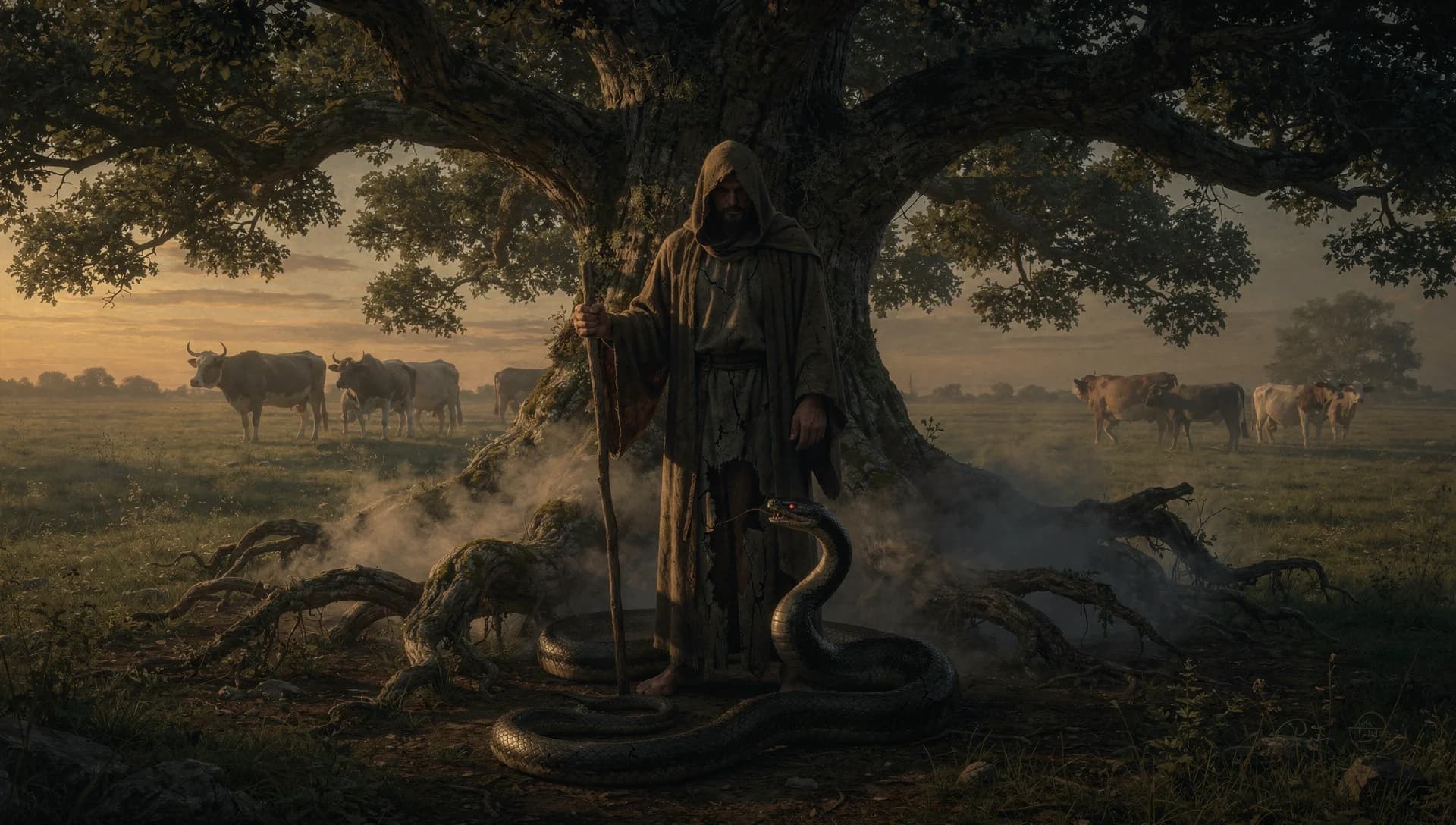
Nodite-faction chthonic memory = Veles, Slavic god of cattle, wisdom, and the underworld
This article expands on the decoder mapping. For the side-by-side card and quick reference, see the mapping page.
The Chthonic Counterpart
Across Indo-European religious traditions, the sky-warrior thunder-god is paired with a distinct kind of adversary: a chthonic figure associated with wisdom, connected to cattle and wealth, and linked to serpents, who rules the dead, guards hidden knowledge, and stands as the structural opposite of the storm-riding warrior. The Vedic Vritra holds back the waters until Indra strikes him down. The Hittite Illuyanka coils at the foot of the sky. The Norse Jörmungandr girdles the earth beneath the sea. The Greek Typhon rises from Tartarus. The Slavic Veles occupies this same structural position: the serpentine underworld sovereign who opposes Perun the thunder-rider.
But Veles is not merely an adversary. In the surviving Slavic sources, he is also the god of cattle (skotij bog), the patron of poets and singers (Veles is invoked in the twelfth-century Slovo o polku Igoreve as the patron of Boyan the bard), the guardian of wealth and commerce, and the lord of the nav, the Slavic afterlife. He is associated with moisture, rivers, forests, and the space beneath the world-tree, where the dead reside.
The Urantia Book identifies the historical substrate that this dual figure preserves.
What the Urantia Book Says
The Urantia Book documents the post-rebellion fate of the rebel faction of the Planetary Prince's corporeal staff. When the rebellion broke out, the one hundred staff members divided:
"When the final roll was called, the corporeal members of the Prince's staff were found to have aligned themselves as follows: Van and his entire court of co-ordination had remained loyal. Ang and three members of the food council had survived." (UB 67:4.1)
"The sixty members of the planetary staff who went into rebellion chose Nod as their leader. They worked wholeheartedly for the rebel Prince but soon discovered that they were deprived of the sustenance of the system life circuits. They awakened to the fact that they had been degraded to the status of mortal beings." (UB 67:4.2)
The afterlife of these rebel staff members as culturally remembered figures is described:
"The presence of these extraordinary supermen and superwomen, stranded by rebellion and presently mating with the sons and daughters of earth, easily gave origin to those traditional stories of the gods coming down to mate with mortals. And thus originated the thousand and one legends of a mythical nature, but founded on the facts of the postrebellion days, which later found a place in the folk tales and traditions of the various peoples whose ancestors had participated in these contacts with the Nodites and their descendants." (UB 67:4.3)
The chthonic character of the Nodite memory arises from a defining feature of their post-rebellion history: they were deprived of the system life circuits and thus lost their immortality, gradually dying across succeeding generations while their descendants retained racial memory of their extraordinary predecessors:
"The staff rebels, deprived of spiritual sustenance, eventually died a natural death. And much of the subsequent idolatry of the human races grew out of the desire to perpetuate the memory of these highly honored beings of the days of Caligastia." (UB 67:4.4)
The Nodite cultural stream subsequently mixed with the Adamic stream and carried the memory of the longer-lived, knowledge-bearing, death-shadowed rebel-faction ancestors into the post-Adamic populations of Russia and Turkestan:
"As the period of the early Adamic migrations ended, about 15,000 B.C., there were already more descendants of Adam in Europe and central Asia than anywhere else in the world, even than in Mesopotamia. The European blue races had been largely infiltrated." (UB 78:3.5)
What the Ancient Sources Say
Veles is attested across the full range of medieval Slavic sources. The Russian Primary Chronicle (1113 CE) records the treaties of Kievan Rus' princes Oleg (907 CE) and Sviatoslav (971 CE) with the Byzantine Empire, in which the Rus' swore oaths "by Perun, our god, and by Veles, the god of cattle." The explicit paired invocation of Perun-and-Veles in the oath formula establishes the pair as the principal dual-structure of the Kievan Rus' pantheon.
The Slovo o polku Igoreve (The Tale of Igor's Campaign, twelfth century) invokes Veles as the ancestor of the poet Boyan, establishing his literary, wisdom-keeping aspect: "Boyan, the grandson of Veles". The bardic-poetic association parallels the Norse Odin's function in wisdom and poetry and the Greek Hermes's boundary-crossing function.
Roman Jakobson's "Slavic Gods" (in Selected Writings VII, Mouton, 1985) identified Veles (Volos in East Slavic) as etymologically connected with the Vedic Vala (the demon who imprisons cattle in a cave, defeated by Indra) and the Hittite wellu- (meadow of the dead). The etymological reconstruction places Veles in a Proto-Indo-European chthonic-god lineage with shared structural features across daughter traditions.
Ivanov and Toporov's Basic Slavic Myth reconstruction identifies the Perun-Veles contest as the central organizing structure of pre-Christian Slavic religion. The contest is not primarily a battle to the death but a recurrent seasonal-cosmic tension: Perun strikes the storm-clouds from his chariot, Veles holds back the waters and the wealth, their conflict brings the rains that fertilize the earth. The structural parallel with the Indra-Vritra contest in the Rigveda is close and detailed.
The cattle association is archaeologically corroborated. Slavic sacred sites associated with Veles show cattle-sacrifice evidence, and peasant folkloric tradition preserved Veles (later syncretized with Saint Vlas / Saint Blaise) as the patron of herdsmen across Russian Orthodox Christianity into the modern period.
The underworld association is preserved in Slavic funerary practice. The nav (Slavic afterlife) was conceived as a pastoral realm where Veles tended the cattle-souls of the dead. The association of the dead with grazing cattle in a subterranean meadow is attested across Slavic folkloric tradition and connects structurally to the Hittite wellu-meadow and the Vedic Yama's pastoral afterlife.
Boris Rybakov's Yazychestvo drevnikh slavyan (Paganism of the Ancient Slavs, Nauka, 1981) remains the most comprehensive scholarly treatment of pre-Christian Slavic religion. Rybakov documents Veles-worship across the archaeological record, including the Zbruch Idol (discovered 1848 in the Zbruch River, Ukraine, ninth-tenth century CE), which depicts a four-faced Slavic deity with one face identified as Veles supporting the earth-disc on his shoulders, a cosmic-pillar function that connects the Slavic Veles to the Norse Ymir and the Greek Atlas.
Why This Mapping Matters
The Perun-Veles opposition is the most structurally significant dual-deity pattern in Slavic religion. The parallel structures across Indo-European traditions, Indra-Vritra, Thor-Jörmungandr, Zeus-Typhon, Marduk-Tiamat, are close enough that scholarly consensus treats them as reflexes of a shared Proto-Indo-European religious inheritance.
The Urantia Book's framework supplies the historical substrate that unifies the pattern: the Van-Nod split at the Planetary Rebellion produced the dual memory of the sky-riding loyal commander opposing the chthonic, knowledge-bearing, shadow-associated rebel-faction leader. The features the Nodite memory preserves, lifespans longer than normal, extraordinary knowledge, association with the mysteries of what lies beneath the world (the rebel-staff having been "degraded to the status of mortal beings" and eventually dying while their Adamic counterparts retained greater longevity), association with cattle and wealth (the Nodites were the staff responsible for animal husbandry and commerce), chthonic-mortuary role (the rebel staff eventually died and their memory was preserved in the cultural unconscious of their descendants), all map onto the Slavic Veles profile.
The Slavic preservation is especially valuable because it preserves the dual-deity structure explicitly and with full elaboration rather than compressing it or splitting it further. The Perun-Veles contest is not reduced to a single-battle mythology (as in some Indo-European traditions) but is preserved as a recurring, structural, seasonal cosmic tension, consistent with the actual Urantia historical reality in which the Van-Nod split produced not a single resolution but an ongoing cultural tension across subsequent millennia.
The bardic function of Veles has additional Urantia-framework significance. The Nodite cultural stream carried forward Adamic and pre-Adamic knowledge content: writing, astronomy, calendar, literary production (the UB identifies the Nodites as responsible for the preservation of pre-rebellion knowledge that Van and Amadon had safeguarded). The Slavic preservation of Veles as the patron of poets, bards, and hidden knowledge preserves the Nodite knowledge-bearing function in distilled mythological form.
The Slavic world-tree (Dub) imagery, treated in the companion Slavic Dub article, places Veles at the roots of the cosmic oak, consistent with the Perun-Veles pair occupying the full vertical cosmic axis (Perun in the crown-heavens, Veles at the root-underworld) that this decoder reading connects with the Dalamatian Tree of Life and its three-world cosmic structure.
Sources
- The Urantia Book, Paper 67 (The Planetary Rebellion), Paper 78 (The Violet Race After the Days of Adam). Urantia Foundation, first printing 1955. Cited passages: 67:4.1-4, 78:3.5.
- Ivanov, Vyacheslav and Vladimir Toporov. Issledovaniya v oblasti slavyanskikh drevnostey. Nauka, Moscow, 1974.
- Jakobson, Roman. "Slavic Gods." In Selected Writings VII, Mouton, 1985.
- Rybakov, Boris. Yazychestvo drevnikh slavyan (Paganism of the Ancient Slavs). Nauka, 1981.
- Povest' vremennykh let (Russian Primary Chronicle). Translated by Samuel Hazzard Cross and Olgerd P. Sherbowitz-Wetzor, Mediaeval Academy of America, 1953.
- Slovo o polku Igoreve (The Tale of Igor's Campaign). Translated by Vladimir Nabokov, McGraw-Hill, 1960.
- Gimbutas, Marija. The Slavs. Praeger, 1971.
- Dumézil, Georges. Mythe et épopée. Gallimard, 1968-1973.
Confidence and Evidence
- Confidence: INFORMED SPECULATION
- Evidence rating: MODERATE
- Basis: The Urantia Book documents the Van-Nod split at UB 67:4 and the survival of Nodite memory in post-rebellion cultural tradition at 67:4.3-4. The Slavic Perun-Veles dual opposition preserves the pattern (loyal sky-warrior versus knowledge-bearing chthonic adversary) that the UB identifies across Indo-European mythological preservations. The cluster of cattle, wisdom, and underworld that the Veles profile preserves matches the Nodite staff-function memory.
Related Decoder Articles
By Derek Samaras
Connecting Articles
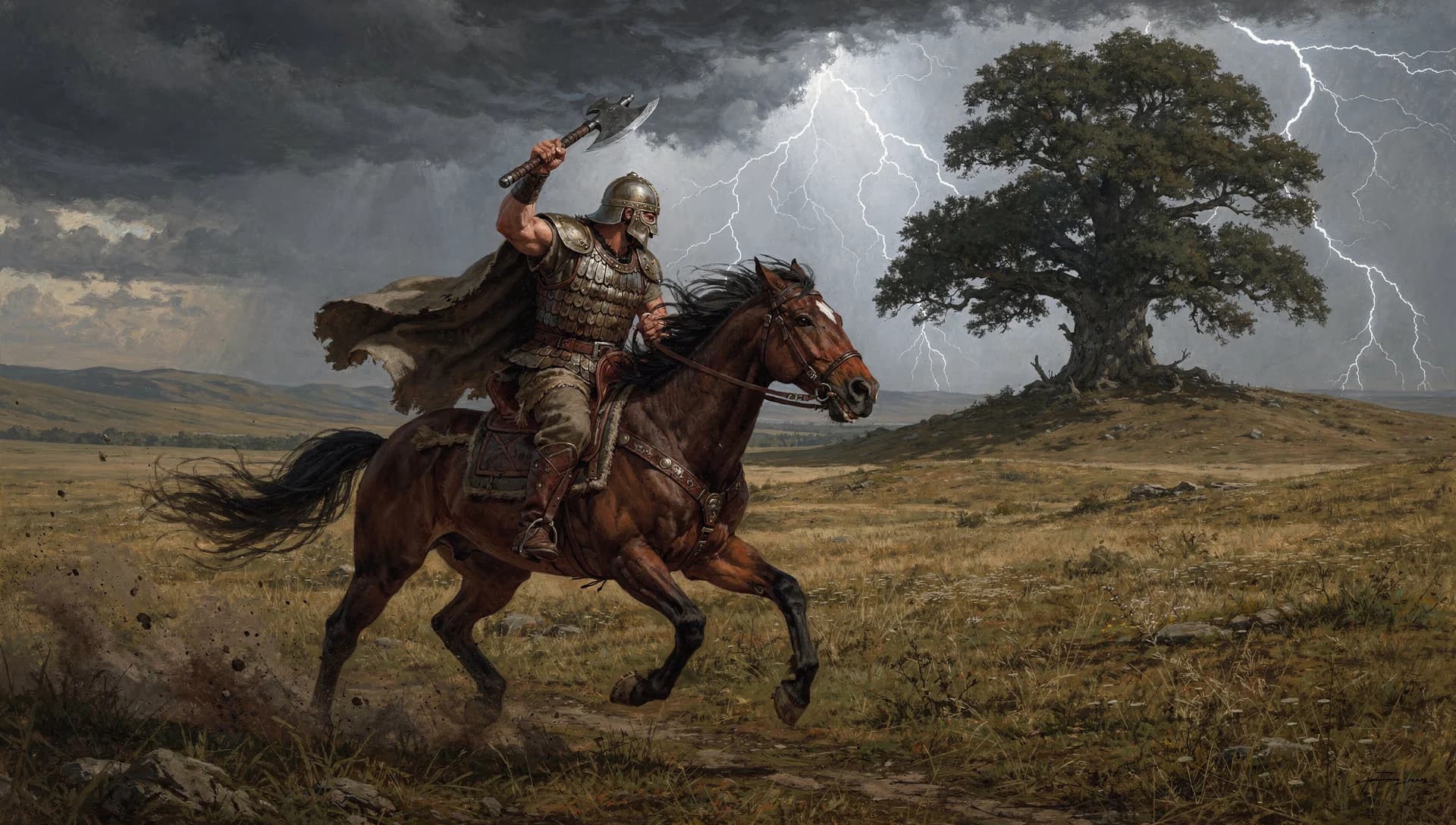
The Thunder-Rider Across the Russian Plains: Perun and the Andite Cavalry
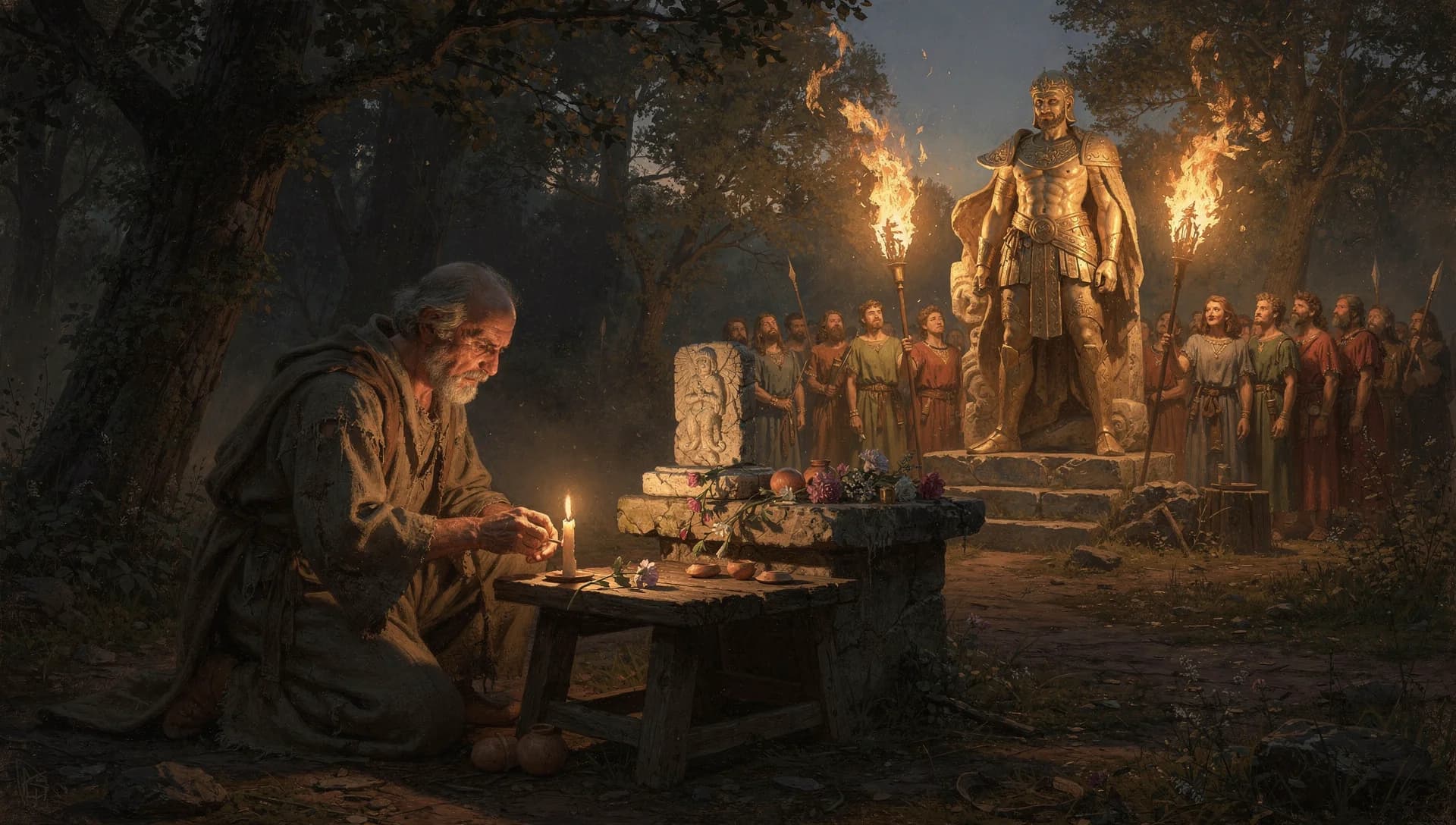
The Forgotten Father: Rod, Svarog, and the Salem Monotheism Layer in Slavic Religion
Three Towers, One Name: Bablot, Bablod, Babel, and the Migration of the Tower Story
Kings Who Lived Too Long: The Nodite Dynasty and the Sumerian King List
The Newsletter
Get the research behind each piece
Free. New Urantia Book explorations, the sources behind the videos, and early looks. No spam, unsubscribe anytime.
Prefer video? Follow on YouTube and Facebook.
Delivered through Substack. You can also read past issues.