
The Counselor Who Was Older Than the King: Merlin and the Wise Counselor Archetype
The Arthurian tradition preserves Merlin as a wise counselor whose age, origin, and specific capacities exceed ordinary human categories. The Urantia Book documents the historical substrate: descendants of the corporeal staff of Dalamatia and the subsequent Adamic-Andite wisdom-keepers carried superhuman knowledge into European cultural memory, where it coalesced into the figure of the prophetic wise counselor who advises kings.
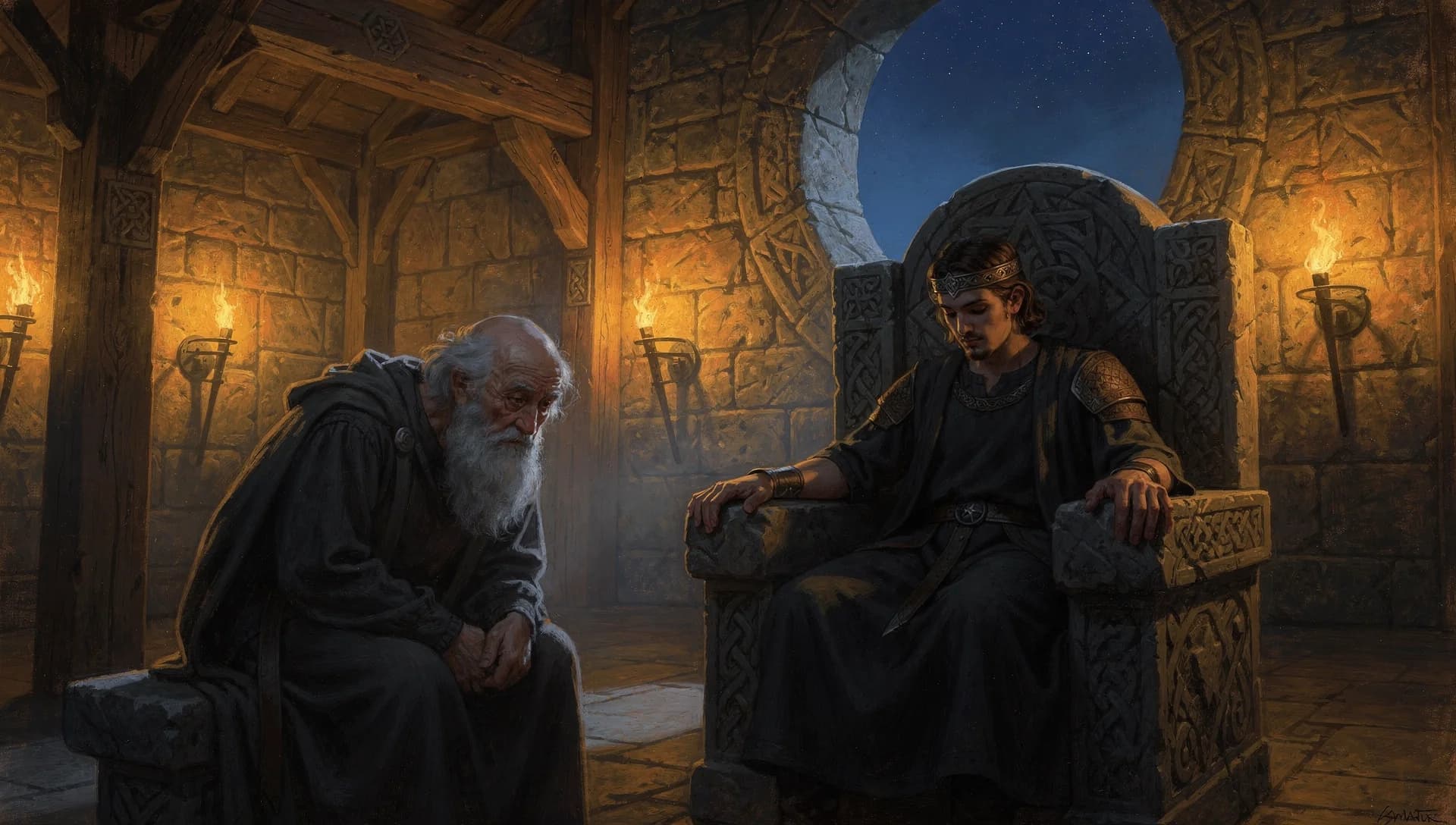
Corporeal staff survivors whose memory became "wise counselor" figures = Merlin / Myrddin, the prophetic wise counselor to kings
This article expands on the decoder mapping. For the side-by-side card and quick reference, see the mapping page.
The Archetype That Keeps Reappearing
Merlin (Myrddin in Welsh) is the most famous European example of a recurring archetype: the wise counselor whose age and knowledge exceed ordinary human categories, who advises kings, who holds prophetic or visionary capacities, and whose ultimate origin is deliberately obscure. The archetype appears elsewhere in world mythology (Nestor advising Agamemnon, Moses's father-in-law Jethro, the Chinese sages of the Zhou court, the Irish fili tradition), but the Arthurian Merlin has received the most sustained literary development.
The distinctive features of the archetype are consistent. The wise counselor is older than ordinary humans (sometimes supernaturally old). His knowledge extends beyond what direct experience could have provided. His prophetic capacities are genuine within the narrative framework. His role is advisory rather than sovereign; he guides the king without replacing him. His eventual departure or withdrawal is often explicitly non-mortal (Merlin's imprisonment in a crystal cave or tree by Nimue, rather than a simple death).
The Urantia Book documents the historical substrate that produces this recurring archetype.
What the Urantia Book Says
The specific historical elements that could seed the wise-counselor archetype include:
First, the corporeal staff of Dalamatia and their Amadonite associates. The staff's modified Andonite assistants lived across multiple centuries (the pure-line staff members were effectively immortal through the tree of life). The Amadonite descendants preserved the staff's cultural-religious teaching through the post-rebellion dark ages. Specific named individuals in this lineage carried superhuman or long-lived knowledge forward.
Second, Van and Amadon specifically. Van's vigil of more than 150,000 years at the highland retreat after the rebellion (treated in the companion Van-Odin decoder article) represents the prototype of the long-lived wise advisor who preserves cosmic knowledge through ages of decline and who advises subsequent generations of emerging civilizational leaders.
Third, the Salem missionary lineage. Machiventa's 94-year incarnation and his subsequent successors (the hermit-scholars of the Salem school) established an ongoing lineage of wisdom-teachers who carried specifically superhuman-derived knowledge into European cultural environments for centuries.
Paper 67 describes Van's specific role:
"Van was left on Urantia until the time of Adam, remaining as titular head of all superhuman personalities functioning on the planet. He and Amadon were sustained by the technique of the tree of life in conjunction with the specialized life ministry of the Melchizedeks for over one hundred and fifty thousand years." (UB 67:6.4)
Van's post-rebellion role is specifically described as the maintenance of continuity, the teaching of successive generations, and the guardianship of the tree of life. He functions, in the Urantia narrative, as the prototype of the long-lived wise counselor who advises subsequent generations of emerging planetary leadership.
Paper 93 describes the continuing Salem missionary tradition:
"Melchizedek continued for some years to instruct his students and to train the Salem missionaries, who penetrated to all the surrounding tribes, especially to Egypt, Mesopotamia, and Asia Minor. And as the decades passed, these teachers journeyed farther and farther from Salem, carrying with them Machiventa's gospel of belief and faith in God." (UB 93:7.1)
"Salem missionaries penetrated all Europe, even to the British Isles." (UB 93:7.2)
The reach of the Salem missionary tradition into the British Isles is the geographic link between the general wisdom counselor archetype and the Celtic Merlin tradition. Salem-descended missionaries, carrying teaching of superhuman origin and preserving institutional memory over long spans, reached the British Isles in the post-Melchizedek centuries. Their descendants and the cultural memory of their capacities would have coalesced in the Celtic imagination into the figure of the wise counselor who advises kings with knowledge exceeding ordinary human experience.
What the Ancient Sources Say
Merlin/Myrddin's textual emergence is relatively well-documented. The earliest Welsh material (the Myrddin poems preserved in the Black Book of Carmarthen and subsequent manuscripts) presents Myrddin as a wild-man prophet, maddened by battle, speaking oracularly from the forest. The development of Merlin as the Arthurian court counselor is substantially the work of Geoffrey of Monmouth in his Historia Regum Britanniae (c. 1136) and Vita Merlini (c. 1150), which combined the Welsh Myrddin traditions with classical prophet-figures (particularly the Sibylline tradition) to produce the Merlin figure of subsequent Arthurian romance.
A. O. H. Jarman's The Legend of Merlin (University of Wales Press, 1960) and Rachel Bromwich's Trioedd Ynys Prydein (University of Wales Press, 1961; revised 2006) document the Welsh sources. Nikolai Tolstoy's The Quest for Merlin (Little, Brown, 1985) treats the broader question of Merlin's possible historical roots.
The scholarly consensus treats Merlin as a composite figure: genuine Welsh prophetic tradition (preserving possibly pre-Christian Celtic druidic-oracular material) combined with medieval literary development that drew on classical and Christian wisdom-figure conventions. The specifically historical substrate is contested; some scholars (Jarman, Tolstoy) argue for genuine historical origins in sixth-century North Britain, while others treat Merlin as essentially a literary construction drawing on typological conventions.
The Urantia Book's framework suggests that both readings capture part of the truth. The Merlin figure has historical antecedents in the long-lived wisdom counselor tradition that the corporeal staff and its successors introduced into European cultural memory. The Welsh Myrddin tradition preserves one cultural formation of this substrate, shaped by the particular features of Celtic British religious-poetic culture. The subsequent Geoffrey of Monmouth development elaborated the figure using the available classical and Christian literary conventions, but the underlying substrate it drew on was already a preserved memory of long-lived counselor figures.
The druidic tradition is directly relevant here. Julius Caesar's Gallic War (Book VI) describes the druids as preserving ancient knowledge transmitted orally across generations, with training requirements of twenty years for full druidic proficiency. Miranda Aldhouse-Green's Caesar's Druids (Yale University Press, 2010) documents the Roman-period evidence. The druids were the Celtic institution preserving religious knowledge across generations in a manner structurally parallel to the Indian Brahmin caste or the Jewish priestly tradition. The Urantia Book's identification of the Sethite-Brahmin lineage as derived from Adamic Dalamatian-era teachers (treated in the companion Sethite-Brahmin decoder article) supports a similar reading for the Celtic druidic tradition: the druids, and by extension the Merlin figure, preserve the cultural memory of Adamic-Andite-Salem wisdom transmission reaching the British Isles.
Why This Mapping Matters
The wise-counselor archetype is one of the most widely distributed features in world mythological tradition. Its features (extraordinary age or long life, superhuman knowledge, prophetic capacity, advisory rather than sovereign role, non-mortal withdrawal) are not universal mythological conventions; they appear in cultures with documented or plausible Adamic-Andite-Salem substrate contact.
The Urantia Book's framework identifies the common historical source. Particular long-lived individuals (the corporeal staff members sustained by the tree of life, Van, Amadon, Machiventa Melchizedek during his 94-year incarnation, the subsequent Salem missionary lineage) introduced into world cultural memory the experience of encountering human-appearing beings whose age, knowledge, and capacities exceeded ordinary human limits. The memory of these encounters, preserved across millennia of oral and textual transmission, crystallized in various receiving cultures into the wise-counselor archetype.
The Celtic Merlin is one preservation of this archetype, shaped by the Welsh and British cultural environment. The Chinese sage tradition is another preservation. The Irish fili tradition is another. The Indian rishi tradition is another. The details differ across cultures; the underlying archetype preserves the same historical substrate.
This reading has implications for how the Arthurian tradition should be read. Merlin is not merely a literary construction; he is the preserved cultural memory of real encounters with long-lived wisdom-teachers whose historical substrate traces back through the Salem missionary tradition to the corporeal staff of Dalamatia. The Arthurian narrative's treatment of Merlin as a genuine advisor whose knowledge exceeds Arthur's own is structurally consistent with the cultural memory of actual wisdom-counselor presence in the Celtic-British environment.
The mapping's broader significance is that it identifies an archetypal persistence across world mythology that traces back to a specific historical substrate. The figure of the wise old counselor, guide of kings and heroes, preserver of cosmic knowledge, prophet of futures, one who withdraws rather than dies: this figure appears consistently because he has real historical antecedents. The Urantia framework makes the antecedents explicit.
Sources
- The Urantia Book, Paper 67 (The Planetary Rebellion), Paper 93 (Machiventa Melchizedek). Urantia Foundation, first printing 1955. Cited passages: 67:6.4, 73:1.1, 93:7.1, 93:7.2.
- Geoffrey of Monmouth. The History of the Kings of Britain. Translated by Lewis Thorpe, Penguin Classics, 1966.
- Geoffrey of Monmouth. The Life of Merlin (Vita Merlini). Edited and translated by Basil Clarke, University of Wales Press, 1973.
- Jarman, A. O. H. The Legend of Merlin. University of Wales Press, 1960.
- Bromwich, Rachel. Trioedd Ynys Prydein: The Triads of the Island of Britain. University of Wales Press, 1961; revised 2006.
- Tolstoy, Nikolai. The Quest for Merlin. Little, Brown, 1985.
- Aldhouse-Green, Miranda. Caesar's Druids: Story of an Ancient Priesthood. Yale University Press, 2010.
- Mac Cana, Proinsias. Celtic Mythology. Hamlyn, 1970; revised 1983.
Confidence and Evidence
- Confidence: INFORMED SPECULATION
- Evidence rating: MODERATE
- Basis: The Urantia Book documents long-lived wisdom counselor figures (Van, Amadon, Machiventa, the Salem missionary lineage) whose historical presence in cultural memory plausibly seeds the widespread wise-counselor archetype. The Celtic Merlin is one preservation of this archetype shaped by the British cultural environment. The druidic tradition provides the institutional preservation mechanism.
Related Decoder Articles
- Van, Sustained by the Tree of Life = Odin on Yggdrasil
- Tuatha Dé Danann = Adamic-Andite Arrival in Ireland
- Machiventa Melchizedek = Deleted Priest-King of Genesis
By Derek Samaras
Connecting Articles
The Good God of Ireland: Dagda and the Salem High-God Imprint
The Oak Priests: Druids, Sacred Groves, and the Universal Tree Cult
The Eternal Smith: Ilmarinen, the Kalevala, and the Craftsman-Sage Pattern of the Prince's Staff
The Ones Who Came First: The Dalamatian Staff and the Navajo Holy People
The Newsletter
Get the research behind each piece
Free. New Urantia Book explorations, the sources behind the videos, and early looks. No spam, unsubscribe anytime.
Prefer video? Follow on YouTube and Facebook.
Delivered through Substack. You can also read past issues.