
The Thunder-Rider Across the Russian Plains: Perun and the Andite Cavalry
Perun, the Slavic god of sky and thunder who rides a chariot through the heavens wielding a hammer or axe, sits in the same Indo-European lineage as Norse Thor and Vedic Indra. The Urantia Book records that hard-riding Andite horsemen moved westward across the Russian plains between 6000 and 5000 BCE. Perun is the Slavic memory of the same military migration stream that the UB names, preserved at the Slavic end of the Indo-European thunder-god diffusion.
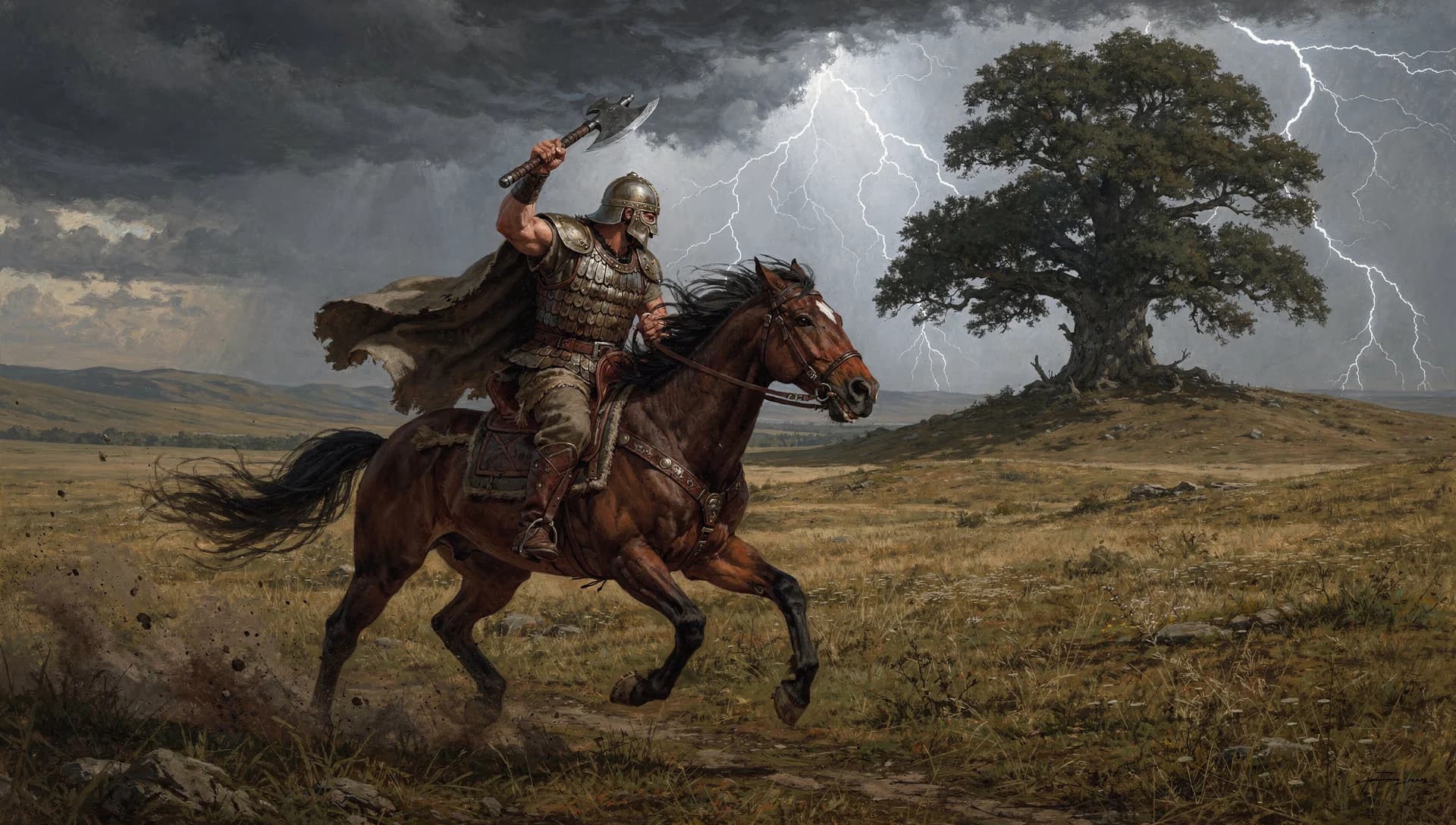
Andite horseman remembered as thunder-god = Perun, Slavic god of sky and thunder with a hammer or axe
This article expands on the decoder mapping. For the side-by-side card and quick reference, see the mapping page.
The Indo-European Thunder-God Pattern
Across the Indo-European language family, one mythological figure recurs with striking structural consistency: a sky-riding warrior deity wielding a thunder weapon (hammer, axe, mace, or bolt), associated with horses and chariots, victorious over a serpent or dragon adversary. Norse Thor carries Mjölnir. Vedic Indra wields the vajra. Baltic Perkūnas strikes with the thunder-axe. Celtic Taranis swings the wheel. The Slavic Perun occupies the same structural position: the thunder-riding warrior-god opposing the chthonic serpent-adversary Veles.
The scholarly reconstruction of Proto-Indo-European mythology (Georges Dumézil's trifunctional thesis, Calvert Watkins's comparative poetics, Vyacheslav Ivanov and Vladimir Toporov's Basic Myth analysis) treats the thunder-god motif as one of the clearest comparative reconstructions available in Indo-European studies. The structural elements, the sky warrior riding through the heavens, the thunder weapon, the serpent adversary, are preserved across languages that separated thousands of years ago and across territories spanning from Ireland to India.
The Urantia Book records the historical military movement that underlies this diffusion.
What the Urantia Book Says
The Urantia Book describes the later Andite migration waves as military, mounted, and westward across the Russian and Eurasian corridor:
"While the Andites poured into Europe in a steady stream, there were seven major invasions, the last arrivals coming on horseback in three great waves." (UB 80:4.1)
The role of the horse in Andite dominance is named:
"But the horse was the evolutionary factor which determined the dominance of the Andites in the Occident. The horse gave the dispersing Andites the hitherto nonexistent advantage of mobility, enabling the last groups of Andite cavalrymen to progress quickly around the Caspian Sea to overrun all of Europe." (UB 80:4.4)
The westward movement across the Russian plains in the sixth and seventh millennia BCE is documented:
"The whole inhabited world, outside of China and the Euphrates region, had made very limited cultural progress for ten thousand years when the hard-riding Andite horsemen made their appearance in the sixth and seventh millenniums before Christ. As they moved westward across the Russian plains, absorbing the best of the blue man and exterminating the worst, they became blended into one people." (UB 80:4.5)
The UB identifies a commander of these northern Andite forces whose memory became divinized in Norse tradition as Thor. Historical reconstruction of the Slavic Perun places him in the same Indo-European migration corridor: the Russian plains, the Dnieper, the Volga, the Don.
What the Ancient Sources Say
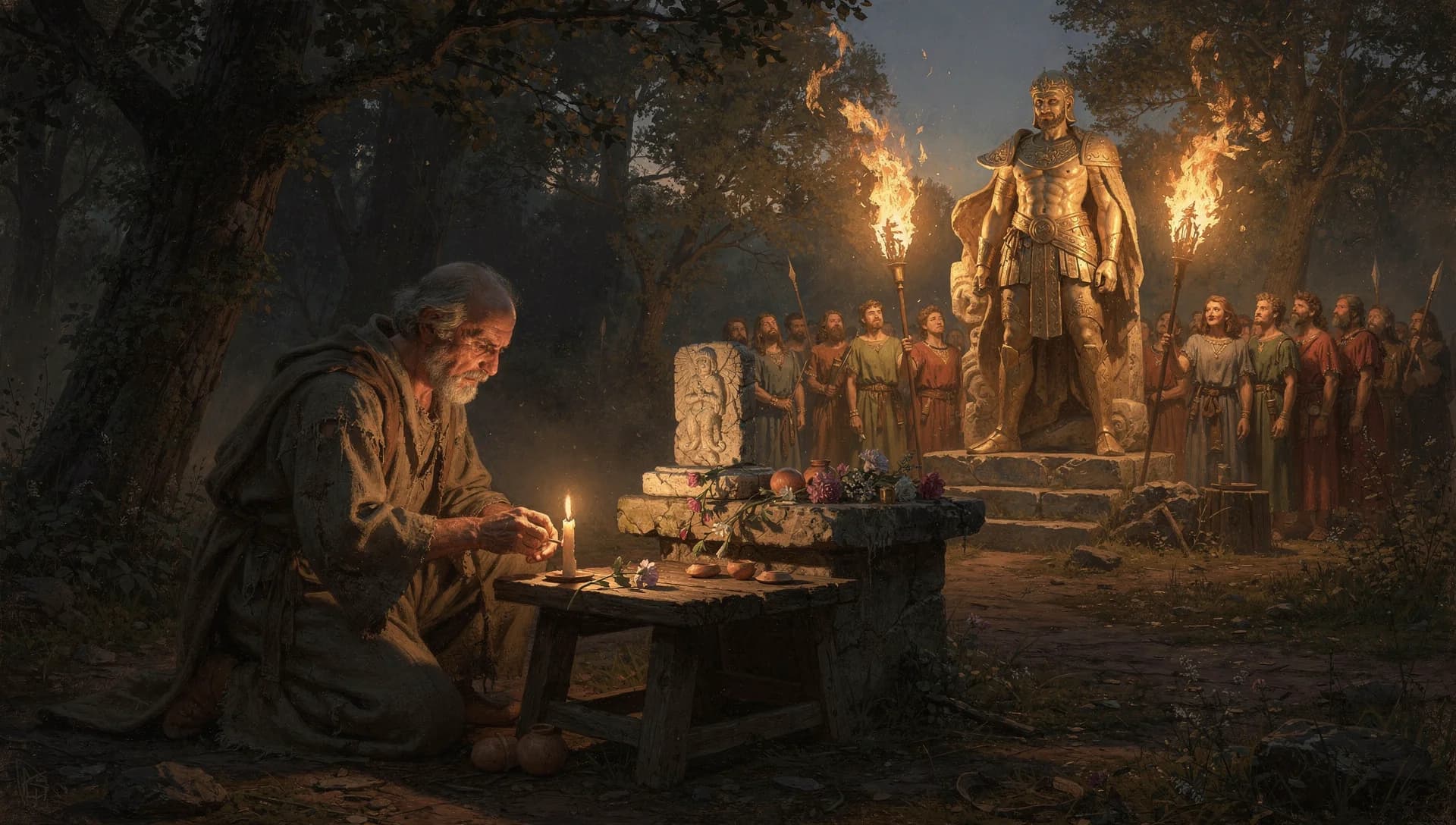
Perun is attested in the Russian Primary Chronicle (the Povest' vremennykh let, compiled approximately 1113 CE), which records Prince Vladimir I of Kiev's 980 CE installation of a Perun idol on a hill above the Dnieper before his 988 CE conversion to Orthodox Christianity. The chronicle describes Perun as the chief deity of the Kievan Rus' pantheon, with a silver head and golden moustache, depicted alongside Khors, Dazhbog, Stribog, Simargl, and Mokosh.
Ivanov and Toporov's Issledovaniya v oblasti slavyanskikh drevnostey (Investigations in the Field of Slavic Antiquities, Nauka, 1974) reconstructed the "Basic Slavic Myth" from fragmentary textual and folkloric evidence: Perun, the sky-god, battles Veles, the chthonic serpent-god, across the storm-cloud heavens, striking with thunder-bolts that bring rain and fertility. The structural parallels with the Vedic Indra-Vritra battle and the Norse Thor-Jörmungandr contest are close and detailed.
Baltic parallels (Lithuanian Perkūnas, Latvian Pērkons, Old Prussian Perkūnas) show the same thunder-god structure with shared etymology. Marija Gimbutas's The Balts (Praeger, 1963) documented the Baltic Perkūnas cult and its Indo-European structural parallels. Gimbutas's broader Kurgan hypothesis, identifying the Pontic-Caspian steppe as the Indo-European homeland and the source of the cavalry-based westward expansion, parallels the UB's description of the Andite migration corridor. The archaeological evidence for horse-mounted Pontic-Caspian pastoralists expanding westward in the fourth and third millennia BCE has been substantially developed since Gimbutas by David Anthony's The Horse, the Wheel, and Language (Princeton University Press, 2007) and by ancient-DNA studies documenting the "Yamnaya" genetic signature's westward spread.
The features the Slavic Perun tradition preserves are consistent: horse and chariot imagery (Perun is carried through the heavens by a chariot), a thunder weapon (the axe or hammer, with Baltic cognates preserving the axe), an oak association (Perun is "he who dwells in the oak", with sacred oaks serving as his primary cult sites), a serpent adversary (Veles as the chthonic opposite), and a tie to military kingship (Perun is the deity of the warrior-prince class, invoked in oath-taking and war-making).
Why This Mapping Matters
The comparative question of Indo-European thunder-god diffusion has been treated across a substantial literature. The Proto-Indo-European thunder-god (reconstructed as *Perkwunos, *Tonaros, or similar forms) is one of the most robust mythological reconstructions available in the field. The structural elements, thunder weapon plus sky riding plus serpent adversary plus horse association, are preserved across Indo-European daughter traditions with a consistency that rules out independent parallel development.
The Urantia Book's framework supplies the historical substrate: hard-riding Andite cavalrymen moving westward across the Russian plains in the sixth and seventh millennia BCE. The Slavic preservation of the thunder-god motif sits at the Slavic end of the diffusion: the Andite cavalry passing through and absorbing the proto-Slavic populations, leaving the cultural memory of the mounted, victorious, weapon-wielding commander crystallized across subsequent millennia into the Perun tradition.
The Andite and Slavic contact zone is identified in the UB framework as the Russian-Pontic region where the Adamic-Nodite mixed populations absorbed the blue race and seeded the subsequent Indo-European expansion. The commanders of this cavalry (divinized variously as Thor among the north Andites, Indra among the east Andites, Perun among the west-central Andites) represent the shared historical figure preserved through diverging cultural and linguistic lineages.
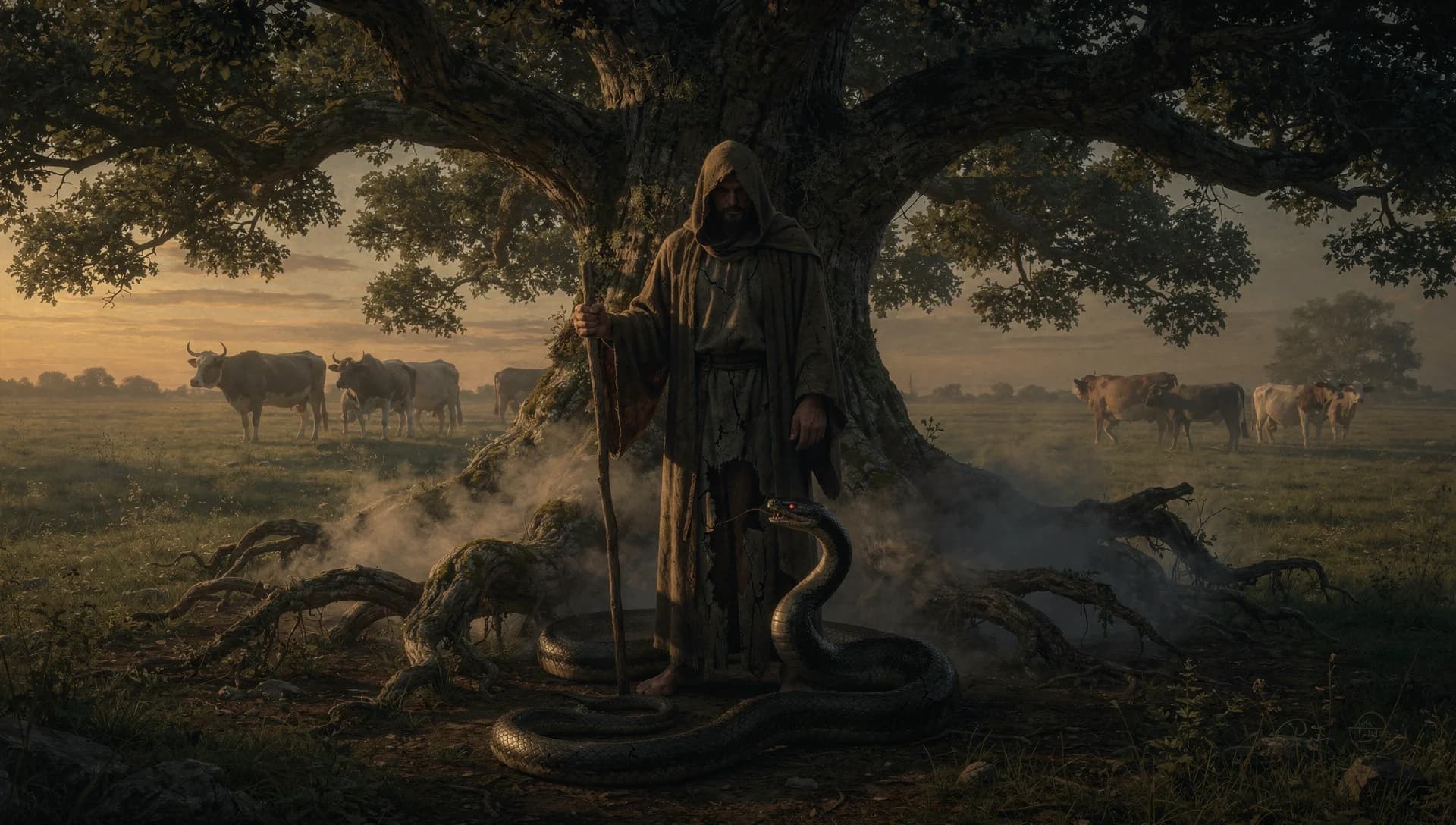
The Perun and Veles opposition carries real weight in the Urantia framework. Veles, the chthonic adversary, preserves Nodite faction memory (treated in the companion Veles article): the rebel commander remembered as the shadow figure opposing the loyal commander. The Slavic preservation of that two-faction opposition, encoded as Perun against Veles, preserves the rebellion against loyalty structure the UB identifies in the Van-Nod split at the root of the Planetary Rebellion.
The oak association the Slavic Perun preserves carries further significance in the Urantia framework, treated in the companion Slavic Dub article: Perun's cult at sacred oaks preserves the Van-era tree-of-life tradition that the UB documents as originating on Dalamatia and preserved through the Nodite and Amadonite cultural streams.
Sources
- The Urantia Book, Paper 78 (The Violet Race After the Days of Adam), Paper 80 (Andite Expansion in the Occident). Urantia Foundation, first printing 1955. Cited passages: 78:3.5, 80:4.1, 80:4.4, 80:4.5, 80:5.4.
- Ivanov, Vyacheslav and Vladimir Toporov. Issledovaniya v oblasti slavyanskikh drevnostey. Nauka, Moscow, 1974.
- Gimbutas, Marija. The Balts. Praeger, 1963.
- Gimbutas, Marija. The Slavs. Praeger, 1971.
- Anthony, David W. The Horse, the Wheel, and Language: How Bronze-Age Riders from the Eurasian Steppes Shaped the Modern World. Princeton University Press, 2007.
- Dumézil, Georges. Mythe et épopée. Gallimard, 1968-1973 (three volumes).
- Jakobson, Roman. "Slavic Gods." In Selected Writings VII, Mouton, 1985.
- Rybakov, Boris. Yazychestvo drevnikh slavyan (Paganism of the Ancient Slavs). Nauka, 1981.
- Povest' vremennykh let (Russian Primary Chronicle). Translated by Samuel Hazzard Cross and Olgerd P. Sherbowitz-Wetzor, Mediaeval Academy of America, 1953.
Confidence and Evidence
- Confidence: UB CONFIRMED
- Evidence rating: STRONG
- Basis: The Urantia Book directly documents the hard-riding Andite horsemen appearing in the sixth and seventh millenniums before Christ and moving westward across the Russian plains (80:4.5). The divinizing of military commanders is our reading of the later Slavic material, not something the book records. The Slavic Perun's structural features (horse riding, thunder weapon, westward facing sky warrior, serpent adversary) are consistent with preservation of the same substrate that produced the Norse Thor and Vedic Indra. The Indo-European thunder-god reconstruction is one of the most robust in comparative mythology.
Related Decoder Articles
By Derek Samaras
Connecting Articles
The Forgotten Father: Rod, Svarog, and the Salem Monotheism Layer in Slavic Religion
The Shadow Beneath the Oak: Veles and the Nodite Chthonic Memory
The Longest Memory: Australian Aboriginal Dreamtime and the Primordial Teaching-Ancestors
The Final Adjudication: Ragnarok and the Pending Verdict
The Newsletter
Get the research behind each piece
Free. New Urantia Book explorations, the sources behind the videos, and early looks. No spam, unsubscribe anytime.
Prefer video? Follow on YouTube and Facebook.
Delivered through Substack. You can also read past issues.