
The People Who Came From the East: Tuatha Dé Danann and the Adamic-Andite Arrival Pattern
Irish mythology preserves a specific historical memory: the Tuatha Dé Danann, superhuman teachers who arrived in Ireland from a distant land, brought civilization, established the sacred sites, fought with prior inhabitants, and eventually withdrew into the sidhe (hollow hills) when their era ended. The Urantia Book documents the historical pattern: the westward spread of Adamic-Andite populations and their Salem missionary successors reached the British Isles.
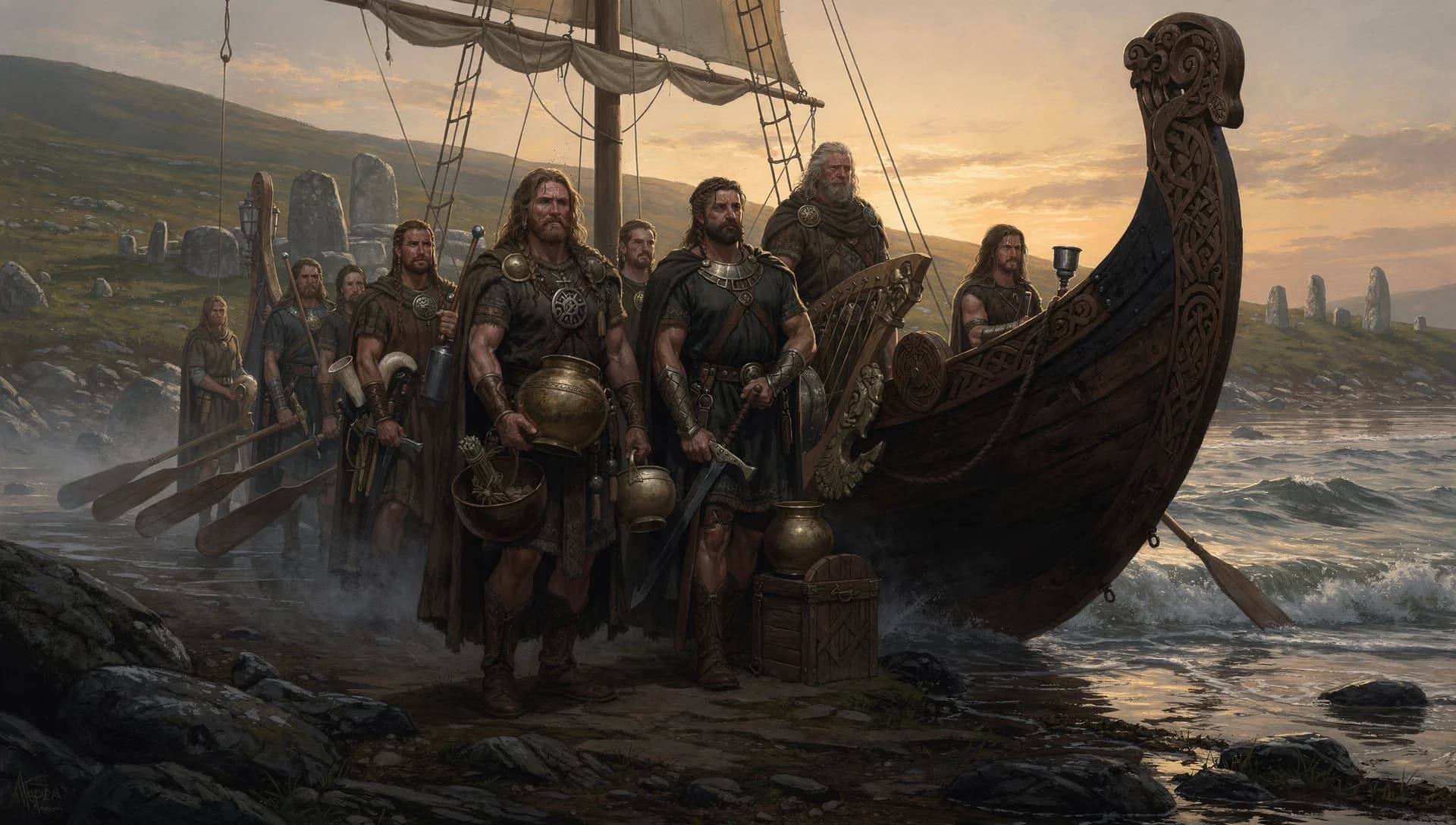
The Adamic-Andite arrival pattern: superhuman teachers coming from the east = Tuatha Dé Danann, the "People of the goddess Danu" who arrived in Ireland
This article expands on the decoder mapping. For the side-by-side card and quick reference, see the mapping page.
The Irish Memory of a Specific Arrival
The Irish mythological cycle preserves, with unusual structural consistency, the memory of a single arrival. The Tuatha Dé Danann ("People of the goddess Danu") came to Ireland from a distant eastern homeland, arrived in Ireland through what the texts variously describe as ships or a magical cloud, defeated the prior inhabitants (the Fir Bolg and the Fomorians), established the sacred sites and ritual traditions of Ireland, and eventually yielded political authority to the incoming Milesians (the Gaels), at which point the Tuatha withdrew into the sidhe (hollow hills) where they remain accessible to those with appropriate spiritual sensitivity.
The historical character of this memory is striking. Most world mythologies locate their divine beings in atemporal mythological realms. The Irish tradition treats the Tuatha Dé Danann as historical arrivals from a definite place at a definite time, with political and cultural consequences. The tradition dates their arrival to approximately 1500 BCE to 1000 BCE depending on the chronological reconstruction.
The Urantia Book identifies the historical substrate that the Irish tradition preserves.
What the Urantia Book Says
The general westward movement of Adamic-Andite populations into Europe is documented across Paper 80. The westward reach into Britain is described:
"By 5000 B.C. the evolving white races were dominant throughout all of northern Europe, including northern Germany, northern France, and the British Isles." (UB 80:5.8)
The Salem missionary reach into the British Isles is specified:
"Salem missionaries penetrated all Europe, even to the British Isles. One group went by way of the Faroes to the Andonites of Iceland, while another traversed China and reached the Japanese of the eastern islands." (UB 93:7.2)
The broader pattern of westward cultural transmission is named:
"The descendants of Adamson, clustered about the shores of the lake of Van, were willing listeners to the Hittite teachers of the Salem cult. From this onetime Andite center, teachers were dispatched to the remote regions of both Europe and Asia." (UB 93:7.2)
The Urantia framework therefore documents multiple westward movements that reached the British Isles: the late Andite migrations of the fifth millennium BCE (establishing the racial substrate of the British Isles population), the Hittite-Adamsonite Salem missionary activity of the second millennium BCE (carrying Salem-derived religious teaching), and subsequent waves of cultural transmission carrying Salem-derived material into Celtic religious life.
The Tuatha Dé Danann, on this framework, preserve the memory of one or more of these westward arrival waves. The "People of the goddess Danu" may preserve the memory of the Adamsonite migration (the descendants of Adamson and Ratta, treated in the companion decoder article), whose eastern highland homeland at the Kopet Dagh corresponds to the distant-eastern origin the Irish tradition preserves. Alternatively, the Tuatha may preserve the memory of the Salem missionary waves that reached the British Isles in the post-Machiventa period. Either identification is consistent with the Urantia framework; the choice between them is interpretive.
What the Ancient Sources Say
The principal sources for the Tuatha Dé Danann are the Lebor Gabála Érenn (Book of Invasions, c. 11th century CE compilation of earlier material), the Mythological Cycle texts (including the Cath Maige Tuired, "The Second Battle of Mag Tuired"), and the subsequent Irish folklore tradition. The standard modern scholarly treatments include Proinsias Mac Cana's Celtic Mythology (Hamlyn, 1970), Miranda Aldhouse-Green's Celtic Goddesses (British Museum Press, 1995), and John Carey's A Single Ray of the Sun: Religious Speculation in Early Ireland (Andover, 1999).
The Tuatha Dé Danann narrative preserved in the Lebor Gabála Érenn includes these features:
First, arrival from a distant eastern homeland. The Tuatha are said to have come from four mythical cities (Falias, Gorias, Murias, Finias) located in the east, where they learned their arts and skills before departing for Ireland.
Second, the associated arts. Each of the four eastern cities is tied to one art of civilization: poetry and wisdom (Falias), smithcraft (Gorias), healing (Murias), druidic magic (Finias). The Tuatha brought four treasures from these cities: the Stone of Fal, the Spear of Lugh, the Cauldron of the Dagda, the Sword of Nuada.
Third, an arrival mechanism. The Lebor Gabála reports the Tuatha arriving in Ireland "in dark clouds" or on ships, defeating the Fir Bolg at the First Battle of Mag Tuired, establishing their rule, and subsequently defeating the Fomorians at the Second Battle of Mag Tuired.
Fourth, a definite withdrawal. After the arrival of the Milesians (the Gaelic ancestors of the historical Irish), the Tuatha Dé Danann withdrew into the sidhe (hollow hills) by agreement. They remain, in Irish folk tradition, the inhabitants of these underground realms and continue to influence Irish life at set seasonal thresholds (particularly Samhain and Beltane).
The scholarly reconstruction of the Tuatha Dé Danann has produced multiple interpretive frameworks. One approach (Georges Dumézil's tripartite Indo-European framework applied to Celtic material) treats the Tuatha as the gods of the Celtic pantheon preserved in euhemerized historical form. Another approach (Proinsias Mac Cana) treats them as Celtic deities whose narrative framing reflects the Irish penchant for quasi-historical mythology. A third approach, consistent with the euhemeristic tradition Snorri Sturluson applied to the Norse pantheon, treats the Tuatha as genuine memory of real historical migrant populations whose impressive cultural and technological capacities were subsequently mythologized by the receiving culture.
The Urantia Book's framework aligns with the third approach. The Tuatha preserve memory of real migrant populations arriving from an eastern homeland with superior cultural and technological capacities, encountering the existing Neolithic and Bronze Age population of Ireland, establishing their cultural dominance, and eventually being displaced by subsequent migrant waves.
The four cities and four treasures feature has clear parallels to other Urantia-identified migration patterns. The Adamic and Andite migrations consistently carried cultural and technological arts (agriculture, smithcraft, healing, ceremonial practice) and sacred objects or practices. The Irish preservation of this pattern through the narrative of four cities and four treasures is structurally consistent with the broader Urantia-documented pattern of Adamic-Andite cultural transmission.
Why This Mapping Matters
The scholarly puzzle of the Tuatha Dé Danann's origin has generated substantial literature without clear resolution. The Irish tradition's historical framing (arrival from an eastern homeland, named cultural contributions, a dated withdrawal) resists the pure mythology reading that would treat the Tuatha as timeless Celtic deities. At the same time, the supernatural features of the tradition (the Tuatha's superhuman capacities, the magical treasures, the withdrawal into sidhe) resist the pure-history reading that would treat them as ordinary human immigrants.
The Urantia Book's framework resolves this puzzle by identifying the specific historical phenomenon the tradition preserves. Adamic-Andite populations carried superior genetic endowment, advanced cultural-technological capacities, and religious-ceremonial traditions into the European substrate across the fifth through second millennia BCE. Subsequent Salem missionary waves carried theistic teaching. Both waves reached the British Isles. The Irish tradition's Tuatha Dé Danann preserve memory of one or more of these waves, framed within the quasi-historical mythological conventions that Irish tradition characteristically employed.
The "goddess Danu" feature of the tradition has particular significance. Danu is named as the mother-figure of the Tuatha but her individual characterization is remarkably thin in the surviving textual sources. She appears more as a nominal ancestor than as a developed mythological personality. This is consistent with the Tuatha narrative preserving memory of a migrant population whose ancestral-matriarchal reference was preserved in the tradition's structural framework even as the individual-mythological development was not sustained. The Urantia framework would suggest Danu as the preserved memory of the matriarchal ancestor of the Adamic-Andite-Salem population whose migration the Irish tradition records.
The mapping's significance is that it places Irish Celtic tradition within the broader Salem-derived transmission framework. Irish religious-mythological preservation is not an isolated insular tradition; it is one of the westernmost preservations of the pan-Eurasian Adamic-Andite-Salem transmission chain that the Urantia Book documents. The Tuatha Dé Danann are the Irish preservation of what the Sumerian tradition preserves as the Anunnaki, what the Greek tradition preserves as the Olympians, what the Norse tradition preserves as the Aesir-Vanir, what the Navajo tradition preserves as the Diyin Diné, and what the Urantia revelation identifies as the actual Dalamatian corporeal staff and its descendants.
Each cultural tradition preserves different features of the underlying historical substrate. The Irish tradition's distinctive preservation (the four eastern cities, the four arts, the sacred treasures, the withdrawal into sidhe) is a culturally specific shape taken by the shared substrate as it was received by the Irish cultural imagination. The underlying reality (superhuman or superior migrants arriving from the east, bringing civilization, eventually withdrawing from visible presence) is consistent with the broader Urantia framework.
Sources
- The Urantia Book, Paper 80 (Andite Expansion in the Occident), Paper 93 (Machiventa Melchizedek). Urantia Foundation, first printing 1955. Cited passages: 80:5.8, 93:7.1, 93:7.2.
- Lebor Gabála Érenn (The Book of Invasions). Translated by R. A. Stewart Macalister, Irish Texts Society, 1938-1956.
- Cath Maige Tuired (The Second Battle of Mag Tuired). Edited and translated by Elizabeth A. Gray, Irish Texts Society, 1982.
- Mac Cana, Proinsias. Celtic Mythology. Hamlyn, 1970; revised 1983.
- Aldhouse-Green, Miranda. Celtic Goddesses: Warriors, Virgins, and Mothers. British Museum Press, 1995.
- Carey, John. A Single Ray of the Sun: Religious Speculation in Early Ireland. Andover and Aberystwyth, 1999.
- Koch, John T., editor. Celtic Culture: A Historical Encyclopedia. 5 volumes, ABC-CLIO, 2006.
- Rees, Alwyn and Brinley Rees. Celtic Heritage: Ancient Tradition in Ireland and Wales. Thames & Hudson, 1961.
Confidence and Evidence
- Confidence: INFORMED SPECULATION
- Evidence rating: MODERATE
- Basis: The Urantia Book documents the westward spread of Adamic-Andite populations to the British Isles and the Salem missionary reach into Britain. The Irish Tuatha Dé Danann tradition preserves features (eastern origin, civilizational contributions, sacred treasures, withdrawal) consistent with memory of such migrant populations. The structural parallel to other Adamic-Andite preservations in world mythology (Anunnaki, Olympians, Aesir-Vanir) supports the common-substrate reading.
Related Decoder Articles
- The Corporeal Staff of One Hundred = Anunnaki
- Adamson + Ratta = Cronus + Rhea, Titan Parents
- The Staff Split = Aesir-Vanir War
By Derek Samaras
Connecting Articles
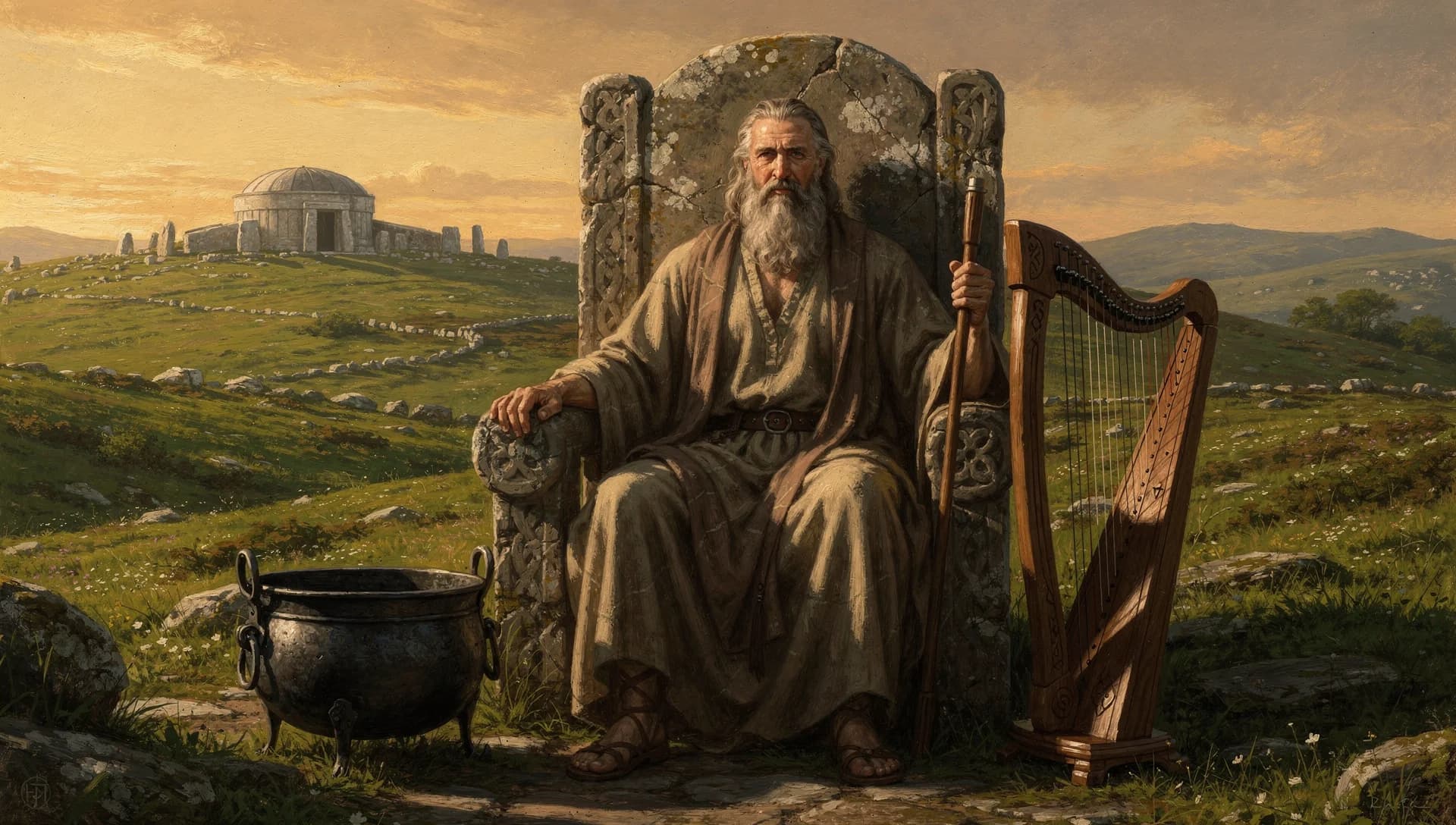
The Good God of Ireland: Dagda and the Salem High-God Imprint
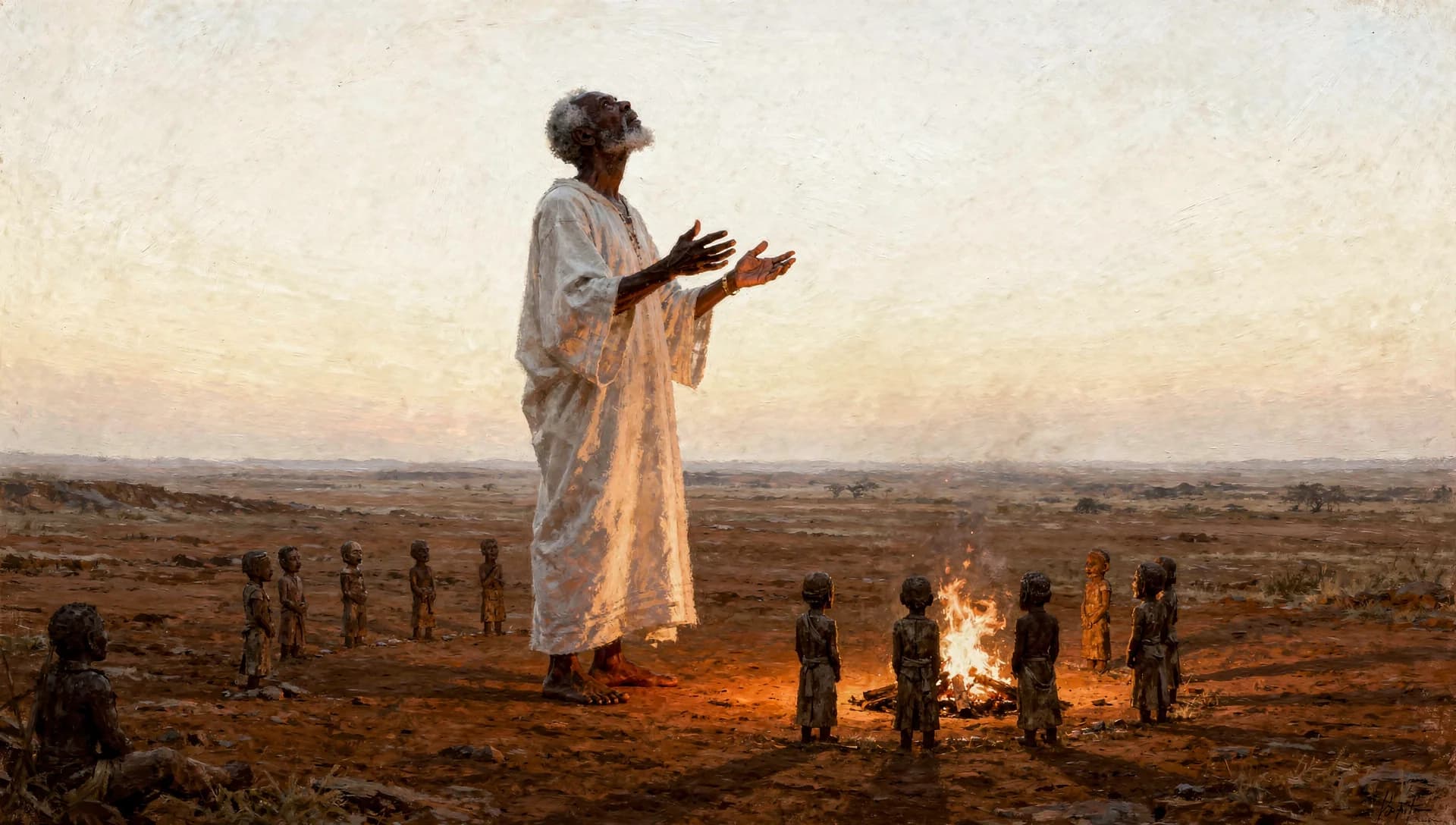
The Sky God Who Withdrew: African High-God Traditions and the Salem Teaching Layer
The Paradise in the West: Chinese Kunlun Mythology and the Andite Memory of Eden
Seven Teachers, One Preparation: The Axial Age and the Salem Continuity
The Newsletter
Get the research behind each piece
Free. New Urantia Book explorations, the sources behind the videos, and early looks. No spam, unsubscribe anytime.
Prefer video? Follow on YouTube and Facebook.
Delivered through Substack. You can also read past issues.