
Three Elements, One Composition: Van, Fandor, and the Assyrian Palace Reliefs
On the palace walls of Ashurnasirpal II at Nimrud, carved between 883 and 859 BCE, three elements recur as a unified composition: a stately winged figure, a winged bull, and a sacred tree at the center. The same three elements appear in the Urantia record of Van: the loyal jurist, the fandor he rode, and the tree of life he guarded for one hundred and fifty thousand years.
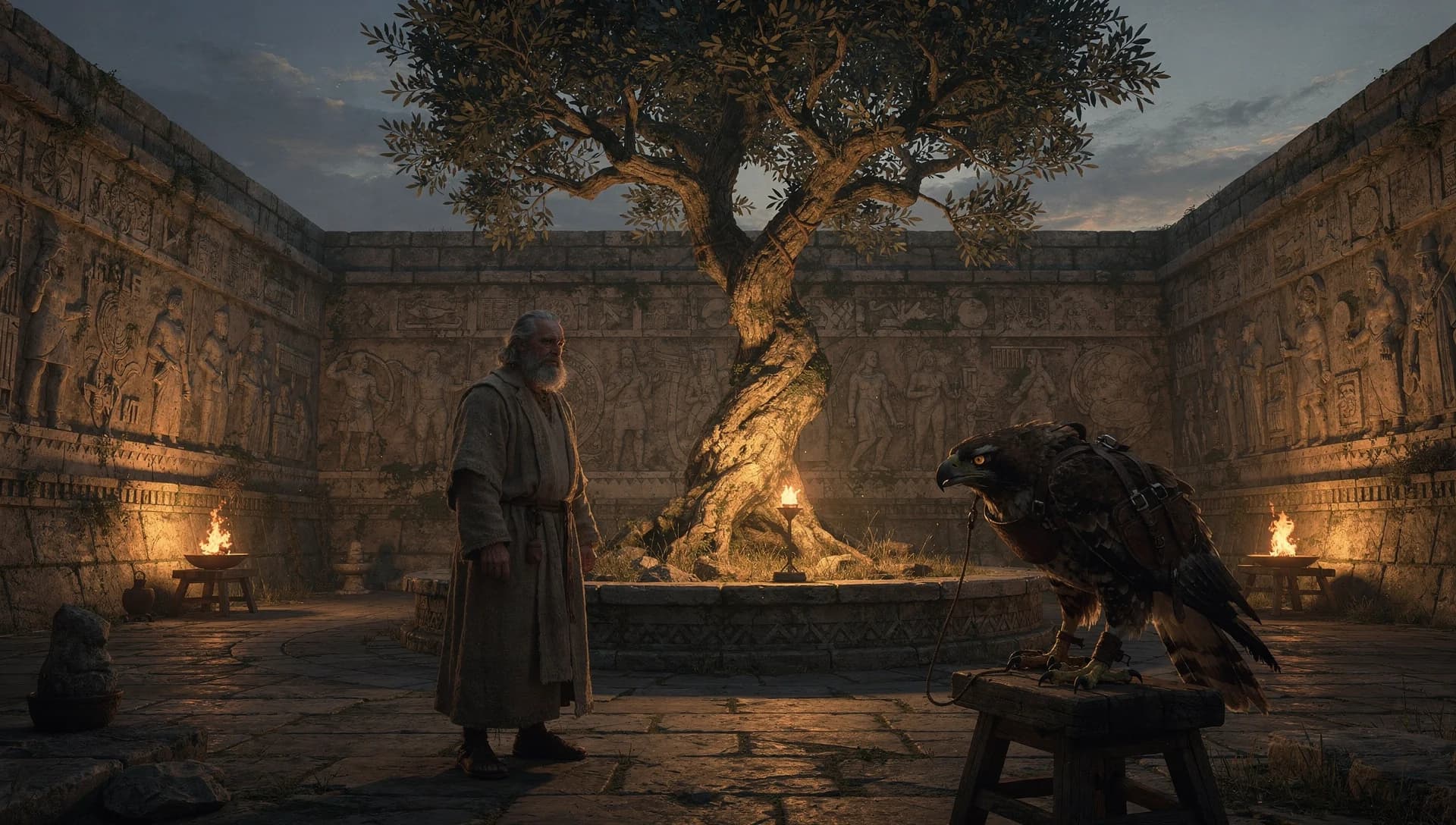
Van + Fandor + Tree of Life = Assyrian Winged Figure Reliefs (Nimrud, ~900-700 BC)
This article expands on the decoder mapping. For the side-by-side card and quick reference, see the mapping page.
The Composition That Will Not Go Away
Walk the Assyrian galleries of the British Museum or the Metropolitan and the same arrangement will confront you again and again. At the center, a stylized tree, bilaterally symmetrical, with a fruiting or flowering canopy. Flanking the tree, human figures with wings, holding cone-shaped and bucket-shaped objects. Guarding the doorways, human-headed winged bulls, the lamassu, rendered at monumental scale. The three elements function as a single symbolic program. They appear together at Nimrud, at Khorsabad, at Nineveh, and in the provincial administrative centers of the Neo-Assyrian state. The tree, the winged attendant figure, and the winged bovine flank are the house style of ninth through seventh century Assyrian sacred art.
The art historians have described the composition carefully and catalogued its iconographic variants. The interpretation is less settled. Samuel Parpola's 1993 argument in Journal of Near Eastern Studies that the tree encodes a Kabbalistic-style emanation diagram represents one line of thought. John Malcolm Russell's measured treatment in Sennacherib's Palace Without Rival at Nineveh (Chicago, 1991) reads the tree as a political emblem of royal fertility. Neither reading fully explains why the tree, the winged attendant, and the winged bovine form an irreducible triad.
The Urantia Book preserves a memory that places the three elements together in a single real event.
What the Urantia Book Says
Van was the loyal jurist of the Caligastia staff who opposed the rebellion and held his ground for seven years after the planetary circuits were severed (UB 67:3.8). When the rebellion broke and the tree of life had to be rescued, it was Van and his associates who took custody of it:
"Upon the outbreak of the rebellion it was regrown from the central core by Van and his associates in their temporary camp. This Edentia shrub was subsequently taken to their highland retreat, where it served both Van and Amadon for more than one hundred and fifty thousand years." (UB 73:6.5)
The specific geography matters. Van's post-rebellion base was a highland retreat. He administered the tree of life in that retreat until the arrival of Adam. The record also attests his use of fandors: the same species was used by Bon's council at Dalamatia, trained as passenger birds, and later employed for Adam and Eve's aerial tour of the Garden (UB 74:3.4).
When Van planted the tree of life in the Garden of Eden for Adam, the association between Van, the tree, and the large bird is preserved in a single compressed description:
"In the center of the Garden temple Van planted the long-guarded tree of life, whose leaves were for the 'healing of the nations,' and whose fruit had so long sustained him on earth. Van well knew that Adam and Eve would also be dependent on this gift of Edentia for their life maintenance after they once appeared on Urantia in material form." (UB 73:6.1)
The three elements are therefore joined in the record: a superhuman figure (Van), a large bird associated with him and with the Garden (the fandor), and a sacred tree at the center (the tree of life). The elements are bound together in the same historical moment and the same geography.
What the Ancient Source Says
Austen Henry Layard's excavations at Nimrud in the 1840s, published in Nineveh and Its Remains (Murray, 1849) and Discoveries in the Ruins of Nineveh and Babylon (Murray, 1853), recovered the alabaster reliefs of the Northwest Palace of Ashurnasirpal II (883-859 BCE). The relief program of Room B features the sacred tree at ritual focus points, with winged figures flanking, and the lamassu at the doorways. The British Museum and the Metropolitan Museum retain the principal panels. Accession numbers: BM 124531 for the sacred tree and winged attendant group; Metropolitan Museum 32.143.3 for the companion pieces.
The iconography persists through later reigns. Sargon II's palace at Dur-Sharrukin (Khorsabad), excavated by Paul-Émile Botta in 1842, repeats the composition. Sennacherib's southwest palace at Nineveh, described by John Malcolm Russell in his 1991 monograph, continues it. The three-element program is diagnostic for Neo-Assyrian royal art.
The kingdom of Urartu, centered on Lake Van in what is now eastern Turkey, flourished from the ninth to the sixth century BCE and produced iconographically related reliefs. The kingdom's native name, Biainili, is the direct ancestor of the modern place-name Van, preserved through Old Armenian phonology. The match is not coincidental to the folklore scholars who have catalogued the region: Nicholas Adontz, in Armenia in the Period of Justinian (Calouste Gulbenkian Foundation, 1970), documents the continuity of the name Van from the Urartian period through Armenian usage into Turkish.
The iconographic program, the sacred tree flanked by winged figures and guarded by winged bovines, persists in the Urartian region. The kingdom whose name literally means the land of Van preserves the same three-element sacred art as its Assyrian neighbors.
Why This Mapping Matters
The three-element composition is unusual in world art history. Most sacred-tree iconographies pair the tree with a single attendant or a single guardian animal. The Assyrian program insists on three: the winged figure, the winged bovine, the tree. The same three elements are present, as real historical features of a single individual's career, in the Urantia Book's account of Van: the superhuman loyal jurist, the giant carrier bird he used, and the tree of life he guarded through the dark ages before delivering it to Adam.
The geographical correlate is the clinching detail. The Urartian kingdom centered on Lake Van preserves the same iconographic program as the Assyrian palaces to its south, and the kingdom's name is etymologically continuous with the name Van as modern scholarship has reconstructed it. The decoder mapping does not require that every Assyrian relief reference the Urantia figure. It requires that the mnemonic package carried west and north by the Andite migrations include the three linked elements, the man, the bird, and the tree, and that the memory lodged most deeply in the region that later bore his name.
The match is structural, iconographic, geographic, and etymological. It is also falsifiable: if a future epigraphic discovery shows that the three-element program originated in Assyria without prior substrate, the mapping collapses. For now, the four lines of evidence coincide.
Sources
- The Urantia Book, Paper 66 (The Planetary Prince's Staff), Paper 67 (The Planetary Rebellion), Paper 73 (The Garden of Eden). Urantia Foundation, first printing 1955. Cited passages: 66:4.13, 73:6.1, 73:6.5.
- Layard, Austen Henry. Nineveh and Its Remains. John Murray, 1849.
- Layard, Austen Henry. Discoveries in the Ruins of Nineveh and Babylon. John Murray, 1853.
- Russell, John Malcolm. Sennacherib's Palace Without Rival at Nineveh. University of Chicago Press, 1991.
- Parpola, Simo. "The Assyrian Tree of Life: Tracing the Origins of Jewish Monotheism and Greek Philosophy," Journal of Near Eastern Studies 52/3 (1993), pp. 161-208.
- Adontz, Nicholas. Armenia in the Period of Justinian. Calouste Gulbenkian Foundation, 1970.
- British Museum. Sacred Tree and Apkallu relief, BM 124531. Lamassu, BM 118872.
- Metropolitan Museum of Art. Nimrud reliefs, Accession 32.143.
Confidence and Evidence
- Confidence: INFORMED SPECULATION
- Evidence rating: MODERATE
- Basis: The iconographic match (three-element composition), geographic match (Urartu centered on Lake Van), etymological match (Biainili → Van), and the Urantia record of Van holding the tree of life in a highland retreat for ~150,000 years coincide (UB 73:6.5). The mapping is structural and distributed across four independent lines of evidence.
Related Decoder Articles
- Van, Loyal Corporeal Staff Member = Enki / Ea
- Fandor, Giant Passenger Bird = Anzu / Zu Bird
- Tree of Life, Sacred Shrub = Huluppu Tree
By Derek Samaras
Connecting Articles
The One Who Hung on the Tree: Van and the Norse Odin
The Bird That Carried the Bull: Fandors and the Mesopotamian Anzu
The Oak Priests: Druids, Sacred Groves, and the Universal Tree Cult
The Thunderbird Was Real: Fandors and the Indigenous American Giant Bird Tradition
The Newsletter
Get the research behind each piece
Free. New Urantia Book explorations, the sources behind the videos, and early looks. No spam, unsubscribe anytime.
Prefer video? Follow on YouTube and Facebook.
Delivered through Substack. You can also read past issues.