
Seven Teachers, One Preparation: The Axial Age and the Salem Continuity
Between roughly 800 and 200 BCE, Zoroaster, Lao-tse, the Buddha, the Hebrew prophets, and the Greek philosophers transformed human consciousness across Eurasia at the same time. Karl Jaspers called it the Axial Age. The Urantia Book names seven outstanding human teachers whose combined work prepared the world for Michael's bestowal: Sethard, Moses, Zoroaster, Lao-tse, Buddha, Philo, and Paul. The parallel emergence traces back to Salem missionary continuity rather than accidental convergence.
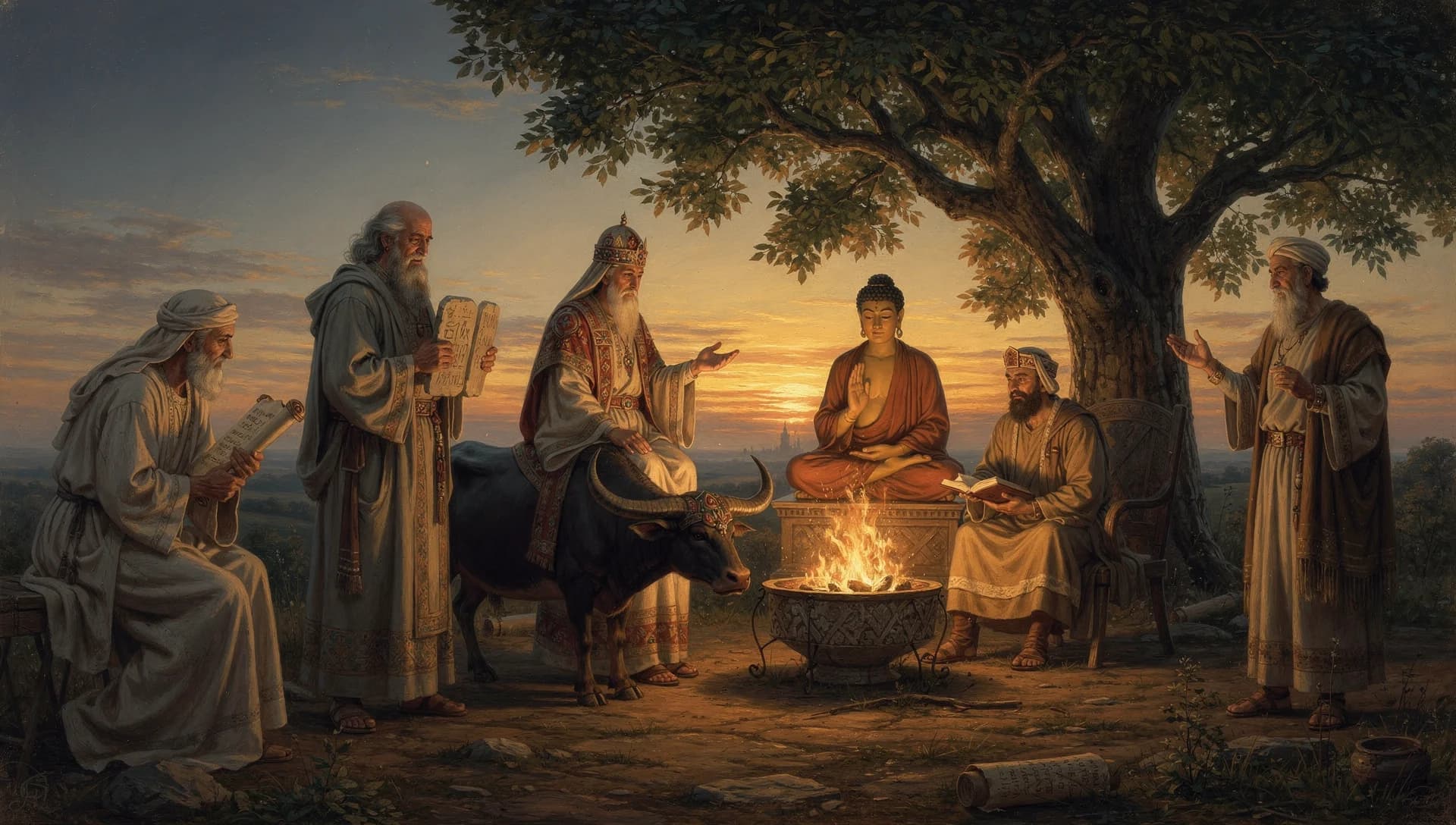
Seven outstanding human teachers preparing the world = Karl Jaspers's Axial Age religious transformation
This article expands on the decoder mapping. For the side-by-side card and quick reference, see the mapping page.
The Axial Age Phenomenon
Something remarkable happened across Eurasia between roughly 800 and 200 BCE. Zoroaster taught in Persia. Lao-tse and Confucius taught in China. The Buddha and the Upanishadic seers taught in India. The Hebrew prophets, from Isaiah through Jeremiah and Ezekiel to the Deutero-Isaiah, transformed Israelite religion. The Greek philosophers, from Thales through Socrates and Plato, reshaped Mediterranean thought. All of this happened in roughly the same window of history.
The shape of the change is consistent across regions. Tribal ritual gave way to universal ethics. Monotheistic insight, or its philosophical equivalent in the unity of being, emerged. Systematic moral reflection took root. Religious life turned inward, away from external sacrifice and toward the interior life of the worshipper.
Karl Jaspers gave the period its name in 1949. In Vom Ursprung und Ziel der Geschichte (The Origin and Goal of History) he called it the Achsenzeit, the Axial Age, and identified it as the pivot on which all subsequent religious and philosophical development has turned.
The mainstream explanation treats the parallel emergence as the natural result of similar social conditions. Cities were growing. States were forming. Literacy was spreading. Trade was connecting once-isolated regions. Similar pressures, the argument runs, produced similar responses across the continent. The Urantia Book points to a deeper substrate.
What the Urantia Book Says
The Urantia Book names seven human teachers whose combined work most significantly prepared the world for Michael's bestowal as Jesus of Nazareth.
"In the matter of the combination of the better elements in contemporaneous systems of ethical and religious teachings, there have been seven outstanding human teachers: Sethard, Moses, Zoroaster, Lao-tse, Buddha, Philo, and Paul." (121:6.4)
The seven span a long stretch of history. Sethard belongs to the early post-Adamic period. Moses lived in the Hebrew exodus context of roughly the fifteenth century BCE. Zoroaster taught in Persia in roughly the seventh century BCE. Lao-tse taught in China in roughly the sixth. The Buddha taught in India in the same century. Philo wrote in early first-century Alexandria, working at the seam between Greek philosophy and Hebrew theology. Paul carried the Christian mission across the Mediterranean in the middle of the first century.
Underneath each of these teachers runs the Salem missionary substrate. The Urantia Book describes the enterprise this way:
"THE early teachers of the Salem religion penetrated to the remotest tribes of Africa and Eurasia, ever preaching Machiventa’s gospel of man’s faith and trust in the one universal God as the only price of obtaining divine favor. Melchizedek’s covenant with Abraham was the pattern for all the early propaganda that went out from Salem and other centers." (94:0.1)
The book is honest about how difficult the work was. The Salem teaching of one God was hard to keep alive in primitive tribal contexts:
"But the task was so great and the tribes were so backward that the results were vague and indefinite. From one generation to another the Salem gospel found lodgment here and there, but except in Palestine, never was the idea of one God able to claim the continued allegiance of a whole tribe or race." (93:7.3)
Papers 94 through 97 trace what became of that seed in different soils. Paper 94 follows the Melchizedek teachings into the Orient. Paper 95 follows them into the Levant. Papers 96 and 97 trace the evolution of the God concept among the Hebrews. Across these papers the Urantia Book documents the transmission lines that produced the major Axial Age developments: the Brahmanic reform in India, the Zoroastrian reform in Persia, the Taoist teaching in China, the Buddhist movement, the Hebrew prophetic tradition, and the Greek philosophical engagement with Hebrew monotheism that reached its synthesis in Hellenistic Alexandria.
The bestowal that all of this prepared for is the framing context:
"By the close of the first century before Christ the religious thought of Jerusalem had been tremendously influenced and somewhat modified by Greek cultural teachings and even by Greek philosophy. In the long contest between the views of the Eastern and Western schools of Hebrew thought, Jerusalem and the rest of the Occident and the Levant in general adopted the Western Jewish or modified Hellenistic viewpoint." (121:6.1)
The seven teachers, on the Urantia Book's account, were not isolated geniuses arriving independently at parallel conclusions. Each of them, directly or through the cultural channels that ran back to Salem, received the monotheistic and ethical content that Machiventa Melchizedek planted in the twentieth century BCE. Each elaborated that content in the language and idiom of his own civilization.
What the Ancient Sources Say
Jaspers laid out the Axial Age thesis in Vom Ursprung und Ziel der Geschichte (Piper Verlag, 1949; English translation, The Origin and Goal of History, Yale University Press, 1953). He identified the period from roughly 800 to 200 BCE as the pivotal transformation of human consciousness, with parallel emergence across China (Confucius, Lao-tse, the Mohists), India (the Buddha, the Upanishadic teachers, the Jain Mahavira), Persia (Zoroaster), Palestine (the classical Hebrew prophets), and Greece (the pre-Socratics through Socrates, Plato, and Aristotle).
Karen Armstrong's The Great Transformation: The Beginning of Our Religious Traditions (Knopf, 2006) is the most substantial recent synthesis. Armstrong walked through the parallel ethical transformations across the four principal centers, China, India, Israel, and Greece, with particular attention to the inward turn that emerged in all four during the period.
Shmuel Eisenstadt's The Origins and Diversity of Axial Age Civilizations (State University of New York Press, 1986) treated the Axial Age as a civilizational shift that produced cultural patterns lasting through subsequent millennia. Eisenstadt named the institutional features that emerged with the period: a transcendent religious orientation, autonomous religious and intellectual elites, a reflexive critical consciousness, and universal ethical frameworks.
The scholarly debate has continued. Robert Bellah's Religion in Human Evolution (Harvard University Press, 2011) read the Axial Age as the culmination of a long evolution of human religious consciousness. Charles Taylor's A Secular Age (Harvard University Press, 2007) read it as the foundation of the later Western secular tradition. Critical voices, including Iain Provan in Convenient Myths (Baylor, 2013), have questioned the strict parallelism and the simultaneity claim while still acknowledging that something significant happened in the period.
The primary sources for each teacher are substantial. For Zoroaster, the Avesta and especially the Gathas, the earliest hymns attributed to him personally, with Mary Boyce's Zoroastrians: Their Religious Beliefs and Practices (Routledge, 1979) as a principal scholarly treatment. For Lao-tse, the Daodejing, compiled across the sixth to third centuries BCE, with a long Chinese commentary tradition. For the Buddha, the Pali Canon, compiled in roughly the third century BCE from earlier oral material, with Richard Gombrich's What the Buddha Thought (Equinox, 2009) as a recent scholarly synthesis. For the Hebrew prophets, the prophetic books of the Bible. For Philo, his own extensive corpus, including On the Creation of the World, Allegorical Interpretation, and On the Life of Moses, with David T. Runia's Philo in Early Christian Literature (Van Gorcum, 1993) as principal scholarly treatment.
Sethard is the one teacher on the Urantia Book's list who has no mainstream historical footprint. He belongs to the Sethite priesthood that the Urantia Book describes at 76:3 as the cultural successor to the Adamic second-garden teaching tradition. This is a Urantia Book claim that does not have independent archaeological corroboration.
Why This Mapping Matters
Why was the Axial Age parallel? The mainstream answers fall into three families. The sociological account, running from Jaspers through Weber's later work on world religions to Eisenstadt's civilizational analysis, attributes the parallel to similar social pressures producing similar cultural responses. The diffusionist account, less dominant but still alive in some circles, points to cross-cultural contact through the Silk Road, the Persian Empire, and Mediterranean trade. The coincidence account, favored by some conservative scholars who resist diffusionist implications, treats the parallel as accidental convergence.
The Urantia Book offers a historical substrate that none of these accounts identifies. The Salem missionary enterprise that Machiventa Melchizedek established in the twentieth century BCE planted monotheistic and ethical content across the Eurasian cultural landscape through institutional transmission. That content was not preserved uniformly. But it was preserved well enough to be picked up later by the Axial Age teachers, who built on the Salem seed in their own languages and idioms.
Each of the Axial Age figures can be traced to Salem-derived content. Zoroaster's ethical monotheism traces to the Salem transmission into Persia, which the Urantia Book documents at 95:6. Lao-tse's unitary philosophy traces to the Salem transmission into China at 94:6. The Buddha's ethical reform traces to Salem content preserved in the Indian priestly tradition at 94:1-4. The Hebrew prophetic tradition preserves the Salem continuity directly through the Abrahamic covenant. Philo's Hellenistic-Jewish synthesis preserves the integration of Greek philosophy with Hebrew theology that the Urantia Book treats as direct preparation for what was coming. Paul carries the whole inheritance forward into the post-Christ era across the Mediterranean.
The simultaneous emergence of these transformations across widely separated regions fits the Urantia Book's account of coordinated preparation for Michael's bestowal. The book describes the bestowal as prepared for over centuries by coordinated celestial ministry, with the Axial Age teachers as significant contributors to the broader program.
The seven-teacher framework at 121:6.4 is a more specific account than the mainstream offers. The mainstream points to structural conditions. The Urantia Book names individual agents working across coordinated stages of history. Where the sociological framework reads the Axial Age as conditioned by social structure, the Urantia Book reads it as prepared by particular people working within a larger plan.
The implications matter. The mainstream reads the Axial Age as a self-contained cultural transformation. The Urantia Book reads it as preparation for the bestowal of Michael as Jesus of Nazareth, with the seven teachers as the most significant contributors to the cultural and religious environment into which the bestowal was inserted.
The mapping's significance is this: the Axial Age should be read not primarily as independent parallel emergence but as the coordinated preparation for the central event of Urantia's revelatory history. The seven outstanding human teachers who contributed to that preparation are concrete agents of the program, each adding distinct cultural and religious content to the work.
Sources
- The Urantia Book, Paper 93 (Machiventa Melchizedek), Paper 94 (The Melchizedek Teachings in the Orient), Paper 95 (The Melchizedek Teachings in the Levant), Paper 97 (Evolution of the God Concept Among the Hebrews), Paper 121 (The Times of Michael's Bestowal). Urantia Foundation, first printing 1955. Cited passages: 93:7.3, 94:0.1, 121:6.4.
- Jaspers, Karl. The Origin and Goal of History. Yale University Press, 1953. German original: Vom Ursprung und Ziel der Geschichte, Piper Verlag, 1949.
- Armstrong, Karen. The Great Transformation: The Beginning of Our Religious Traditions. Knopf, 2006.
- Eisenstadt, Shmuel. The Origins and Diversity of Axial Age Civilizations. State University of New York Press, 1986.
- Bellah, Robert. Religion in Human Evolution: From the Paleolithic to the Axial Age. Harvard University Press, 2011.
- Boyce, Mary. Zoroastrians: Their Religious Beliefs and Practices. Routledge, 1979.
- Gombrich, Richard F. What the Buddha Thought. Equinox, 2009.
- Runia, David T. Philo in Early Christian Literature: A Survey. Van Gorcum, 1993.
Confidence and Evidence
- Confidence: UB CONFIRMED
- Evidence rating: STRONG
- Basis: The Urantia Book directly names the seven outstanding human teachers at 121:6.4 and documents the Salem missionary enterprise at 93:7 and 94:0.1. Karl Jaspers's Axial Age thesis independently identifies the same roughly 800 to 200 BCE period as the pivotal transformation of human religious and philosophical consciousness. The convergence between the Urantia Book's seven-teacher account and the independent scholarly Axial Age analysis is substantial. The Salem missionary substrate explains the parallel emergence more specifically than the mainstream sociological accounts do.
Related Decoder Articles
- Melchizedek = Machiventa and the Salem Enterprise
- Zoroaster = Persian Salem Teaching Reform
- Dying-and-Rising Gods = Corrupted Salem Teaching
Byline: Derek Samaras | Urantia Book Network | April 2026
Connecting Articles
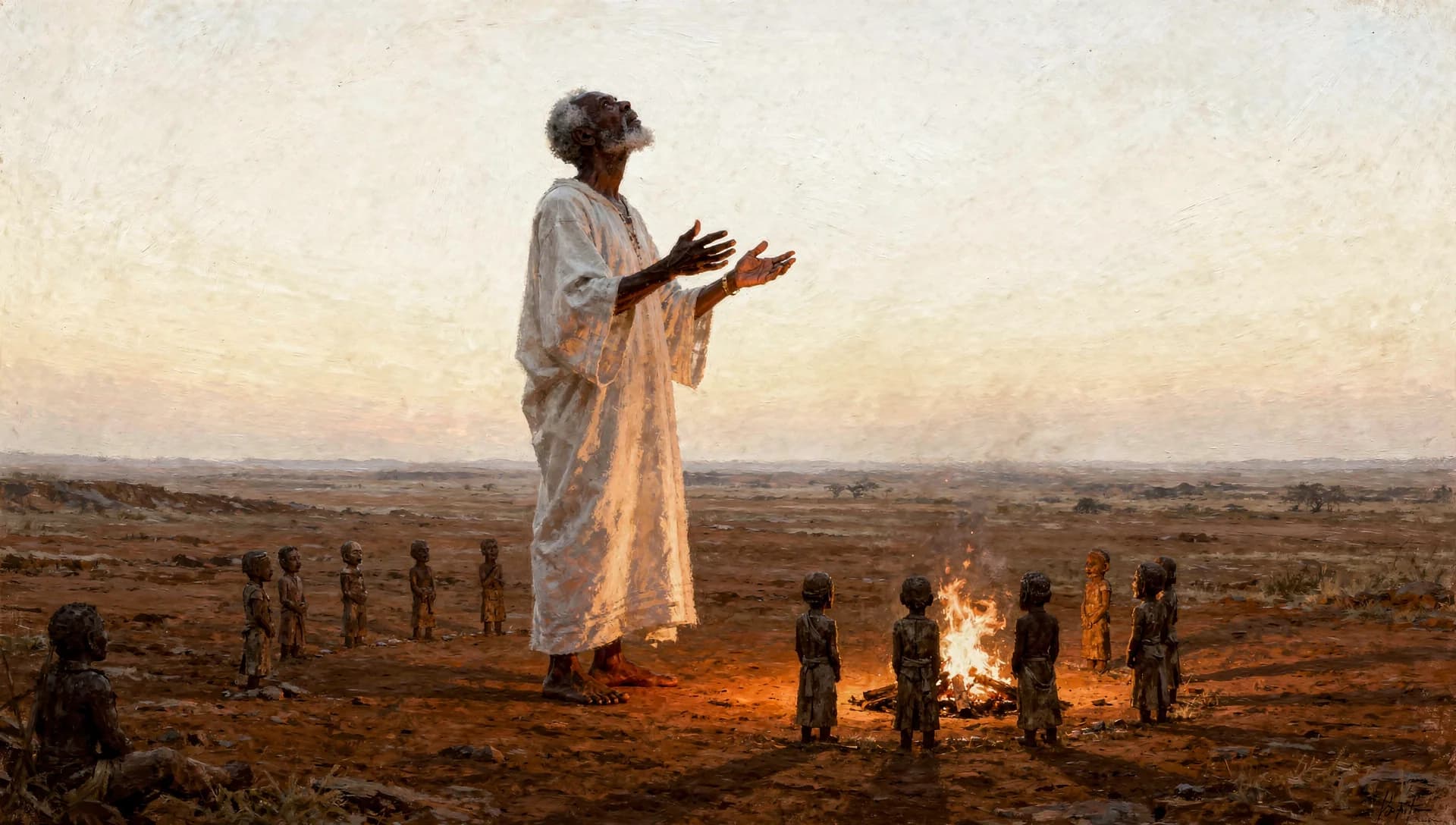
The Sky God Who Withdrew: African High-God Traditions and the Salem Teaching Layer
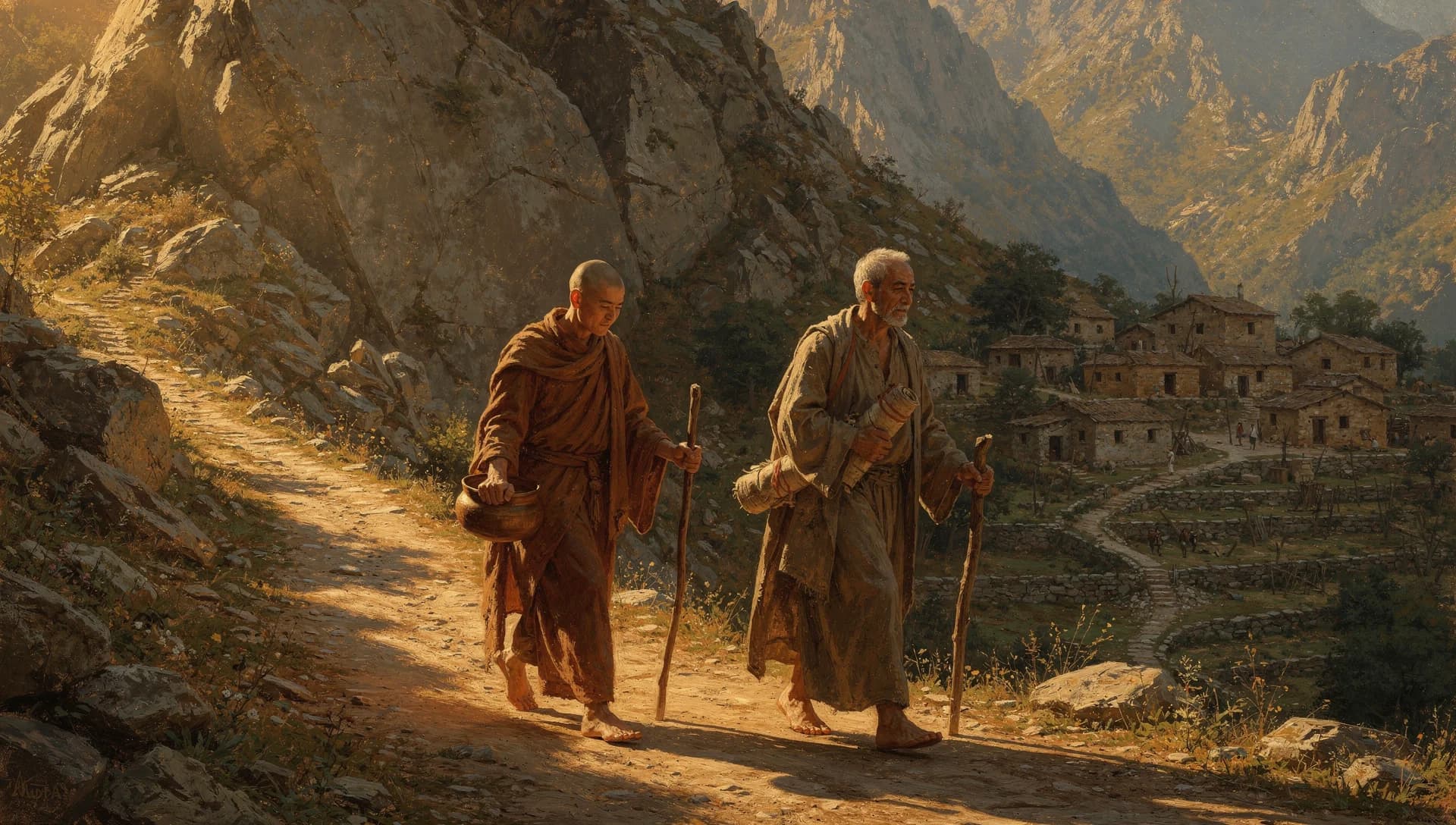
The Vow to Stay: Bodhisattva Ideal and the Salem Missionary Commission
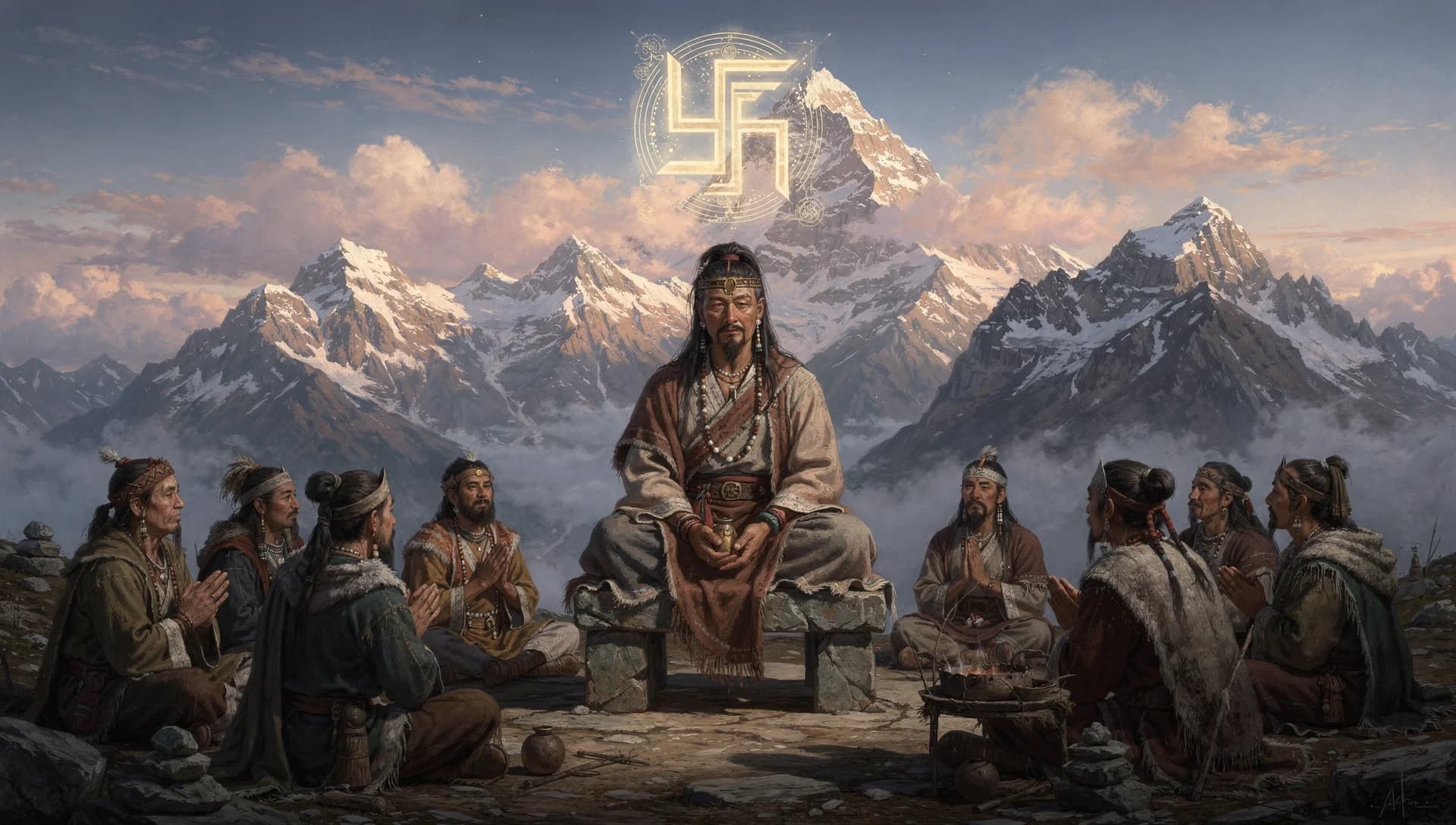
The Primordial Teacher Before Buddha: Tonpa Shenrab, Yungdrung Bön, and the Salem Layer in Tibetan Religion
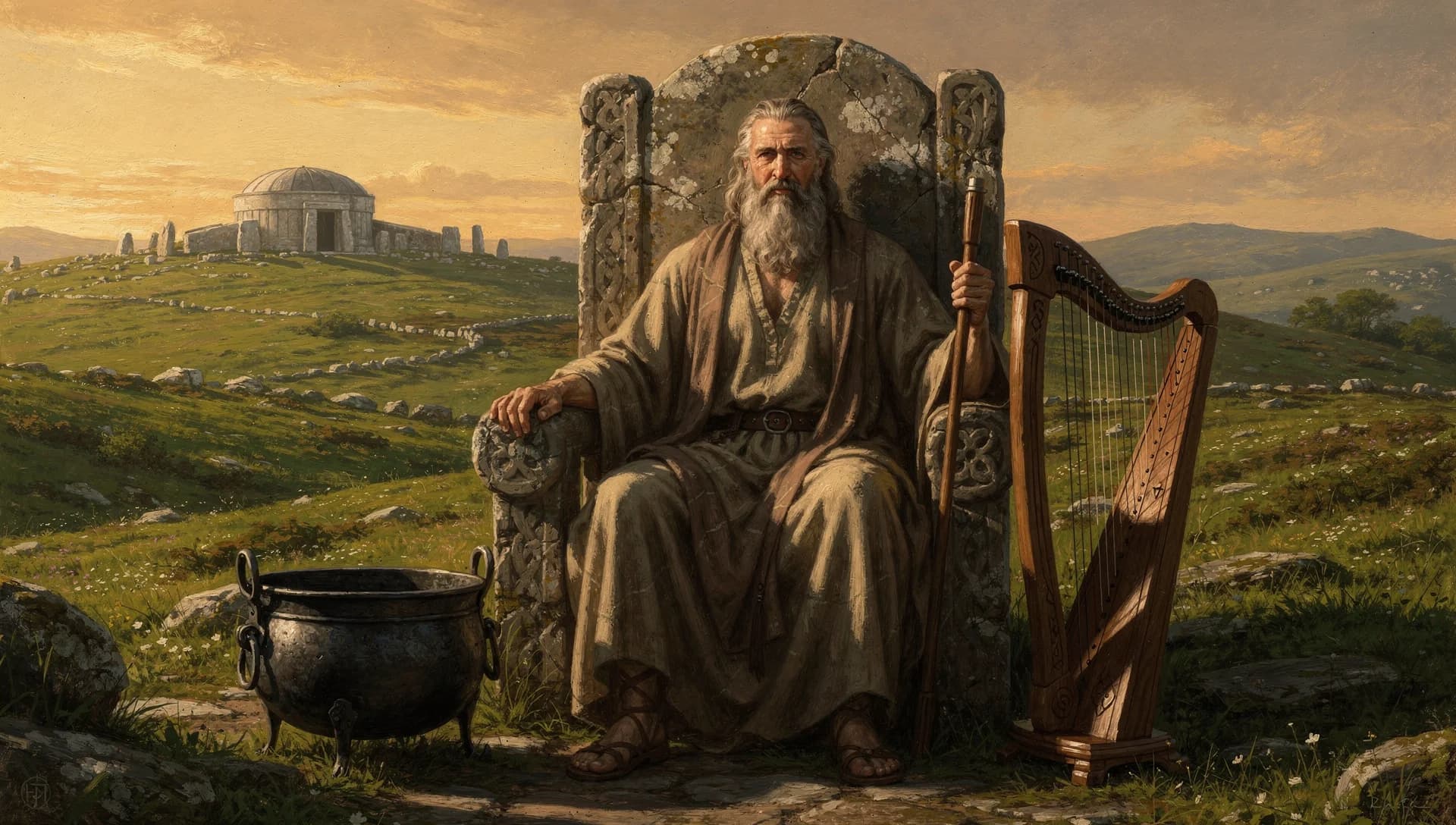
The Good God of Ireland: Dagda and the Salem High-God Imprint
The Newsletter
Get the research behind each piece
Free. New Urantia Book explorations, the sources behind the videos, and early looks. No spam, unsubscribe anytime.
Prefer video? Follow on YouTube and Facebook.
Delivered through Substack. You can also read past issues.