
The Pre-Olympian Couple: Adamson and Ratta in the Greek Memory
Greek mythology places a divine couple before the Olympians. Cronus and Rhea are Titans, parents of a generation of superhuman children, seated in a highland sanctuary before the younger gods take power. The Urantia Book records such a couple in the same geographic zone, preserving traces of the Dalamatian regime for seven thousand years, and states plainly that one branch of their descendants migrated west into Greece.
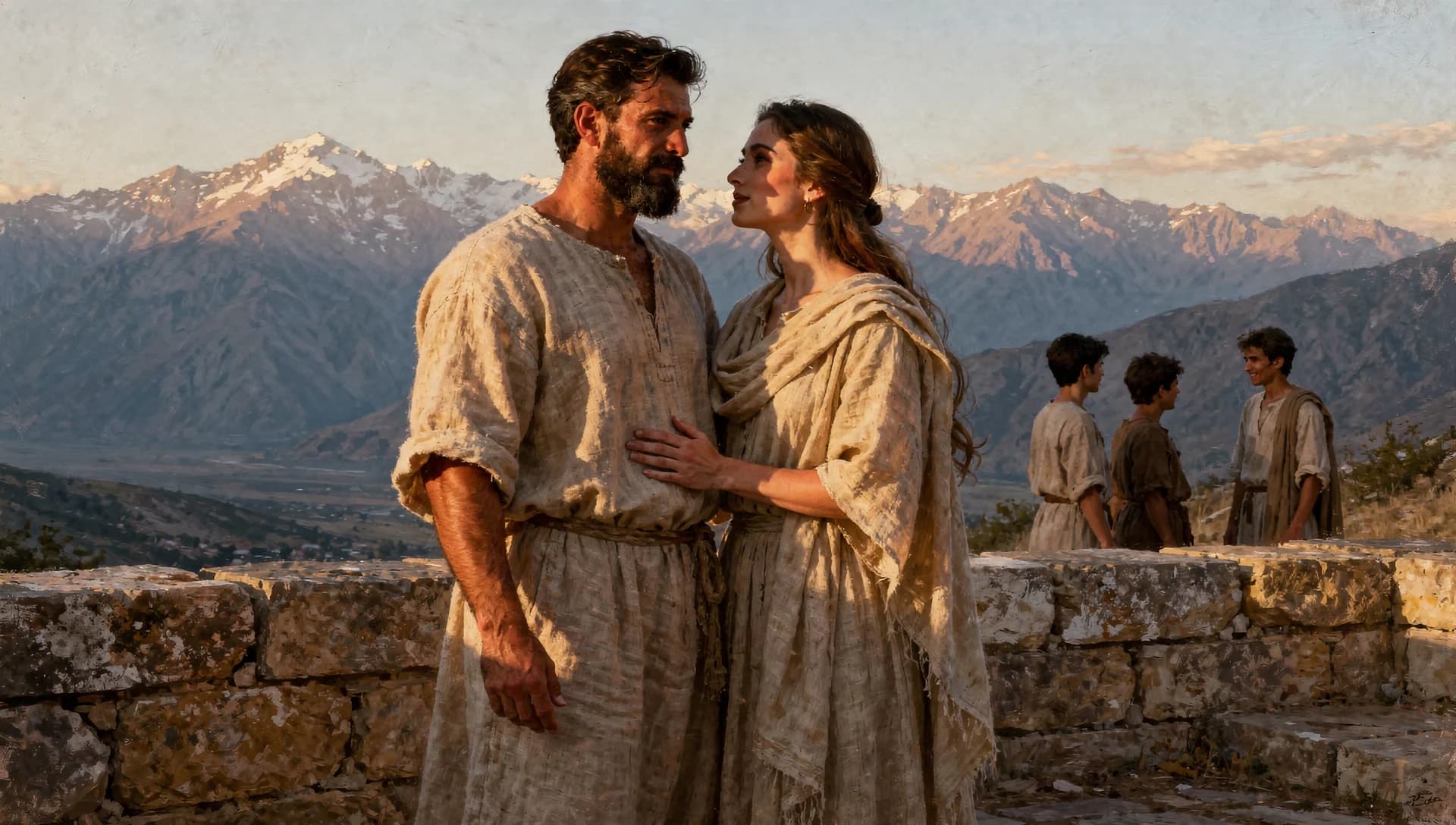
Adamson + Ratta, superhuman couple = Cronus + Rhea, Titan parents of the Olympians
This article expands on the decoder mapping. For the side-by-side card and quick reference, see the mapping page.
Before the Olympians
Greek religion is a stratified structure. The Olympians sit on top. Beneath them lie the Titans, the earlier generation, defeated and partially displaced. Beneath the Titans lie the Protogenoi, the primordial beings from which everything else emerged. The texture of the religion is archaeological. Each layer remembers the one beneath it, and the remembering is not always flattering to the newer order.
The Titan couple at the apex of the pre-Olympian layer is Cronus and Rhea. Hesiod's Theogony (c. 700 BCE) names them as the parents of Zeus, Poseidon, Hades, Hera, Demeter, and Hestia. They preside over a Golden Age. They produce a generation of superhuman children. They are eventually displaced by one of those children, who becomes the new supreme god. The whole sequence is treated by Hesiod as historical, a dynastic succession from one divine order to the next, with a specific geographic provenance: Crete for the birth of Zeus, various highland locations for the upbringing of the other children.
Several features of this dynastic layer resist the ordinary mythological categories. The couple is presented as a pair, not as a single supreme figure. Their children are not a single race but individually distinct. The children are superhuman but not omnipotent. The parents are eventually displaced, not destroyed. The geography is specific. The time is finite.
The Urantia Book records a superhuman couple, in a specific geography, with a definite time window, who produced a generation of unique children and whose cultural legacy persisted for millennia before the Olympian-equivalent younger gods came to prominence. The match is not loose, and at one point the Urantia record names the transmission route to Greece directly.
What the Urantia Book Says
Adamson was the firstborn of Adam and Eve in the first garden. After the default, after the second garden was established in the region between the Tigris and Euphrates, Adamson declined to remain in the south. He traveled north in search of the land Van and Amadon had described to him throughout his childhood:
"Adamson was among that group of the children of Adam and Eve who elected to remain on earth with their father and mother. Now this eldest son of Adam had often heard from Van and Amadon the story of their highland home in the north, and sometime after the establishment of the second garden he determined to go in search of this land of his youthful dreams." (77:5.2)
He was a mature man with a settled history. He had already raised a large family in the first garden, and he undertook the journey north after personal loss:
"Adamson was 120 years old at this time and had been the father of thirty-two pure-line children of the first garden. He wanted to remain with his parents and assist them in upbuilding the second garden, but he was greatly disturbed by the loss of his mate and their children, who had all elected to go to Edentia along with those other Adamic children who chose to become wards of the Most Highs." (77:5.3)
He took a company of twenty-seven with him. After three years of travel he located the survivors of Van and Amadon's highland settlement, and there found a woman who was both beautiful and descended from the Prince's staff:
"A company of twenty-seven followed Adamson northward in quest of these people of his childhood fantasies. In a little over three years Adamson's party actually found the object of their adventure, and among these people he discovered a wonderful and beautiful woman, twenty years old, who claimed to be the last pure-line descendant of the Prince's staff." (77:5.5)
Ratta was the last pure-line descendant of the Caligastia staff's loyal lineage. Her mating with Adamson produced sixty-seven children, a number of whom were unlike anything seen before:
"Adamson and Ratta had a family of sixty-seven children. They gave origin to a great line of the world's leadership, but they did something more. It should be remembered that both of these beings were really superhuman. Every fourth child born to them was of a unique order. It was often invisible. Never in the world's history had such a thing occurred." (77:5.6)
These unique offspring became a corps of helpers who labored alongside the couple for the whole of their long lives:
"Adamson and Ratta thus had at their command this corps of marvelous helpers, who labored with them throughout their long lives to assist in the propagation of advanced truth and in the spread of higher standards of spiritual, intellectual, and physical living. And the results of this effort at world betterment never did become fully eclipsed by subsequent retrogressions." (77:5.8)
The couple lived for centuries. Adamson reached three hundred and ninety-six years, and the partnership remained active across that whole span:
"Adamson lived for 396 years. Many times he returned to visit his father and mother. Every seven years he and Ratta journeyed south to the second garden, and meanwhile the midwayers kept him informed regarding the welfare of his people. During Adamson's life they did great service in upbuilding a new and independent world center for truth and righteousness." (77:5.7)
The Adamsonite civilization they founded persisted at high cultural level for seven thousand years:
"The Adamsonites maintained a high culture for almost seven thousand years from the times of Adamson and Ratta. Later on they became admixed with the neighboring Nodites and Andonites and were also included among the 'mighty men of old.' And some of the advances of that age persisted to become a latent part of the cultural potential which later blossomed into European civilization." (77:5.9)
The geography is named, and so, in the same paragraph, is the migration west into Greece:
"This center of civilization was situated in the region east of the southern end of the Caspian Sea, near the Kopet Dagh. A short way up in the foothills of Turkestan are the vestiges of what was onetime the Adamsonite headquarters of the violet race. In these highland sites, situated in a narrow and ancient fertile belt lying in the lower foothills of the Kopet range, there successively arose at various periods four diverse cultures respectively fostered by four different groups of Adamson's descendants. It was the second of these groups which migrated westward to Greece and the islands of the Mediterranean." (77:5.10)
This last sentence is the load-bearing detail. The Urantia Book does not leave the transmission to inference. It states that one of the four Adamsonite cultural groups migrated west to Greece and the Mediterranean islands. The Kopet Dagh range runs along the modern Iran-Turkmenistan border, a highland zone with a narrow fertile belt at the foothills. The Urantia record names this as the headquarters of the Adamsonite violet race, persisting at civilizational prominence for some seven thousand years (77:5.9, 77:5.10), and identifies the Greek world as one of the places its people went.
What the Ancient Source Says
Hesiod's Theogony is the earliest systematic Greek account of the Titan generation. The standard scholarly edition remains M. L. West's (Hesiod: Theogony, Oxford University Press, 1966). Cronus and Rhea are introduced as children of Gaia and Ouranos, themselves primordial. The couple is given a geographic provenance that varies across the tradition: Arcadia, Crete, the peaks of Mount Ida, the slopes of Olympus. The common structural feature is highland, not lowland.
The Cretan tradition, preserved in later sources including Diodorus Siculus and reconstructed by Karl Kerenyi (The Gods of the Greeks, Thames and Hudson, 1951), places the birth of Zeus in a cave on Mount Ida, with Rhea protecting the infant from Cronus by a substitution ritual. The Arcadian tradition places the event at Mount Lykaion. The Anatolian-substrate readings traced by Martin West (The East Face of Helicon, Oxford, 1997) point eastward: the Cronus and Rhea narrative shows structural continuity with Hittite and Hurrian succession myths, particularly the Kumarbi Cycle, which places the Titan-level couple in the Anatolian and Iranian highlands east of the Aegean.
Carolina Lopez-Ruiz's When the Gods Were Born: Greek Cosmogonies and the Near East (Harvard University Press, 2010) argues persuasively that the Greek succession myth is an adaptation of a pre-existing Near Eastern mythology whose original geography was the highland zone between the Black Sea, the Caspian, and the upper Euphrates. The Kumarbi Cycle's Song of Ullikummi, preserved in Hittite tablets from Bogazkoy, centers its divine-succession narrative on mountainous country east of Asia Minor.
The geography the Greek tradition preserves as the origin of the Titan generation, eastward, highland, fertile but narrow, is the same geography the Urantia Book names for Adamson's headquarters at the Kopet Dagh. The direction of travel the scholars reconstruct, from the eastern highlands westward into the Aegean world, is the same direction the Urantia Book states for the second group of Adamson's descendants.
Why This Mapping Matters
The match is on four features, three of which are structurally unusual for mythological couples, and a fifth that the Urantia Book supplies directly.
First, the couple as a pair. Cronus and Rhea are treated in the Greek tradition as a unified generation rather than a single supreme figure. This is unusual. Most supreme ancestral deities in Indo-European religion are male and singular. The pairing is structural, and it matches the Urantia record of Adamson and Ratta as the specific co-founders of a lineage.
Second, the number of children. Hesiod names six: Zeus, Poseidon, Hades, Hera, Demeter, Hestia. Later traditions add others. The Urantia Book names sixty-seven. The orders of magnitude differ because the Greek tradition preserves only the mythologically active subset. The others drop out of the canon as generations pass and local deities are forgotten. That every fourth child of Adamson and Ratta "was of a unique order" and "was often invisible" is the structural feature that could most plausibly seed the category of divine offspring that is not quite divine and not quite human: the demigod, the daimon, the Hero. These categories are what the Greek tradition preserves most densely.
Third, the highland geography. The Greek tradition places the Titan couple eastward and upward. The Urantia Book places the Adamsonite headquarters at the Kopet Dagh, eastward and upward from Mesopotamia. Lopez-Ruiz's documented transmission from Anatolia through the Aegean provides the mechanism.
Fourth, the civilizational legacy. The Greek tradition treats the Titan generation as the Golden Age, the time before the present order. The Urantia Book states explicitly that Adamsonite cultural advances "persisted to become a latent part of the cultural potential which later blossomed into European civilization."
Fifth, and decisively, the named migration. Most decoder mappings rest on inference about how a memory traveled. This one does not have to. The Urantia Book states that the second of the four Adamsonite groups "migrated westward to Greece and the islands of the Mediterranean" (77:5.10). The Greek memory of a pre-Olympian highland couple is, on this reading, not a memory imported from a stranger people. It is the founding memory of one of the populations that became Greek.
The five features cohere into a single integrated claim: the Greek memory of a pre-Olympian highland couple with many superhuman children, whose legacy is the substrate of later civilization, is a broken but real memory of the historical Adamson and Ratta regime at the Kopet Dagh, carried west by the very people who became the Greeks.
Sources
- The Urantia Book, Paper 77 (The Midway Creatures). Urantia Foundation, first printing 1955. Cited passages: 77:5.2, 77:5.3, 77:5.5, 77:5.6, 77:5.7, 77:5.8, 77:5.9, 77:5.10.
- Hesiod. Theogony. Edition and commentary by M. L. West. Oxford University Press, 1966.
- West, Martin L. The East Face of Helicon: West Asiatic Elements in Greek Poetry and Myth. Oxford University Press, 1997.
- Lopez-Ruiz, Carolina. When the Gods Were Born: Greek Cosmogonies and the Near East. Harvard University Press, 2010.
- Kerenyi, Karl. The Gods of the Greeks. Translated by Norman Cameron. Thames and Hudson, 1951.
- Hoffner, Harry A. Hittite Myths. Second edition, Society of Biblical Literature, 1998 (Kumarbi Cycle).
Confidence and Evidence
- Confidence: INFORMED SPECULATION
- Evidence rating: MODERATE to STRONG
- Basis: Four structurally unusual features of the Greek Cronus and Rhea tradition (couple as a pair, many superhuman children, highland eastern geography, civilizational legacy) align with the Urantia record of Adamson and Ratta at the Kopet Dagh. Unusually for a decoder mapping, the Urantia Book also states the transmission route directly: the second Adamsonite group "migrated westward to Greece and the islands of the Mediterranean" (77:5.10). The Kumarbi transmission route documented by West and Lopez-Ruiz provides an independent scholarly mechanism for the same movement from the eastern highlands westward.
Note on Citations
Every direct quotation from The Urantia Book in this article was checked against the canonical paragraph it cites and is verbatim from that paragraph. Where the source text uses a long dash, this article substitutes a comma or period in keeping with house style. No wording is otherwise altered. Quotations that present only part of a paragraph keep the source sentences intact and unchanged. Readers are encouraged to verify every citation against the canonical text.
Related Decoder Articles
- 16 Children of Adamson + Ratta = Olympian Gods
- Adamson + Ratta = Krishna + Radha
- Adamson riding Fandor = Krishna / Vishnu riding Garuda
- Van, Loyal Corporeal Staff Member = Enki / Ea
- The Corporeal Staff of One Hundred = Anunnaki
By Derek Samaras
Connecting Articles
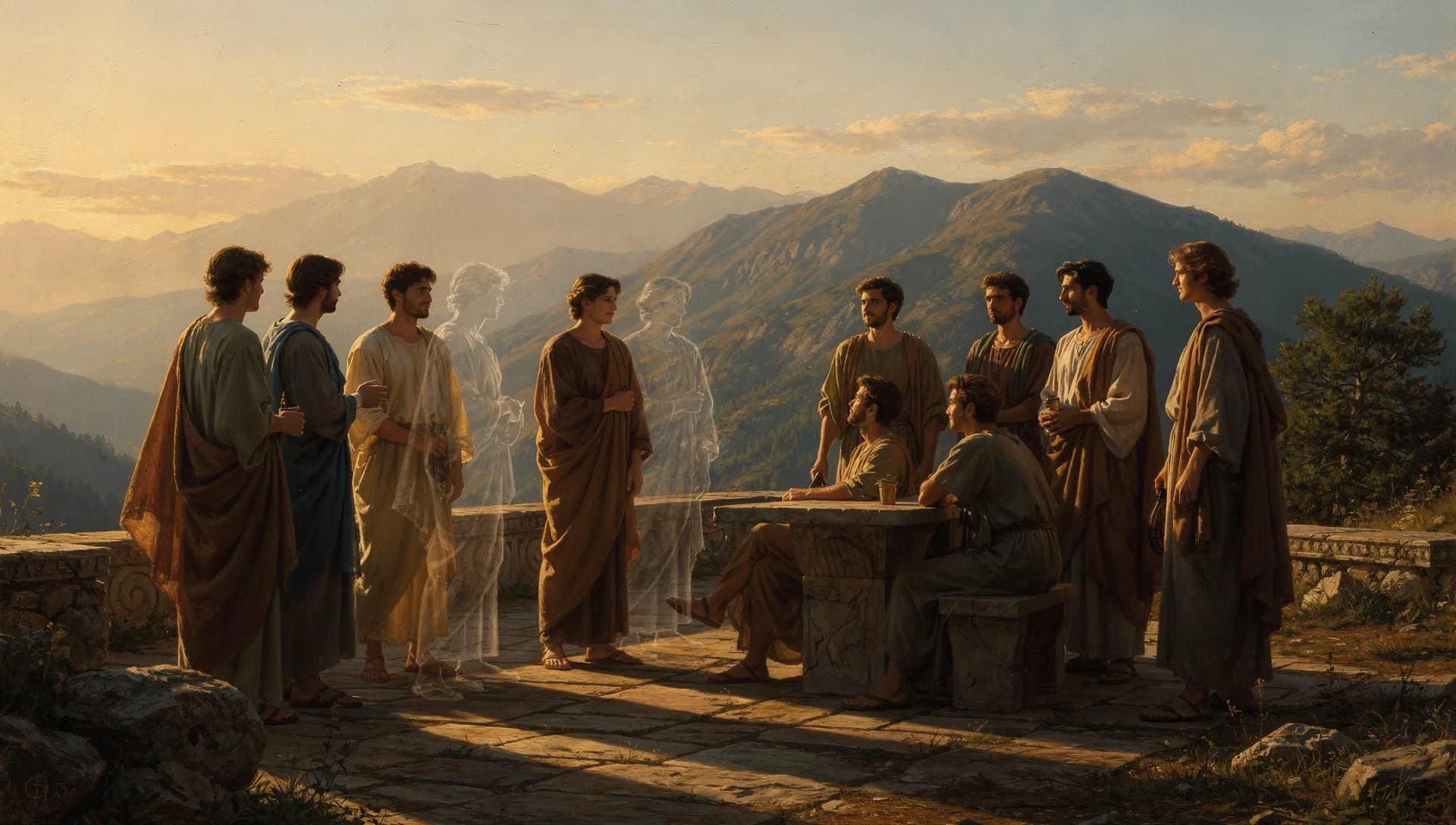
Sixty-Seven Children, Twelve Remembered: The Adamsonites and the Olympian Pantheon
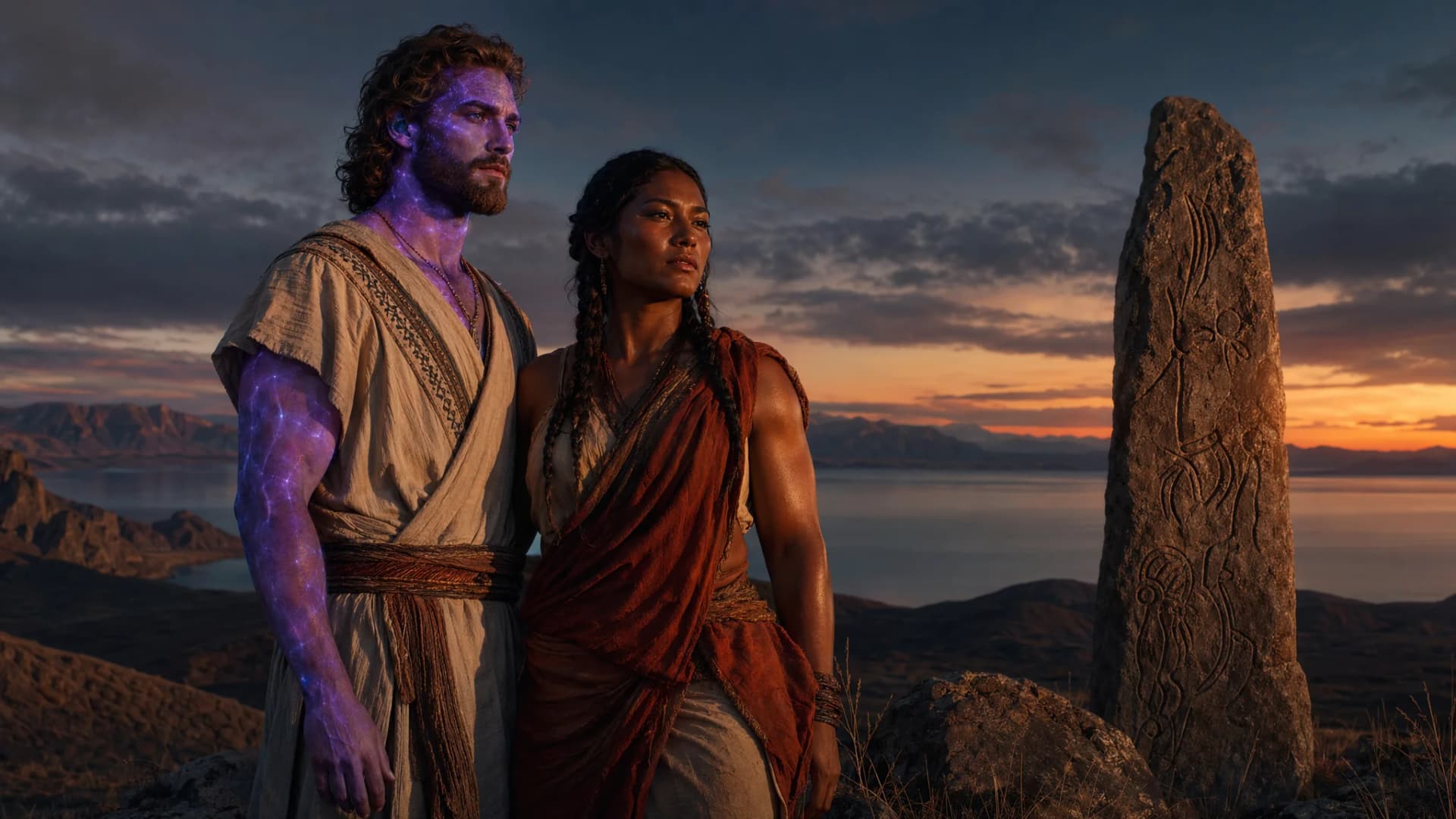
The Dark-Skinned Lord and His Beloved: Adamson, Ratta, and Krishna-Radha
The Bird That Carried the Hero: Adamson, Fandor, and the Hindu Garuda
The Sky Father Who Could Not Be Seen: Caligastia and the Greek Ouranos
The Newsletter
Get the research behind each piece
Free. New Urantia Book explorations, the sources behind the videos, and early looks. No spam, unsubscribe anytime.
Prefer video? Follow on YouTube and Facebook.
Delivered through Substack. You can also read past issues.