
The Paradise in the West: Chinese Kunlun Mythology and the Andite Memory of Eden
Classical Chinese mythology places paradise in the west. The Kunlun mountain, where the Queen Mother of the West tends a garden of immortality peaches, is the most enduring Chinese mythological locus. The Urantia Book documents the Andite migration from western Turkestan into China and provides the historical substrate for what the Chinese tradition remembered.
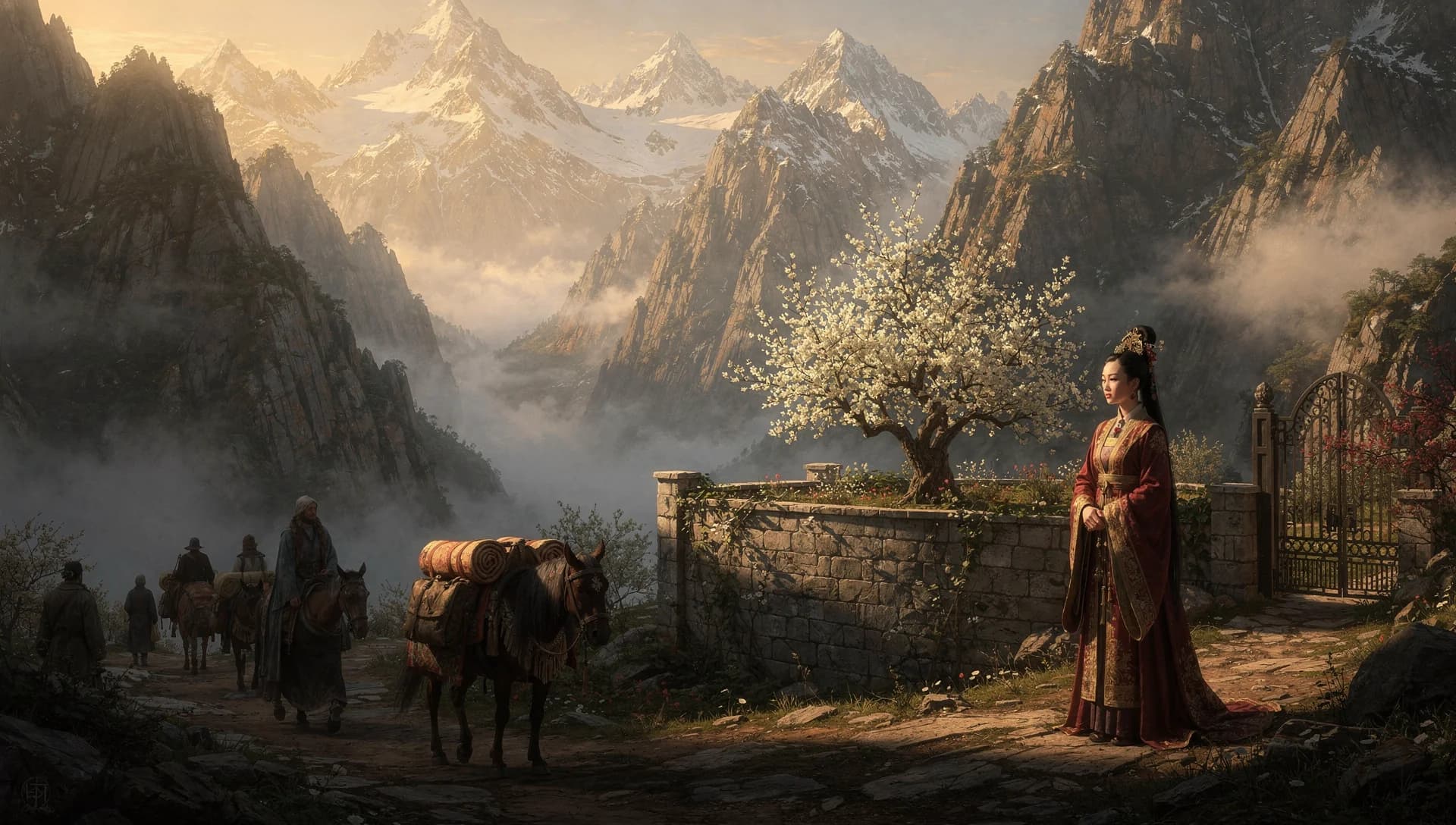
Andite traditions of Eden and Dalamatia carried east = Chinese "Land of the Gods in the West," Kunlun mythology
This article expands on the decoder mapping. For the side-by-side card and quick reference, see the mapping page.
Why Chinese Paradise Is West
Chinese mythology has a distinctive geographic orientation. The paradise where the immortals dwell, where the sacred tree bears the fruit of immortality, where the Queen Mother presides over the garden, is not in the east (as in many Mediterranean traditions) or in the south (as in tropical traditions) or in the heavens (as in many Indo-European traditions). It is in the west.
The Kunlun mountain, situated in Chinese mythological geography somewhere in the western regions (the historical Kunlun range in what is now Xinjiang and Tibet), is the paradigmatic sacred axis. Xiwangmu, the Queen Mother of the West, tends a garden there where the peaches of immortality grow. The divine immortals (xian) reside in palaces on its slopes. Sages and seekers throughout Chinese literary history have depicted their journey toward enlightenment as a westward pilgrimage toward Kunlun.
The westward orientation is unusual enough to call for an explanation. The Urantia Book's account of the Andite migrations into China supplies one.
What the Urantia Book Says
Paper 79 describes the Andite migrations from their Turkestan homeland into the settled regions of China:
"About fifteen thousand years ago the Andites, in considerable numbers, were traversing the pass of Ti Tao and spreading out over the upper valley of the Yellow River among the Chinese settlements of Kansu. Presently they penetrated eastward to Honan, where the most progressive settlements were situated. This infiltration from the west was about half Andonite and half Andite." (UB 79:7.1)
The Andites, genetic and cultural descendants of Adam and Eve's second-garden lineage crossed with the Nodite and surrounding populations, carried into China a substantial cultural inheritance:
"The later waves of Andites brought with them certain of the cultural advances of Mesopotamia; this is especially true of the last waves of migration from the west. They greatly improved the economic and educational practices of the northern Chinese; and while their influence upon the religious culture of the yellow race was short-lived, their later descendants contributed much to a subsequent spiritual awakening." (UB 79:7.4)
The cultural inheritance included specific religious memories. The Andites were, in the Urantia Book's account, the carriers of Dalamatian and Edenic traditions into the regions they reached. Their arrival in China, from the west, would have deposited into the Chinese cultural substrate memories of the second garden (located in what is now Mesopotamia, west of China) and, through it, fainter but still present memories of the first garden (Eden) and the tree of life.
The specific memory of Eden as a western garden is preserved in the broader Urantia account:
"The committee on location was absent for almost three years. It reported favorably concerning three possible locations: The first was an island in the Persian Gulf; the second, the river location subsequently occupied as the second garden; the third, a long narrow peninsula—almost an island—projecting westward from the eastern shores of the Mediterranean Sea." (UB 73:3.1)
From the Chinese perspective, this geography places Eden firmly in the west. The tree of life in the central courtyard of the Garden temple, transplanted later to Van's highland retreat and eventually to the second garden, is a western garden with a sacred tree from the Chinese cultural standpoint. When Andite migrants reached China via the Turkestan corridor, they carried the memory of exactly this complex: a western garden, a sacred tree, an originating couple, a lost paradise.
What the Ancient Source Says
The Kunlun mythology is preserved across a broad range of early Chinese literary sources. The principal early compendium is the Shanhaijing (Classic of Mountains and Seas), composed across several centuries from the fourth century BCE to the first century CE. The standard modern edition is Anne Birrell's The Classic of Mountains and Seas (Penguin, 1999). Birrell's Chinese Mythology: An Introduction (Johns Hopkins University Press, 1993) provides the comparative treatment.
The Shanhaijing describes Kunlun as a sacred mountain in the west with specific paradise-garden features. The garden contains a sacred tree (or trees) whose fruit confers immortality. The garden is guarded by divine beings. The ruler is Xiwangmu, the Queen Mother of the West, originally a fierce ambiguous deity who in later traditions becomes a benevolent hostess of immortals. The Huainanzi (c. 139 BCE) and the Liezi (compiled several centuries later from older material) elaborate the Kunlun mythology in philosophical and literary directions.
Suzanne E. Cahill's Transcendence and Divine Passion: The Queen Mother of the West in Medieval China (Stanford University Press, 1993) traces the Xiwangmu cult through Chinese religious history. The figure's distinctive features, western geography, association with immortality fruit, gardening and horticultural associations, gatekeeping function at the boundary between mortal and immortal realms, are stable across the tradition.
The scholarly question of where the Kunlun motif originated has produced a range of hypotheses. Some scholars have treated it as an indigenous Chinese cosmological development, perhaps drawing on the actual Kunlun mountain range as an inaccessible geographic symbol. Others have noted parallels with Near Eastern paradise traditions and proposed cultural transmission via the Silk Road. Victor Mair's The Mummies of Urumchi (W. W. Norton, 1999) documents the Tocharian-related populations of the western reaches whose existence establishes deep cultural contact between China and the Iranian-Central Asian corridor. Anthony Barbieri-Low's Artisans in Early Imperial China (University of Washington Press, 2007) and related scholarship on the Silk Road traces the documented material-culture exchange.
The transmission route the Urantia Book names, Andite migration from Turkestan through the Ti Tao pass into China, corresponds geographically to the very corridor modern archaeological and genetic research has established as the principal route of West-East cultural and demographic exchange across the Bronze Age Eurasian steppe. The genetic signatures of Bronze Age Central Asian populations in Northwest Chinese Bronze Age burials, documented in studies of the Yamnaya expansion and its descendants, establish the transmission corridor.
Why This Mapping Matters
The westward geographic orientation of Chinese paradise mythology is one of the distinctive features of the tradition. Most ancient mythological traditions locate paradise in a direction specific to the culture's geographic origin and orientation: Mesopotamian traditions tend toward the east (Dilmun), Indian toward the north or west depending on region, Mediterranean often toward the west (the Hesperides, the Blessed Isles), Norse toward the center (Asgard at the world tree). The Chinese westward orientation is specific and stable across two millennia of literary tradition.
A cultural substrate would plausibly generate such a stable geographic orientation if the substrate were itself western in origin. The Urantia Book names the Andite migrations as that substrate. The Andites came from the west, carrying cultural memories of regions further west still (the second garden in Mesopotamia, Eden in the eastern Mediterranean). The Chinese tradition's persistent westward orientation preserves the geographic memory the migration carried.
The Kunlun-Eden structural correspondences are multiple. A western garden. A sacred tree with fruit of immortality. A presiding female figure (Xiwangmu / Eve, with the understanding that Eve's authority in the second garden is a specific Urantia record and that later traditions would compress and transform the figure). A gatekeeping function at the boundary between mortal and divine life. An association with longevity and transcendence. Each correspondence is specific enough to note; the combined set is structurally dense.
The mapping's significance is that it places the Chinese Kunlun tradition within the same distributed-memory framework that connects the Sumerian Dilmun, the Hebrew Eden, the Greek garden of the Hesperides, and the various other traditions of a sacred garden set in paradise geography. They are not independent parallel developments. They are variant preservations of a single historical Edenic substrate, each shaped by the specific geographic orientation of the receiving culture. Chinese Kunlun is the westward-facing preservation.
The claim is suggestive rather than narrowly demonstrable. The Urantia Book does not make the Kunlun identification directly; the 79:7.4 citation points to the Andite migration corridor rather than to a specific identification. The structural correspondence between Andite-carried Edenic memory and Chinese Kunlun mythology is inferred from the combined weight of the westward orientation, the sacred tree, the immortality fruit, the presiding female figure, and the documented Andite transmission route. The inference is strong enough to mark but would benefit from further scholarly development.
Sources
- The Urantia Book, Paper 73 (The Garden of Eden), Paper 79 (Andite Expansion in the Orient). Urantia Foundation, first printing 1955. Cited passages: 73:3.1, 79:7.1, 79:7.4.
- Shanhaijing (The Classic of Mountains and Seas). Translated by Anne Birrell, Penguin Classics, 1999.
- Birrell, Anne. Chinese Mythology: An Introduction. Johns Hopkins University Press, 1993.
- Cahill, Suzanne E. Transcendence and Divine Passion: The Queen Mother of the West in Medieval China. Stanford University Press, 1993.
- Mair, Victor H. The Mummies of Urumchi. W. W. Norton, 1999.
- Barbieri-Low, Anthony J. Artisans in Early Imperial China. University of Washington Press, 2007.
- Huainanzi: A Guide to the Theory and Practice of Government in Early Han China. Translated by John S. Major, Sarah A. Queen, Andrew Seth Meyer, and Harold D. Roth. Columbia University Press, 2010.
- Graham, A. C., translator. The Book of Lieh-tzu. Columbia University Press, 1990.
Confidence and Evidence
- Confidence: INFORMED SPECULATION
- Evidence rating: MODERATE
- Basis: The Urantia Book documents the Andite migration into China via the Turkestan corridor (79:7.1-4) and the westward geographic location of Eden (73:3.1). The Chinese Kunlun tradition's distinctive westward-paradise orientation, sacred tree, immortality fruit, and presiding female figure match the Edenic substrate the Andite migrations would have carried. The specific Kunlun identification is inferred from the structural correspondence; the Urantia citation supports the transmission mechanism rather than the mapping directly.
Related Decoder Articles
- Singlangton, Yellow Race Spiritual Leader = "One Truth" → Tao
- Tree of Life, Sacred Shrub = Huluppu Tree
- Salem Monotheism in Chinese Form = Lao-tse's Tao
By Derek Samaras
Connecting Articles
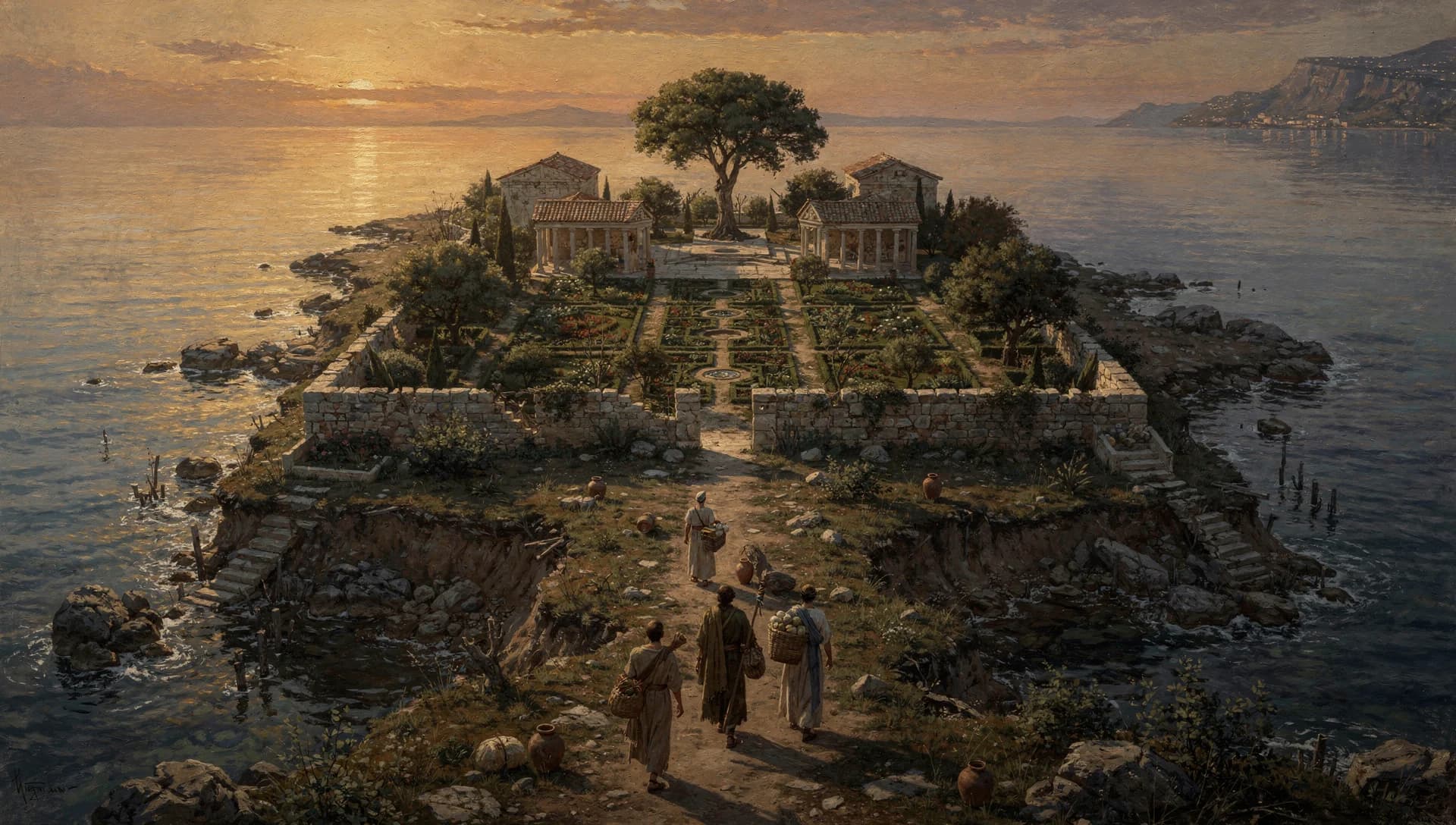
The Paradise That Sank: Eden, Atlantis, and Sumerian Dilmun
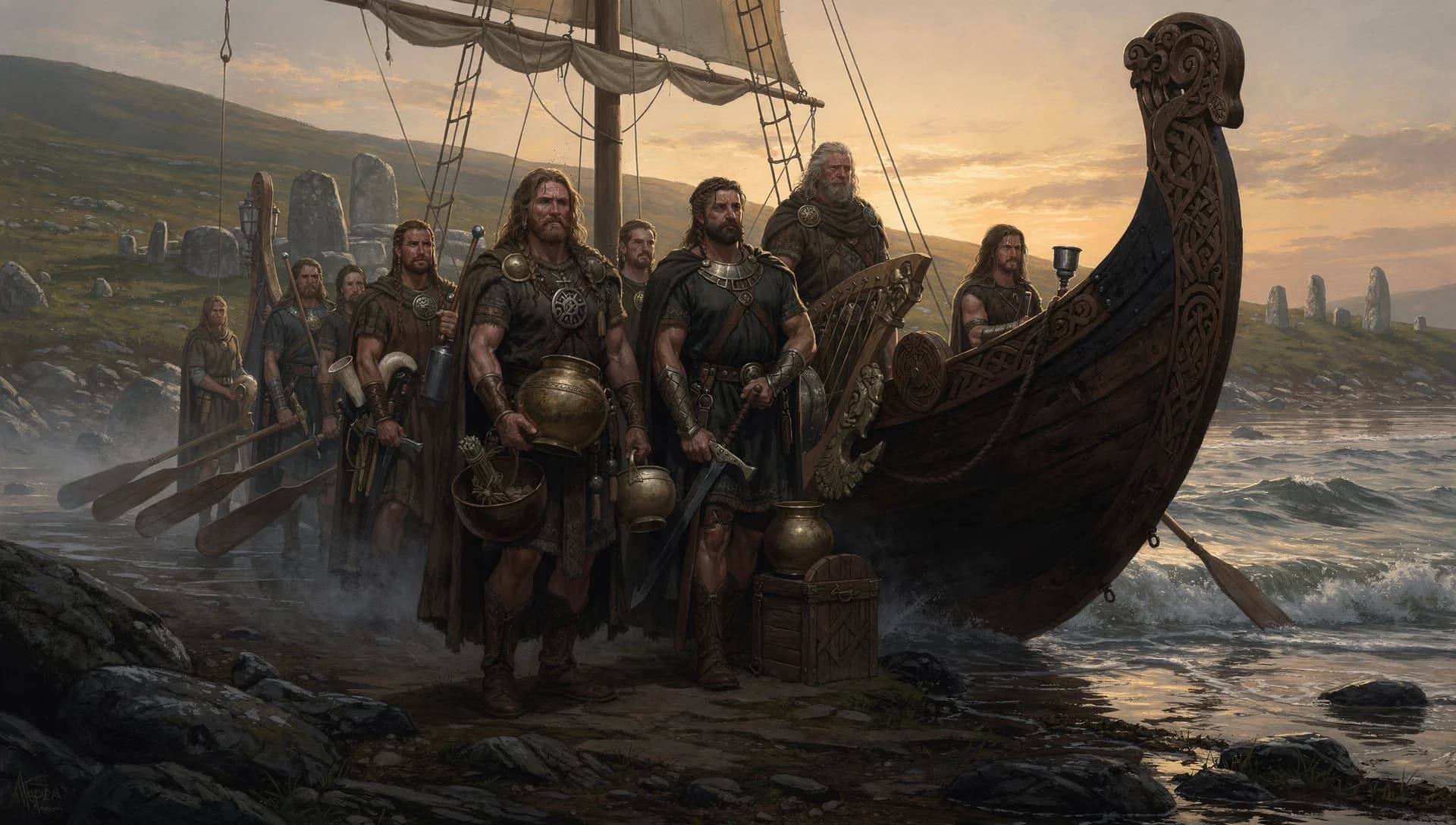
The People Who Came From the East: Tuatha Dé Danann and the Adamic-Andite Arrival Pattern
A Tree Delivered to a Garden: The Tree of Life and the Sumerian Huluppu
The Longest Memory: Australian Aboriginal Dreamtime and the Primordial Teaching-Ancestors
The Newsletter
Get the research behind each piece
Free. New Urantia Book explorations, the sources behind the videos, and early looks. No spam, unsubscribe anytime.
Prefer video? Follow on YouTube and Facebook.
Delivered through Substack. You can also read past issues.