
The Cosmic Tree: The Tree of Life and Norse Yggdrasil
Norse cosmology is organized around Yggdrasil, the World Tree whose branches extend across the sky and whose three roots reach into the realms of gods, frost-giants, and the dead. The Urantia Book describes a physical shrub from Edentia, sent to Urantia at the Planetary Prince's arrival, whose fruit conferred immortality on the corporeal staff. The structural parallels are close enough to mark.
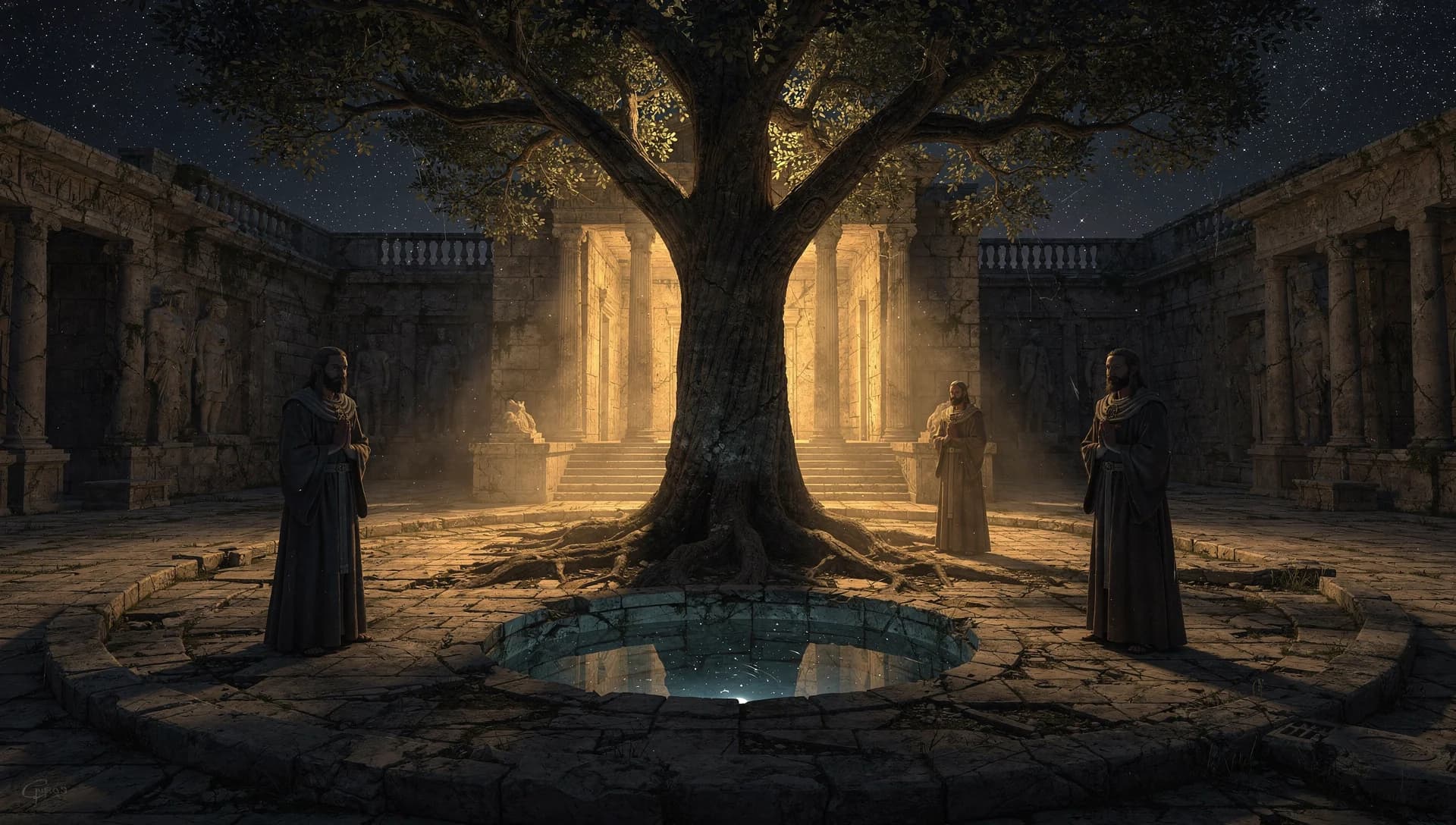
Tree of Life, the Edentia shrub at the center of the Father's temple = Yggdrasil, the World Tree sustaining all realms
This article expands on the decoder mapping. For the side-by-side card and quick reference, see the mapping page.
The Tree at the Center of Everything
Norse cosmology has a distinct architectural structure. Reality is organized around a single central axis: the World Tree, Yggdrasil. The tree's branches extend across the sky. Its three roots reach into distinct realms. Its life-sustaining waters flow from wells at its base. The tree is not merely a mythological image; it is the Norse tradition's cosmological infrastructure, the axis mundi around which all nine worlds are arranged.
The Urantia Book places a physical object at the architectural center of its own account of ancient Urantia's administrative structure: the Tree of Life, a shrub of Edentia transplanted to the central courtyard of the Father's temple in Dalamatia. The structural parallel between this physical tree and the Norse cosmic Yggdrasil is dense enough to warrant a direct decoder mapping.
What the Urantia Book Says
The Urantia account of the Tree of Life is precise and detailed. The tree is a real botanical object with definite biological properties:
"These antidotal complements of the Satania life currents were derived from the fruit of the tree of life, a shrub of Edentia which was sent to Urantia by the Most Highs of Norlatiadek at the time of Caligastia's arrival. In the days of Dalamatia this tree grew in the central courtyard of the temple of the unseen Father, and it was the fruit of the tree of life that enabled the material and otherwise mortal beings of the Prince's staff to live on indefinitely as long as they had access to it." (UB 66:4.13)
Its technical function is described:
"This superplant stored up certain space-energies which were antidotal to the age-producing elements of animal existence. The fruit of the tree of life was like a superchemical storage battery, mysteriously releasing the life-extension force of the universe when eaten. This form of sustenance was wholly useless to the ordinary evolutionary beings on Urantia, but specifically it was serviceable to the one hundred materialized members of Caligastia's staff and to the one hundred modified Andonites who had contributed of their life plasm to the Prince's staff, and who, in return, were made possessors of that complement of life which made it possible for them to utilize the fruit of the tree of life for an indefinite extension of their otherwise mortal existence." (UB 73:6.4)
The Urantia Book is emphatic that the tree was real, not symbolic:
"The 'tree of the knowledge of good and evil' may be a figure of speech, a symbolic designation covering a multitude of human experiences, but the 'tree of life' was not a myth; it was real and for a long time was present on Urantia." (UB 73:6.3)
After the rebellion, the tree was rescued and relocated:
"During the days of the Prince's rule the tree was growing from the earth in the central and circular courtyard of the Father's temple. Upon the outbreak of the rebellion it was regrown from the central core by Van and his associates in their temporary camp. This Edentia shrub was subsequently taken to their highland retreat, where it served both Van and Amadon for more than one hundred and fifty thousand years." (UB 73:6.5)
The tree was eventually transplanted to the Garden of Eden:
"In the center of the Garden temple Van planted the long-guarded tree of life, whose leaves were for the 'healing of the nations,' and whose fruit had so long sustained him on earth. Van well knew that Adam and Eve would also be dependent on this gift of Edentia for their life maintenance after they once appeared on Urantia in material form." (UB 73:6.1)
The structural features preserved across this description are: a single tree, cosmologically central (at the heart of the Father's temple), architectural axis of the administrative system, providing life-sustaining nourishment, carried forward across millennia of planetary history, associated with named superhuman guardians.
What the Ancient Source Says
Yggdrasil's description is preserved across the Norse religious corpus. The Völuspá 19-20 places it at the cosmic center:
"An ash I know, there stands, Yggdrasil is its name, a tall tree, watered with white mud; from there come the dews that fall in the valleys, ever green it stands over the well of fate."
Grímnismál 31-32 gives the three-root architecture:
"Three roots extend three ways beneath the ash Yggdrasil: one extends to Hel, another to the frost-giants, a third over mankind."
The Prose Edda's Gylfaginning 15-16 systematizes the tradition. Yggdrasil is the ash tree whose branches "extend across the sky." Its three roots are nourished by three separate wells (Urðarbrunnr, Mímisbrunnr, Hvergelmir), each associated with a distinct cosmic realm. A divine council meets beneath the tree. A serpent (Níðhöggr) gnaws at its roots. An eagle perches in its top branches. A squirrel (Ratatoskr) runs between them, carrying messages. The tree is actively populated by a complete cosmic ecosystem.
Anders Hultgård's "The Askr and Embla Myth in a Comparative Perspective" (in Old Norse Religion in Long-Term Perspectives, Nordic Academic Press, 2006) treats Yggdrasil within the broader Indo-European world-tree tradition. The parallels extend to Vedic Hinduism (the Aśvattha tree in Bhagavad Gita 15), Slavic mythology (the World Tree in Russian folk tradition), Baltic mythology (the Austras koks of Latvian tradition), and broader Siberian shamanic traditions. The world-tree motif is an Indo-European and possibly broader Eurasian religious universal.
John Lindow's Norse Mythology (2001) treats Yggdrasil as the "cosmological structure that holds together the nine worlds," the Norse realization of the broader world tree template. Jesse Byock's translation and introduction to The Prose Edda (Penguin, 2005) discusses the tree's ecological features and their mythological significance.
The world-tree template's ancient origin is not in dispute. What is less settled is the question of whether the template has a historical or revelatory substrate or whether it is a pure mythological universal emerging from natural human attention to actual large trees as cosmological metaphors. Mircea Eliade's The Sacred and the Profane (Harcourt, 1959) treated the world tree as a natural phenomenological universal. Georges Dumézil's Gods of the Ancient Northmen (1973) emphasized the Indo-European structural specificity.
Why This Mapping Matters
The world-tree motif is unusually widespread across religious traditions. Most Indo-European religions preserve it in some form. Siberian shamanism has it. Some Native American traditions have it. The Mesopotamian kiskanu tree, the Egyptian ished tree, and the Chinese kunlun tree all carry some world-tree features (treated in separate decoder articles for the relevant traditions). The ubiquity is significant; the motif is not a Norse-specific innovation.
The Urantia Book's account offers a historical substrate. An actual physical tree, sent from Edentia to Urantia at the Planetary Prince's arrival roughly five hundred thousand years ago, placed at the architectural center of the Dalamatian administrative complex (UB 66:4.13), carrying biological properties that sustained superhuman life, rescued and preserved through the rebellion, and transplanted successively to Van's highland retreat and eventually to the Garden of Eden. This historical tree would have been the single most visually and functionally significant cultural artifact of the pre-rebellion civilization, and memory of it would plausibly propagate through the subsequent human traditions as the generative substrate of the world-tree motif.
The structural features that map between the Urantia Tree of Life and the Norse Yggdrasil include: architectural centrality (Father's temple courtyard / cosmic axis), life-sustaining function (fruit conferring immortality / waters nourishing the worlds), dedicated guardianship (Van and loyalists / gods at the council), long cosmological span (more than 150,000 years of preservation / the age of the worlds), and association with a superhuman order (corporeal staff / Aesir).
The Norse-specific features that the Urantia account does not directly match (the three roots into three realms, the serpent at the root, the eagle in the top, the squirrel Ratatoskr) are likely local mythological elaborations that the Norse tradition added to the underlying substrate. The serpent at the root may preserve the memory of the serpent-associated Genesis 3 narrative (treated in the Serapatatia-Serpent decoder article). The tripartite root-realm structure may preserve the memory of the three-fold cosmic administration (Havona, superuniverses, time-space creation) that the Urantia revelation describes. These are suggestive rather than narrowly demonstrable.
The mapping's significance is that it places the Norse world-tree motif within the same distributed-memory framework that connects the various world-tree traditions across Eurasia. The traditions are not independent parallel developments of a phenomenological universal. They are cultural preservations of a historical artifact, carried through millennia of cultural transmission and locally elaborated in each receiving tradition. The Norse Yggdrasil is the Germanic-Norse preservation; the Urantia revelation supplies the specific historical referent that the preservation is carrying.
Sources
- The Urantia Book, Paper 66 (The Planetary Prince's Staff), Paper 73 (The Garden of Eden). Urantia Foundation, first printing 1955. Cited passages: 66:4.13, 73:6.1, 73:6.3, 73:6.4, 73:6.5.
- Dronke, Ursula, editor and translator. The Poetic Edda, Volume II: Mythological Poems. Oxford University Press, 1997.
- Sturluson, Snorri. The Prose Edda. Translated by Jesse L. Byock. Penguin, 2005.
- Lindow, John. Norse Mythology: A Guide to Gods, Heroes, Rituals, and Beliefs. Oxford University Press, 2001.
- Simek, Rudolf. Dictionary of Northern Mythology. Translated by Angela Hall. D. S. Brewer, 1993.
- Hultgård, Anders. "The Askr and Embla Myth in a Comparative Perspective," in Old Norse Religion in Long-Term Perspectives, Nordic Academic Press, 2006.
- Eliade, Mircea. The Sacred and the Profane. Translated by Willard R. Trask. Harcourt, Brace & World, 1959.
- West, M. L. Indo-European Poetry and Myth. Oxford University Press, 2007.
Confidence and Evidence
- Confidence: INFORMED SPECULATION
- Evidence rating: MODERATE
- Basis: The Urantia Book describes a physical Tree of Life at the architectural center of the Dalamatian administrative complex, carrying distinct biological properties, guarded across more than 150,000 years, and transplanted successively through the planetary history. The Norse Yggdrasil's features (cosmological centrality, life-sustaining function, association with superhuman guardians) structurally match the Urantia Tree of Life. The broader Indo-European world-tree tradition establishes a consistent inherited substrate across multiple downstream traditions.
Related Decoder Articles
- Van, Sustained by the Tree of Life = Odin on Yggdrasil
- Tree of Life, Sacred Shrub = Huluppu Tree
- Van + Fandor + Tree of Life = Assyrian Winged Figure Reliefs
By Derek Samaras
Connecting Articles
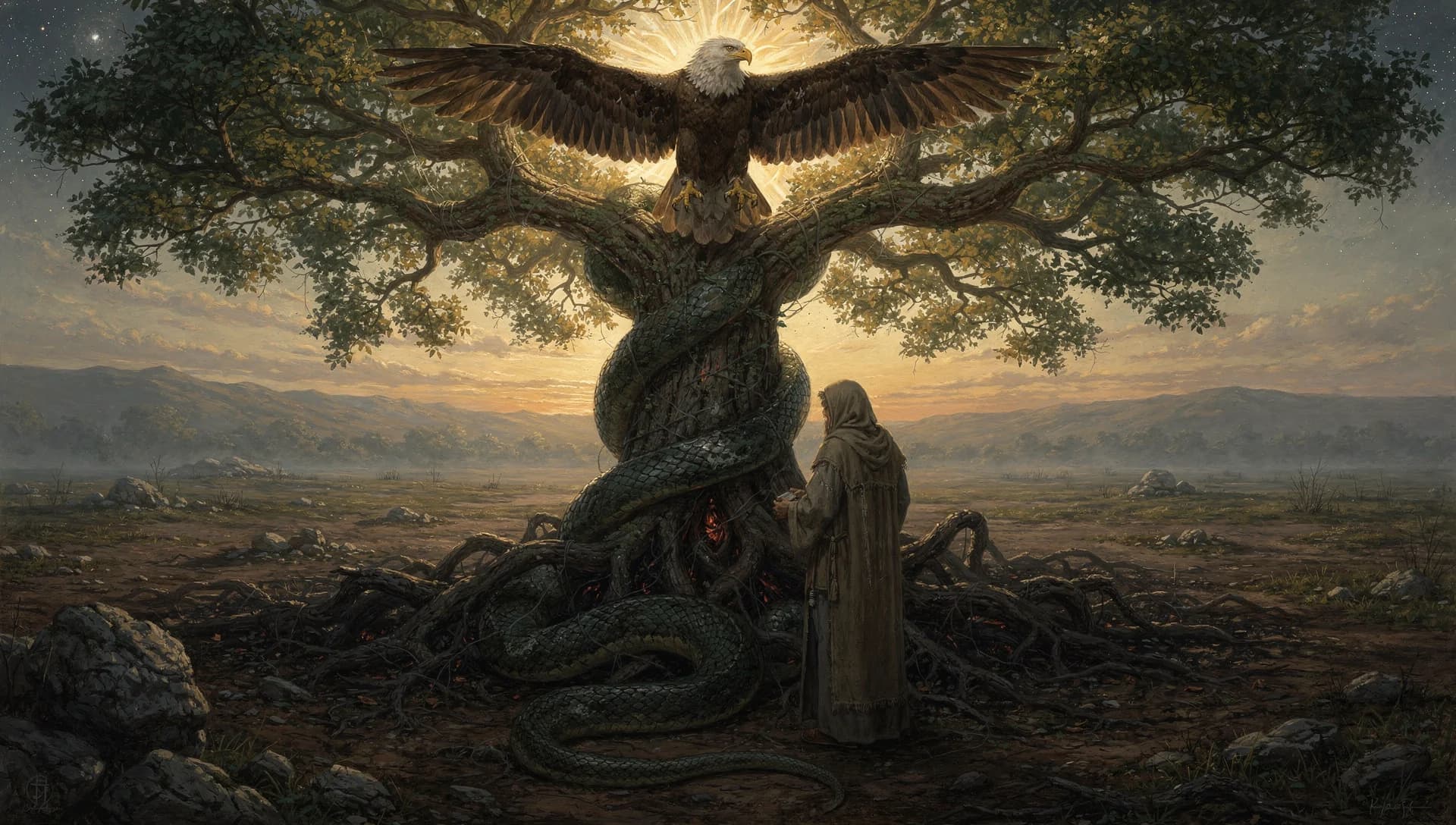
Bird in Crown, Serpent at Root: The Universal Tree of Life Cult Across World Cultures
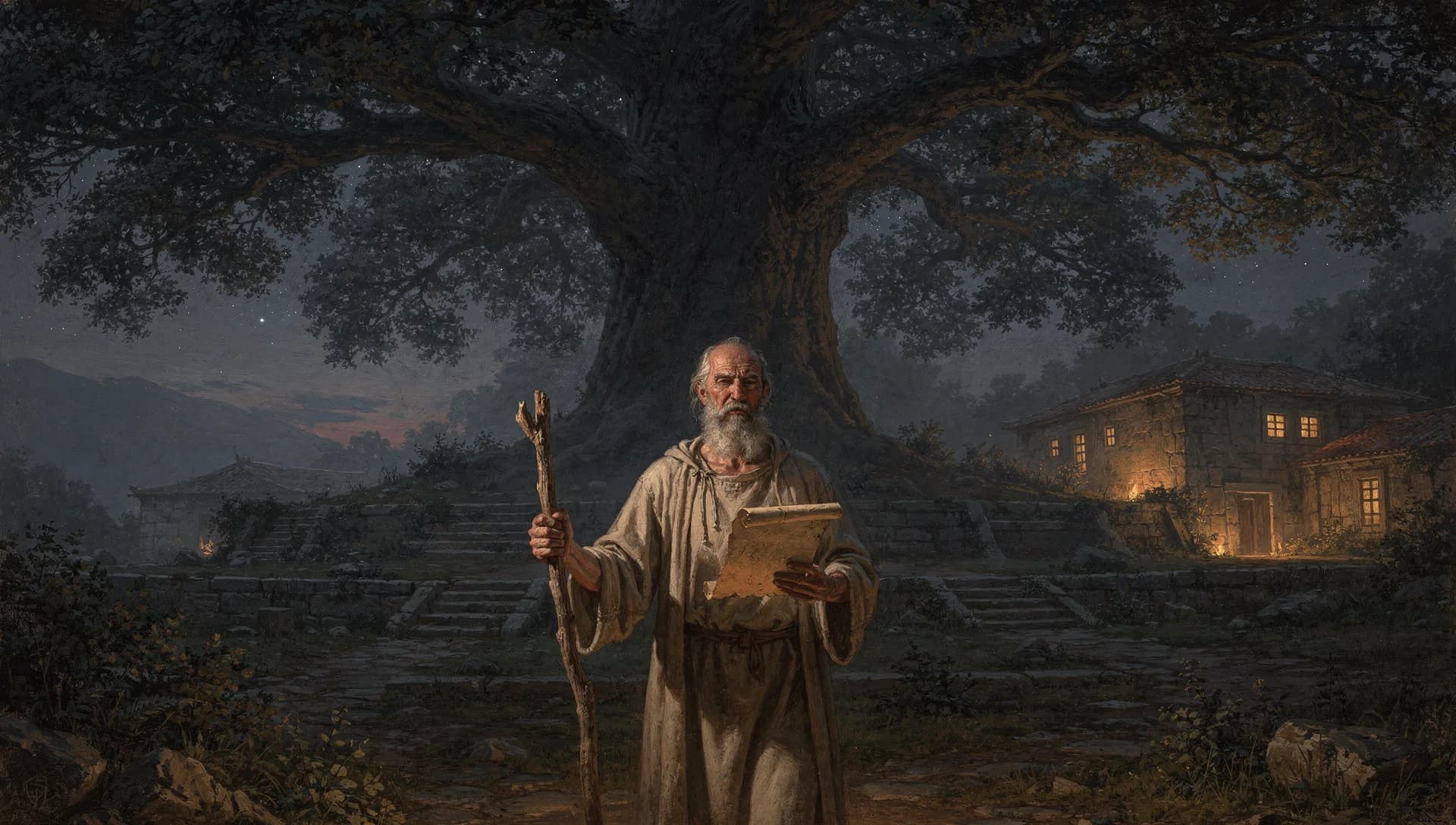
The One Who Hung on the Tree: Van and the Norse Odin
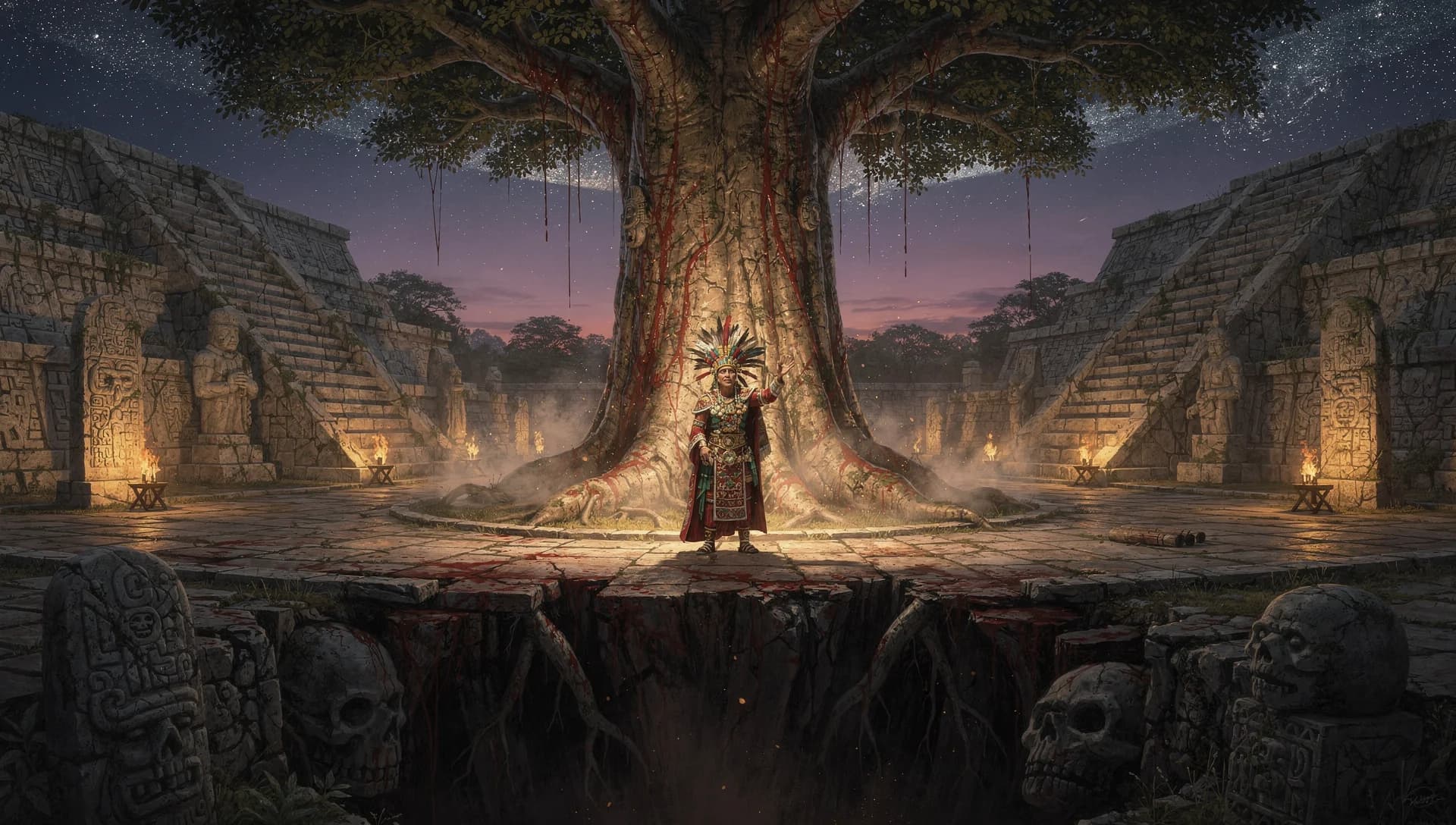
The Tree at the Center of the World: Maya Ceiba Yaxche' and the Tree of Life
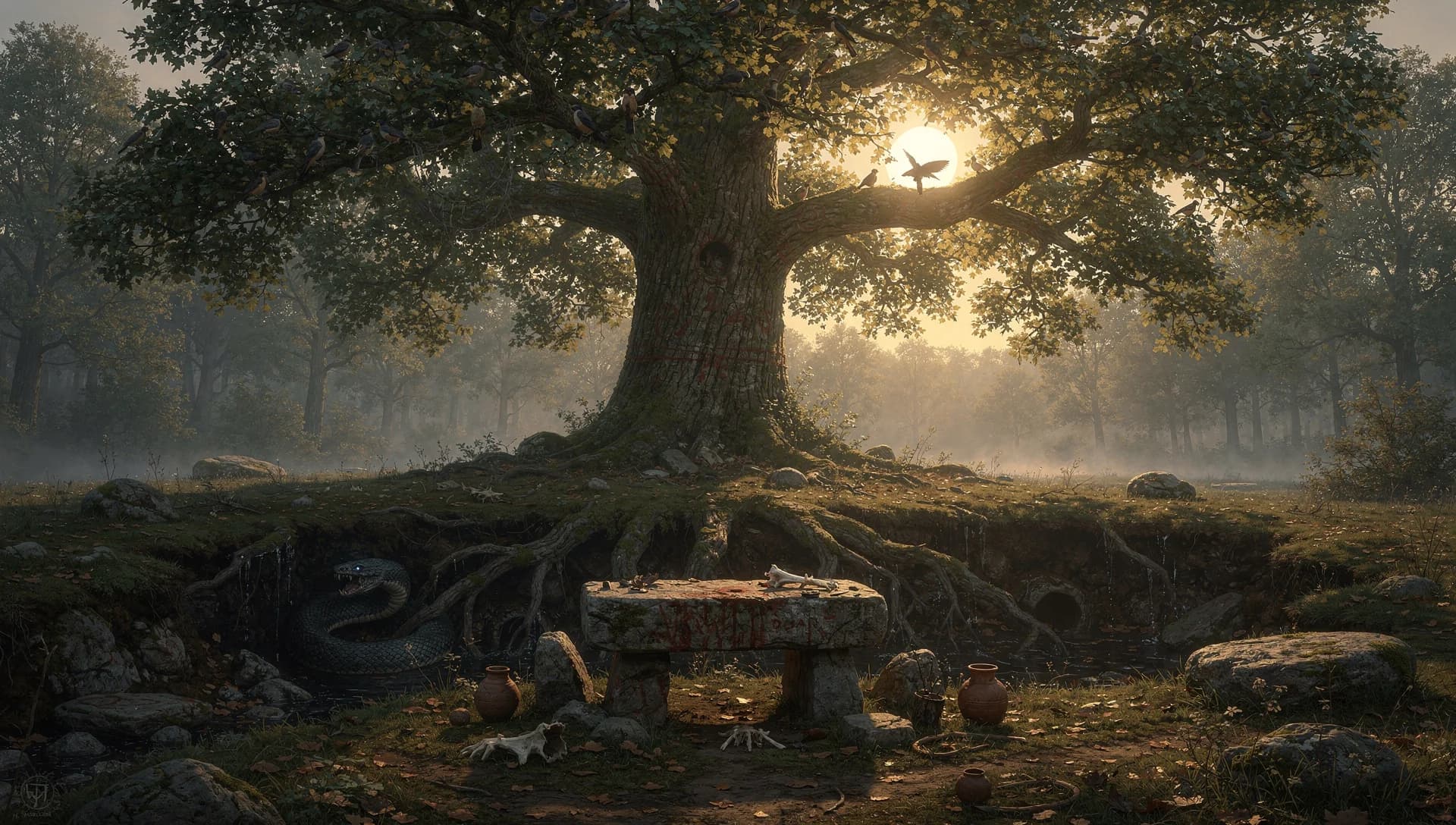
The Oak at the Center of the World: The Slavic Dub and the Universal Tree Cult
The Newsletter
Get the research behind each piece
Free. New Urantia Book explorations, the sources behind the videos, and early looks. No spam, unsubscribe anytime.
Prefer video? Follow on YouTube and Facebook.
Delivered through Substack. You can also read past issues.