
 Mythic
Yggdrasil, the World Tree sustaining all realms (Norse)
 UB
UBTree of Life, the Edentia shrub at the center of the Father's temple
Full Article
Read the deep-dive article on this connection
Tree of Life, the Edentia shrub at the center of the Father's temple = Yggdrasil, the World Tree sustaining all realms (Norse)
The Connection
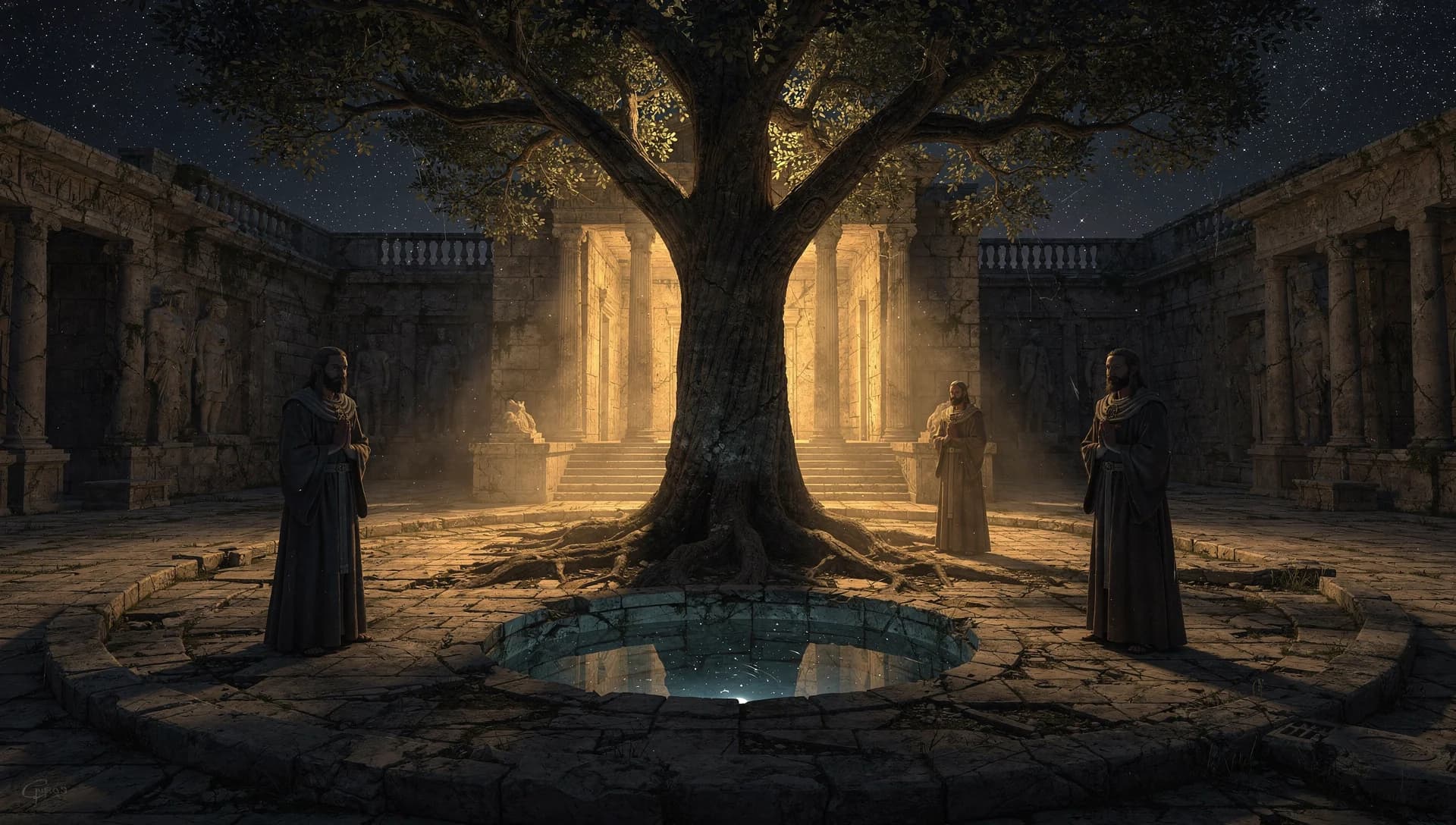
Yggdrasil is the cosmic tree at the center of Norse cosmology whose roots span all worlds and whose life-giving waters sustain the gods. The Tree of Life is a real shrub from Edentia, placed in the central courtyard of the Father's temple in Dalamatia, whose fruit conferred immortality on the Prince's staff. Both trees are sacred, cosmologically central, life-sustaining, and located at the meeting point of the divine and mortal worlds. The image of a world tree whose fruit or sap confers immortality on those with access to it is the same image across both traditions.
UB Citation
UB 66:4.13, 73:6.1, 73:6.5
Academic Source
Prose Edda, Gylfaginning 15-16 (Sturluson, c. 1220 CE); Völuspá 19-20 (Poetic Edda)
Historical Evidence(Moderate evidence)
Prose Edda Gylfaginning 15 describes Yggdrasil as the tree whose branches "extend across the sky" and whose three roots reach the realms of the gods, the frost-giants, and the underworld. Völuspá 19 adds that the tree stands "ever green" beside the well of fate. UB 66:4.13 places the Tree of Life in "the central and circular courtyard of the Father's temple" and specifies that its fruit provided "the antidotal complements of the Satania life currents" that conferred immortality. Jesse Byock (UCLA) notes Yggdrasil's role as the cosmological structure that "holds together the nine worlds," the exact function the Tree of Life serves as the physical link between divine provision and mortal existence.
Deep Dive
Open the Prose Edda at Gylfaginning 15 and Snorri Sturluson, around 1220 CE, gives the standard medieval Icelandic description of Yggdrasil. The tree's branches spread across the sky. Three great roots reach into the three regions of the cosmos: one to the realm of the Aesir, where the well of Urd and the three Norns sit weaving fate; one to the realm of the frost-giants, where Mimir's well of wisdom flows; one to Niflheim, the underworld of the dead, where the dragon Nidhogg gnaws at the root from below. The tree holds the cosmos together. It is the structural axis of the nine worlds. Various creatures populate it: the eagle at the top, the squirrel Ratatoskr running up and down the trunk carrying insults between the eagle and the dragon, the four stags that browse the leaves. Voluspa 19, in the older Eddic poetry, calls the tree ever-green and places it beside the well of fate.
The Urantia Book gives us, in Paper 66:4.13, the historical referent for this cosmic image: "These antidotal complements of the Satania life currents were derived from the fruit of the tree of life, a shrub of Edentia which was sent to Urantia by the Most Highs of Norlatiadek at the time of Caligastia's arrival. In the days of Dalamatia this tree grew in the central courtyard of the temple of the unseen Father, and it was the fruit of the tree of life that enabled the material and otherwise mortal beings of the Prince's staff to live on indefinitely as long as they had access to it." Paper 66:4.14 adds: "While of no value to the evolutionary races, this supersustenance was quite sufficient to confer continuous life upon the Caligastia one hundred and also upon the one hundred modified Andonites who were associated with them."
So the tree of life is not a mythological symbol; it is a real shrub, transplanted from Edentia to Urantia at the time of the Planetary Prince's arrival, growing in the central courtyard of the temple in Dalamatia, providing the immortality-sustaining nutrition that allowed the corporeal staff of the Prince to live continuously on the planet across the long centuries of their administrative work.
Paper 73:6.5 records the tree's subsequent history: "During the days of the Prince's rule the tree was growing from the earth in the central and circular courtyard of the Father's temple. Upon the outbreak of the rebellion it was regrown from the central core by Van and his associates in their temporary camp. This Edentia shrub was subsequently taken to their highland retreat, where it served both Van and Amadon for more than one hundred and fifty thousand years."
Paper 73:6.1 records Van's later replanting at the second garden: "In the center of the Garden temple Van planted the long-guarded tree of life, whose leaves were for the healing of the nations, and whose fruit had so long sustained him on earth. Van well knew that Adam and Eve would also be dependent on this gift of Edentia for their life maintenance after they once appeared on Urantia in material form."
The biographical-historical reality the UB describes is dense. A real shrub, of Edentia origin, transplanted three times across the long planetary history (Dalamatia, the post-rebellion highland retreat, the Adamic Edenic garden), sustaining specific named superhuman beings whose physiology required this supplementary energy source for continuous life. The tree was a real botanical reality with real life-supporting properties.
The Norse cosmological tree, then, is the cultural memory of this real tree, refracted through tens of thousands of years of cultural transmission. The structural match holds at multiple points. First, both trees stand at the cosmological center: Yggdrasil at the axis of the nine worlds, the tree of life in "the central and circular courtyard of the Father's temple." Second, both trees connect divine and mortal realms: Yggdrasil's roots reach into the realms of the gods, giants, and dead, with its branches spreading across the sky; the tree of life is described as the link between divine provision (Edentia, the headquarters of the constellation) and mortal-corporeal existence on Urantia. Third, both are sources of life-sustaining substances. The wells at Yggdrasil's roots (Urd, Mimir, Hvergelmir) flow with knowledge and life-water; the tree of life's fruit and leaves are the immortality-conferring energy.
Fourth, both are characterized as "ever-green" or eternally renewing. Voluspa 19 specifies that Yggdrasil stands ever-green; the UB tree of life is "regrown from the central core" at multiple points across its planetary history, surviving relocation across hundreds of thousands of years. Fifth, both have an associated guardian who maintains them. Yggdrasil has the three Norns who care for it; the tree of life is guarded by the loyalist staff and especially by Van himself across his long vigil.
E. O. G. Turville-Petre, in Myth and Religion of the North, and Jesse Byock, in his various translations and studies, have documented the cosmological centrality of Yggdrasil in the Norse imagination. The tree is not a peripheral image; it is the structural axis of the entire mythological cosmos. This level of cosmological centrality is exactly what we would expect for a cultural memory of a real planetary tree of life that really did sit at the center of the original civilizational headquarters and that really did sustain the lives of the planetary administrative staff. The Norse tradition has preserved the cosmological centrality with extraordinary fidelity even as it has elaborated the biographical details into mythological imagery.
The strongest counterargument is the universal-archetype reading: world-trees are pan-cultural mythological constructs (the Indian ashvattha, the Mesopotamian huluppu, the Christian tree of life in Revelation 22, the Mayan ceiba), and the Norse Yggdrasil is one instance of a universal pattern rather than a specific cultural memory of a particular tree. The reply is that the universality is consistent with the UB account: a real tree of life on Urantia, with global cultural memory of its existence and its functions, would produce exactly the universal-archetype pattern that comparative religion documents. The Norse case is one rich instance, with its specific structural features (axis-of-cosmos, well at the root, guardian figures, ever-green character) preserving the underlying historical reality with unusual fidelity.
What the parallel implies is that one of the most central images in Norse cosmology preserves cultural memory of a real botanical reality on this planet, the Edentia shrub that sustained the Prince's staff across the long Dalamatian and post-rebellion era. The decoder's job is to recover the historical referent and to honor Yggdrasil as the Norse cultural memory of the actual tree of life.
Key Quotes
“These antidotal complements of the Satania life currents were derived from the fruit of the tree of life, a shrub of Edentia which was sent to Urantia by the Most Highs of Norlatiadek at the time of Caligastia’s arrival. In the days of Dalamatia this tree grew in the central courtyard of the temple of the unseen Father, and it was the fruit of the tree of life that enabled the material and otherwise mortal beings of the Prince’s staff to live on indefinitely as long as they had access to it.”
“In the center of the Garden temple Van planted the long-guarded tree of life, whose leaves were for the “healing of the nations,” and whose fruit had so long sustained him on earth. Van well knew that Adam and Eve would also be dependent on this gift of Edentia for their life maintenance after they once appeared on Urantia in material form.”
“During the days of the Prince’s rule the tree was growing from the earth in the central and circular courtyard of the Father’s temple. Upon the outbreak of the rebellion it was regrown from the central core by Van and his associates in their temporary camp. This Edentia shrub was subsequently taken to their highland retreat, where it served both Van and Amadon for more than one hundred and fifty thousand years.”
Cultural Impact
The world-tree image is one of the most widely distributed mythological constructs in human religious imagination. The Norse Yggdrasil, the Hindu ashvattha (the inverted cosmic fig tree of the Bhagavad Gita), the Mesopotamian huluppu (the tree planted by Inanna), the Mayan ceiba (the great cosmic tree of K'iche' cosmology), the biblical tree of life in Genesis 2 and Revelation 22, the Buddhist bodhi tree under which Siddhartha attained enlightenment, the Persian gaokerena (the white haoma tree), the Chinese kien-mou: every major religious tradition has its world-tree. The cultural inheritance is one of the deepest substrates of religious imagination across the planet. The Norse case is among the most fully articulated, with the dense cosmological-mythological apparatus around Yggdrasil providing material for over a millennium of Scandinavian, Germanic, and broader European cultural elaboration. Through Wagner's Ring cycle, Tolkien's mythology, modern fantasy literature and gaming, the cosmic-tree image continues to shape contemporary imagination. The UB account, by identifying the historical referent in the tree of life, restores the parsimonious source for what otherwise looks like a mysterious universal archetype.
Modern Resonance
Contemporary readers encountering Yggdrasil through Norse mythology, fantasy literature, video games, or environmental philosophy often find the image powerfully resonant without quite knowing why. The UB framework offers an explanation: the resonance is the residue of cultural memory of a real planetary phenomenon, the actual tree of life that grew at Dalamatia and was preserved through the long post-rebellion era by Van's vigil and replanted at the second garden for Adam and Eve. The image is not arbitrary symbolism; it is the cultural memory of an actual biological reality. For modern readers attracted to ecological and cosmic-tree imagery, this historical referent restores a parsimonious source. The various world-tree traditions across the planet are not multiple independent inventions; they are multiple regional memories of one original tree that really did sit at the cosmological center of human civilization in its earliest organized form. The decoder's job is to point at the original referent and to let the various traditions converge on their shared historical source.
Related Mappings
Andite military commander (~5000 BC)
= Thor, Norse god of thunder and warfare
Van, sustained by the Tree of Life for 150,000 years
= Odin, self-hung on Yggdrasil, the World Tree (Norse)
The staff split: loyal vs. rebel members of the Prince's corps
= The Aesir-Vanir War, the first conflict among the gods (Norse)
Caligastia, the deposed Planetary Prince whose deception continues on earth
= Loki, the shapeshifting trickster within the Aesir who engineers Ragnarok
Related Articles
Where to next
The free newsletter. The research behind each piece, no spam.