
The One Who Hung on the Tree: Van and the Norse Odin
The Havamal of the Poetic Edda preserves one of the most striking images in Norse religious literature: Odin hangs for nine nights on the World Tree, wounded, enduring a prolonged vigil to gain transcendent wisdom. The Urantia Book records a specific figure who actually did this: Van, who was sustained by the Tree of Life for one hundred and fifty thousand years while maintaining the memory of truth during the long dark age.
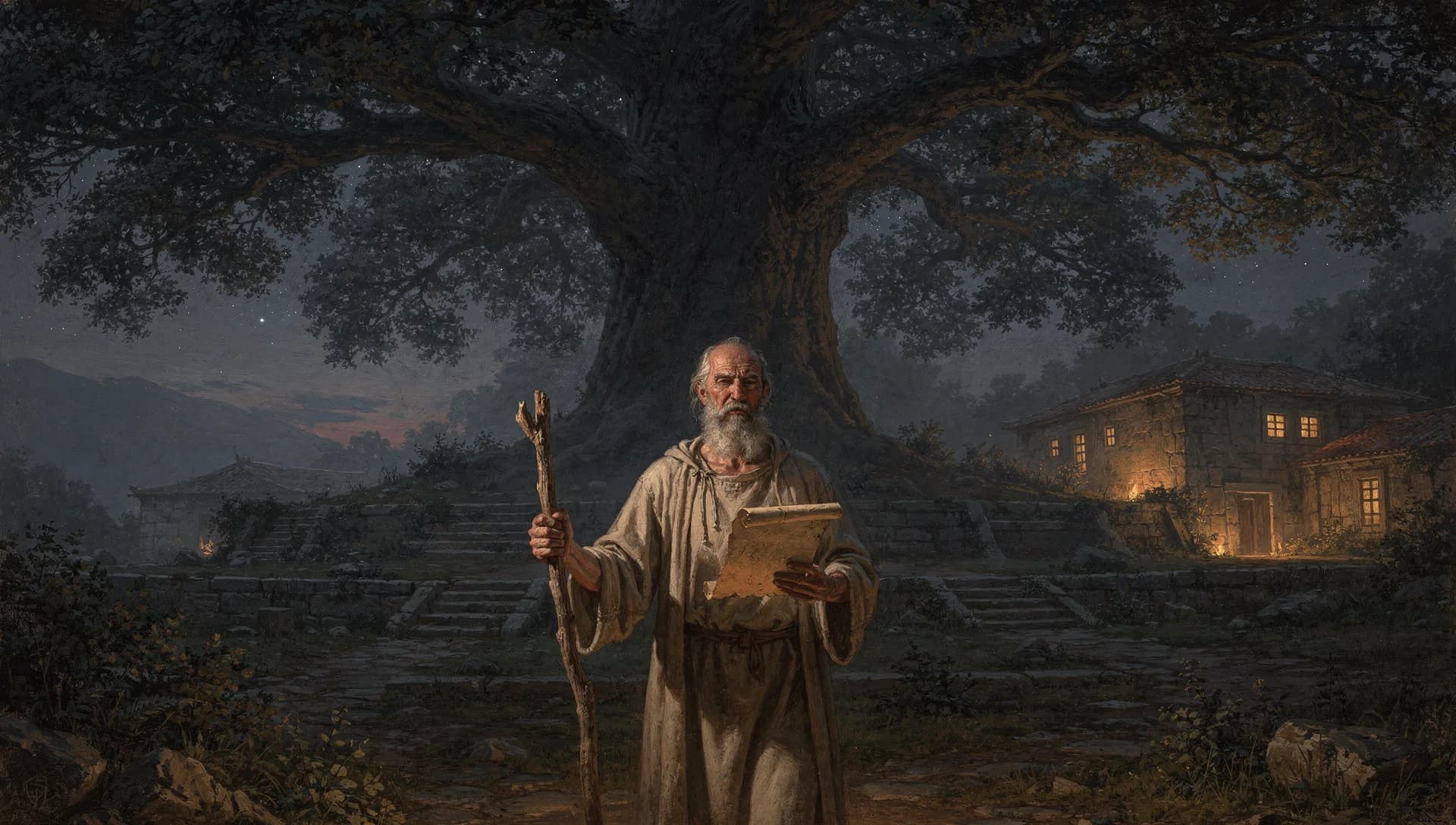
Van, sustained by the Tree of Life for more than 150,000 years = Odin, self-hung on Yggdrasil, the World Tree
This article expands on the decoder mapping. For the side-by-side card and quick reference, see the mapping page.
The Hanged God
The Norse religious literature preserves an image unlike anything else in the Indo-European religious corpus. Odin, the chief of the Aesir, describes his own prolonged vigil on the World Tree in the first person. Havamal 138-139 of the Poetic Edda gives the passage in Odin's own voice:
"I know that I hung on a windy tree nine long nights, wounded with a spear, dedicated to Odin, myself to myself, on that tree of which no man knows from where its roots run."
The passage is theologically peculiar enough to have generated centuries of scholarly debate. Why does the supreme god hang himself? Why on the World Tree? Why for nine nights? Why does he describe the tree as one "of which no man knows from where its roots run"? The answers the Norse tradition gives are mythological: Odin gains the knowledge of the runes through this ordeal, acquires transcendent wisdom, and establishes his claim to chief authority among the gods through voluntary suffering.
The Urantia Book records a historical figure whose life produces exactly this structural memory.
What the Urantia Book Says
Van was the loyal jurist of the Caligastia staff who refused to join the planetary rebellion. After the rebellion broke the planetary circuits, Van and his associate Amadon sustained themselves for more than one hundred and fifty thousand years through the biological mechanism of the Tree of Life:
"Van was left on Urantia until the time of Adam, remaining as titular head of all superhuman personalities functioning on the planet. He and Amadon were sustained by the technique of the tree of life in conjunction with the specialized life ministry of the Melchizedeks for over one hundred and fifty thousand years." (UB 67:6.4)
The nature of the tree itself is described in technical terms:
"These antidotal complements of the Satania life currents were derived from the fruit of the tree of life, a shrub of Edentia which was sent to Urantia by the Most Highs of Norlatiadek at the time of Caligastia's arrival. In the days of Dalamatia this tree grew in the central courtyard of the temple of the unseen Father, and it was the fruit of the tree of life that enabled the material and otherwise mortal beings of the Prince's staff to live on indefinitely as long as they had access to it." (UB 66:4.13)
"This superplant stored up certain space-energies which were antidotal to the age-producing elements of animal existence. The fruit of the tree of life was like a superchemical storage battery, mysteriously releasing the life-extension force of the universe when eaten. This form of sustenance was wholly useless to the ordinary evolutionary beings on Urantia, but specifically it was serviceable to the one hundred materialized members of Caligastia's staff and to the one hundred modified Andonites who had contributed of their life plasm to the Prince's staff, and who, in return, were made possessors of that complement of life which made it possible for them to utilize the fruit of the tree of life for an indefinite extension of their otherwise mortal existence." (UB 73:6.4)
After the rebellion the tree was rescued by Van's associates and carried to the highland retreat:
"Upon the outbreak of the rebellion it was regrown from the central core by Van and his associates in their temporary camp. This Edentia shrub was subsequently taken to their highland retreat, where it served both Van and Amadon for more than one hundred and fifty thousand years." (UB 73:6.5)
The structural match to the Odin-on-Yggdrasil account has several precise elements. First, an individual. Second, a prolonged sustained vigil at a sacred tree. Third, the acquisition of cosmic knowledge and planetary authority through the vigil. Fourth, the explicit characterization of the tree as cosmologically central (Van's tree was at the center of the Father's temple in Dalamatia; Yggdrasil is the center of the Norse cosmos).
The Van account, as the Urantia Book presents it, is the literal historical event behind what the Norse tradition remembers mythologically. The "nine nights" of Havamal is a mythological compression of the more than one hundred and fifty thousand years the Urantia account specifies. The compression is not coincidental; it is the normal pattern of mythological memory, where durations too long to narrate get compressed into ritually meaningful numbers (the sacred number nine in Norse cosmology).
What the Ancient Source Says
The Havamal ("Words of the High One") is one of the poems of the Poetic Edda, preserved in the thirteenth-century Codex Regius manuscript (GKS 2365 4to, National Library of Iceland) but containing material that philologists date to the ninth through eleventh centuries CE. Ursula Dronke's edition (The Poetic Edda, 3 volumes, Oxford University Press, 1969-2011) is the standard scholarly reference. John Lindow's Norse Mythology: A Guide to Gods, Heroes, Rituals, and Beliefs (Oxford University Press, 2001) provides comparative treatment.
The passage on Odin's self-sacrifice spans Havamal stanzas 138-141. Odin hangs "on a windy tree" (vindgameiðr, generally read as a kenning for Yggdrasil) for nine nights, wounded with a spear, dedicated to himself ("given to Oðinn, myself to myself"). The vigil yields these outcomes: the acquisition of the runes, the ability to perform nine mighty songs, the drink of Óðrœrir (the mead of poetic inspiration).
Yggdrasil's own description spans the Völuspá, Grímnismál, and the Prose Edda's Gylfaginning. The Völuspá 19-20 describes the tree as "ever green" beside the well of fate (Urðarbrunnr). Grímnismál 31-32 names the three roots reaching to Hel, the frost-giants, and to mankind. Gylfaginning 15-16 elaborates the cosmological framework: Yggdrasil is the tree that holds the nine worlds together, whose branches extend across the sky, whose roots are nourished by the wells of wisdom and fate.
The scholarly question of Odin's self-sacrifice has generated substantial comparative literature. Mircea Eliade's Shamanism: Archaic Techniques of Ecstasy (Princeton University Press, 1964) reads the vigil as a classical shamanic initiation: the ritual death and rebirth of the shaman through the world-tree ascent. Georges Dumézil's Gods of the Ancient Northmen (University of California Press, 1973) traces the Indo-European structural background. H. R. Ellis Davidson's Gods and Myths of Northern Europe (Penguin, 1964) treats the passage within the broader Norse religious frame.
The Indo-European parallels (Vedic ritual tree ascents, Baltic and Slavic world-tree traditions) establish that the Norse image belongs to a broader Eurasian religious tradition. The Norse distinctiveness is the narrative fusion of the world-tree motif with a named supreme deity's self-sacrifice. Most comparative traditions have a world tree without the Odin-vigil narrative; the narrative is the Norse innovation on the broader substrate.
Why This Mapping Matters
The Norse Odin-on-Yggdrasil narrative is theologically unique in the Indo-European corpus. A supreme god who hangs himself on the cosmic tree to acquire wisdom, wounded, dedicated to himself, is not a structural template found elsewhere in the Indo-European religious imagination. The nearest parallel is the Christian crucifixion, but that has its own historical referent and is not what the Norse tradition is drawing on.
The Urantia Book supplies the specific historical event the Norse tradition compresses. Van's sustained vigil of more than one hundred and fifty thousand years at the Tree of Life in the highland retreat, after the planetary rebellion, is exactly the structural shape the Odin-Yggdrasil myth preserves. A superhuman being. A prolonged ordeal at a sacred tree. The acquisition of cosmic authority through the vigil. The eventual emergence as the steward of cosmic knowledge and civilization for the subsequent age.
The transmission route from the Van tradition to the Norse Havamal is plausible though not precisely documentable. The Andite migrations northward into Europe carried the cultural-religious substrate that eventually produced the Germanic and Norse religious traditions. Memory of Van and his tree-vigil would have been compressed across millennia of oral transmission, reframed within the evolving Indo-European religious vocabulary, and eventually systematized by the Icelandic skalds of the Viking Age into the Odin narrative the Havamal preserves.
The linguistic evidence is suggestive. The Vanir, the older divine family in Norse religion, are philologically the people of Van. The Aesir-Vanir war (treated in a companion decoder article) preserves the memory of the staff split. The Odin-on-Yggdrasil narrative, as the Aesir-side preservation of the vigil memory, becomes associated with the dominant younger divine house rather than with the Van-faction Vanir, but the underlying memory is of the same historical vigil.
The decoder's claim is that the Norse tradition preserves, in compressed mythological form, the specific historical fact of Van's long vigil at the Tree of Life. The compression is severe (150,000 years to 9 nights). The narrative relocation is significant (from the highland retreat east of India to the Norse cosmic tree). The theological repackaging is substantial (from loyal jurist maintaining truth to supreme god acquiring wisdom). But the structural core (named being, sustained tree-vigil, cosmic authority gained) is the same, and the preservation across 150,000 years of cultural transmission is itself a remarkable fact about what deep human religious memory is capable of carrying.
Sources
- The Urantia Book, Paper 66 (The Planetary Prince's Staff), Paper 67 (The Planetary Rebellion), Paper 73 (The Garden of Eden). Urantia Foundation, first printing 1955. Cited passages: 66:4.13, 67:6.4, 73:6.4, 73:6.5.
- Dronke, Ursula, editor and translator. The Poetic Edda, Volumes I-III. Oxford University Press, 1969-2011.
- Sturluson, Snorri. Edda. Translated by Anthony Faulkes. Everyman, 1987.
- Lindow, John. Norse Mythology: A Guide to Gods, Heroes, Rituals, and Beliefs. Oxford University Press, 2001.
- Eliade, Mircea. Shamanism: Archaic Techniques of Ecstasy. Translated by Willard R. Trask. Bollingen Series 76, Princeton University Press, 1964.
- Dumézil, Georges. Gods of the Ancient Northmen. Edited by Einar Haugen, University of California Press, 1973.
- Ellis Davidson, H. R. Gods and Myths of Northern Europe. Penguin, 1964.
- Turville-Petre, E. O. G. Myth and Religion of the North. Holt, Rinehart and Winston, 1964.
Confidence and Evidence
- Confidence: INFORMED SPECULATION
- Evidence rating: MODERATE
- Basis: The structural match between Van's sustained Tree of Life vigil and Odin's Yggdrasil vigil is precise: named individual, tree-vigil of exceptional duration, acquisition of cosmic authority and knowledge. The Havamal text's theological peculiarity (supreme god self-sacrificing on cosmic tree) has no structural parallel elsewhere in the Indo-European corpus and invites a historical antecedent. The Urantia account supplies such an antecedent.
Related Decoder Articles
- Van, Loyal Corporeal Staff Member = Enki / Ea
- The Staff Split = Aesir-Vanir War
- Van + Fandor + Tree of Life = Assyrian Winged Figure Reliefs
By Derek Samaras
Connecting Articles
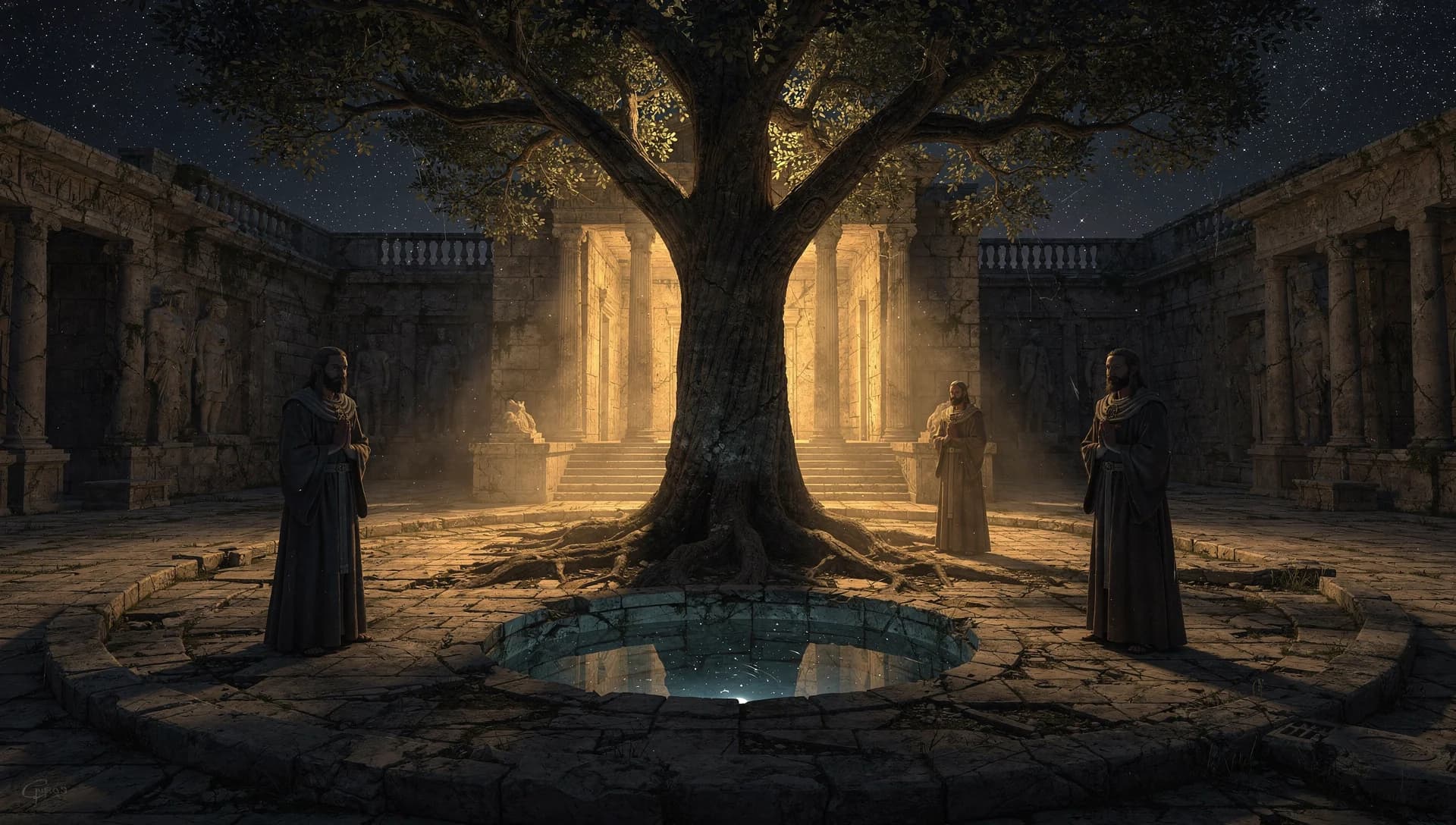
The Cosmic Tree: The Tree of Life and Norse Yggdrasil
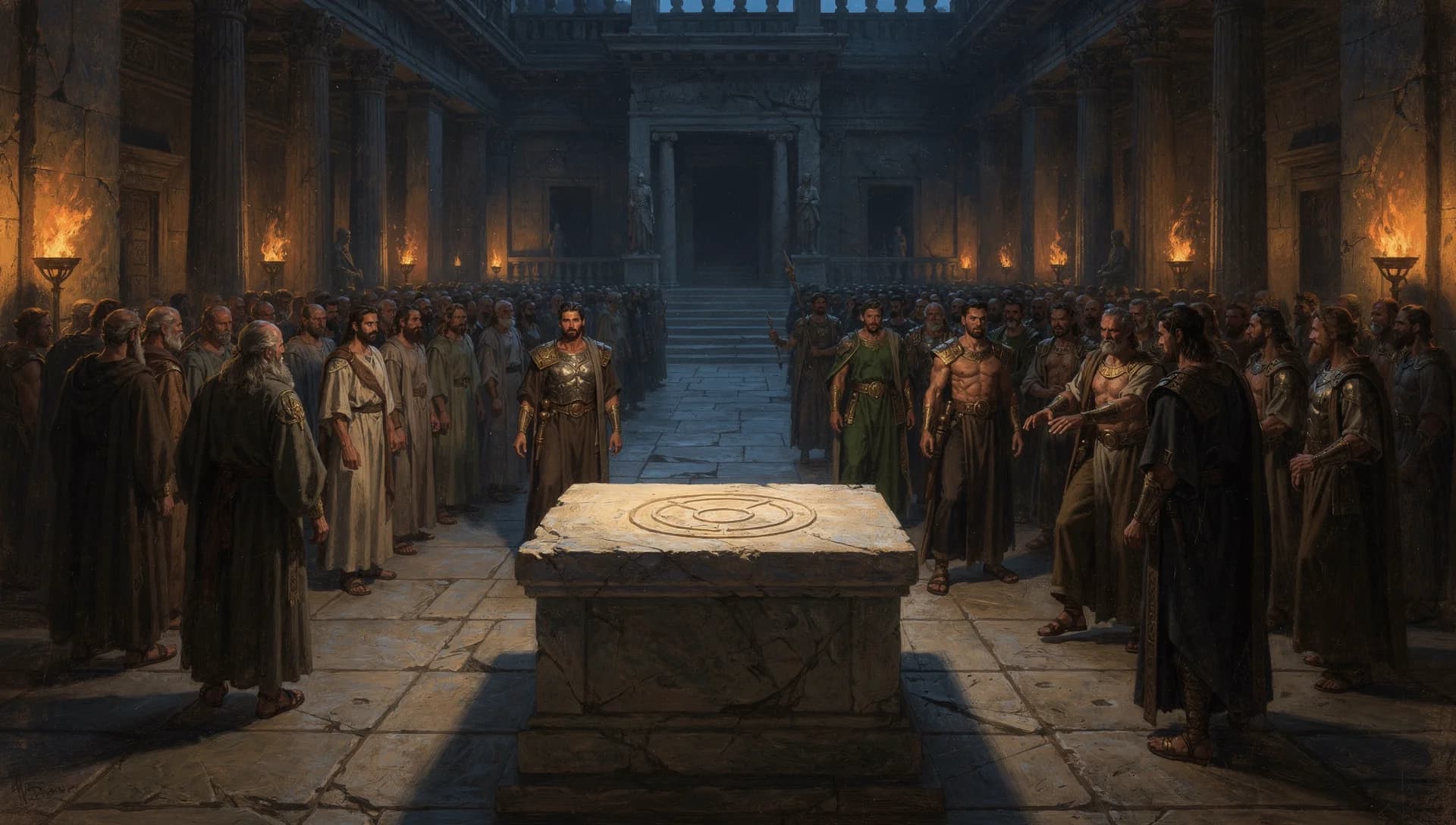
The First War Among the Gods: The Staff Split and the Aesir-Vanir Conflict
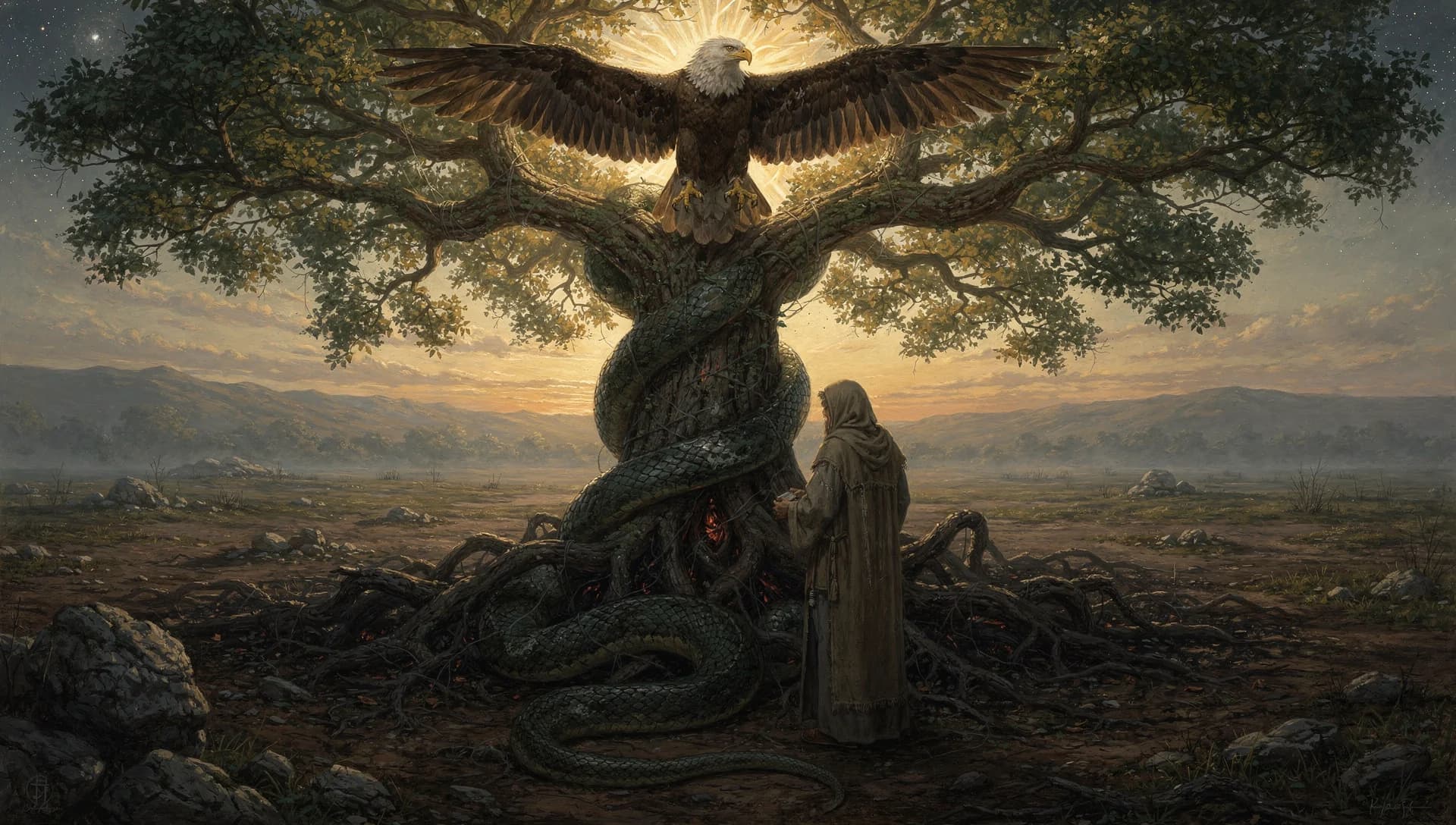
Bird in Crown, Serpent at Root: The Universal Tree of Life Cult Across World Cultures
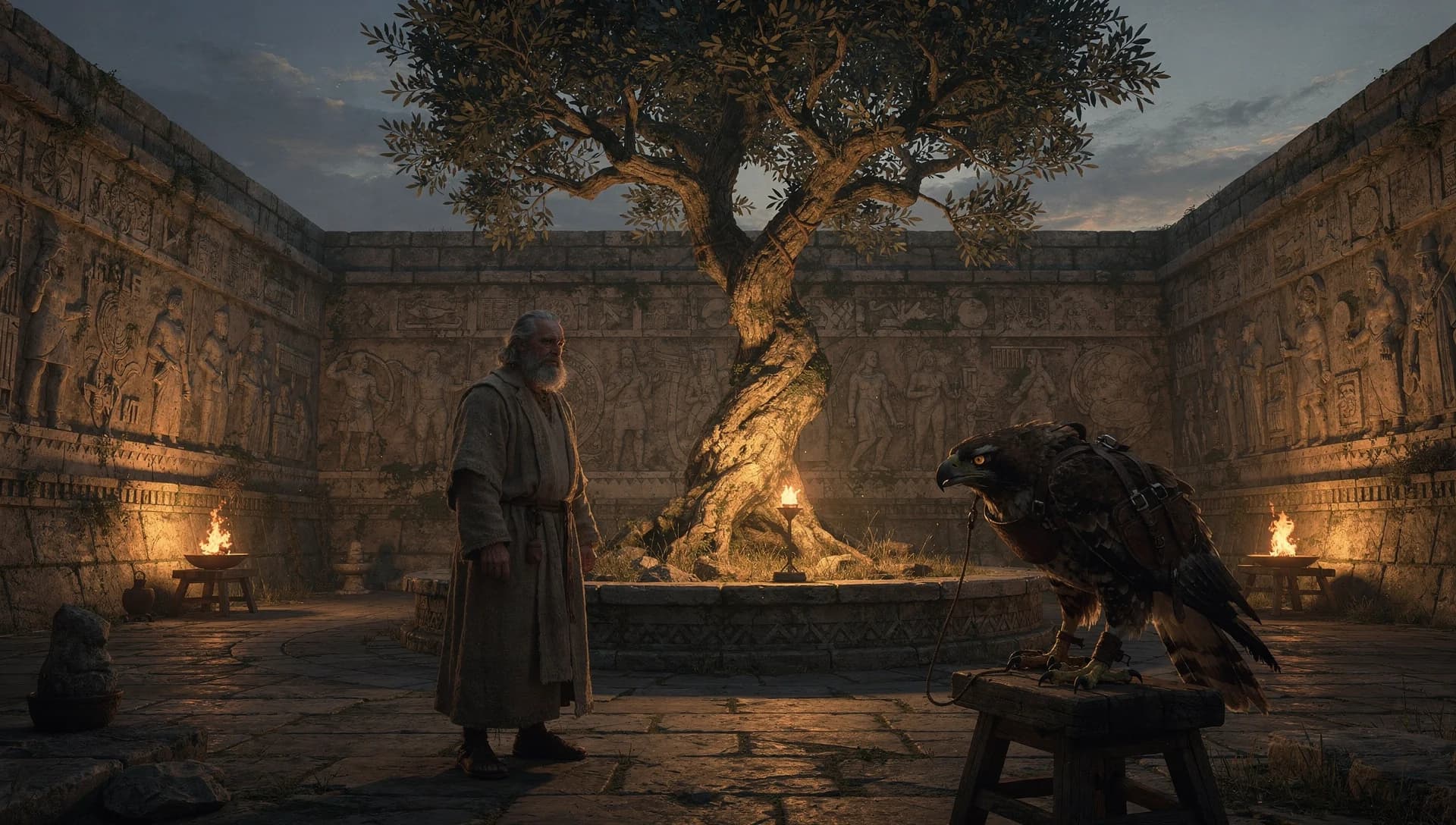
Three Elements, One Composition: Van, Fandor, and the Assyrian Palace Reliefs
The Newsletter
Get the research behind each piece
Free. New Urantia Book explorations, the sources behind the videos, and early looks. No spam, unsubscribe anytime.
Prefer video? Follow on YouTube and Facebook.
Delivered through Substack. You can also read past issues.