
Bird in Crown, Serpent at Root: The Universal Tree of Life Cult Across World Cultures
The world tree appears with striking consistency across cultures that had no historical contact: Norse Yggdrasil, Hindu Ashvattha, the Buddhist Bodhi tree, the Sumerian huluppu, the Maya ceiba, the Slavic Dub, the Assyrian Sacred Tree. In nearly every case, a bird sits in the crown, a serpent coils at the roots, and a divine or royal figure stands along the axis. The Urantia Book states plainly that a universal cult of the tree of life once existed, and identifies its seed as the actual Tree of Life at Dalamatia and the first Eden.
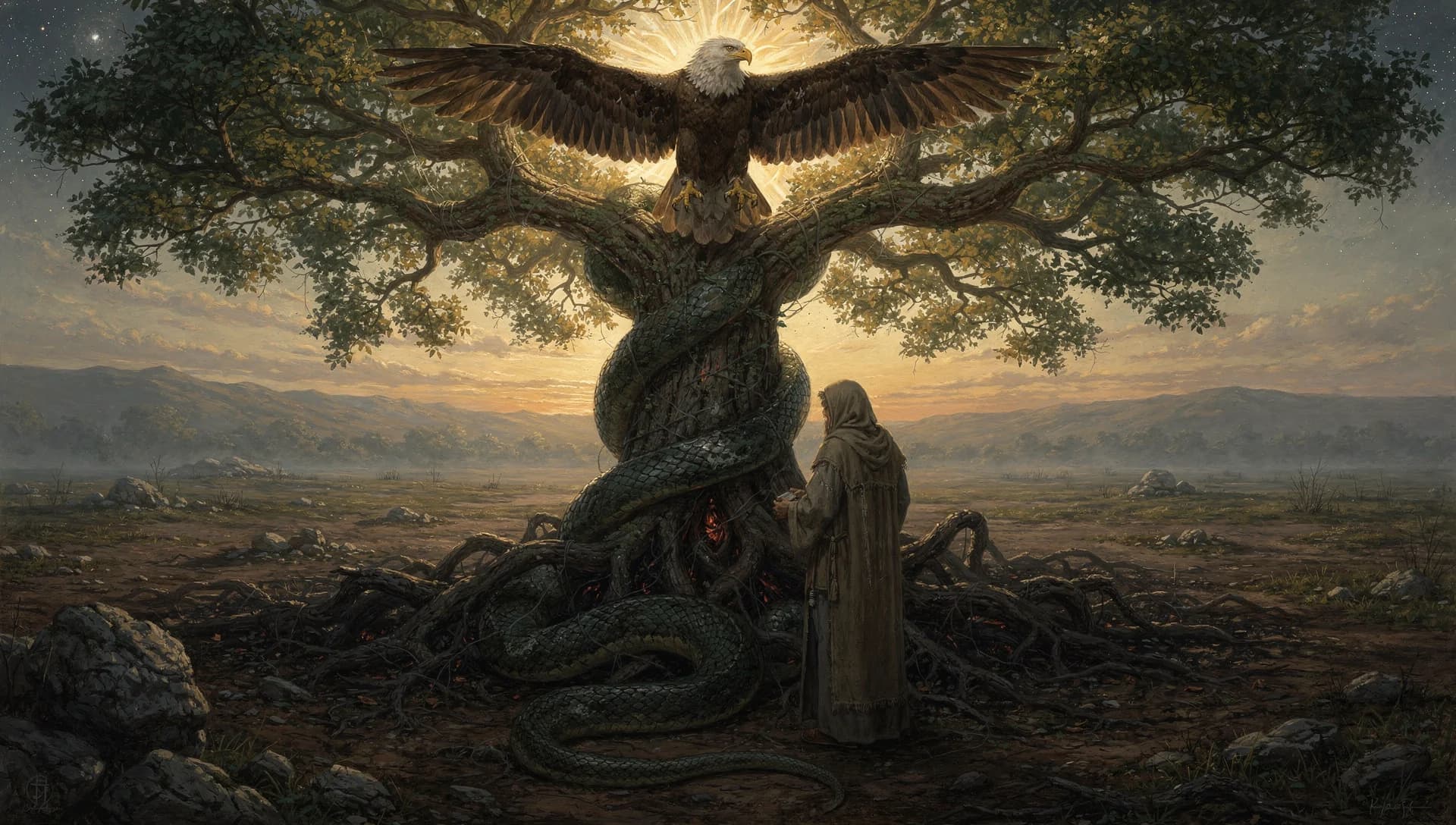
Universal cult of the Tree of Life = Cross-cultural sacred world-tree motif (Yggdrasil, Bodhi tree, ceiba, Ashvattha, huluppu)
This article expands on the decoder mapping. For the side-by-side card and quick reference, see the mapping page.
The Cross-Cultural Pattern
The world tree shows up in culture after culture, with the same internal architecture, in places that had no documented contact with one another.
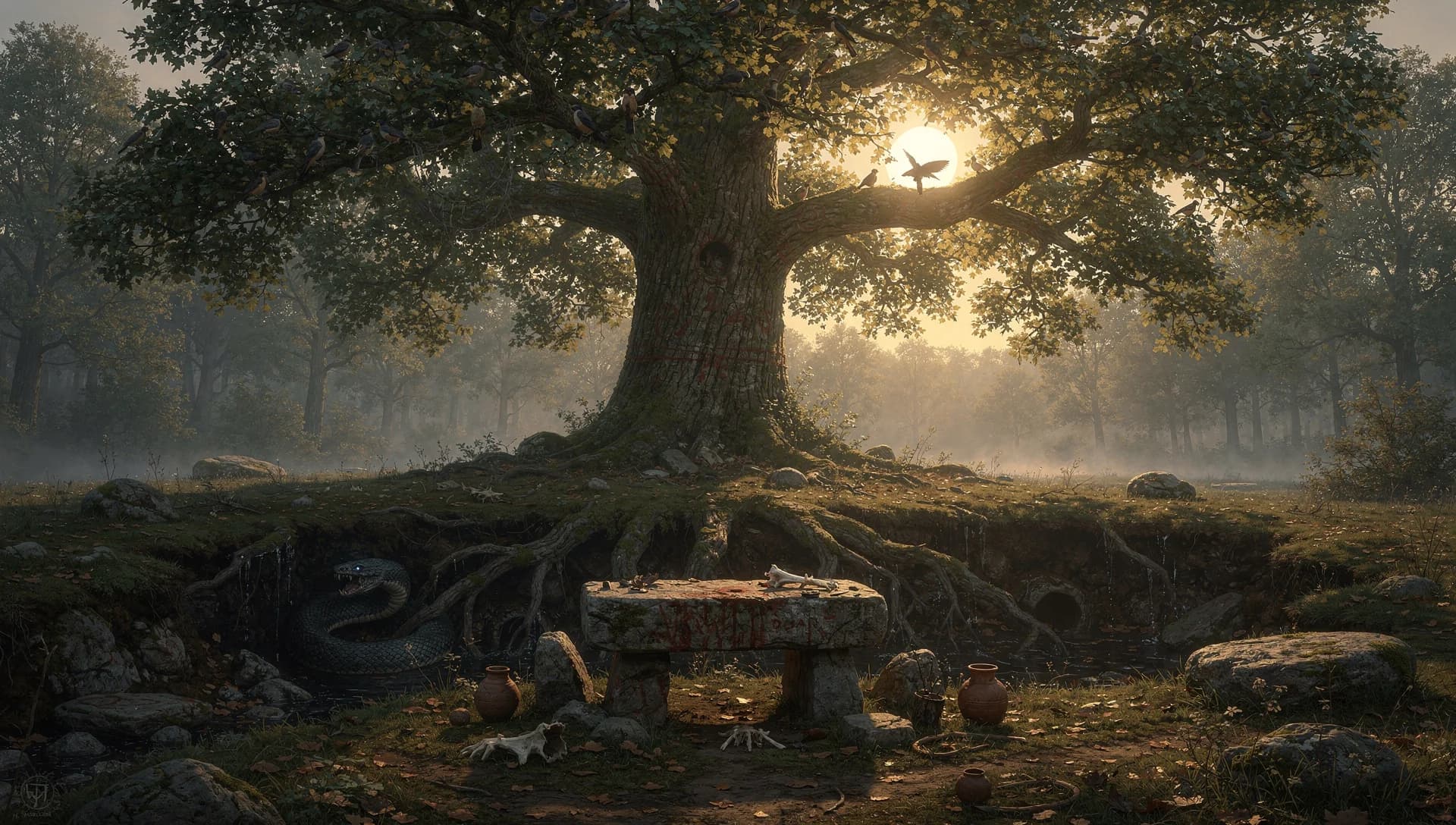
Norse Yggdrasil stands at the cosmic center. An eagle perches in its crown. Nidhogg the serpent gnaws at its roots. The Norns tend it at the trunk. Hindu Ashvattha, the sacred fig, grows with roots in heaven and branches below, with Garuda in the crown and Shesha the cosmic serpent at the base. The Buddhist Bodhi tree, under which the Buddha attained enlightenment, carries the same cosmic-axis function. The Sumerian huluppu sits at the world's heart with the Anzu bird in the crown and a serpent at the roots. The Maya ceiba, Yaxche', stands at the center with bird above and serpent below. The Slavic Dub, the sacred oak, preserves the same three-element structure. The Assyrian Sacred Tree appears in royal iconography flanked by winged figures.
The shared composition is what makes the case. Bird in the crown. Serpent at the roots. A divine or royal figure along the axis. The repetition of this exact triad across cultures with no shared history is one of the strongest single arguments for a common seed memory in world comparative religion.
What the Urantia Book Says
The Urantia Book states the universal pattern directly:
"Except in China, there once existed a universal cult of the tree of life." (85:2.4)
The historical reality behind the universal cult is the actual Tree of Life at Dalamatia:
"These antidotal complements of the Satania life currents were derived from the fruit of the tree of life, a shrub of Edentia which was sent to Urantia by the Most Highs of Norlatiadek at the time of Caligastia's arrival. In the days of Dalamatia this tree grew in the central courtyard of the temple of the unseen Father, and it was the fruit of the tree of life that enabled the material and otherwise mortal beings of the Prince's staff to live on indefinitely as long as they had access to it." (66:4.13)
The real character of the tree is emphasized against any reading that would reduce it to symbol alone:
"The 'tree of the knowledge of good and evil' may be a figure of speech, a symbolic designation covering a multitude of human experiences, but the 'tree of life' was not a myth; it was real and for a long time was present on Urantia." (73:6.3)
The tree's later presence in the first Garden of Eden is documented at UB 73:6 and 74:2. Adam and Eve maintained access to it until the Edenic default. After the Garden submerged, Van recovered the tree.
What the Ancient Sources Say
The comparative scholarship on the world tree is extensive. Roger Cook's The Tree of Life: Image for the Cosmos (Thames and Hudson, 1974) catalogued the motif across dozens of unconnected cultures and noted the recurring three-element composition. E. O. James's The Tree of Life: An Archaeological Study (Brill, 1966) surveyed the Near Eastern branch and its diffusion. Mircea Eliade's Patterns in Comparative Religion (Sheed and Ward, 1958) treated the cosmic tree as one of the most widely attested religious symbols in world religion.
Each individual instance has its own rich source tradition. Yggdrasil appears in Snorri Sturluson's Prose Edda (thirteenth century CE) and the Poetic Edda. Ashvattha appears throughout Vedic literature, with the Bhagavad Gita (15.1-3) treating the inverted cosmic tree directly. The Bodhi tree appears across the Pali Canon. The Sumerian huluppu tradition is preserved in the Gilgamesh, Enkidu, and the Netherworld composition. The Maya ceiba is carved into Pakal's sarcophagus at Palenque. The Slavic Dub is treated in Rybakov's Yazychestvo drevnikh slavyan. The Assyrian Sacred Tree appears on the Ashurnasirpal II reliefs.
The harder question is how the same three-element composition surfaced in cultures separated by oceans and millennia. Independent invention struggles to explain the level of structural detail shared. Diffusion struggles with the geographic spread. The Urantia Book's framework offers a third path: a real Tree of Life at Dalamatia, remembered across multiple transmission lines. That account fits both the structural consistency and the geographic distribution at once.
Why This Mapping Matters
The recurring three-element composition of the world tree across widely separated cultures is one of the strongest single cases for a shared substrate in world comparative religion. The frequency and specificity of the shared features go well past what coincidence would produce.
The Urantia Book supplies the concrete substrate. An actual Edentia shrub stood at the center of the Father's temple at Dalamatia. From that source, the cosmic-axis memory traveled through several pathways: pre-rebellion Dalamatian cultural diffusion, post-rebellion Nodite preservation, Edenic continuation in the first Garden, post-Edenic Salem-era transmission, and later Andite migrations across the continents. Each pathway carried the same root memory into new languages and new landscapes.
Read this way, the universal tree of life cult is not independently invented symbolism. It is genuine preservation of an actual historical object and the cultural and religious function it performed. The Yggdrasil, Ashvattha, ceiba, and huluppu convergence is the footprint of a real memory carried across the long separations of continental history.
Sources
- The Urantia Book, Paper 66 (The Planetary Prince's Staff), Paper 73 (The Garden of Eden), Paper 85 (The Origins of Worship). Urantia Foundation, first printing 1955. Cited passages: 66:4.13, 73:6.3, 85:2.4.
- Cook, Roger. The Tree of Life: Image for the Cosmos. Thames and Hudson, 1974.
- James, E. O. The Tree of Life: An Archaeological Study. Brill, 1966.
- Eliade, Mircea. Patterns in Comparative Religion. Sheed and Ward, 1958.
- Parpola, Simo. "The Assyrian Tree of Life." Journal of Near Eastern Studies 52, no. 3, 1993.
- Philpot, J. H. The Sacred Tree, or, The Tree in Religion and Myth. Macmillan, 1897.
Confidence and Evidence
- Confidence: UB CONFIRMED
- Evidence rating: STRONG
- Basis: The Urantia Book directly states the universal tree cult at 85:2 and documents the actual Tree of Life at Dalamatia at 66:4.13 and 73:6.3. The cross-cultural distribution of the three-element tree motif is extensively documented. The shared substrate mechanism specifically accounts for both the structural consistency and the geographic distribution.
Related Decoder Articles
Byline: Derek Samaras | Urantia Book Network | April 2026
Connecting Articles
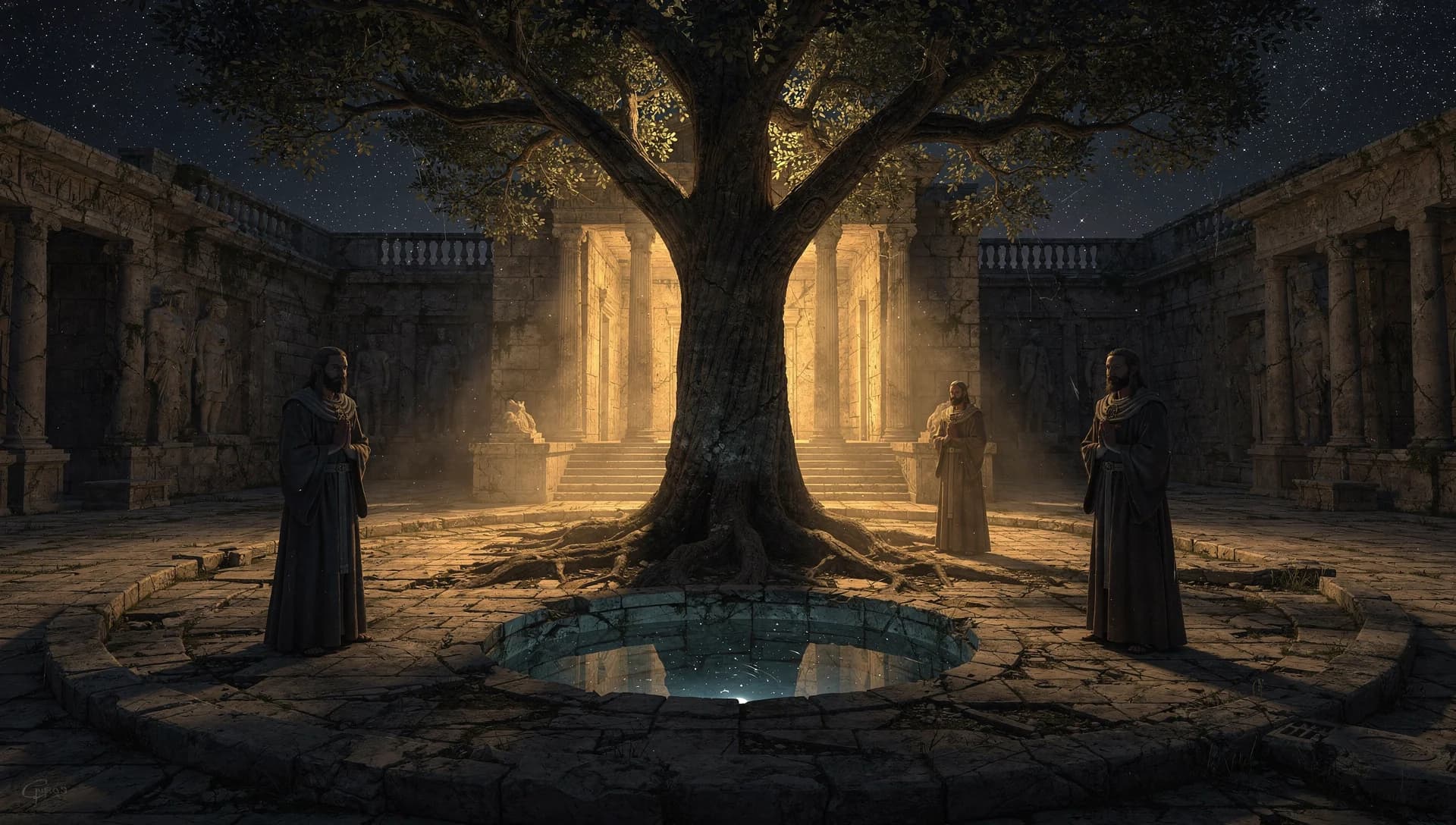
The Cosmic Tree: The Tree of Life and Norse Yggdrasil
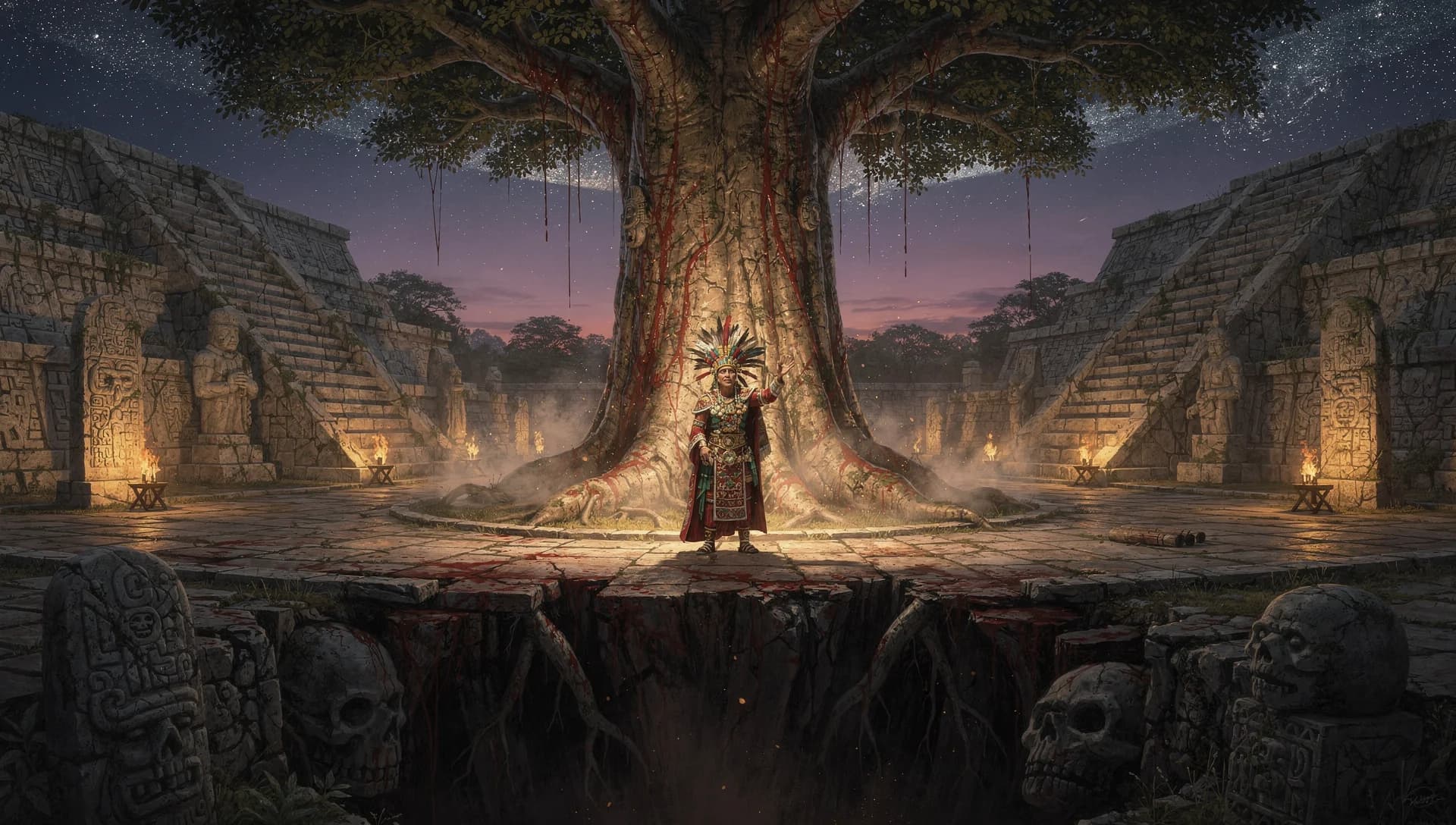
The Tree at the Center of the World: Maya Ceiba Yaxche' and the Tree of Life
The Oak at the Center of the World: The Slavic Dub and the Universal Tree Cult
The One Who Hung on the Tree: Van and the Norse Odin
The Newsletter
Get the research behind each piece
Free. New Urantia Book explorations, the sources behind the videos, and early looks. No spam, unsubscribe anytime.
Prefer video? Follow on YouTube and Facebook.
Delivered through Substack. You can also read past issues.