
A Tree Delivered to a Garden: The Tree of Life and the Sumerian Huluppu
The oldest recorded story about a sacred tree delivered to a garden is not in Genesis. It is preserved on Sumerian tablets a thousand years older, in which Enki rescues the huluppu tree and Inanna plants it in her garden at Uruk. The Urantia Book describes the same structural event with greater specificity.
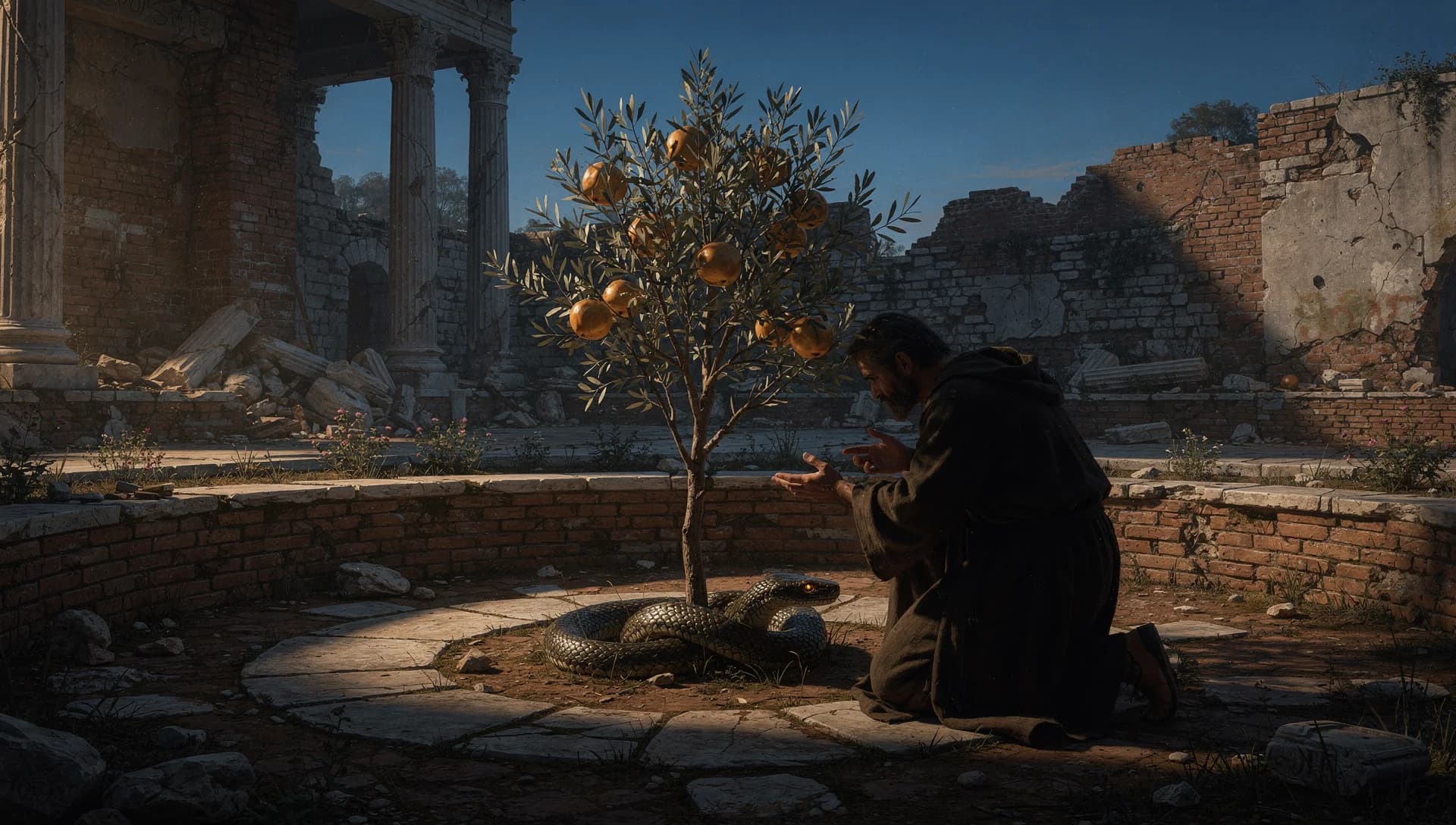
Tree of Life, sacred shrub = Huluppu Tree, sacred tree in Inanna's garden
This article expands on the decoder mapping. For the side-by-side card and quick reference, see the mapping page.
The Tree That Travelled
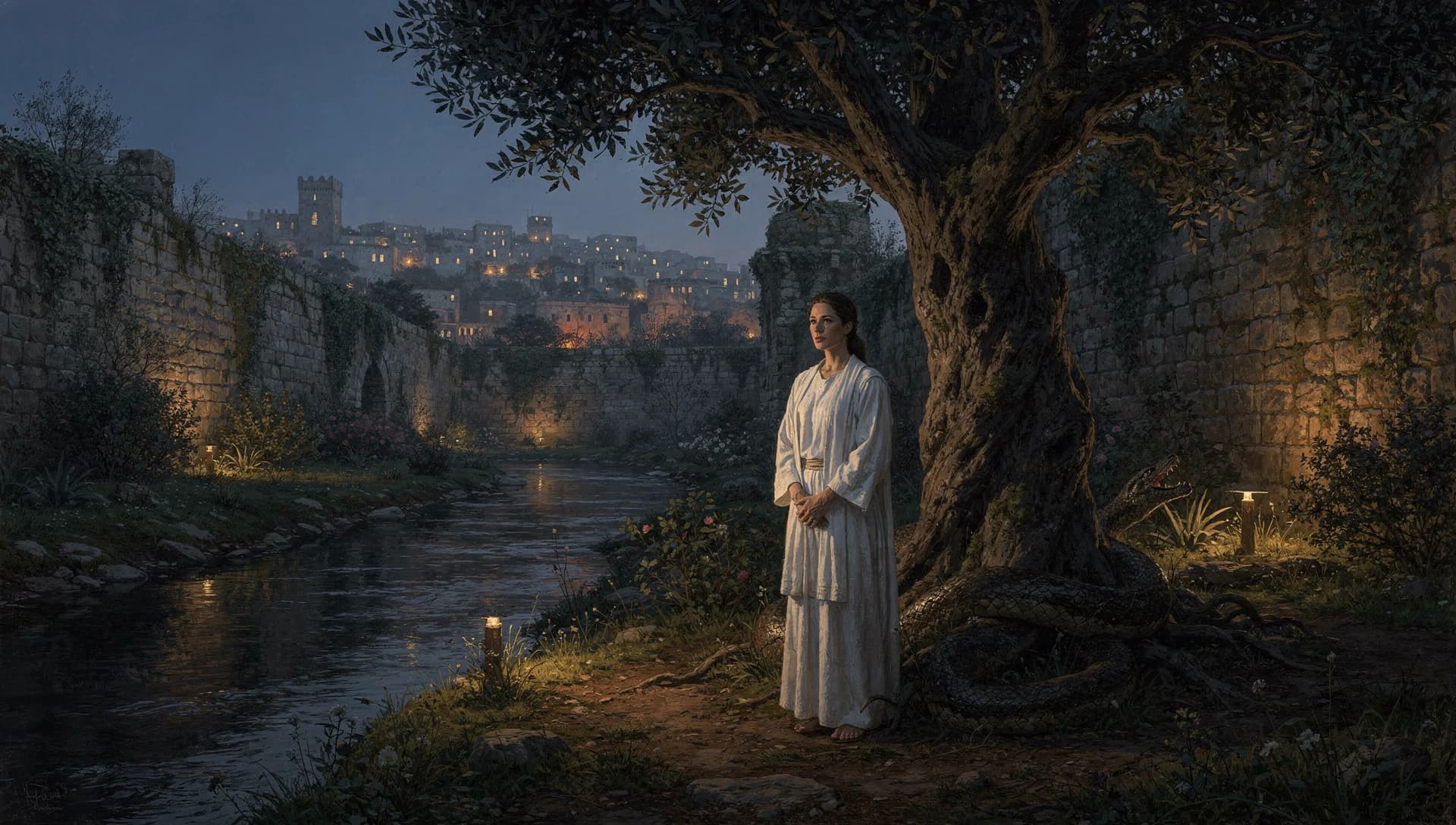
Among the Sumerian tablets catalogued by the Oxford-based Electronic Text Corpus of Sumerian Literature (ETCSL 1.8.1.4), the composition known as Gilgamesh, Enkidu, and the Netherworld opens with a prologue older than the main poem. In the prologue, the goddess Inanna finds a huluppu tree growing on the banks of the Euphrates. She transplants it to her own garden at Uruk. Years pass. A serpent takes up residence in the roots. The tree becomes a matter of cosmic concern. Enki is involved; Gilgamesh is eventually summoned to cut the tree down and dispose of its inhabitants.
The Sumerologists have treated the huluppu prologue as folkloric framing for the Netherworld material. But the structural features of the tree's story are unusually specific. A sacred tree. A wisdom god (Enki) involved in its rescue. A female figure (Inanna) who plants it in her walled garden. A serpent at the roots. The eventual loss of the tree. These features, taken together, are not ordinary. They are the skeleton of a very particular story.
The Urantia Book records the same structural event, with names that do not match the Sumerian names but with a detail-map that matches closely.
What the Urantia Book Says
The Urantia account makes the tree of life a literal biological object, not a symbol. It is a shrub of Edentia, sent to Urantia at the time of Caligastia's arrival, and its fruit and leaves sustain the superphysical metabolism of the corporeal staff:
"These antidotal complements of the Satania life currents were derived from the fruit of the tree of life, a shrub of Edentia which was sent to Urantia by the Most Highs of Norlatiadek at the time of Caligastia's arrival. In the days of Dalamatia this tree grew in the central courtyard of the temple of the unseen Father, and it was the fruit of the tree of life that enabled the material and otherwise mortal beings of the Prince's staff to live on indefinitely as long as they had access to it." (UB 66:4.13)
When the rebellion broke, Van and his associates rescued the tree, regrew it, and carried it to a highland retreat. At the time of Adam's arrival it was planted again in the Garden of Eden:
"In the center of the Garden temple Van planted the long-guarded tree of life, whose leaves were for the 'healing of the nations,' and whose fruit had so long sustained him on earth. Van well knew that Adam and Eve would also be dependent on this gift of Edentia for their life maintenance after they once appeared on Urantia in material form." (UB 73:6.1)
The record insists that the tree was real, not a figure of speech:
"The 'tree of the knowledge of good and evil' may be a figure of speech, a symbolic designation covering a multitude of human experiences, but the 'tree of life' was not a myth; it was real and for a long time was present on Urantia." (UB 73:6.3)
Its biological function is described in technical language:
"This superplant stored up certain space-energies which were antidotal to the age-producing elements of animal existence. The fruit of the tree of life was like a superchemical storage battery, mysteriously releasing the life-extension force of the universe when eaten. This form of sustenance was wholly useless to the ordinary evolutionary beings on Urantia, but specifically it was serviceable to the one hundred materialized members of Caligastia's staff and to the one hundred modified Andonites who had contributed of their life plasm to the Prince's staff, and who, in return, were made possessors of that complement of life which made it possible for them to utilize the fruit of the tree of life for an indefinite extension of their otherwise mortal existence." (UB 73:6.4)
Eve is the central female figure of the Edenic record. Adam's fall is connected to the tree. When the Nodites later invaded Eden, they ate the fruit expecting divine power and found that the tree's chemistry no longer worked for them (UB 73:6.7).
What the Ancient Source Says
The huluppu prologue of Gilgamesh, Enkidu, and the Netherworld survives in multiple Old Babylonian copies and has been edited by Aaron Shaffer (Sumerian Sources of Tablet XII of the Epic of Gilgameš, University of Pennsylvania, 1963), translated by Samuel Noah Kramer in History Begins at Sumer (Chicago, 1956), and rendered for a general readership by Diane Wolkstein and Samuel Noah Kramer in Inanna: Queen of Heaven and Earth (Harper & Row, 1983). The ETCSL edition (Oxford) preserves the Sumerian text with transliteration.
The structural features are as follows. A huluppu tree, identified as a specific species, grows beside the Euphrates. It is threatened by floodwaters. Inanna rescues it, transplants it to her sacred garden at Uruk, and tends it for years with the intention of making a throne and bed from its wood. A serpent inhabits the roots, an Anzu bird nests in the crown, and a demon named Lilitu or Lilith occupies the trunk. Gilgamesh, at Inanna's request, cuts the tree down and distributes its wood.
The Sacred Tree motif in Neo-Assyrian palace art, discussed in the companion article on the Nimrud reliefs, is iconographically connected to this Sumerian textual tradition. British Museum curatorial notes on the Ashurnasirpal II reliefs explicitly link the palm-frond motifs to "the tree of life plucked for the benefit of the king." The iconographic continuity from the third-millennium huluppu material through the first-millennium Assyrian tree is documented by Barbara Porter in Trees, Kings, and Politics (Academic Press Fribourg, 2003).
Why This Mapping Matters
The one-to-one features are unusually specific. A sacred tree (huluppu / tree of life). A wisdom figure involved in its stewardship (Enki / Van, whose identity as the prototype of Enki is argued in the companion article). A female central figure to whom the tree is delivered for her garden (Inanna / Eve). A walled garden setting (Uruk / Eden). A serpent at the roots or associated with the tree. The eventual loss of the tree.
The Urantia Book adds the biological mechanism (superchemical life-extension energy) which the Sumerian text does not preserve. The Sumerian text adds narrative furniture (Gilgamesh, the throne, the Anzu in the branches) which the Urantia record does not include. The overlap is dense enough to ask which direction the information flows.
Chronologically, the Urantia narrative places the Edenic tree tens of thousands of years before the earliest Sumerian cuneiform attestation. If the Andite migrations out of the second garden carried the memory of Eden westward and northward, the Sumerian huluppu prologue is exactly the kind of residue one would expect to find in the first written civilization. The tree is remembered. The female figure is remembered. The wise steward is remembered. The details are rearranged and partially lost, as all thousand-year oral memories are rearranged and partially lost, but the skeleton survives.
Sources
- The Urantia Book, Paper 66 (The Planetary Prince's Staff), Paper 73 (The Garden of Eden). Urantia Foundation, first printing 1955. Cited passages: 66:4.13, 73:6.1, 73:6.3, 73:6.4, 73:6.5, 73:6.7.
- ETCSL (Electronic Text Corpus of Sumerian Literature), Oxford. Text 1.8.1.4, Gilgamesh, Enkidu, and the Netherworld.
- Kramer, Samuel Noah. History Begins at Sumer. University of Chicago Press, 1956.
- Wolkstein, Diane and Samuel Noah Kramer. Inanna: Queen of Heaven and Earth. Harper & Row, 1983.
- Shaffer, Aaron. Sumerian Sources of Tablet XII of the Epic of Gilgameš. University of Pennsylvania Press, 1963.
- Porter, Barbara Nevling. Trees, Kings, and Politics: Studies in Assyrian Iconography. Academic Press Fribourg, 2003.
- Parpola, Simo. "The Assyrian Tree of Life: Tracing the Origins of Jewish Monotheism and Greek Philosophy," Journal of Near Eastern Studies 52/3 (1993), pp. 161-208.
Confidence and Evidence
- Confidence: INFORMED SPECULATION
- Evidence rating: STRONG
- Basis: The overlapping features (sacred tree, wisdom steward, female recipient, walled garden, serpent, eventual loss) are six in number and shared between the two accounts. The geographical and chronological distribution of the Andite migrations provides a plausible transmission path from Eden to Uruk.
Related Decoder Articles
- Van, Loyal Corporeal Staff Member = Enki / Ea
- Eve, Material Daughter = Inanna / Ishtar
- Van + Fandor + Tree of Life = Assyrian Winged Figure Reliefs
By Derek Samaras
Connecting Articles
Civilization Delivered in Ten Portions: The Dalamatia Councils and the Sumerian ME
Eve and Inanna: The Garden, the Tree, and the Fall
Nod and Enlil: The Rebel Who Became the Storm-God
Van Is Remembered: The Steadfast Jurist and His Sumerian Echo
The Newsletter
Get the research behind each piece
Free. New Urantia Book explorations, the sources behind the videos, and early looks. No spam, unsubscribe anytime.
Prefer video? Follow on YouTube and Facebook.
Delivered through Substack. You can also read past issues.