
The God Who Became an It: Salem Monotheism and the Hindu Brahman
The Urantia Book's account of the Hindu Brahman concept is unusually specific and unusually stern. The abstract, impersonal, absolute Brahman of the Upanishads did not arise from contemplation of nature. It arose from the priestly rejection of a personal God that the Salem missionaries had brought to India, and the consequences for Indian spiritual life have lasted more than two thousand years.
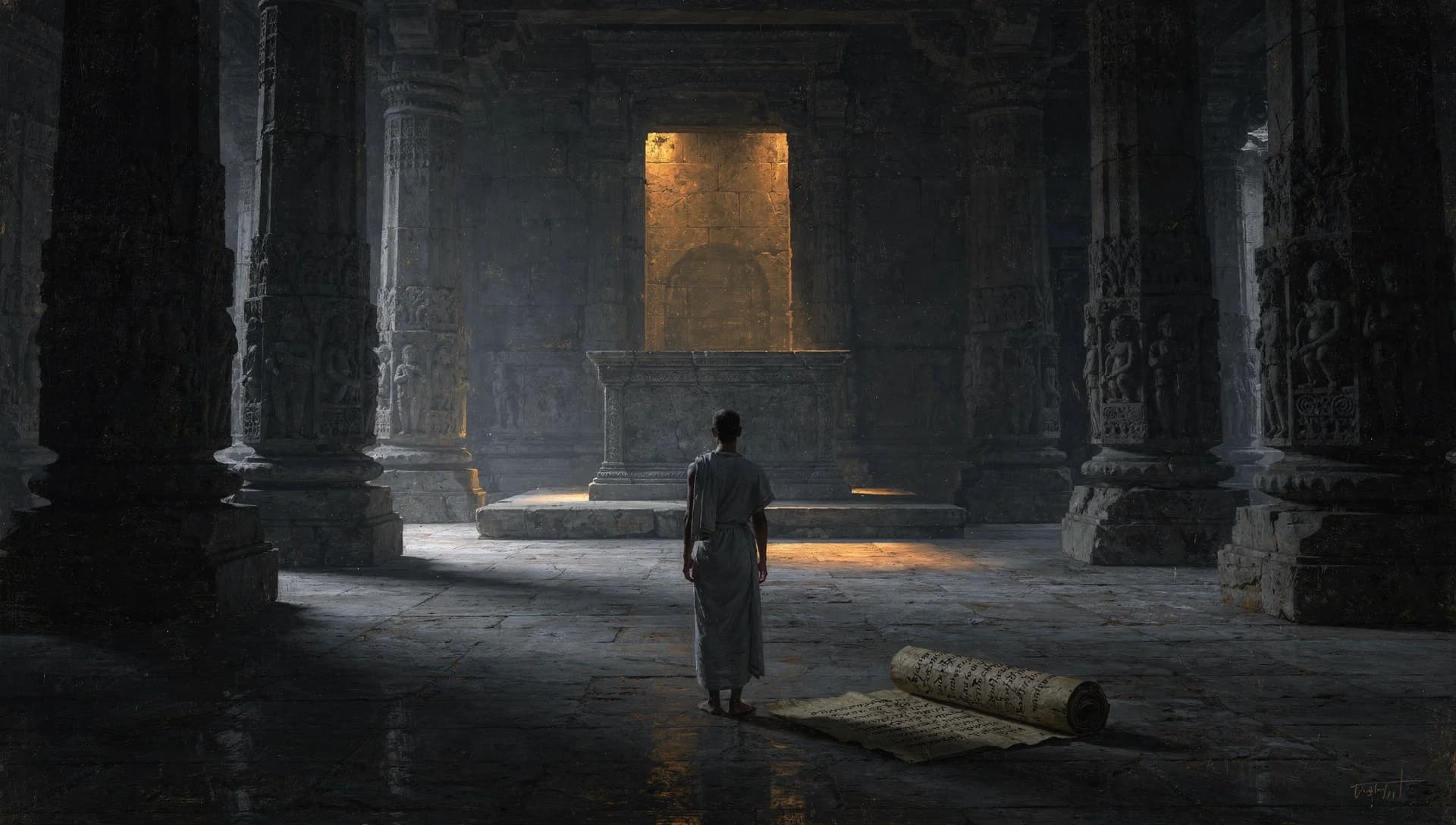
Salem monotheism, rejected and abstracted = Brahman, the abstract absolute that replaced personal God
This article expands on the decoder mapping. For the side-by-side card and quick reference, see the mapping page.
The Rejection That Reshaped a Subcontinent
By the second millennium BCE, the Indian subcontinent was a complex religious landscape. The northern and western regions had been partially absorbed by the Aryan-Andite invaders, whose Vedic polytheism was organized around tribal deities; the Deccan to the south preserved an older Dravidian substrate with its own religious forms. The Brahman priestly caste was in the process of assuming coordinated control over the expanding Vedic ritual apparatus.
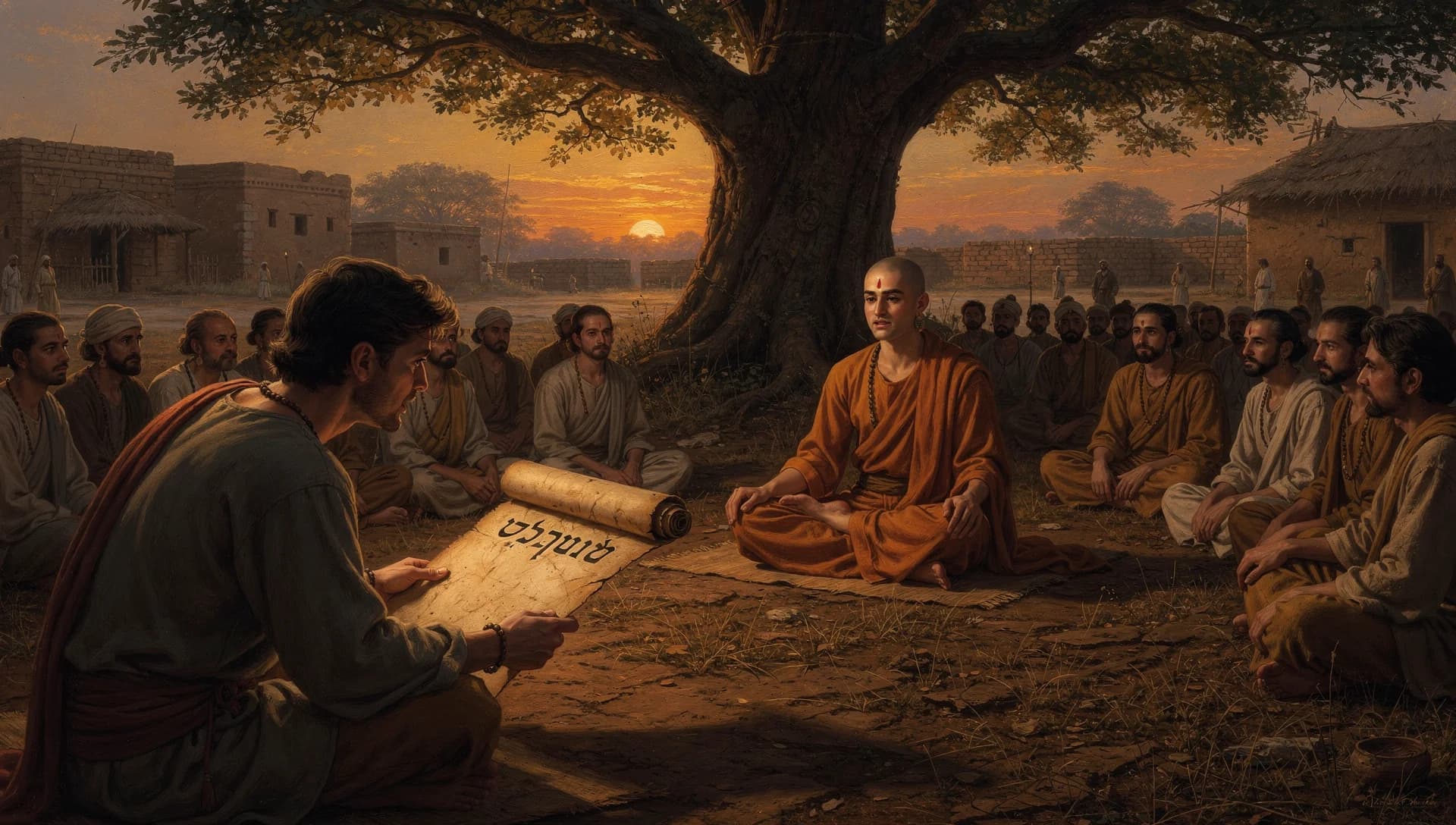
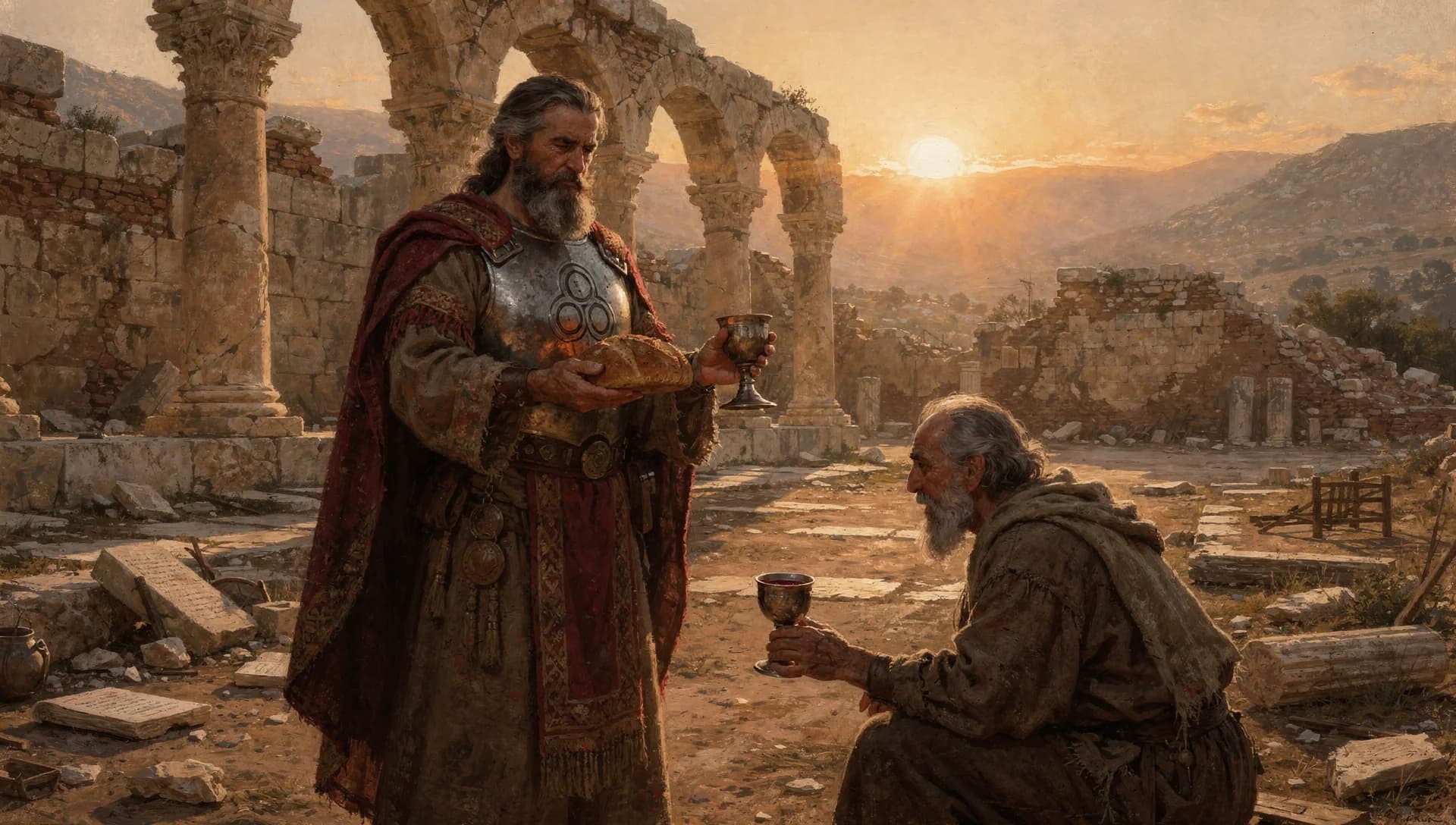
Into this environment, the Melchizedek Salem missionaries arrived. They preached a very specific gospel: one God, personal, approachable, to be trusted and had faith in. The Urantia Book's account of what happened next is one of the sharpest theological judgments in the book.
What the Urantia Book Says
The Salem missionary encounter with the Brahman priesthood is described directly:
"In the days of Melchizedek, India was a cosmopolitan country which had recently come under the political and religious dominance of the Aryan-Andite invaders from the north and west. At this time only the northern and western portions of the peninsula had been extensively permeated by the Aryans. These Vedic newcomers had brought along with them their many tribal deities." (UB 94:1.1)
The structural feature of Vedism that mattered was its trajectory. Vedism was already consolidating toward a form of higher theism under pressure of internal reform, and the Salem teaching entered at a moment when the tradition could have tipped into monotheism:
"The Vedic cult was then in process of growth and metamorphosis under the direction of the Brahman caste of teacher-priests, who were gradually assuming control over the expanding ritual of worship. The amalgamation of the onetime thirty-three Aryan deities was well under way when the Salem missionaries penetrated the north of India." (UB 94:1.2)
"The Salem missionaries preached the one God of Melchizedek, the Most High of heaven. This portrayal was not altogether disharmonious with the emerging concept of the Father-Brahma as the source of all gods, but the Salem doctrine was nonritualistic and hence ran directly counter to the dogmas, traditions, and teachings of the Brahman priesthood. Never would the Brahman priests accept the Salem teaching of salvation through faith, favor with God apart from ritualistic observances and sacrificial ceremonials." (UB 94:1.5)
The rejection was explicit and institutional. The Brahman priesthood saw the Salem teaching as a direct threat to the ritual system on which their social position depended. The consequence is laid out with striking precision:
"In their efforts at self-preservation the Brahmans had rejected the one God of Melchizedek, and now they found themselves with the hypothesis of Brahman, that indefinite and illusive philosophic self, that impersonal and impotent it which has left the spiritual life of India helpless and prostrate from that unfortunate day to the twentieth century." (UB 94:2.7)
The paragraph is uncompromising. The abstraction of God into Brahman, the impersonal absolute, is described not as a neutral philosophical development but as the residue of a specific historical rejection. The Brahman priesthood declined the Salem teaching. What remained to them, after that declension, was a conceptual construct that could occupy the vacated theological space without threatening the ritual and caste apparatus the priesthood had built.
The Urantia Book elaborates the philosophical cost:
"The undue concentration on self led certainly to a fear of the nonevolutionary perpetuation of self in an endless round of successive incarnations as man, beast, or weeds. And of all the contaminating beliefs which could have become fastened upon what may have been an emerging monotheism, none was so stultifying as this belief in transmigration—the doctrine of the reincarnation of souls—which came from the Dravidian Deccan." (UB 94:2.3)
"This philosophically debilitating teaching was soon followed by the invention of the doctrine of the eternal escape from self by submergence in the universal rest and peace of absolute union with Brahman, the oversoul of all creation. Mortal desire and human ambition were effectually ravished and virtually destroyed. For more than two thousand years the better minds of India have sought to escape from all desire, and thus was opened wide the door for the entrance of those later cults and teachings which have virtually shackled the souls of many Hindu peoples in the chains of spiritual hopelessness. Of all civilizations, the Vedic-Aryan paid the most terrible price for its rejection of the Salem gospel." (UB 94:2.4)
The assessment continues with a direct acknowledgment of what the Brahmanic system also accomplished:
"In the concept of Brahman the minds of those days truly grasped at the idea of some all-pervading Absolute, for this postulate was at one and the same time identified as creative energy and cosmic reaction. Brahman was conceived to be beyond all definition, capable of being comprehended only by the successive negation of all finite qualities. It was definitely a belief in an absolute, even an infinite, being, but this concept was largely devoid of personality attributes and was therefore not experiencible by individual religionists." (UB 94:3.2)
The near-miss is explicit. The Brahman concept touched real cosmic Absolute reality. What it could not do was carry the weight of personal religious experience. Had the philosophers of those days been able to make the next advance, conceiving the Brahman as personal, approachable, and associative, the Hindu tradition could have supplied the complete religious framework. They did not make that advance. The abstract it remained an it.
What the Ancient Source Says
The primary sources for the Brahman concept are the Upanishads, composed between approximately 800 BCE and 300 BCE. The principal texts include the Brihadaranyaka, Chandogya, Aitareya, Taittiriya, Kena, Katha, Mundaka, and Mandukya. Patrick Olivelle's The Early Upanishads (Oxford University Press, 1998) provides the standard critical English edition.
The Upanishadic development of the Brahman concept is typically described in three stages. In the earliest stratum, Brahman retains some connection to the Vedic ritual formula (brahman in the sense of sacred utterance). In the middle stratum, Brahman expands into the cosmic principle that underlies all ritual and all reality. In the latest stratum, particularly in the Chandogya and Brihadaranyaka, Brahman is fully abstracted into the ineffable Absolute, approachable only through negative theology (neti neti, "not this, not this") and accessible only by the contemplative identification of atman with Brahman.
Paul Deussen's The Philosophy of the Upanishads (translated by A. S. Geden, T&T Clark, 1906; reprinted Dover, 1966), Sarvepalli Radhakrishnan's The Principal Upanisads (HarperCollins, 1953; Humanity Books, 1992), and more recent work by Signe Cohen (The Upanishads: A Complete Guide, Routledge, 2018) trace the philological development. The common scholarly observation is that the later Upanishadic Brahman is a concept of cosmic absoluteness that has shed the personal and devotional features present in some earlier Vedic and Brahmanic materials.
The historical question of why this abstraction occurred has been a recurring topic in Indology. The conventional academic explanations cite internal developments of Vedic thought, the pressure of Dravidian non-theistic substrates, the influence of early Buddhist non-theism, and the philosophical rigor of the neti-neti method. The Urantia Book adds a specific historical causal factor the academic literature does not have access to: the Brahman priesthood's institutional rejection of the Salem monotheistic teaching in the second millennium BCE.
F. Max Müller's The Six Systems of Indian Philosophy (Longmans, 1899) and E. Washburn Hopkins's The Religions of India (Ginn, 1895) represent the older Western scholarly framing. More recent treatments in the Cambridge History of Religions in Asia (Cambridge University Press, 2020) continue to emphasize the depersonalization of God in the Upanishadic tradition as one of the distinctive features of Indian philosophy, and Robert Charles Zaehner's Hinduism (Oxford, 1962) explicitly notes the contrast with the contemporaneous Hebraic development of personal monotheism.
Why This Mapping Matters
The Urantia Book's treatment of Brahman is one of its most direct theological judgments about a living tradition. The judgment is specific: the abstract impersonal absolute of Upanishadic Hinduism is not a higher theological development. It is the residue of a priestly rejection of a personal God that would have threatened the ritual-caste apparatus on which the rejecting priesthood's social authority rested.
This is a strong claim. The comparative Indological literature has generally treated the Upanishadic abstraction as an intellectual advance, the moment when Indian philosophy achieved a rigorous non-anthropomorphic concept of the absolute. The Urantia Book inverts the valuation: the abstraction is a loss, not a gain, because personal religious experience requires a personal God and the abstract absolute cannot be the object of faith in the Salem sense.
The judgment does not dismiss Indian philosophy. Paper 94's treatment repeatedly acknowledges the philosophical depth, the contemplative rigor, the honesty of the Upanishadic project. What the Urantia Book disputes is the outcome. India, as Paper 94 summarizes the two-millennium consequence, has been left with a religious culture that is intellectually sophisticated and spiritually undernourished, capable of producing contemplative adepts but incapable of producing a mass religious life grounded in personal faith. Paper 94:4.10 states the current remedy directly: "Today, in India, the great need is for the portrayal of the Jesusonian gospel, the Fatherhood of God and the sonship and consequent brotherhood of all men."
The mapping therefore identifies a specific theological and historical turning point. In the second millennium BCE, the Brahman priesthood had a choice. They chose to preserve their ritual apparatus. The philosophical abstraction of the divine into Brahman is the shape the choice took. The Indian spiritual tradition has been working within the constraints of that choice ever since.
Sources
- The Urantia Book, Paper 94 (The Melchizedek Teachings in the Orient). Urantia Foundation, first printing 1955. Cited passages: 94:1.1, 94:1.2, 94:1.5, 94:1.6, 94:2.3, 94:2.4, 94:2.6, 94:2.7, 94:3.2, 94:3.5, 94:3.7, 94:4.10.
- Olivelle, Patrick, translator. Upanishads. Oxford World's Classics, Oxford University Press, 1996.
- Olivelle, Patrick. The Early Upanishads: Annotated Text and Translation. Oxford University Press, 1998.
- Deussen, Paul. The Philosophy of the Upanishads. Translated by A. S. Geden. T&T Clark, 1906; reprinted Dover, 1966.
- Radhakrishnan, Sarvepalli. The Principal Upanisads. HarperCollins, 1953; reprinted Humanity Books, 1992.
- Zaehner, R. C. Hinduism. Oxford University Press, 1962.
- Cohen, Signe. The Upanishads: A Complete Guide. Routledge, 2018.
- Flood, Gavin. An Introduction to Hinduism. Cambridge University Press, 1996.
Confidence and Evidence
- Confidence: UB CONFIRMED
- Evidence rating: STRONG
- Basis: The Urantia Book treats the Brahman concept directly and extensively across Paper 94, identifying the priestly rejection of the Salem teaching as the specific historical cause of the depersonalization. The philological development of the Upanishadic Brahman concept in the academic literature is consistent with the Urantia timeline; the causal explanation the Urantia Book supplies is unavailable to independent scholarship but consistent with the shape of the data.
Related Decoder Articles
- Thought Adjuster = Atman, the Inner Self
- Salem Trinity Teaching = Hindu Trimurti
- Sethite Priests = Brahman Priestly Caste
By Derek Samaras
Connecting Articles
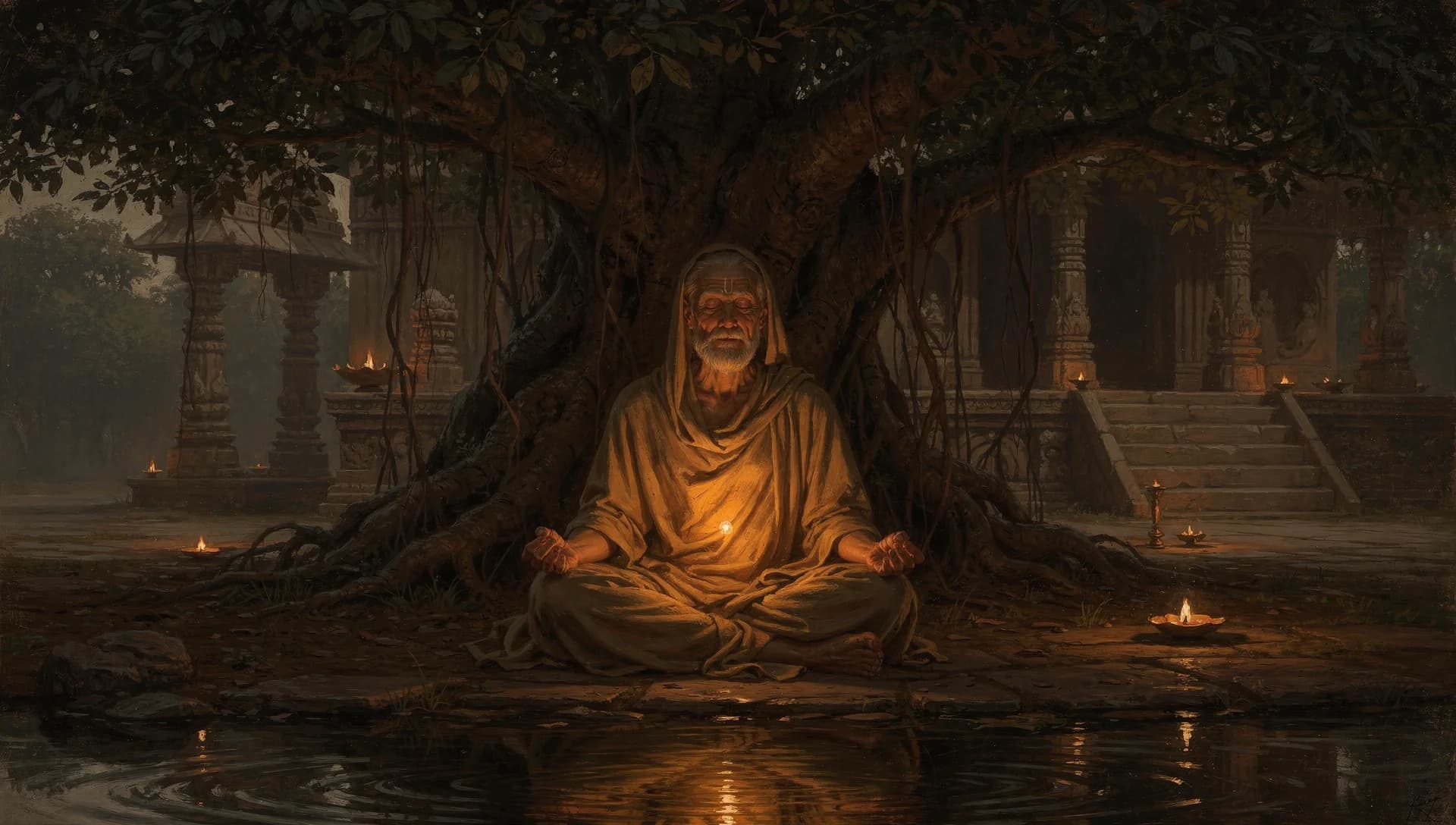
The Inner Fragment: The Hindu Atman and the Thought Adjuster
The Prophet Who Almost Got There: Gautama Siddhartha and the Salem Gospel
The Priest Who Had No Father: Machiventa Melchizedek and the Genesis Fragment

The Memory That Reached Japan: Machiventa and the Shinto Substrate
The Newsletter
Get the research behind each piece
Free. New Urantia Book explorations, the sources behind the videos, and early looks. No spam, unsubscribe anytime.
Prefer video? Follow on YouTube and Facebook.
Delivered through Substack. You can also read past issues.