
The Memory That Reached Japan: Machiventa and the Shinto Substrate
The Urantia Book makes a remarkable historical claim: the people of Japan, far-distant from Salem of Palestine, learned of the incarnation of Machiventa Melchizedek. The Shinto tradition, the oldest continuous religious practice of the Japanese archipelago, preserved the memory as part of the proto-Taoist stratum that reached it from mainland Asia.
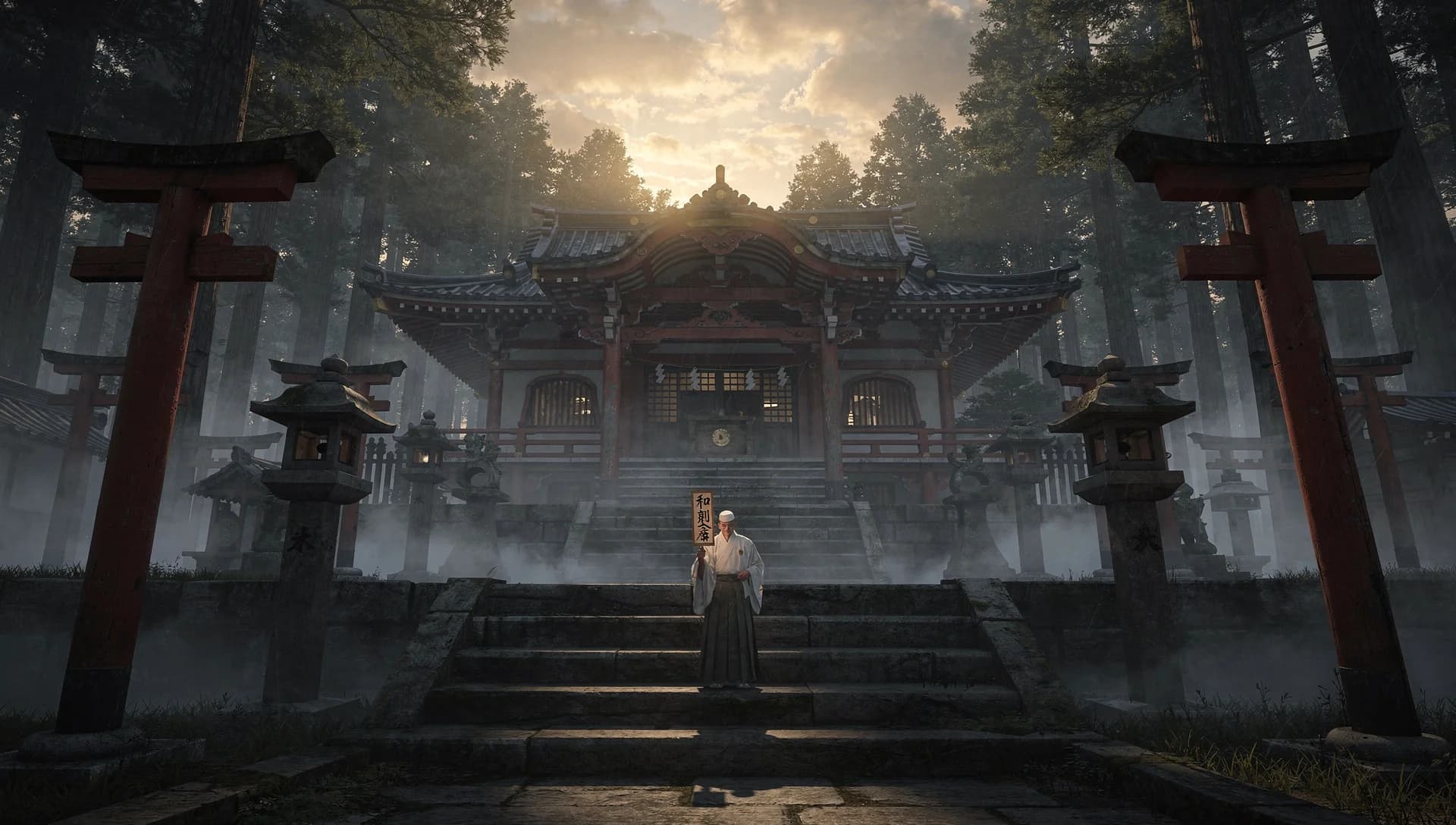
Machiventa Melchizedek, his incarnation remembered in Japan = Shinto awareness of a divine incarnation at Salem
This article expands on the decoder mapping. For the side-by-side card and quick reference, see the mapping page.
A Surprising Claim
Among the many comparative religious claims the Urantia Book makes, the Japan claim is one of the more surprising. The text does not say that Shinto ideas resemble Salem ideas, or that Shinto concepts parallel Salem concepts. It says something stronger: that the people of Japan, separated from Palestine by roughly seven thousand miles and by thousands of years of cultural transmission, "learned of the incarnation of Machiventa Melchizedek."
This is a historical claim about the transmission of information. The incarnation of Machiventa at Salem around 1886 BCE was a discrete historical event. The claim is that memory of this event reached Japan. The transmission route, the text implies, was proto-Taoist: the same cultural stream that carried Salem-derived monotheism into China via the Central Asian corridor continued eastward into the Japanese archipelago.
What the Urantia Book Says
The key passage occurs in Paper 94's account of the eastward Salem transmission:
"This composite belief spread through the lands of the yellow and brown races as an underlying influence in religio-philosophic thought. In Japan this proto-Taoism was known as Shinto, and in this country, far-distant from Salem of Palestine, the peoples learned of the incarnation of Machiventa Melchizedek, who dwelt upon earth that the name of God might not be forgotten by mankind." (UB 94:5.6)
Four claims are embedded in this passage. First, Japanese Shinto and the mainland proto-Taoist stream share a common substrate; they are not independent traditions. Second, the composite belief (incorporating Salem monotheism, Singlangton's One Truth, and Indian Brahman-absolute influences) reached Japan along with the proto-Taoist material. Third, the memory of Machiventa's incarnation was part of what reached Japan. Fourth, the purpose statement about Machiventa's incarnation ("that the name of God might not be forgotten by mankind") was transmitted along with the historical memory.
The surrounding context in Paper 94:5 places the Japanese transmission within the broader account of proto-Taoism's formation:
"It was in direct consequence of this teaching that the earliest form of Taoism arose in China, a vastly different religion than the one which bears that name today. Early or proto-Taoism was a compound of the following factors:" (UB 94:5.2)
The factors listed are three (94:5.3-5): Singlangton's lingering One Truth tradition, Salem missionary Most High Creator Deity teaching, and Brahman-Absolute concepts absorbed from Indian teachers. This composite, formed in China and then carried east to Japan, constituted the earliest stratum of what later became Shinto.
The long-term persistence of the Japanese tradition is not elaborated in the Urantia Book beyond the passage quoted. What the text establishes is the claim that the transmission happened and that the Machiventa memory was part of what was transmitted.
What the Ancient Source Says
The early history of Shinto is one of the more challenging subjects in East Asian religious studies. Unlike Daoism or Confucianism, Shinto did not produce a canonical body of early texts. The first systematic documents, the Kojiki (712 CE) and the Nihon Shoki (720 CE), were compiled after the introduction of Buddhism and Chinese writing, and represent a sophisticated eighth-century systematization rather than a direct record of earlier strata. Helen Hardacre's Shinto: A History (Oxford University Press, 2017) provides the standard modern treatment.
What can be reconstructed about pre-eighth-century Japanese religion includes a dense cultic engagement with kami (divine presences in natural features, ancestors, and exceptional individuals), a ritual complex organized around purity and pollution, a cosmology featuring a high heavenly plain (Takamagahara) and an underworld, and a royal-genealogical theology connecting the imperial line to the sun kami Amaterasu. How much of this was shaped by mainland Chinese, Korean, and Indian influences versus indigenous Jomon and Yayoi substrates is contested.
Nelly Naumann's Die einheimische Religion Japans (Brill, 1988) and Kuroda Toshio's classic article "Shinto in the History of Japanese Religion" (Journal of Japanese Studies, 1981) argue for extensive continental influence on the formation of what became Shinto. Mark Teeuwen and Fabio Rambelli's edited volume Buddhas and Kami in Japan (Routledge, 2003) treats the layered history of Japanese religious synthesis. The consensus direction of scholarship is that Japanese religion from the proto-historical period forward was shaped by multiple transmission streams from the Asian mainland, including Chinese proto-Taoist and Buddhist material and Korean intermediary traditions.
The claim that Japanese tradition preserved a memory of the Machiventa incarnation is not testable against surviving textual evidence. The Kojiki and Nihon Shoki, the earliest Japanese religious documents, show no explicit Machiventa memory under that name. What they show is a complex royal-divine genealogy and a creation narrative centered on the primordial generations of kami. Whether traces of an externally derived memory of a historical incarnation are preserved beneath the eighth-century editorial layer is a question the documentary evidence cannot directly answer.
The transmission route the Urantia Book describes, Salem to Mesopotamia to Central Asia to China to Japan, follows the documented cultural-exchange corridors. Gina Barnes's Archaeology of East Asia (Oxbow, 2015) documents the Jomon-Yayoi transition in Japan and the Yayoi-period (c. 1000 BCE to 300 CE) intensification of mainland contact. The Yayoi migration from the Korean peninsula into Kyushu brought rice cultivation, bronze and iron metallurgy, and a documented cultural-religious stratum that was continuous with late Shang and Zhou Chinese material. If the proto-Taoist stream the Urantia Book describes was circulating in China by the first millennium BCE, it had open transmission routes into Japan through the Yayoi migration and subsequent contact.
Why This Mapping Matters
The Japan claim is one of the more constrained and difficult claims in the Urantia Book's comparative religious material to evaluate. It makes a historical assertion about the transmission of information to a specific geographic and cultural endpoint. The information is not obviously present in the documentary record of the receiving culture. But the transmission route is documented, the composite proto-Taoist substrate is documented, and the Chinese content the Urantia Book identifies as the source of the Japanese transmission is extensively attested.
What the mapping offers, even with the claim of a memory of Machiventa being indirectly testable, is a framework for understanding the Japanese religious tradition's place in the broader Salem-derived trajectory. Japanese Shinto is, on the Urantia account, not an isolated indigenous religious development with only later overlays of foreign influence. It is a receiving endpoint in a continuous transmission network that traces back through Chinese proto-Taoism to the Salem Melchizedek mission.
This has consequences for how we read Shinto theology. The kami concept, the purity-pollution ritual complex, the cosmology of the high heavenly plain, the royal-genealogical theology: these are not purely indigenous emergents. They are shaped by the incoming Salem-derived substrate as it merged with the prior Jomon-Yayoi religious foundation. The distinctive features of Shinto (the intense engagement with natural kami, the purity emphasis, the imperial genealogical framework) can be read as the Japanese-specific shape taken by the composite substrate when it merged with the indigenous material.
The Machiventa memory itself, whether or not it survives in the surviving Japanese texts in recoverable form, would have functioned as part of the general high-god orientation the Salem substrate carried. The Shinto tradition's preservation of a generalized sense that the divine had manifested in history, had established covenant with humanity, and had left an operative memory for subsequent generations to preserve, is consistent with what a downstream recipient of the Machiventa memory would be expected to preserve.
The mapping is therefore best understood not as a narrow claim about a specific textual parallel but as a broader claim about the place of Japanese religion within the global Salem-derived trajectory. Japan was not the far edge of an isolated religious world. It was a receiving endpoint of the same coordinated transmission network that shaped the religious life of the Eurasian continent from Egypt to China.
Sources
- The Urantia Book, Paper 94 (The Melchizedek Teachings in the Orient). Urantia Foundation, first printing 1955. Cited passage: 94:5.2-7.
- Hardacre, Helen. Shinto: A History. Oxford University Press, 2017.
- Teeuwen, Mark and Fabio Rambelli, editors. Buddhas and Kami in Japan: Honji Suijaku as a Combinatory Paradigm. Routledge, 2003.
- Kuroda Toshio. "Shinto in the History of Japanese Religion," translated by James C. Dobbins and Suzanne Gay, Journal of Japanese Studies 7/1 (1981), pp. 1-21.
- Naumann, Nelly. Die einheimische Religion Japans. Brill, 1988.
- Barnes, Gina L. Archaeology of East Asia: The Rise of Civilization in China, Korea and Japan. Oxbow Books, 2015.
- Kojiki. Translated by Gustav Heldt, Columbia University Press, 2014.
- Nihon Shoki. Translated by W. G. Aston, Tuttle, 1972.
Confidence and Evidence
- Confidence: UB CONFIRMED (by direct textual statement in Paper 94:5.6)
- Evidence rating: SUGGESTIVE to MODERATE
- Basis: The Urantia Book directly names the Japanese reception of proto-Taoism and the Machiventa memory in Paper 94:5.6. The transmission route (Salem → Central Asia → China → Japan) is consistent with documented archaeological and cultural-exchange evidence. The Machiventa memory is not directly testable against the surviving Japanese textual record, which was systematized in the eighth century CE after significant editorial restructuring.
Related Decoder Articles
- Singlangton, Yellow Race Spiritual Leader = "One Truth" → Tao
- Salem Monotheism in Chinese Form = Lao-tse's Tao
- Soul and Spirit = Yang and Yin
By Derek Samaras
Connecting Articles
The Priest Who Had No Father: Machiventa Melchizedek and the Genesis Fragment
The Last Stand: Salem Missionaries and the Greek Cynics
The Prophet Who Almost Got There: Gautama Siddhartha and the Salem Gospel
The Pharaoh Who Preached One God: Ikhnaton and the Salem Mission
The Newsletter
Get the research behind each piece
Free. New Urantia Book explorations, the sources behind the videos, and early looks. No spam, unsubscribe anytime.
Prefer video? Follow on YouTube and Facebook.
Delivered through Substack. You can also read past issues.