
The Inner Fragment: The Hindu Atman and the Thought Adjuster
Of all the world's religions, Hindu philosophy came closest to identifying the specific inner divine presence the Urantia Book calls the Thought Adjuster. The Upanishadic teaching of atman, the inner self, reaches the same conceptual territory. Where the Hindu tradition stopped short is also precisely described.
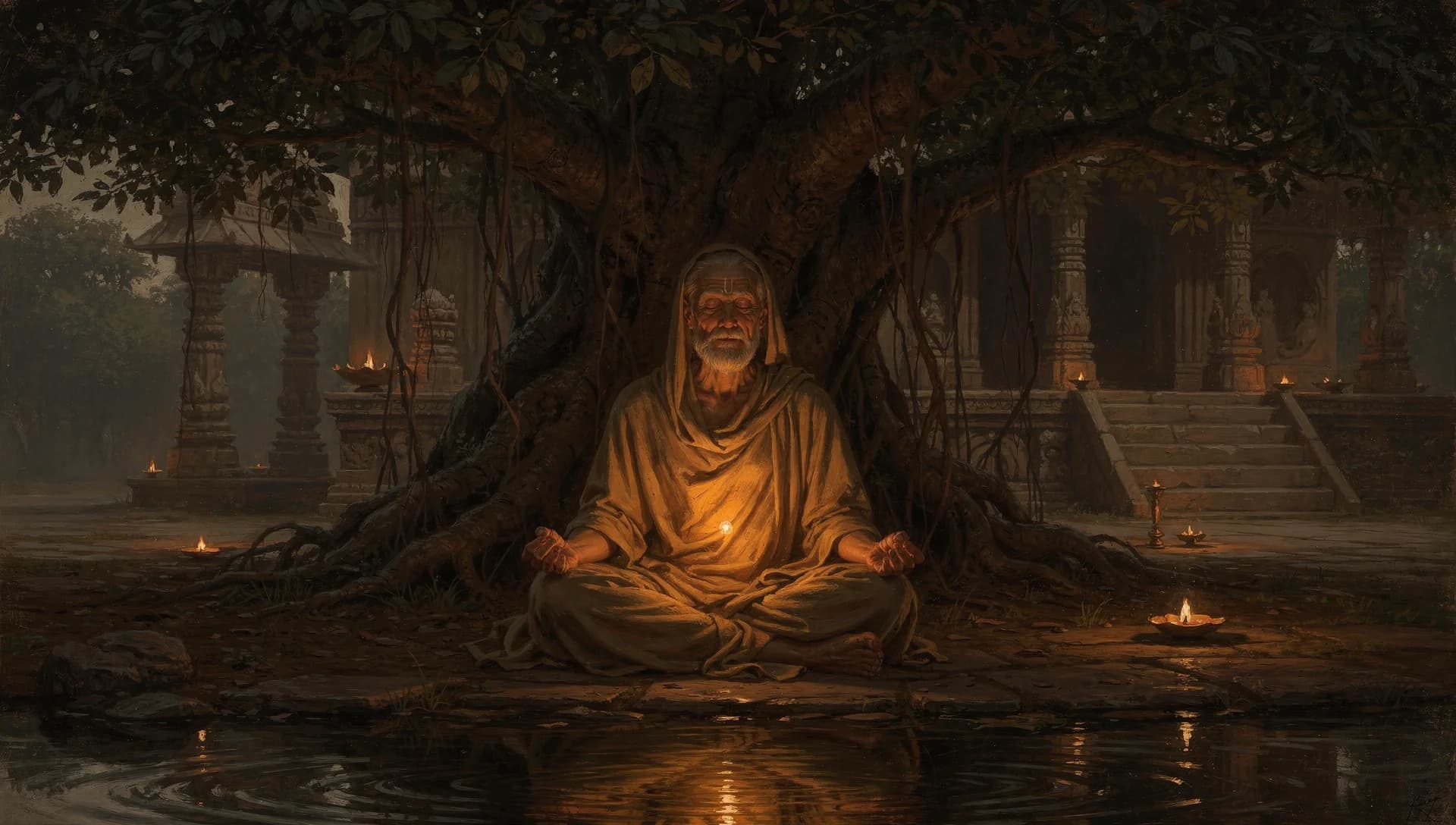
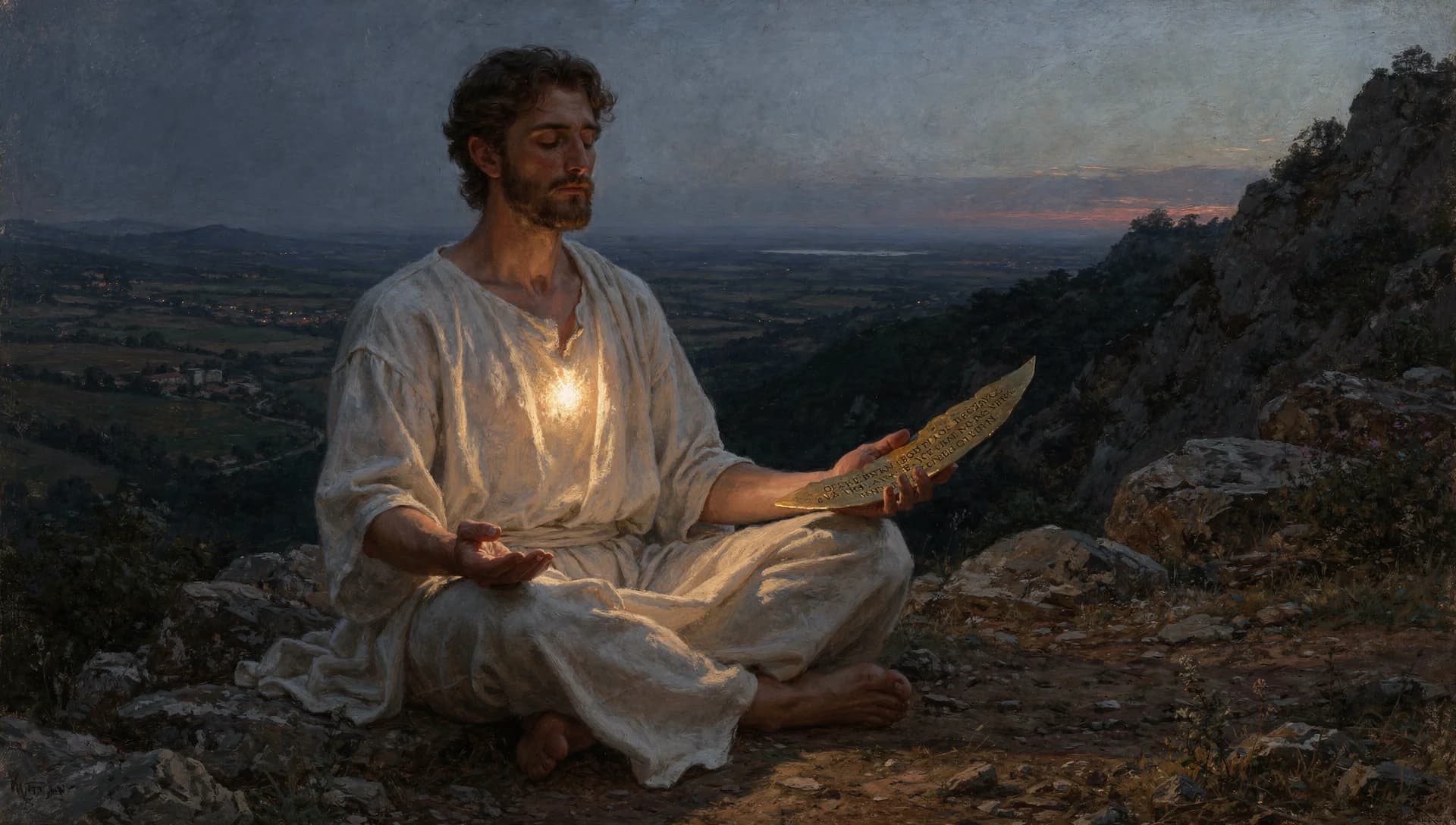
Thought Adjuster, indwelling divine fragment = Atman, the inner self / divine spark in Hinduism
This article expands on the decoder mapping. For the side-by-side card and quick reference, see the mapping page.
The Concept Hinduism Almost Had
The Upanishadic tradition of classical Hindu philosophy produced one of the most distinctive concepts in the world's religious literature: the atman. The term translates as the self, the inner self, or the soul, and the Upanishads treat it as a divine presence within the individual mortal, continuous with the ultimate divine reality (Brahman), recoverable through disciplined introspection.
What makes the Hindu atman remarkable is its precision. The concept is not a vague sense of inner divinity. It is a specific claim: that within the individual consciousness there is a fragment or presence of the absolute, distinguishable from the surface mind, accessible through a specific practice, and continuous with the cosmic ground. That is an unusual theological position. Most religious traditions locate the divine outside the individual, approached through ritual or ethical practice. Hindu philosophy locates a divine presence inside.
The Urantia Book identifies the concept as a specifically proximate approximation of the Thought Adjuster, and names the one thing the Hindu tradition missed.
What the Urantia Book Says
The Urantia Book identifies the Thought Adjuster as the actual indwelling fragment of the Universal Father, bestowed upon the mortal mind and functioning as the spirit pilot of the ascending soul. Paper 111's opening summary places the concept in direct comparative relation to the Hindu atman:
"In the conception of the atman the Hindu teachers really approximated an appreciation of the nature and presence of the Adjuster, but they failed to distinguish the copresence of the evolving and potentially immortal soul. The Chinese, however, recognized two aspects of a human being, the yang and the yin, the soul and the spirit. The Egyptians and many African tribes also believed in two factors, the ka and the ba; the soul was not usually believed to be pre-existent, only the spirit." (UB 111:0.4)
The judgment is careful. Hindu teachers really approximated the Adjuster concept. They understood the indwelling of the divine. They developed the practice of introspective discovery. What they missed was the distinction between two realities: the indwelling divine presence (the Adjuster, in Urantia terminology), and the evolving morontia soul that grows from the co-operation between the Adjuster and the human personality.
The Urantia Book's full treatment of the Adjuster places it at the center of mortal religious experience:
"Mind is your ship, the Adjuster is your pilot, the human will is captain. The master of the mortal vessel should have the wisdom to trust the divine pilot to guide the ascending soul into the morontia harbors of eternal survival. Only by selfishness, slothfulness, and sinfulness can the will of man reject the guidance of such a loving pilot and eventually wreck the mortal career upon the evil shoals of rejected mercy and upon the rocks of embraced sin." (UB 111:1.9)
The distinction the Hindu tradition missed is developed in Paper 111 at length. The Adjuster is the indwelling divine presence, pre-personal, derived directly from the Universal Father. The soul is a new emergent reality, born in the co-operation of the Adjuster and the human personality, and it is the soul, not the Adjuster alone, that survives mortal death:
"Material evolution has provided you a life machine, your body; the Father himself has endowed you with the purest spirit reality known in the universe, your Thought Adjuster. But into your hands, subject to your own decisions, has been given mind, and it is by mind that you live or die. It is within this mind and with this mind that you make those moral decisions which enable you to achieve Adjusterlikeness, and that is Godlikeness." (UB 111:1.4)
The distinction matters theologically. If the indwelling is the only reality, then salvation is a return to the source: the atman reabsorbed into Brahman, the individual dissolving into the universal. This is the classical Advaita Vedanta position, articulated most systematically by Adi Shankara in the eighth century CE. If the indwelling is one reality alongside an emergent soul, then salvation is a co-created survival: the individual personality and the indwelling spirit together, fused and differentiated, persisting and growing.
The Urantia Book's claim is that Hindu philosophy got the first reality but missed the second.
What the Ancient Source Says
The atman concept is developed across the principal Upanishads, composed between roughly 800 BCE and 300 BCE. The standard English scholarly editions include Patrick Olivelle's The Early Upanishads: Annotated Text and Translation (Oxford University Press, 1998) and Upanishads (Oxford World's Classics, 1996). The Chandogya, Brihadaranyaka, Katha, and Mundaka Upanishads contain the central theoretical statements.
The Chandogya Upanishad (6.8.7) gives the classic formulation: tat tvam asi, "that thou art." The pronouncement identifies the inner self (atman) with the ultimate cosmic reality (Brahman). Patrick Olivelle's commentary emphasizes the subtlety of the Sanskrit: the identification is not metaphorical. The inner self is the cosmic absolute, partially and individually manifested.
The Katha Upanishad (1.2.20) describes the atman as "smaller than the small, greater than the great, hidden in the heart of all creatures." The Mundaka Upanishad (3.1.1) offers the image of two birds on one tree: the inner witness self (atman) that watches, and the personal self that acts. The image is striking because it implicitly recognizes what the Urantia Book says the tradition missed: the two realities, the indwelling witness and the acting personality.
The subsequent scholastic development of the tradition, particularly in Shankara's Advaita Vedanta, went decisively in the other direction. Shankara argued that the two-bird image is illusory. There is only the one self. The appearance of duality is maya, cosmic illusion, dispelled by correct knowledge. Richard King's Indian Philosophy: An Introduction to Hindu and Buddhist Thought (Edinburgh University Press, 1999) traces the hardening of the non-dual position across the first millennium CE.
The minority tradition, Ramanuja's eleventh-century Vishishtadvaita (qualified non-dualism), preserved a version of what the Urantia Book identifies as the missing distinction. Ramanuja argued that while the self is continuous with Brahman, it is not identical; the soul is a real finite reality, qualified by a real relationship with the divine. Julius Lipner's The Face of Truth: A Study of Meaning and Metaphysics in the Vedantic Theology of Ramanuja (SUNY Press, 1986) treats the school in detail. Ramanuja's position is, within the Hindu tradition, the closest to the Urantia distinction between the Adjuster and the soul.
Why This Mapping Matters
Most comparative religious scholarship treats the Hindu atman concept and the Christian indwelling spirit as loosely analogous: both posit inner divine presence, both invite contemplative access, both ground salvation in the recovery of the inner. The Urantia Book's treatment is considerably more precise. The atman concept does not merely approximate a Christian analogue. It specifically approximates the Thought Adjuster, a precisely characterized fragment of the Universal Father, bestowed on the prepared mortal mind, functioning as the pilot of the ascending soul.
This specificity matters for three reasons. First, it locates the Hindu tradition in a definite relationship to the revealed material: not as a separate path, but as an incomplete articulation of the same underlying reality. Second, it identifies the exact conceptual gap that, if filled, would bring Hindu philosophy and the Urantia material into alignment: the distinction between the Adjuster as indwelling divine presence and the soul as emergent co-created reality. Third, it suggests a transmission history: the Melchizedek Salem mission penetrated northern India in the second millennium BCE, and the Brahman priestly class rejected the full Salem teaching (94:1.5-6) while absorbing and reframing some of its inner-presence content.
The tradition that produced the Upanishads was already working on material the Salem missionaries were introducing. The atman concept emerged in a cultural environment that had been partially reshaped by the Melchizedek teaching. The near-approximation of the Adjuster concept in the Upanishads may therefore be not a spontaneous parallel development but a partially successful absorption of part of the Salem gospel, the part that survived the Brahmanic rejection of simple monotheism.
Sources
- The Urantia Book, Paper 111 (The Adjuster and the Soul). Urantia Foundation, first printing 1955. Cited passages: 111:0.4, 111:1.4, 111:1.9.
- Olivelle, Patrick. The Early Upanishads: Annotated Text and Translation. Oxford University Press, 1998.
- Olivelle, Patrick, translator. Upanishads. Oxford World's Classics, Oxford University Press, 1996.
- King, Richard. Indian Philosophy: An Introduction to Hindu and Buddhist Thought. Edinburgh University Press, 1999.
- Lipner, Julius. The Face of Truth: A Study of Meaning and Metaphysics in the Vedantic Theology of Ramanuja. State University of New York Press, 1986.
- Deussen, Paul. The Philosophy of the Upanishads. Translated by A. S. Geden. T&T Clark, 1906; reprinted Dover, 1966.
- Radhakrishnan, Sarvepalli. The Principal Upanisads. HarperCollins, 1953; reprinted Humanity Books, 1992.
Confidence and Evidence
- Confidence: UB CONFIRMED
- Evidence rating: STRONG
- Basis: The Urantia Book names the atman concept directly in Paper 111 and identifies precisely what the Hindu tradition approximated and what it missed. The Upanishadic material itself, particularly the two-birds image of Mundaka 3.1.1, preserves the distinction between witness-self and acting-self that the non-dual scholastic tradition later collapsed. Ramanuja's Vishishtadvaita is the Hindu school that most closely tracks the Urantia distinction.
Related Decoder Articles
- Salem Monotheism Rejected = Brahman, the Abstract Absolute
- Salem Trinity Teaching = Hindu Trimurti
- Sethite Priests = Brahman Priestly Caste
By Derek Samaras
Connecting Articles
The God Who Became an It: Salem Monotheism and the Hindu Brahman
The Seed of the Infinite Within: Tathagatagarbha, Atman, and the Thought Adjuster

The Mark of Mercy: Cain's Thought Adjuster and the Genesis Mark
The Spark Within the Body: Orphic Brotherhood and the Thought Adjuster in Greek Dress
The Newsletter
Get the research behind each piece
Free. New Urantia Book explorations, the sources behind the videos, and early looks. No spam, unsubscribe anytime.
Prefer video? Follow on YouTube and Facebook.
Delivered through Substack. You can also read past issues.