
Three from One: The Salem Trinity Teaching and the Hindu Trimurti
The classical Hindu Trimurti, the divine triad of Brahma, Vishnu, and Shiva, emerged in the first millennium CE as the organizing structure of developed Hindu theology. The Urantia Book identifies it as a partial absorption and substantial corruption of the Trinity teaching that the Salem missionaries had brought to India two thousand years earlier.
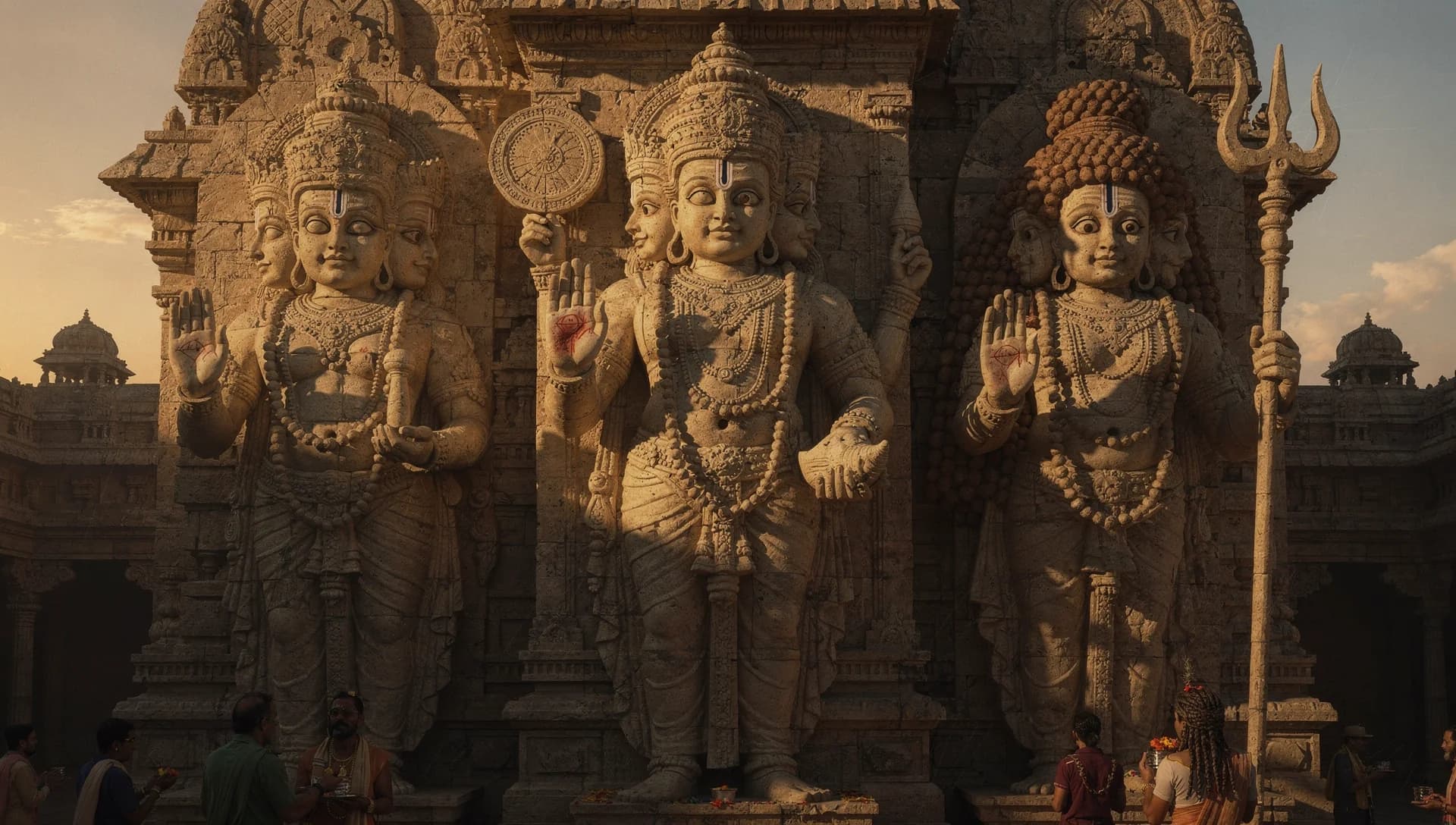
Salem Trinity teaching, corrupted in India = Hindu Trimurti (Brahma, Vishnu, Shiva)
This article expands on the decoder mapping. For the side-by-side card and quick reference, see the mapping page.
Three Gods That Are One
The Hindu Trimurti is one of the most recognizable structural features of developed Hindu theology. Three supreme deities (Brahma the creator, Vishnu the preserver, Shiva the destroyer and transformer), each associated with one face of cosmic process, each worshiped by distinct devotional communities, together constituting the sovereign triadic expression of the underlying Absolute. The structure is formally similar to the Christian Trinity and has often been remarked upon in comparative religious scholarship.
The similarity is not incidental. The Urantia Book identifies the Hindu Trimurti as the partial absorption, and substantial corruption, of a specifically Salem teaching about the Trinity that the Melchizedek missionaries brought to northern India in the second millennium BCE.
What the Urantia Book Says
The Urantia Book places the Trinity doctrine at the center of the Salem missionary program:
"Among the Hindus the trinitarian concept took root as Being, Intelligence, and Joy. (A later Indian conception was Brahma, Siva, and Vishnu.) While the earlier Trinity portrayals were brought to India by the Sethite priests, the later ideas of the Trinity were imported by the Salem missionaries and were developed by the native intellects of India through a compounding of these doctrines with the evolutionary triad conceptions." (UB 104:1.5)
The Salem Trinity teaching was not identical to the later Christian Trinity formulation. It was a simpler and more flexible pedagogical structure, adaptable to the theological starting point of different peoples. Among the polytheistic peoples, the emphasis was on three, as a stepping-stone away from the many and toward the one. Among the monotheistic, the emphasis was on the unity, with the three as an elaboration.
Paper 94 describes the specific fate of the teaching in India:
"The polytheism of these Aryans represented a degeneration of their earlier monotheism occasioned by their separation into tribal units, each tribe having its venerated god. This devolution of the original monotheism and trinitarianism of Andite Mesopotamia was in process of resynthesis in the early centuries of the second millennium before Christ." (UB 94:1.3)
The Andite Mesopotamian religion the Aryan invaders carried with them into India therefore already contained a monotheistic and trinitarian memory, traceable back through the Andite migrations to the post-Adamic cultural substrate. The Salem missionaries' teaching found, in the Aryan religious memory, a partial readiness. What the Brahmanic priesthood did with that substrate is the subject of the mapping.
The classical Trimurti formulation is described in Paper 94:
"Hindu theology, at present, depicts four descending levels of deity and divinity:" (UB 94:4.2)
"1. The Brahman, the Absolute, the Infinite One, the IT IS." (UB 94:4.3)
"2. The Trimurti, the supreme trinity of Hinduism. In this association Brahma, the first member, is conceived as being self-created out of the Brahman—infinity. Were it not for close identification with the pantheistic Infinite One, Brahma could constitute the foundation for a concept of the Universal Father. Brahma is also identified with fate." (UB 94:4.4)
"The worship of the second and third members, Siva and Vishnu, arose in the first millennium after Christ. Siva is lord of life and death, god of fertility, and master of destruction. Vishnu is extremely popular due to the belief that he periodically incarnates in human form. In this way, Vishnu becomes real and living in the imaginations of the Indians. Siva and Vishnu are each regarded by some as supreme over all." (UB 94:4.5)
Three observations in this passage are relevant to the mapping. First, the Trimurti is structurally subordinated to Brahman, placed at the second of four descending levels rather than at the theological apex. This is the specific corruption the Urantia Book names: the Trinity, originally taught as the supreme expression of divine plurality, has been demoted to a lower metaphysical rank beneath the abstract impersonal Absolute. Second, Brahma, the trinitarian first member, almost functioned as a proper Universal Father concept but was prevented from doing so by its close identification with the pantheistic Infinite. Third, the later development of Vishnu and Shiva worship, emerging only in the first millennium CE, shows that the Trimurti structure continued to evolve long after the Salem missionary period, absorbing new devotional material and reorganizing around new centers of popular religious experience.
What the Ancient Source Says
The formal articulation of the Trimurti as a systematic theological structure is generally dated to the Puranic period, roughly the first millennium CE. The earliest clear Trimurti statements appear in the Maitri Upanishad, the Padma Purana, and the Vishnu Purana. Gavin Flood's An Introduction to Hinduism (Cambridge University Press, 1996) provides the standard modern survey of Trimurti development. Wendy Doniger's The Hindus: An Alternative History (Penguin, 2009) treats the historical emergence of Vaishnava and Shaiva devotional movements as independent traditions that were subsequently incorporated into a unified Trimurti framework.
The genealogical priority of the component deities is contested. Brahma is the oldest of the three as a named supreme deity, attested in Vedic and late Vedic material. Vishnu appears as a minor Vedic deity in the Rig Veda but rises to supreme status in the Puranic period, absorbing local solar and preserver deities through the avatar doctrine. Shiva's pre-Vedic Dravidian origins have been a recurring scholarly topic since John Marshall's Indus Valley Civilization excavations: the so-called "proto-Shiva" seal from Mohenjo-Daro (Seal 420) depicts a horned figure in yogic posture, interpreted by Marshall as a possible antecedent of the later Shiva. Asko Parpola's work (The Roots of Hinduism: The Early Aryans and the Indus Civilization, Oxford University Press, 2015) traces the complex ways in which Dravidian religious substrates merged with Aryan-Vedic material to produce classical Hinduism.
The structural formality of the Trimurti, three aspects or persons of a single underlying divine reality, has been noted since early comparative religious scholarship. F. Max Müller in the late nineteenth century, and more recently scholars like Klaus Klostermaier (A Survey of Hinduism, SUNY Press, third edition 2007), have discussed the formal similarities with Christian Trinity theology while emphasizing the substantive differences: the Trimurti members are typically not coequal but hierarchically ordered; the devotional communities are typically exclusive rather than unified; and the metaphysical ground is Brahman rather than a personal triadic Godhead.
Why This Mapping Matters
The Urantia Book's account of the Trinity-Trimurti relationship is historically specific. It claims that the Melchizedek Salem missionaries taught a Trinity doctrine to the Aryan-Brahman priesthood in the second millennium BCE. The teaching was received, but in a form subordinated to the priestly rejection of simple monotheism. The Trinity concept survived as a structural memory, attached first to Brahma alone and later elaborating into the three-member Trimurti as Hindu theology developed across the first millennium CE.
This differs from the conventional academic account, which treats the Trimurti as a distinctively Indian synthesis emerging from the internal dynamics of Vedic, Puranic, and Dravidian religious traditions. The academic account is not wrong about those internal dynamics. The Urantia account adds a causal factor the academic account cannot see: the Salem missionary Trinity teaching provided the structural seed that Hindu theology subsequently elaborated.
The structural evidence weighs in the Urantia Book's favor. Trinitarian structures are not universally distributed in world religious traditions. They are dense in a specific geographic and historical corridor: post-Salem Egyptian religion (Amon-Ra, Ptah, Osiris groupings), post-Salem Mesopotamian religion (Anu-Enlil-Enki triad), post-Salem Indian religion (Brahma-Vishnu-Shiva), and post-Salem Semitic religion leading eventually to the Hebrew and Christian Trinity doctrines. The traditions outside the Salem missionary corridor have monotheistic and polytheistic structures but only rarely develop the specifically triadic supreme form that the Salem teaching would have seeded.
Paper 104 treats the Trinity concept as one of the deepest truths the Urantia revelation communicates, and the Hindu Trimurti as an important and partially successful preservation of that truth within a tradition that rejected the fuller Salem gospel. The mapping is not dismissive of the Hindu Trimurti. It is an acknowledgment that the Trimurti, within the limits imposed by the Brahmanic rejection of personal monotheism, carries forward a real theological memory from the second millennium BCE Salem mission.
Sources
- The Urantia Book, Paper 94 (The Melchizedek Teachings in the Orient), Paper 104 (Growth of the Trinity Concept). Urantia Foundation, first printing 1955. Cited passages: 94:1.3, 94:4.2-6, 104:1.5.
- Flood, Gavin. An Introduction to Hinduism. Cambridge University Press, 1996.
- Doniger, Wendy. The Hindus: An Alternative History. Penguin, 2009.
- Klostermaier, Klaus K. A Survey of Hinduism. Third edition, State University of New York Press, 2007.
- Parpola, Asko. The Roots of Hinduism: The Early Aryans and the Indus Civilization. Oxford University Press, 2015.
- Olivelle, Patrick. Upanishads. Oxford World's Classics, Oxford University Press, 1996.
- Zaehner, R. C. Hinduism. Oxford University Press, 1962.
Confidence and Evidence
- Confidence: UB CONFIRMED
- Evidence rating: MODERATE to STRONG
- Basis: The Urantia Book names the Salem Trinity teaching directly in Paper 104 and traces its reception and partial corruption in India across Paper 94. The geographic distribution of triadic supreme-deity structures in post-Salem religious traditions is consistent with the claim. The Puranic elaboration of the Trimurti in the first millennium CE is consistent with a long-term development from a structural seed in the second millennium BCE.
Related Decoder Articles
- Salem Monotheism Rejected = Brahman, the Abstract Absolute
- Thought Adjuster = Atman, the Inner Self
- Sethite Priests = Brahman Priestly Caste
By Derek Samaras
Connecting Articles

The Bird That Carried the Hero: Adamson, Fandor, and the Hindu Garuda
The God Who Became an It: Salem Monotheism and the Hindu Brahman
The Prophet Who Almost Got There: Gautama Siddhartha and the Salem Gospel
The Priest Who Had No Father: Machiventa Melchizedek and the Genesis Fragment
The Newsletter
Get the research behind each piece
Free. New Urantia Book explorations, the sources behind the videos, and early looks. No spam, unsubscribe anytime.
Prefer video? Follow on YouTube and Facebook.
Delivered through Substack. You can also read past issues.