
 Mythic
Brahman, the abstract absolute that replaced personal God
 UB
UBSalem monotheism, rejected and abstracted
Full Article
Read the deep-dive article on this connection
Salem monotheism, rejected and abstracted = Brahman, the abstract absolute that replaced personal God
The Connection
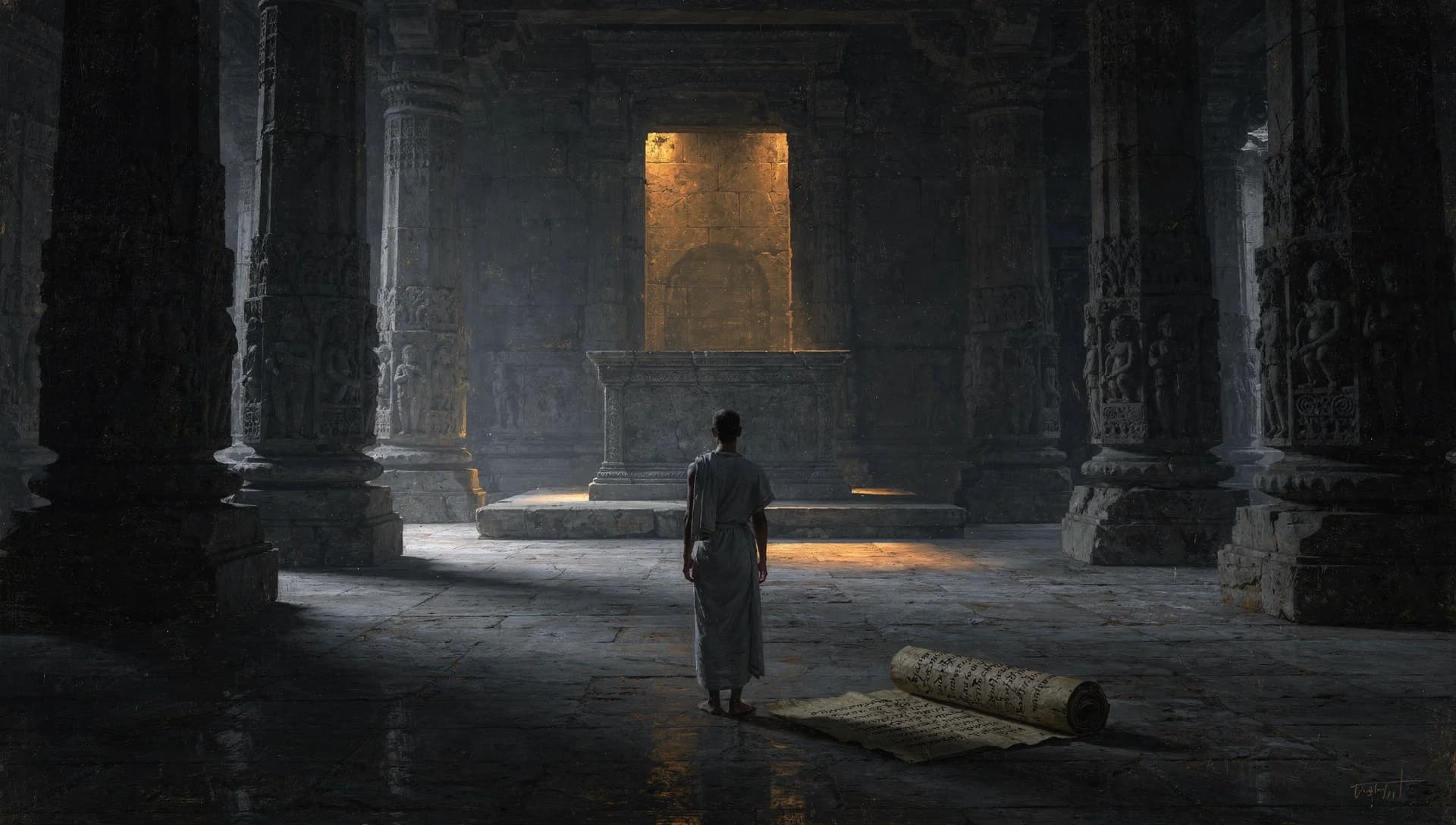
The UB explains that India received Salem missionaries who taught the one God of Melchizedek, but the Brahman priests rejected the personal God concept in favor of an abstract, impersonal absolute. Brahman became "the it" rather than "the He." This abstraction was a philosophical retreat from the Salem teaching of a personal, approachable Father.
UB Citation
Academic Source
Dasgupta, A History of Indian Philosophy (1922); Radhakrishnan, Indian Philosophy (1923)
Historical Evidence(Moderate evidence)
The UB states that the Brahman concept resulted from Indian thinkers struggling with Salem monotheism: "the Brahmans seized upon the impersonal It of the developing Trinity doctrine." The historical progression from Vedic personal gods (Indra, Agni, Varuna) to the abstract Brahman of the Upanishads is well-documented in Indian philosophy. Surendranath Dasgupta traces this philosophical evolution from personal deity worship to monistic abstraction across several centuries.
Deep Dive
The Sanskrit word brahman has a complex history in Indian religious vocabulary. In the early Vedas it refers to sacred utterance, the power inherent in ritual speech. By the time of the Upanishads, the term has been extended to refer to the ultimate reality underlying the cosmos: the impersonal absolute, the ground of being, that-from-which-all-things-arise-and-into-which-all-things-return. The Brahmasutras of Badarayana and the great commentarial tradition culminating in Shankara's Advaita Vedanta have made Brahman the most thoroughly worked-out concept of impersonal absolute in any religious tradition. Brahman is sat-chit-ananda, "being-consciousness-bliss," undifferentiated, attributeless (nirguna), beyond all categories. The Mandukya Upanishad describes it through negation: "not this, not this." It cannot be grasped by mind, cannot be expressed in words, cannot be characterized by any positive description. It simply is, and the realization that one's deepest self (Atman) is identical with this Brahman constitutes liberation.
The Upanishadic tradition presents Brahman not as the development of a personal monotheism but as a deliberate transcending of the personal-deity concept. The earlier Vedic gods (Indra the warrior, Agni the fire, Varuna the cosmic ruler, Mitra the social bond, Soma the ritual drink and divinity) were progressively philosophized into aspects or appearances of the underlying impersonal absolute. This philosophical move represents one of the most sophisticated achievements of religious thought in any culture, and it has shaped Indian and global religious philosophy ever since. But it also represents, on the UB reading, a critical theological wrong turn: the loss of the personal Father in favor of the impersonal absolute.
UB 94:2.6 articulates the historical mechanism of this development. After the rejection of Salem missionary teaching, "having become contaminated with the flood of debasing and debilitating cults and creeds from the Deccan, with their anthropomorphisms and reincarnations, the Brahmanic priesthood experienced a violent reaction against these vitiating beliefs; there was a definite effort to seek and to find true reality. The Brahmans set out to deanthropomorphize the Indian concept of deity, but in so doing they stumbled into the grievous error of depersonalizing the concept of God, and they emerged, not with a lofty and spiritual ideal of the Paradise Father, but with a distant and metaphysical idea of an all-encompassing Absolute."
The diagnosis is precise. The Brahman priests were not simply elaborating their own native theology. They were responding to the chaos created by the rejection of the Salem teaching: a chaos of polytheistic cults, ritualism, magic, and crude anthropomorphism. They wanted something purer, more philosophical, more rigorous. The Salem teaching of one personal God was the right answer to their need, but they had already rejected it, in part because the personalism of the Salem teaching seemed to them too close to the anthropomorphism they were reacting against. They could not see the difference between a genuinely personal Universal Father (the Salem doctrine) and a humanlike anthropomorphic deity (the popular cults). So they reached past both, into the impersonal absolute, and ended up with a Brahman that was philosophically rigorous but personally inaccessible.
UB 94:2.7 sums up the result with rare bluntness: "In their efforts at self-preservation the Brahmans had rejected the one God of Melchizedek, and now they found themselves with the hypothesis of Brahman, that indefinite and illusive philosophic self, that impersonal and impotent it which has left the spiritual life of India helpless and prostrate from that unfortunate day to the twentieth century." The phrase "impersonal and impotent it" is one of the sharpest theological judgments in the entire UB. The impersonal absolute is impotent because it cannot love, cannot will, cannot save, cannot relate. It can only be realized as identical with one's deepest self, and even that realization is not a relationship but a recognition of identity. The whole architecture of personal moral and spiritual development that the Salem teaching offered was lost.
The strongest counterargument is that the Hindu tradition itself preserves powerful counter-currents to the Advaita Vedanta tradition. Vaishnavism and Shaivism, particularly in their bhakti articulations, preserve a genuinely personal-theistic vision in which Vishnu or Shiva is a personal God who can be loved, related to, and prayed to. Ramanuja's Vishishtadvaita Vedanta articulates a sophisticated philosophical position that preserves both personal theism and ultimate identity. Modern Hindu reformers like Ramakrishna, Vivekananda, and Sri Aurobindo have worked extensively to integrate the impersonal and personal aspects. The reply is that the UB's diagnosis is not aimed at the entire Hindu tradition but at the specific Brahman-as-impersonal-absolute strand that became dominant in the Vedantic mainstream. The bhakti tradition, the Vaishnavite philosophical schools, and the modern Hindu reformers are, on the UB reading, partial recoveries of the personal-theistic vision that the Salem teaching originally brought and that the early Brahman priests rejected. They are working back toward what was lost.
UB 94:1.6 makes the historical loss explicit: "The rejection of the Melchizedek gospel of trust in God and salvation through faith marked a vital turning point for India. The Salem missionaries had contributed much to the loss of faith in all the ancient Vedic gods, but the leaders, the priests of Vedism, refused to accept the Melchizedek teaching of one God and one simple faith." The Salem mission's effect on India was largely destructive: it undermined the older polytheism without succeeding in establishing the new monotheism. The result was a religious vacuum that the impersonal Brahman concept eventually filled. India received the Salem critique of polytheism but rejected the Salem affirmation of personal monotheism, and the consequence was a tradition philosophically magnificent but devotionally unreachable for most of its adherents through most of its history.
Key Quotes
“These were the times of the compilation of the later scriptures of the Hindu faith, the Brahmanas and the Upanishads. Having rejected the teachings of personal religion through the personal faith experience with the one God, and having become contaminated with the flood of debasing and debilitating cults and creeds from the Deccan, with their anthropomorphisms and reincarnations, the Brahmanic priesthood experienced a violent reaction against these vitiating beliefs; there was a definite effort to seek and to find true reality. The Brahmans set out to deanthropomorphize the Indian concept of deity, but in so doing they stumbled into the grievous error of depersonalizing the concept of God, and they emerged, not with a lofty and spiritual ideal of the Paradise Father, but with a distant and metaphysical idea of an all-encompassing Absolute.”
“In their efforts at self-preservation the Brahmans had rejected the one God of Melchizedek, and now they found themselves with the hypothesis of Brahman, that indefinite and illusive philosophic self, that impersonal and impotent it which has left the spiritual life of India helpless and prostrate from that unfortunate day to the twentieth century.”
“The rejection of the Melchizedek gospel of trust in God and salvation through faith marked a vital turning point for India. The Salem missionaries had contributed much to the loss of faith in all the ancient Vedic gods, but the leaders, the priests of Vedism, refused to accept the Melchizedek teaching of one God and one simple faith.”
Cultural Impact
The impersonal Brahman concept has shaped Indian philosophical and religious thought for nearly three millennia and through Indian influence has shaped global religious philosophy as well. Schopenhauer's metaphysics, Emerson's Transcendentalism, the Theosophical movement, the perennialist philosophy of Aldous Huxley and Frithjof Schuon, the modern New Age tradition with its emphasis on universal consciousness rather than personal deity: all of these owe substantial debts to the Hindu Brahman concept. Within Indian philosophy itself, the Advaita Vedanta tradition has produced some of the most rigorous metaphysical thinking in any culture, comparable to and influential on the work of Plotinus, Eckhart, Spinoza, Hegel, and the post-Hegelian idealist tradition. The intellectual achievement is enormous. The cost, on the UB reading, is the loss of the personal Father, with consequences for the spiritual and ethical life of the cultures that adopted this framework. Modern critiques of impersonal mysticism (from Christian theologians like Hans Urs von Balthasar, from Jewish theologians like Martin Buber, from Vaishnavite philosophers like Bhaktivedanta Swami) all converge on a similar diagnosis: the impersonal absolute, however philosophically magnificent, fails to ground the relational, ethical, and devotional dimensions of human spiritual life.
Modern Resonance
Contemporary spiritual seekers in the West, often disaffected with traditional Christianity but drawn to non-Western contemplative traditions, frequently find the impersonal Brahman concept attractive. The "I am That I Am" spiritual identity-realization that has popularized through teachers like Eckhart Tolle, Adyashanti, and Mooji is recognizably the Atman-Brahman teaching of Advaita Vedanta. The UB framework offers a sympathetic but corrective reading of this contemporary movement. The recognition of one's deepest identity as divine is genuinely correct: the Adjuster is one's deepest self, fragment of the Father. But the absorption of the personal soul into the impersonal absolute is a wrong turn. The personal individual is real, eternally real, destined for an eternal personal career, not for dissolution into impersonal awareness. Contemporary readers seeking to integrate non-dual contemplative insight with personal moral and relational life will find the UB framework more sustainable than pure Advaita: it preserves what is true in the impersonal-absolute insight while restoring what was lost when the early Brahman priests rejected the personal Father of Melchizedek.
Related Mappings
Related Articles
Where to next
The free newsletter. The research behind each piece, no spam.