
The Prophet Who Almost Got There: Gautama Siddhartha and the Salem Gospel
In the second year of the Buddha's teaching at Benares, a pupil named Bautan imparted to his teacher the traditions of the Salem missionaries and the Melchizedek covenant. The Urantia Book records that Gautama then took an advanced stand on salvation through faith, coming surprisingly near to being a revival of the Salem gospel. The moment the Buddhist tradition almost became the continuation of Machiventa's mission.
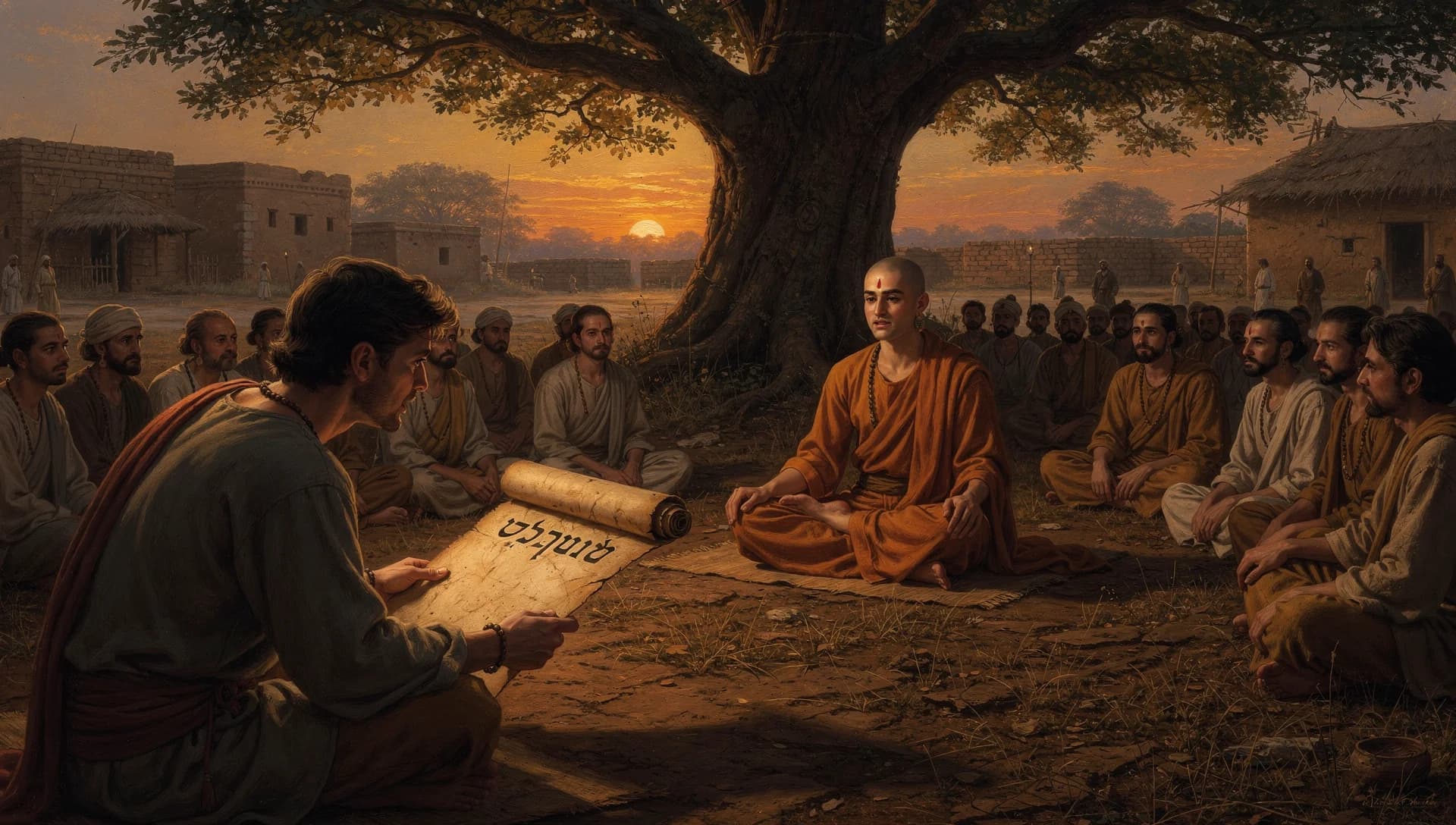
Salem gospel, almost revived in India = Gautama Siddhartha, the Buddha who almost found the gospel
This article expands on the decoder mapping. For the side-by-side card and quick reference, see the mapping page.
The Moment That Could Have Changed Everything
The founding of Buddhism is conventionally dated to the sixth century BCE, contemporary with Lao-tse and Confucius in China and with Deutero-Isaiah and the Zoroastrian reform in the western Axial-Age intervention (treated in the companion decoder articles). Gautama Siddhartha, a prince of the Shakya clan in the foothills of the Himalayas, abandoned his palace life, pursued six years of ascetic yogic practice, rejected it as futile, achieved enlightenment under the Bodhi tree at Bodh Gaya, and taught for forty-five years before his death around 483 BCE.
The Urantia Book treats Gautama with substantial respect as one of the outstanding religious figures of the Axial Age. It also records a specific historical moment when Buddhism almost became the continuation of the Salem Melchizedek mission rather than the independent religious movement it actually became.
What the Urantia Book Says
Paper 94 introduces Gautama directly:
"Contemporary with Lao-tse and Confucius in China, another great teacher of truth arose in India. Gautama Siddhartha was born in the sixth century before Christ in the north Indian province of Nepal. His followers later made it appear that he was the son of a fabulously wealthy ruler, but, in truth, he was the heir apparent to the throne of a petty chieftain who ruled by sufferance over a small and secluded mountain valley in the southern Himalayas." (UB 94:7.1)
The path to enlightenment is described:
"Gautama formulated those theories which grew into the philosophy of Buddhism after six years of the futile practice of Yoga. Siddhartha made a determined but unavailing fight against the growing caste system. There was a lofty sincerity and a unique unselfishness about this young prophet prince that greatly appealed to the men of those days. He detracted from the practice of seeking individual salvation through physical affliction and personal pain." (UB 94:7.2)
The critical Salem-contact moment is described:
"Gautama was a real prophet, and had he heeded the instruction of the hermit Godad, he might have aroused all India by the inspiration of the revival of the Salem gospel of salvation by faith. Godad was descended through a family that had never lost the traditions of the Melchizedek missionaries." (UB 94:7.4)
"At Benares Gautama founded his school, and it was during its second year that a pupil, Bautan, imparted to his teacher the traditions of the Salem missionaries about the Melchizedek covenant with Abraham; and while Siddhartha did not have a very clear concept of the Universal Father, he took an advanced stand on salvation through faith—simple belief. He so declared himself before his followers and began sending his students out in groups of sixty to proclaim to the people of India 'the glad tidings of free salvation; that all men, high and low, can attain bliss by faith in righteousness and justice.'" (UB 94:7.5)
The outcome is described:
"Gautama's wife believed her husband's gospel and was the founder of an order of nuns. His son became his successor and greatly extended the cult; he grasped the new idea of salvation through faith but in his later years wavered regarding the Salem gospel of divine favor through faith alone, and in his old age his dying words were, 'Work out your own salvation.'" (UB 94:7.6)
"When proclaimed at its best, Gautama's gospel of universal salvation, free from sacrifice, torture, ritual, and priests, was a revolutionary and amazing doctrine for its time. And it came surprisingly near to being a revival of the Salem gospel. It brought succor to millions of despairing souls, and notwithstanding its grotesque perversion during later centuries, it still persists as the hope of millions of human beings." (UB 94:7.7)
The Urantia assessment is both respectful and clear-eyed:
"Siddhartha taught far more truth than has survived in the modern cults bearing his name. Modern Buddhism is no more the teachings of Gautama Siddhartha than is Christianity the teachings of Jesus of Nazareth." (UB 94:7.8)
The historical moment at Benares is theologically crucial. For a period during Gautama's active ministry, Buddhism was substantially a movement of salvation by faith drawing on Salem Melchizedek traditions. His wife and son continued this faith-based teaching initially. But the subsequent Buddhist tradition drifted progressively away from this core, returning to a self-reliance framework ("Work out your own salvation") and eventually developing the elaborate ritual-philosophical structures that contemporary Buddhism carries.
What the Ancient Sources Say
The Buddhist canonical sources (Pali Canon for Theravada, the vast Mahayana sutra collection, the Tibetan tantras) were composed across centuries after Gautama's death. The earliest surviving textual witnesses (Gandharan Buddhist texts from the first century BCE) post-date Gautama's ministry by four centuries. The content of Gautama's original teaching must be reconstructed from the textual tradition with awareness of the subsequent editorial layers.
Richard Gombrich's Theravada Buddhism: A Social History from Ancient Benares to Modern Colombo (Routledge, 1988) and his What the Buddha Thought (Equinox, 2009) provide the principal modern scholarly reconstructions. Gombrich argues for substantial recoverable content in Gautama's original teaching despite the editorial overlay. Rupert Gethin's The Foundations of Buddhism (Oxford University Press, 1998) provides the accessible comprehensive treatment.
The historical Gautama, as reconstructed from the earliest textual layers, was substantially less philosophical-systematic than later Buddhist tradition presents. He was a reformer who rejected certain features of contemporary Indian religious life (Vedic ritualism, Brahmanical caste, extreme ascetic practice) and offered an alternative path centered on ethical practice and meditative cultivation. His theological commitments are debated; some scholars (Gombrich among them) argue for a less anti-theistic Gautama than later Buddhist tradition presents, while others maintain the traditional non-theistic reading.
The "Bautan" Salem-transmission moment the Urantia Book describes is not attested in any surviving Buddhist textual source. The name does not appear in the Pali Canon or in the Mahayana tradition. This is consistent with the Urantia's broader observation that much original content of Gautama's teaching did not survive into the later tradition. If the Bautan episode did occur, it would have been part of the earliest layer of Gautama's Benares teaching period (the second year after the Bodhi-tree enlightenment, approximately 527 BCE on conventional chronology), and subsequent editorial work would have had four centuries to compress or eliminate references to external theological sources before the earliest surviving Buddhist texts were composed.
The Salem-Buddhist transmission chain the Urantia Book describes is consistent with the documented historical facts. The Salem missionary tradition had been active in India for centuries by Gautama's lifetime. The companion decoder article on Sethite priests establishes that the Salem-derived priestly tradition was a continuing presence in Indian religious life. A hermit-scholar descendant of the Salem missionary tradition living in sixth century BCE India is historically plausible without being textually attested.
The doctrinal parallels between Gautama's teaching and Salem teaching are close enough to note. Gautama rejected Vedic sacrificial ritual (Salem rejected Canaanite sacrificial ritual). Gautama rejected caste-based religious exclusion (Salem rejected ethnic exclusion). Gautama emphasized ethical practice over ritual performance (Salem emphasized faith and ethical life over cultic observance). These parallels are consistent with the Urantia claim that Gautama was substantially working with Salem-derived material during his middle teaching period.
Why This Mapping Matters
Buddhism's place in the broader history of religion has been persistently complex for comparative-religious scholarship. It is sometimes treated as a specifically Indian religious development rooted in the Hindu tradition. It is sometimes treated as an independent religious innovation reacting against that tradition. It is sometimes treated as a philosophical rather than religious movement (the "godless philosophy" framing that the Urantia Book itself uses in 94:8.18). Each framing captures something about Buddhism but misses other features.
The Urantia Book's contribution is to identify the specific Salem connection that Gautama's middle-period teaching preserved. Buddhism is not purely a Hindu-substrate development. It is not purely an Indian reform movement. It is not purely a philosophical system. At its best (and particularly during Gautama's Benares period following the Bautan contact), it was a Salem-derived gospel of salvation by faith that almost became the Indian subcontinent's continuation of the Melchizedek mission.
This reading has practical consequences for how Buddhism should be read and practiced. The historical Gautama is closer to the core Salem-Melchizedek-Jesus tradition than the subsequent Buddhist tradition has generally represented. The "godless philosophy" framing, while partly accurate for the later tradition, does not capture what Gautama was actually teaching during the Salem-influenced period of his ministry. The features that contemporary Buddhism preserves (emphasis on ethical life, rejection of ritual substitutes for moral cultivation, emphasis on universal access to spiritual liberation) are Salem-derived features that Buddhism carried forward from the original gospel even as it lost the specifically theistic-personal framework in which Salem had originally presented them.
The mapping's significance is that it places Buddhism within the Salem-derived tradition rather than outside it. Gautama is, on this account, one of the sixth-century Axial Age reformers working with Salem material, alongside Lao-tse (treated in the companion decoder article), Zoroaster (treated in the companion Zoroastrian articles), Deutero-Isaiah (treated in the companion Hebrew scribal revision article), and others. The coordinated Axial Age intervention, per the Urantia account, was designed to preserve the Salem tradition at a moment when it was in danger of being lost, and Gautama was one of its principal Indian-subcontinent agents.
Reading Buddhism with this framework allows recognizing both what it preserves and what it lost. It preserves ethical universalism, rejection of ritual substitutes for moral cultivation, compassionate response to suffering, and the emphasis on inner cultivation that Gautama inherited from his Salem-Sethite substrate. It lost the explicit theism, the personal relationship with the divine Father, and the concept of survival through faith that the Salem gospel originally carried. The Maitreya expectation (treated in the companion decoder article on Michael's return) represents Buddhism's preserved anticipation of a future religious figure who will restore what Gautama almost brought but did not quite achieve.
Sources
- The Urantia Book, Paper 94 (The Melchizedek Teachings in the Orient). Urantia Foundation, first printing 1955. Cited passages: 94:7.1, 94:7.2, 94:7.4, 94:7.5, 94:7.6, 94:7.7, 94:7.8, 94:8.17, 94:8.18.
- Gombrich, Richard F. Theravada Buddhism: A Social History from Ancient Benares to Modern Colombo. Routledge, 1988.
- Gombrich, Richard F. What the Buddha Thought. Equinox, 2009.
- Gethin, Rupert. The Foundations of Buddhism. Oxford University Press, 1998.
- Conze, Edward. Buddhism: Its Essence and Development. Revised edition, Harper & Row, 1959.
- Harvey, Peter. An Introduction to Buddhism: Teachings, History and Practices. Second edition, Cambridge University Press, 2013.
- Williams, Paul. Mahayana Buddhism: The Doctrinal Foundations. Second edition, Routledge, 2009.
Confidence and Evidence
- Confidence: UB CONFIRMED
- Evidence rating: MODERATE
- Basis: The Urantia Book provides historical detail about Gautama's Salem-contact moment in Paper 94:7.4-5. The Bautan episode is not attested in Buddhist textual sources but is consistent with the observable editorial compression of Gautama's original teaching across the four centuries before the earliest surviving Buddhist texts. The doctrinal parallels between Gautama's teaching and Salem teaching (rejection of ritual, rejection of caste, emphasis on ethical practice) support the Salem-influence claim.
Related Decoder Articles
- Zoroaster, Salem Missionary Descendant = Zarathustra
- Salem Monotheism in Chinese Form = Lao-tse's Tao
- Salem Missionaries' Purest European Teaching = Cynics
By Derek Samaras

Connecting Articles
The One First Cause: Salem Monotheism in Lao-tse's Tao
The Priest Who Had No Father: Machiventa Melchizedek and the Genesis Fragment

The Memory That Reached Japan: Machiventa and the Shinto Substrate
The Pharaoh Who Preached One God: Ikhnaton and the Salem Mission
The Newsletter
Get the research behind each piece
Free. New Urantia Book explorations, the sources behind the videos, and early looks. No spam, unsubscribe anytime.
Prefer video? Follow on YouTube and Facebook.
Delivered through Substack. You can also read past issues.