
The Last Stand: Salem Missionaries and the Greek Cynics
The Urantia Book names the philosophical school that preserved Melchizedek's monotheistic gospel in Europe into the Roman period. It was the Cynics. The claim is specific, directly cited, and unusually testable against what classical scholarship knows about this strange and underappreciated Hellenistic tradition.
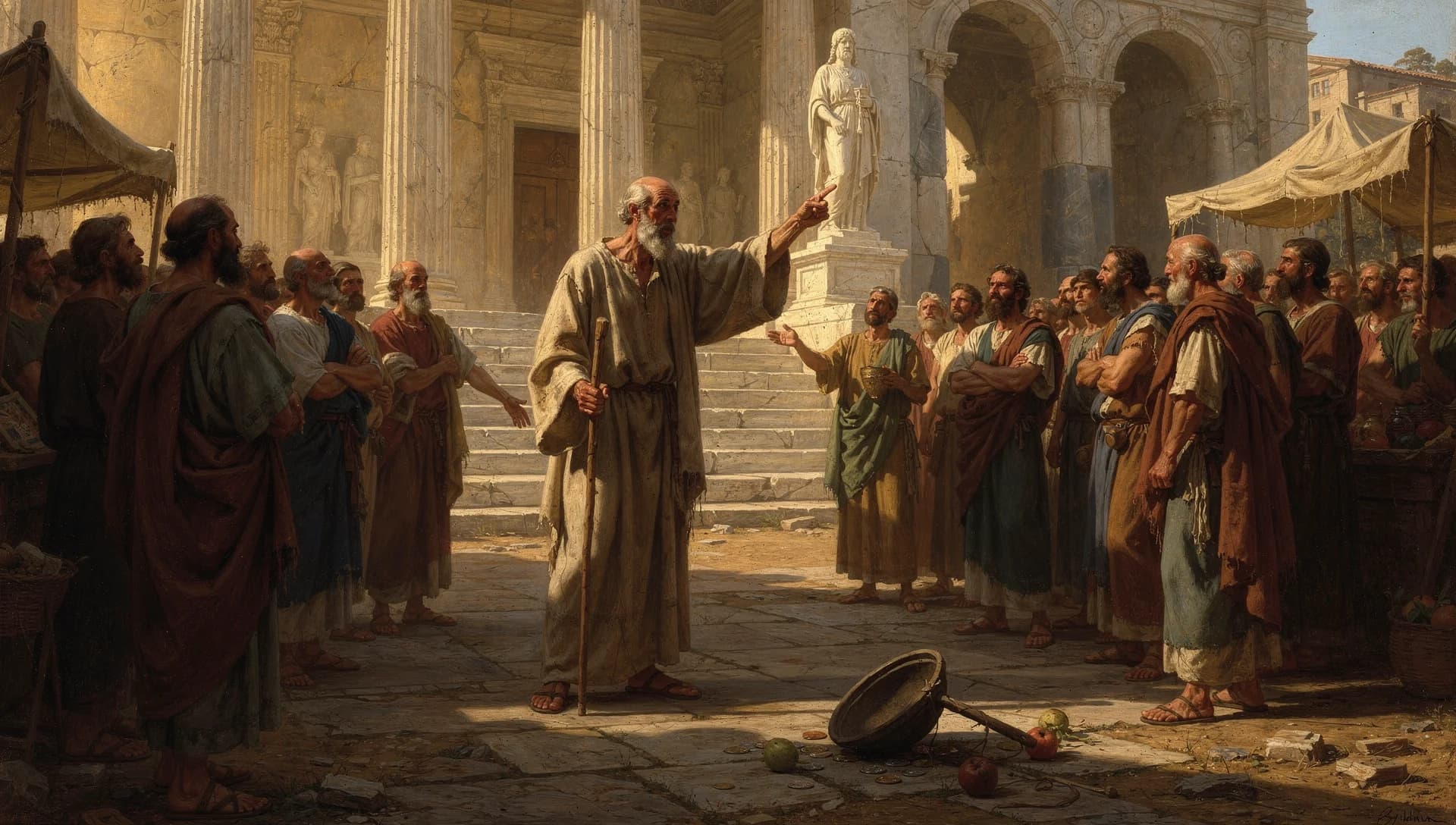
Salem missionaries' purest European teaching = Cynics, philosophical school preserving Salem monotheism
This article expands on the decoder mapping. For the side-by-side card and quick reference, see the mapping page.
A Specific Claim About a Specific School
The Urantia Book makes a direct historical claim in Paper 98: that among all the philosophical and religious movements active in Europe during the centuries between Machiventa Melchizedek's incarnation and the Christian era, one specific school preserved the Salem monotheistic gospel in its purest form. The school named is the Cynics.
"For a long time in Europe the Salem missionaries carried on their activities, becoming gradually absorbed into many of the cults and ritual groups which periodically arose. Among those who maintained the Salem teachings in the purest form must be mentioned the Cynics. These preachers of faith and trust in God were still functioning in Roman Europe in the first century after Christ, being later incorporated into the newly forming Christian religion." (UB 98:0.2)
This is not an abstract mythological parallel. It is a historical attribution, and it is one that can be tested against what classical historians know about the Cynic tradition. What the historians know, it turns out, fits unusually well.
What the Urantia Book Says
The basic claim is that the intellectual ancestry of Greek philosophy, Jewish theology, and Christian ethics traces in significant part to the Melchizedek mission at Salem, and that the principal vehicle by which Melchizedek's teaching reached Europe was the Cynic school:
"The basic doctrines of Greek philosophy, Jewish theology, and Christian ethics were fundamentally repercussions of the earlier Melchizedek teachings." (UB 98:0.4)
The Salem missionaries fanned outward from Machiventa's Palestinian center in the second millennium BCE. Europe was one of several fields. In Europe the teaching encountered the Etruscan and later Roman state religion, which proved resistant:
"In the great monotheistic renaissance of Melchizedek's gospel during the sixth century before Christ, too few of the Salem missionaries penetrated Italy, and those who did were unable to overcome the influence of the rapidly spreading Etruscan priesthood with its new galaxy of gods and temples, all of which became organized into the Roman state religion." (UB 98:3.2)
The Cynics emerge in the narrative as the rearguard. The Salem emphasis on simple monotheistic faith, ethical directness, and rejection of elaborate ritual was preserved most purely by this particular philosophical movement:
"The last stand of the dwindling band of Salem believers was made by an earnest group of preachers, the Cynics, who exhorted the Romans to abandon their wild and senseless religious rituals and return to a form of worship embodying Melchizedek's gospel as it had been modified and contaminated through contact with the philosophy of the Greeks. But the people at large rejected the Cynics; they preferred to plunge into the rituals of the mysteries, which not only offered hopes of personal salvation but also gratified the desire for diversion, excitement, and entertainment." (UB 98:3.9)
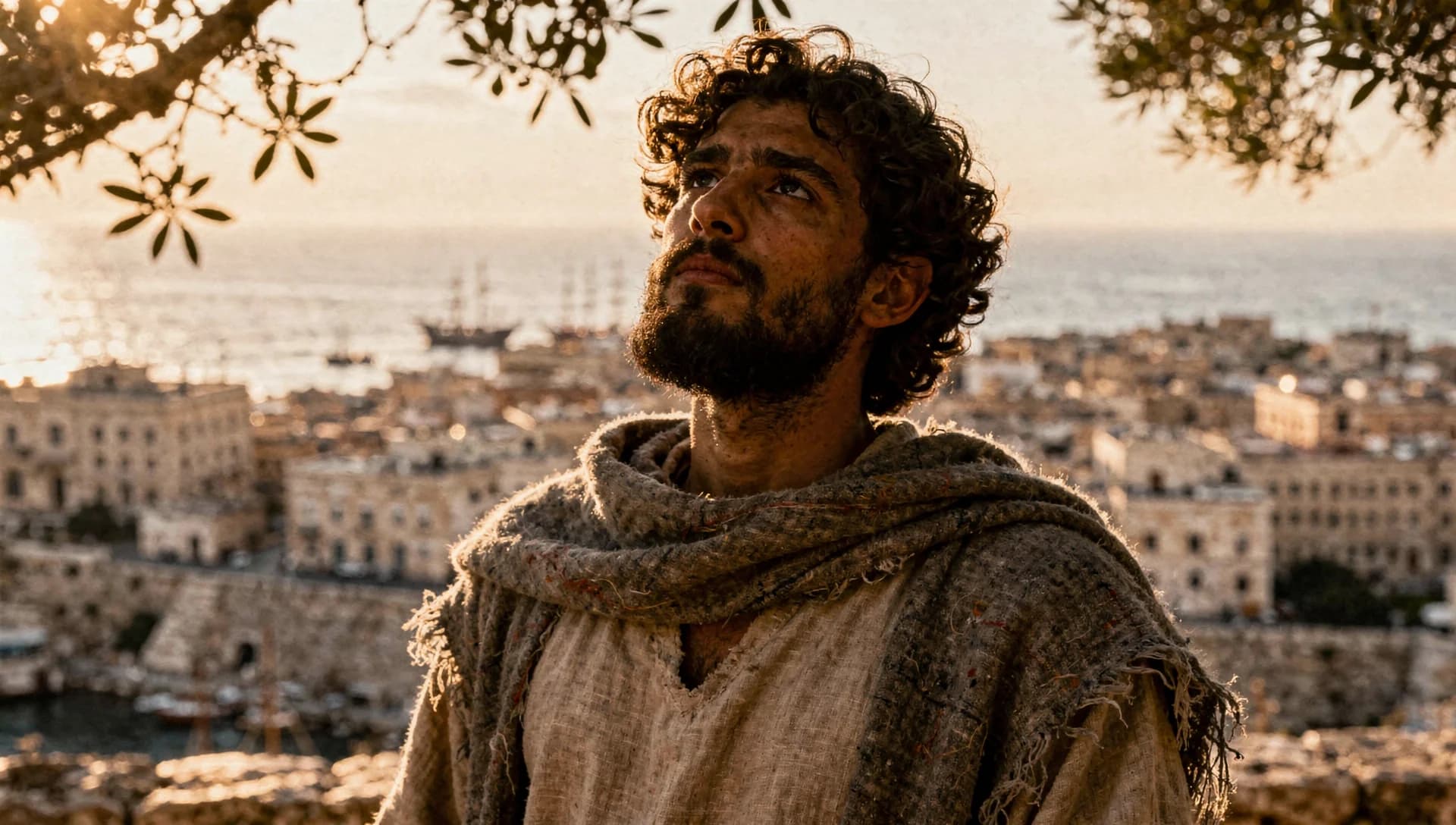
Later, the Urantia record places Jesus himself in direct personal contact with the Roman Cynic leadership during his eastern travels prior to the beginning of his public ministry. Mardus, "the acknowledged leader of the Cynics of Rome," is singled out as one of the philosophical figures Jesus met night after night (UB 132:2.1). The Cynic tradition in the Roman Empire, therefore, is not peripheral to the Urantia account of the pre-Christian religious landscape. It is central.
What the Ancient Source Says
Cynicism, as an identifiable philosophical movement, is traditionally dated from Antisthenes (c. 445-365 BCE) and Diogenes of Sinope (c. 412-323 BCE). The standard modern reference work is The Cambridge Companion to the Cynics (Cambridge University Press, 1996), edited by R. Bracht Branham and Marie-Odile Goulet-Cazé. The principal primary sources are Diogenes Laertius, Lives of Eminent Philosophers Book VI, and the fragments collected in Giovanni Giannantoni's Socraticorum Reliquiae (Naples, 1985) and Socratis et Socraticorum Reliquiae (Bibliopolis, 1990).
The intellectual profile of the school has four features that are notable for comparative purposes. First, radical monotheism. Cynic theology, where it is articulable at all, is strikingly austere: a single cosmic deity, conceived in ethical rather than mythological terms, who requires a simple life and inner integrity from his worshipers. Donald Dudley's A History of Cynicism (Methuen, 1937) documents the consistent Cynic rejection of the Olympian pantheon as a system of morally serious religion, and the substitution of a unified divine principle, often named simply theos.
Second, the rejection of elaborate ritual. The Cynics were notorious in antiquity for their scorn of temples, sacrifices, oracles, and the whole cultic apparatus of Greek and Roman religion. Their preferred mode of religious expression was ethical practice in public, not ritual performance in a sanctuary. This is precisely the Salem-Melchizedek stance the Urantia Book describes.
Third, itinerant preaching. The Cynics operated not as a seminary-bound school but as street preachers. Their characteristic public performance was the diatribe, an ethical harangue delivered in the agora, the gymnasium, or the marketplace. This mode of operation is a direct functional analogue to the Salem missionary pattern the Urantia Book describes for Machiventa's emissaries.
Fourth, continuity into the Roman imperial period. Unlike most classical philosophical schools, Cynicism did not decline sharply after the Hellenistic period. Dio Chrysostom in the first century CE, Epictetus in the second, and a scattering of named Cynics through late antiquity attest the school's continuous activity across precisely the centuries when the Urantia Book says they were preaching Melchizedek's gospel in Roman Europe. Derek Krueger's Symeon the Holy Fool: Leontius's Life and the Late Antique City (University of California Press, 1996) traces their late-antique survival and the absorption of their mode of sanctity into Christian ascetic traditions.
F. Gerald Downing's Cynics and Christian Origins (T&T Clark, 1992) argues at book length that primitive Christianity, particularly in its Palestinian and Syrian forms, shares so many structural features with Cynic preaching that direct historical contact between the two movements is probable. Downing's argument, controversial when published, has been progressively validated by subsequent New Testament scholarship and by detailed prosopographical work on first-century itinerant preachers.
Why This Mapping Matters
Classical scholarship has long treated Cynicism as an oddly isolated movement. It shares features with Socratic philosophy (Antisthenes is a pupil of Socrates) but goes further than Socratic ethics in its theological austerity and its rejection of civic religion. It shares features with later Christian asceticism (Diogenes as a model for the Christian desert fathers) but predates it by centuries. It shares features with Hebrew prophetic preaching (itinerant, ethical, austere, critical of cultic formalism) but has no obvious historical connection.
The Urantia Book's attribution supplies the missing genealogy. If the Salem missionary tradition, itself rooted in Machiventa Melchizedek's Palestinian base, fanned outward into Europe and was preserved in purest form by the Cynics, then the Cynic similarities to Hebrew prophetic style, to Socratic ethical seriousness, and to later Christian asceticism are not coincidences. They are a common inheritance, transmitted through a single channel, and preserved with characteristic loss and accretion over several centuries.
The claim is specifically testable against the Cynic profile, and the Cynic profile confirms it. The monotheism is there. The anti-cultic stance is there. The itinerant preaching is there. The continuity into the Roman imperial period is there. The absorption into early Christianity, which the Urantia Book states explicitly, is precisely what Downing and subsequent scholars have documented.
That is a considerable amount of confirmation for a single sentence of attribution in Paper 98.
Sources
- The Urantia Book, Paper 98 (The Melchizedek Teachings in the Occident), Paper 132 (The Sojourn at Rome). Urantia Foundation, first printing 1955. Cited passages: 98:0.2, 98:0.4, 98:3.2, 98:3.9, 132:2.1.
- Branham, R. Bracht, and Marie-Odile Goulet-Cazé, eds. The Cambridge Companion to the Cynics. Cambridge University Press, 1996.
- Dudley, Donald R. A History of Cynicism from Diogenes to the 6th Century A.D. Methuen, 1937.
- Giannantoni, Giovanni. Socratis et Socraticorum Reliquiae. Bibliopolis, 1990.
- Downing, F. Gerald. Cynics and Christian Origins. T&T Clark, 1992.
- Goulet-Cazé, Marie-Odile. L'ascèse cynique: Un commentaire de Diogène Laërce VI 70-71. Vrin, 1986.
- Krueger, Derek. Symeon the Holy Fool: Leontius's Life and the Late Antique City. University of California Press, 1996.
- Diogenes Laertius. Lives of Eminent Philosophers, Book VI. Translation by R. D. Hicks. Loeb Classical Library, Harvard University Press, 1925.
Confidence and Evidence
- Confidence: UB CONFIRMED
- Evidence rating: STRONG
- Basis: The Urantia Book names the Cynics directly and explicitly as the European preservers of Salem monotheism. The four structural features of Cynic philosophy attested in classical scholarship (radical monotheism, anti-cultic stance, itinerant preaching, continuity into the Roman imperial period) all match the Salem missionary profile. F. G. Downing's independent argument for direct historical contact between Cynics and early Christianity provides academic corroboration.
Related Decoder Articles
- Mardus, Cynic Leader Taught by Jesus
- Stoic Ethics Absorbed into Pauline Christianity
- Angamon, Stoic Leader Taught by Jesus
By Derek Samaras
Connecting Articles
The Priest Who Had No Father: Machiventa Melchizedek and the Genesis Fragment

The Memory That Reached Japan: Machiventa and the Shinto Substrate
Day After Day: Jesus and Mardus, Leader of the Roman Cynics
The Prophet Who Almost Got There: Gautama Siddhartha and the Salem Gospel
The Newsletter
Get the research behind each piece
Free. New Urantia Book explorations, the sources behind the videos, and early looks. No spam, unsubscribe anytime.
Prefer video? Follow on YouTube and Facebook.
Delivered through Substack. You can also read past issues.