
 Mythic
Cynics, philosophical school preserving Salem monotheism
 UB
UBSalem missionaries' purest European teaching
Full Article
Read the deep-dive article on this connection
Salem missionaries' purest European teaching = Cynics, philosophical school preserving Salem monotheism
The Connection
The UB identifies the Cynic philosophy as the purest surviving remnant of Salem missionary teaching in Europe. While most Greek philosophical schools diluted the original monotheistic message, the Cynics preserved its core emphasis on simplicity, virtue, and direct relationship with the divine, stripped of ritual and institutional complexity.
UB Citation
Academic Source
Dudley, A History of Cynicism (1937); Desmond, Cynics (2008)
Historical Evidence(Moderate evidence)
The UB states that of the various Greek philosophical movements influenced by Salem teaching, the Cynics preserved the most authentic remnant. William Desmond documents the Cynic emphasis on self-sufficiency, virtue as the only good, and rejection of conventional religion in favor of direct moral practice. Diogenes of Sinope's radical monotheistic tendency and rejection of temple ritual parallel the original Salem emphasis on faith over ceremony.
Deep Dive
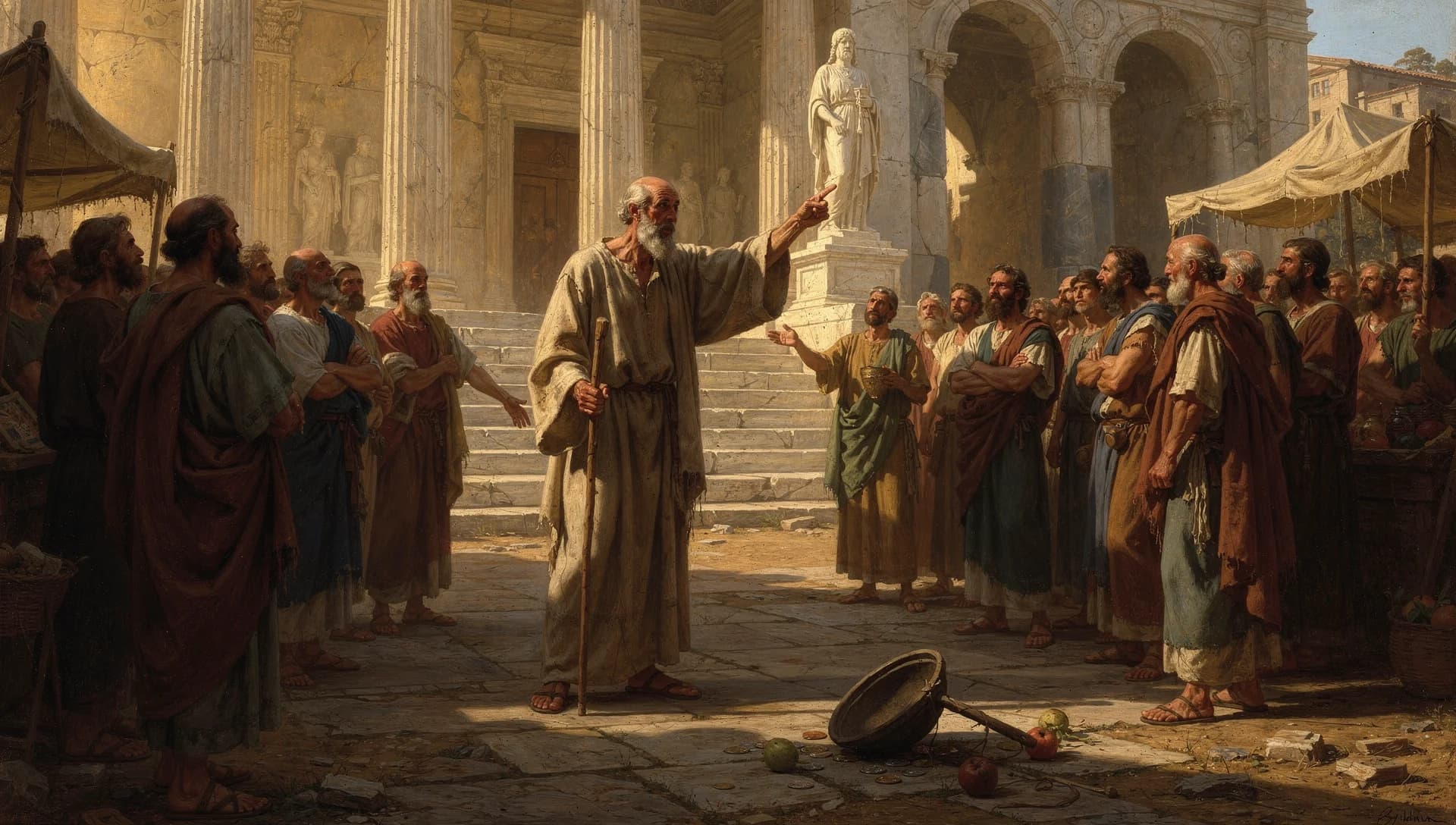
In the marketplace of Athens in the fourth century BCE you could find Diogenes of Sinope sitting in a clay jar, eating raw food, defecating in public, and shouting at passersby that virtue was the only good and that custom was a tyranny over reason. He carried a lamp in daylight, claiming to be looking for an honest man. He told Alexander the Great to stand out of his sunlight. The Cynic philosophy that he embodied and that his followers Crates of Thebes and Hipparchia of Maroneia carried forward was not a system in the academic sense; it was a life-discipline, a deliberate stripping away of social pretense in favor of immediate ethical practice. Within the Greek philosophical landscape the Cynics were the radicals: more austere than the Stoics, more action-oriented than the Platonists, more religious in posture than the Epicureans, and uniformly contemptuous of temple ritual and civic religion.
The Urantia Book identifies the Cynic movement as the purest surviving remnant of Salem missionary teaching in Europe. Paper 98:0.2 states that "for a long time in Europe the Salem missionaries carried on their activities, becoming gradually absorbed into many of the cults and ritual groups which periodically arose. Among those who maintained the Salem teachings in the purest form must be mentioned the Cynics. These preachers of faith and trust in God were still functioning in Roman Europe in the first century after Christ, being later incorporated into the newly forming Christian religion." This is one of the more specific identifications the UB makes of a Greek philosophical movement, and it deserves examination.
The Salem teaching was the Melchizedek covenant: faith in one universal God as the only price of obtaining divine favor, with simple ethical conduct rather than ritual sacrifice as its expression. The Cynic emphasis matches this on three points. First, on monotheistic posture: Diogenes and his successors mocked the polytheistic civic cult and its sacrificial ritualism, redirecting religious reverence toward what they called the natural order, which functioned in their thought as a quasi-monotheistic supreme principle. Second, on faith as direct trust rather than ritual transaction: the Cynic was supposed to live in immediate dependence on the goodness of nature, refusing accumulation, accepting whatever the day provided. Third, on ethical practice as the test of religious truth: the Cynic rejected speculation in favor of demonstration, an emphasis Salem missionaries would have recognized as the demand that faith become works.
William Desmond, in Cynics (Acumen, 2008) and The Greek Praise of Poverty (Notre Dame, 2006), documents the Cynic genealogy from Antisthenes through Diogenes through Crates and Hipparchia, into the Roman period with Demetrius and Demonax, and finally into the early Christian centuries. Donald Dudley's classic A History of Cynicism (1937) traced the same line. F. Gerald Downing's work, especially Cynics and Christian Origins (T&T Clark, 1992), made the case that the Cynic movement was the closest pre-existing template for the Jesus tradition's ethical teaching, with the wandering missionary lifestyle, the rejection of property, the emphasis on direct moral instruction over institutional religion, and the use of striking sayings and gestures all matching closely. The mainstream academic position is that the parallel reflects independent development from comparable social conditions; the UB position is that the parallel reflects a real historical lineage running from Salem through itinerant teachers into the Cynic tradition.
The strongest counterargument is that the Cynic movement is well-documented in its own Greek context as deriving from Antisthenes, a student of Socrates, with no need for a Salem-missionary genealogy. The reply is that the UB does not deny the Greek philosophical context; it identifies Antisthenes and his followers as receptive vessels for Salem teaching that had been propagating through the eastern Mediterranean for centuries. Salem missionaries had reached Greece by various routes during the first millennium BCE, and the soil where the seed took root was Athenian philosophy. The Cynic preservation of the simplest faith-and-ethics core, while stripping away the metaphysical speculation that drew Plato and the dialectical complexity that drew Aristotle, fits the UB pattern of how Salem teaching survived in non-priestly hands.
What the parallel implies is that the historical Jesus stepped into a Mediterranean world where one specific philosophical school was already preaching, in functionally identical terms, the core of the gospel he came to restore. Paul's later missionary success in Greek-speaking cities owes something to the prior Cynic preparation: Stoic and Cynic ethics had already cleared the philosophical ground for a faith-centered, ethics-driven, ritual-skeptical religion. The Cynic-Christian convergence noted by Downing and others is, in the UB reading, not an accident but the meeting of two streams from the same ultimate source.
Key Quotes
“For a long time in Europe the Salem missionaries carried on their activities, becoming gradually absorbed into many of the cults and ritual groups which periodically arose. Among those who maintained the Salem teachings in the purest form must be mentioned the Cynics. These preachers of faith and trust in God were still functioning in Roman Europe in the first century after Christ, being later incorporated into the newly forming Christian religion.”
“Desmond documents the Cynic emphasis on autarkeia (self-sufficiency), the rejection of social convention as opposed to natural reason, and the recasting of religious reverence as ethical demonstration rather than ritual performance.”
Cultural Impact
The Cynic movement seeded multiple subsequent traditions of religious-ethical radicalism. The early Christian desert fathers in third- and fourth-century Egypt and Syria, with their stripped-down monastic discipline and their contempt for civic religion, drew explicitly on Cynic models. The medieval mendicant orders, especially the early Franciscans, recovered the Cynic-Christian wandering-poor ideal in a thirteenth-century context. The Reformation traditions of plain religion, austerity, and direct relationship with God carry the same family signature. In modern times the Cynic genealogy informs Thoreau's Walden, Tolstoy's Christian anarchism, Gandhi's satyagraha, and the wider tradition of voluntary simplicity that runs through twentieth-century counterculture. The contemporary minimalist movement, the Mennonite and Bruderhof communities, and the broader anti-consumerist religious left all carry recognizable Cynic genes, mediated through Christian traditions that themselves owe more to the Cynic substrate than is usually acknowledged. When a contemporary writer reaches for the figure of the holy fool, the wandering teacher, the renunciant who exposes hypocrisy through simple conduct, that writer is drawing from the well that Diogenes dug.
Modern Resonance
The recovery of the Cynic tradition in late twentieth-century scholarship, especially through Downing's Cynics and Christian Origins and Abraham Malherbe's earlier work on Cynic epistles, has reopened the question of how the historical Jesus relates to his Mediterranean philosophical neighbors. The Jesus Seminar's John Dominic Crossan portrayed Jesus as essentially a Jewish Cynic peasant-philosopher, a reading that has both supporters and critics. The UB account preserves what is right in the Cynic-Jesus reading, the structural and content overlap is real, while restoring the missing piece: both the Cynic tradition and the Jesus tradition descend from the same Salem-Melchizedek source, with Cynicism the Greek-philosophical inheritance and Jesus the direct continuation. For contemporary readers wrestling with the question of why Jesus's teaching sounds Cynic in so many places, the UB provides a coherent historical answer.
Related Mappings
Adamson + Ratta, superhuman couple
= Cronus + Rhea, Titan parents of the Olympians
16 children of Adamson + Ratta
= Olympian Gods: Zeus, Hera, Poseidon, etc.
Caligastia, invisible sky ruler
= Ouranos, Greek sky father (via Hittite Anu transmission)
Rodan of Alexandria, Greek philosopher
= Greek thinker who engaged directly with Jesus' teaching
Related Articles
Where to next
The free newsletter. The research behind each piece, no spam.