
The Philosophy in Paul: How Stoic Ethics Entered Christianity
Paul's Christianity was a synthesis, and one of its principal ingredients was Greek Stoic moral philosophy. The Urantia Book names this directly and academic scholarship has documented it in detail. The convergence is not a corruption of the gospel. It is the mechanism by which the gospel became intellectually accessible to the Greco-Roman world.
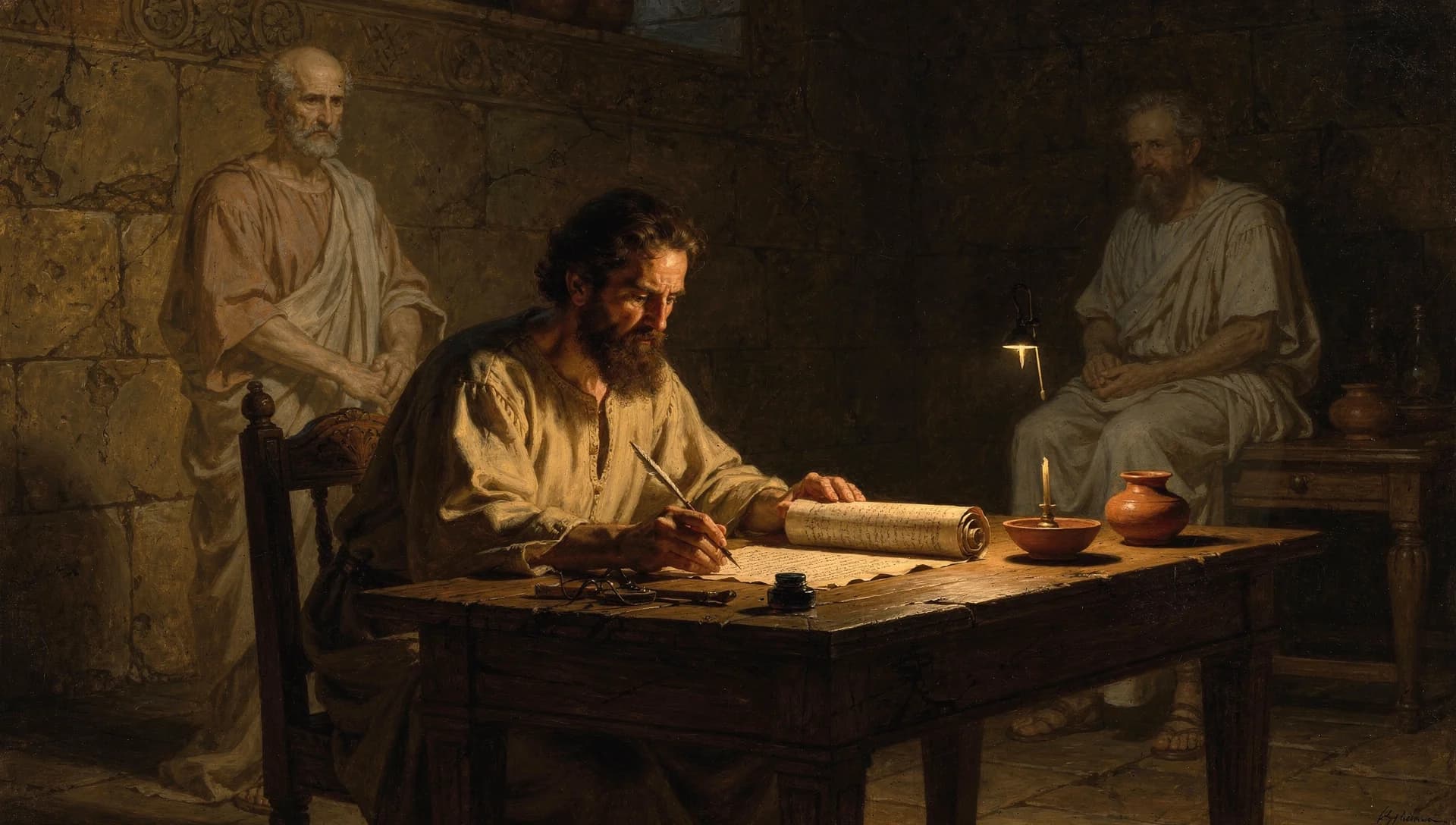
Stoic ethics absorbed into Pauline Christianity = Greek philosophical contribution to early Christianity
This article expands on the decoder mapping. For the side-by-side card and quick reference, see the mapping page.
A Synthesis, Not a Simple Transmission
Paul's Christianity was not a pure transmission of Jesus' teaching in Aramaic to the Jewish synagogues of the Mediterranean. It was a synthesis, worked out in Greek, that took the core of Jesus' gospel and fused it with existing Hellenistic Jewish, Greek philosophical, and Roman legal materials into a form that could be absorbed by the entire literate population of the empire. The Urantia Book treats this synthesis as deliberate and, on balance, successful.
The relevant philosophical ingredient, for present purposes, is Stoic moral philosophy. The Urantia Book names it directly as one of the four strands Paul wove together. Modern academic scholarship, working from the textual evidence of the Pauline epistles without access to the Urantia material, has documented the Stoic ingredient in detail. The two bodies of evidence converge.
What the Urantia Book Says
The Urantia Book's statement of the Pauline synthesis is explicit:
"And so a different people were called upon to carry an advancing theology to the world, a system of teaching embodying the philosophy of the Greeks, the law of the Romans, the morality of the Hebrews, and the gospel of personality sanctity and spiritual liberty formulated by Paul and based on the teachings of Jesus." (UB 121:7.6)
Four ingredients. Three of them are general inheritances available to any Hellenistic Jew of the first century: Greek philosophy, Roman law, Hebrew morality. The fourth is Jesus's specific teaching, mediated through Paul. The synthesis is the historically consequential one.
The text then details the philosophical ancestries that shaped Paul's formulation:
"Paul's cult of Christianity exhibited its morality as a Jewish birthmark. The Jews viewed history as the providence of God—Yahweh at work. The Greeks brought to the new teaching clearer concepts of the eternal life. Paul's doctrines were influenced in theology and philosophy not only by Jesus' teachings but also by Plato and Philo. In ethics he was inspired not only by Christ but also by the Stoics." (UB 121:7.7)
The Stoic ethical component is named specifically. The gospel came through the teachings of Christ. The ethics came through Christ and the Stoics together. This is not a reduction of Pauline ethics to Stoicism. It is the specific claim that Stoic ethical thought was a second major source, alongside the direct teaching of Jesus, for the ethical framework Paul articulated.
The subsequent paragraphs give the fuller inventory:
"The gospel of Jesus, as it was embodied in Paul's cult of Antioch Christianity, became blended with the following teachings:" (UB 121:7.8)
And the first-named teaching in the list that follows is "The philosophic reasoning of the Greek proselytes to Judaism, including some of their concepts of the eternal life." (UB 121:7.9), pointing directly at the Hellenistic Jewish philosophical substrate Philo occupied and in which Stoic material was already densely present.
What the Ancient Source Says
The scholarly literature on Paul and Stoicism is substantial. The foundational modern work is Troels Engberg-Pedersen's Paul and the Stoics (T&T Clark, 2000), which argues that Paul's ethical framework in Galatians, Romans, and the Corinthian correspondence is more thoroughly Stoic than traditional Pauline theology has recognized. Engberg-Pedersen's follow-up, Cosmology and Self in the Apostle Paul: The Material Spirit (Oxford University Press, 2010), extends the argument to Paul's understanding of the spirit (pneuma) itself, which he reads as operating within a Stoic philosophical framework of a material spiritual substance that pervades and structures the cosmos.
Runar Thorsteinsson's Roman Christianity and Roman Stoicism (Oxford University Press, 2010) documents the specific parallels between the moral exhortations of Romans 12-13 and the parallel exhortations in Seneca's Epistulae Morales. The parallels extend to vocabulary, argument structure, and the characteristic Stoic distinction between what is in our power (eph' hēmin) and what is not.
Marcia Colish's two-volume The Stoic Tradition from Antiquity to the Early Middle Ages (Brill, 1985) treats the Stoic component of patristic Christian ethics as a through-line from Paul to Augustine and beyond. Her argument is that Stoic ethics was absorbed into Christianity so thoroughly in the first four centuries that by the time it was explicitly reflected upon, it had ceased to be identifiable as Stoic and had become the default moral vocabulary of Latin Christendom.
Abraham Malherbe's Paul and the Popular Philosophers (Fortress, 1989) and Paul and the Thessalonians (Fortress, 1987) document the rhetorical and stylistic patterns Paul shares with the Stoic and Cynic popular preachers of the Hellenistic period. The diatribe style, the use of the imagined interlocutor, the moral catalogue, the reasoned ethical argument: all are patterns Paul shares with his Stoic and Cynic contemporaries.
The cumulative weight of this literature supports a clear conclusion. Paul's ethics are not purely a development of Jesus' teaching. They are a genuine synthesis, with the Stoic tradition as a major contributing source. The Urantia Book states this in a single sentence. The academic literature has produced several thousand pages of detailed argument in its support.
Why This Mapping Matters
The Pauline synthesis is one of the most historically consequential intellectual events in Western history. What Paul did in the two decades after Jesus' death, and what the generations of Christian teachers who followed him built upon, determined the specific shape Christianity took and the specific forms in which it could travel across the Roman empire and beyond.
If Pauline Christianity had been a pure unmixed transmission of Jesus' Aramaic teaching, it could not have functioned as an imperial religion. The intellectual resources of the Mediterranean world would not have been available to explicate it, defend it, or extend it. The mission to the Gentiles required that the gospel be articulable in Greek philosophical vocabulary, and the gospel's moral teaching required that it be articulable in the moral vocabulary the educated classes of the empire already possessed. That moral vocabulary was substantially Stoic.
Paul's education in Tarsus, at the intersection of Jewish rabbinic tradition and Greek philosophical culture, positioned him for the synthesis. His contact with figures like Angamon the Stoic and Mardus the Cynic, in Rome and elsewhere, provided the specific philosophical relationships that made the synthesis operational. The Urantia Book's picture of Paul's formation, taking Jesus' teaching as the core, weaving in Stoic ethics as the moral framework, Greek philosophy as the metaphysical framework, and Hebrew religious narrative as the historical framework, matches what the academic analysis of the Pauline letters confirms.
The mapping matters because it reframes what is often treated as corruption (the "Hellenization of the gospel") as what the Urantia Book treats as the designed architecture. The Stoic ingredients in Pauline Christianity are not a falling-away from the pure teaching. They are a necessary component of the mission strategy, enabling the gospel to reach minds that the unmixed teaching could not have reached.
The Jesus-Angamon and Jesus-Mardus encounters, recorded in Paper 132, are the human moments where this architecture was set in place. The philosophical relationships Jesus cultivated during his Roman sojourn seeded the Roman intellectual climate for the reception of Paul thirty years later. The synthesis Paul then articulated is the record of what that preparation made possible.
Sources
- The Urantia Book, Paper 121 (The Times of Michael's Bestowal), Paper 132 (The Sojourn at Rome). Urantia Foundation, first printing 1955. Cited passages: 121:7.6, 121:7.7, 121:7.8, 121:7.9.
- Engberg-Pedersen, Troels. Paul and the Stoics. T&T Clark, 2000.
- Engberg-Pedersen, Troels. Cosmology and Self in the Apostle Paul: The Material Spirit. Oxford University Press, 2010.
- Thorsteinsson, Runar M. Roman Christianity and Roman Stoicism: A Comparative Study of Ancient Morality. Oxford University Press, 2010.
- Colish, Marcia L. The Stoic Tradition from Antiquity to the Early Middle Ages. 2 volumes, Brill, 1985.
- Malherbe, Abraham J. Paul and the Popular Philosophers. Fortress Press, 1989.
- Malherbe, Abraham J. Paul and the Thessalonians: The Philosophic Tradition of Pastoral Care. Fortress Press, 1987.
- Long, A. A. Hellenistic Philosophy: Stoics, Epicureans, Sceptics. Second edition, University of California Press, 1986.
Confidence and Evidence
- Confidence: UB CONFIRMED
- Evidence rating: STRONG
- Basis: The Urantia Book states the Stoic contribution to Pauline Christianity directly in Paper 121. The academic literature produced since the 1980s has documented the Stoic ingredient in detail across multiple monographs and article-length treatments. The two bodies of evidence converge on substantially the same account.
Related Decoder Articles
- Angamon, Stoic Leader Taught by Jesus
- Mardus, Cynic Leader Taught by Jesus
- Salem Missionaries' Purest European Teaching = Cynics
By Derek Samaras
Connecting Articles

The All-Night Talk: Jesus and Angamon, Leader of the Stoics

The Three-Source Christianity: Paul, Mystery Cults, and the Composite Religion

The Longest Memory: Australian Aboriginal Dreamtime and the Primordial Teaching-Ancestors
The Final Adjudication: Ragnarok and the Pending Verdict
The Newsletter
Get the research behind each piece
Free. New Urantia Book explorations, the sources behind the videos, and early looks. No spam, unsubscribe anytime.
Prefer video? Follow on YouTube and Facebook.
Delivered through Substack. You can also read past issues.