
The Pharaoh Who Preached One God: Ikhnaton and the Salem Mission
In the fourteenth century BCE, a young pharaoh of the Eighteenth Dynasty abandoned the traditional Egyptian pantheon, built a new capital, and proclaimed worship of a single universal God. The Urantia Book identifies him as one of the most remarkable human beings in history and explains precisely how the Salem missionary tradition reached the Egyptian throne.
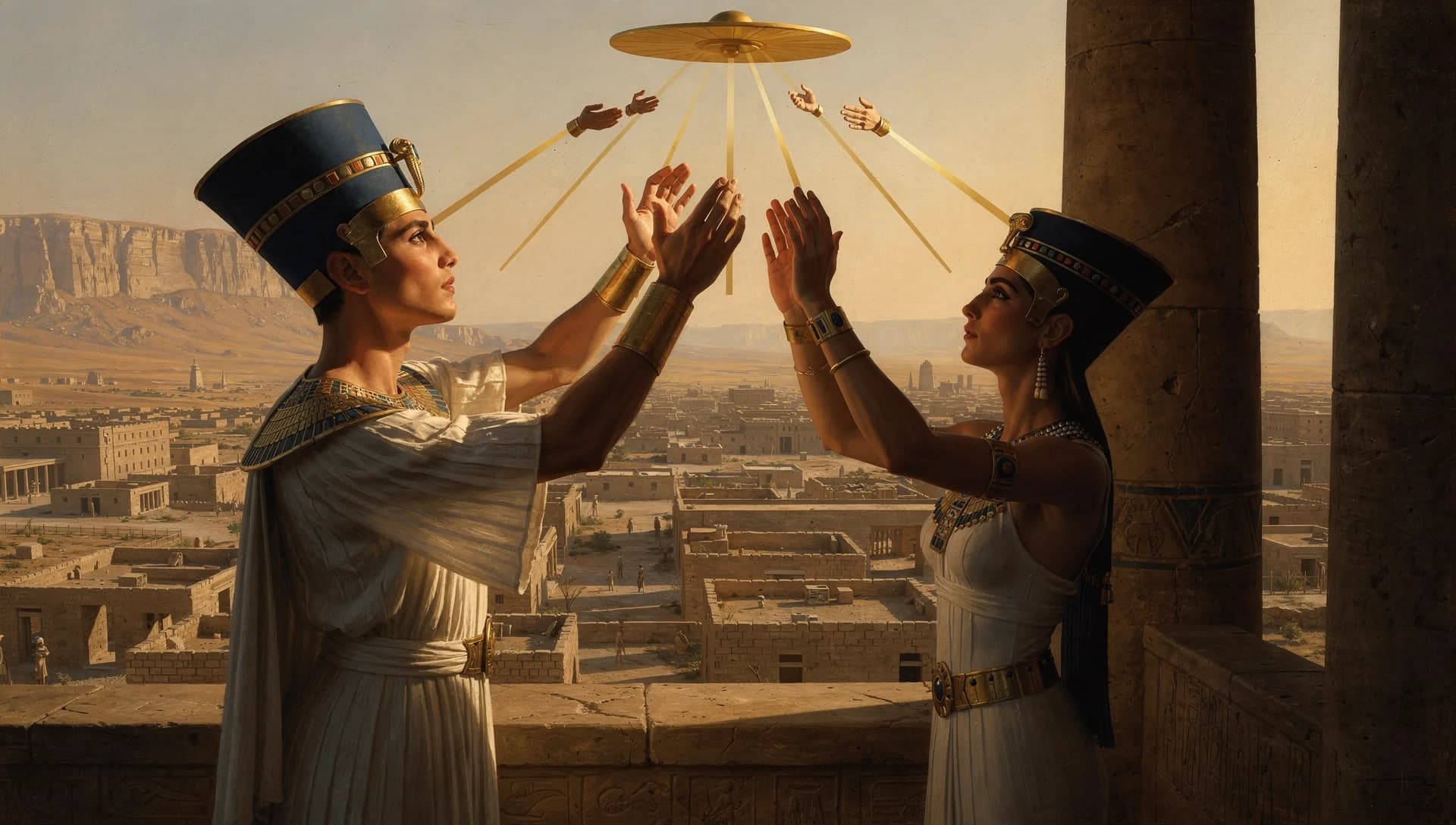
Machiventa Melchizedek's Salem missionaries = Ikhnaton / Akhenaten, pharaoh who proclaimed one God
This article expands on the decoder mapping. For the side-by-side card and quick reference, see the mapping page.
The Pharaoh Who Moved His Capital
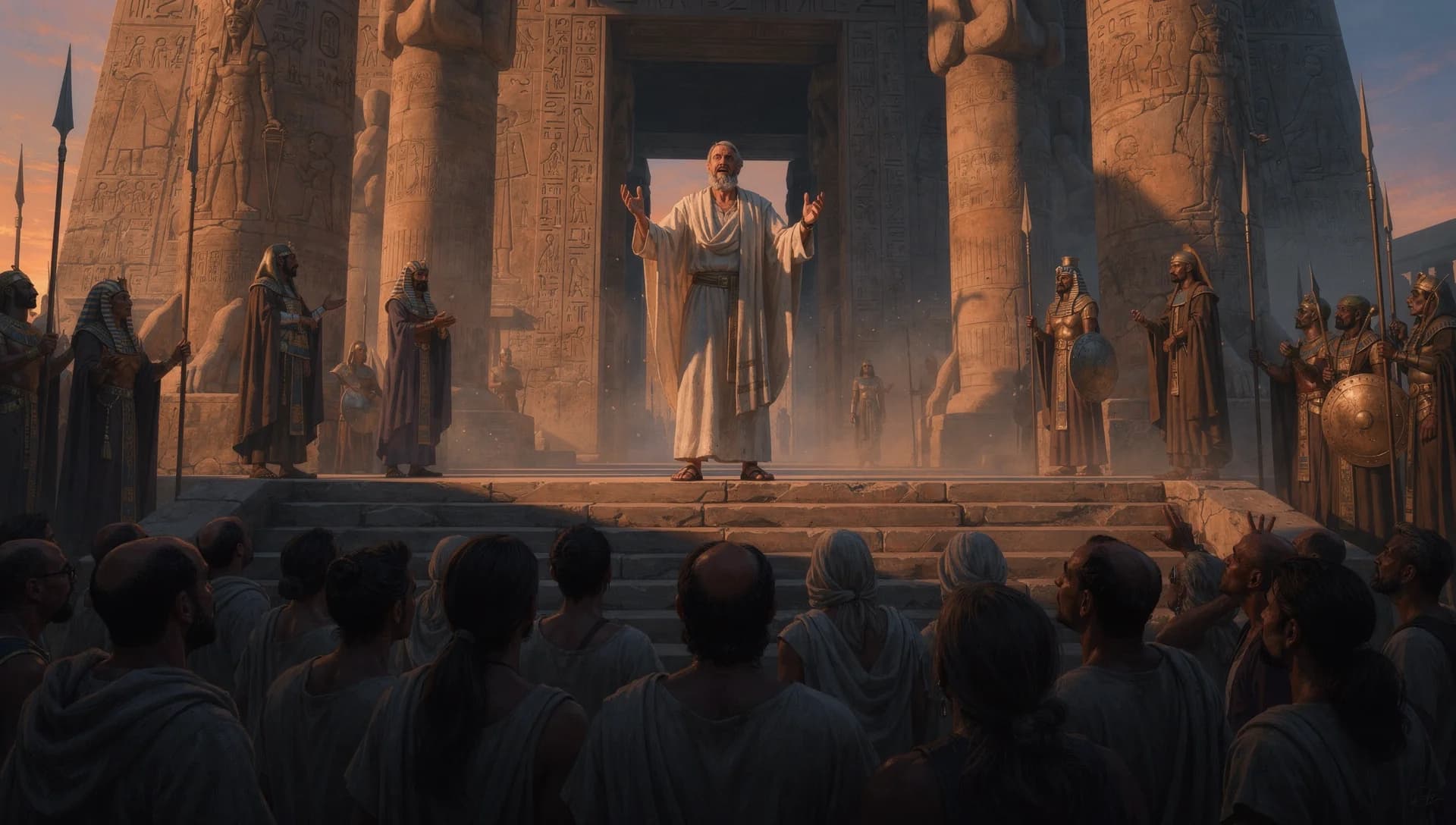
In 1353 BCE, a young pharaoh of the Eighteenth Dynasty ascended the throne of Egypt as Amenhotep IV. Within five years he had done something no Egyptian ruler before or after ever did. He abandoned the traditional pantheon of Thebes, suppressed the cult of Amon-Ra, proclaimed a single supreme deity whose symbol was the solar disc (Aton), changed his own name to Akhenaten ("effective for Aton"), abandoned the ancient capital, and built an entirely new city at Amarna dedicated to the worship of the One God.
The episode is among the best-documented of ancient history. James P. Allen's Ancient Egyptian Pyramid Texts (Society of Biblical Literature, 2005) and Dominic Montserrat's Akhenaten: History, Fantasy and Ancient Egypt (Routledge, 2000) provide the modern scholarly framing. The question that has occupied Egyptology since Flinders Petrie's nineteenth-century excavations at Amarna is simple and unresolved: where did Ikhnaton's monotheism come from?
The Urantia Book answers directly.
Watch the cinematic companion to this article:
What the Urantia Book Says
The mechanism by which Salem teaching reached the royal house is specifically described:
"The teachings of Amenemope were slowly losing their hold on the Egyptian mind when, through the influence of an Egyptian Salemite physician, a woman of the royal family espoused the Melchizedek teachings. This woman prevailed upon her son, Ikhnaton, Pharaoh of Egypt, to accept these doctrines of One God." (UB 95:5.1)
Three specific historical claims are embedded in this passage. First, an Egyptian Salemite physician, a practicing member of the Salem monotheistic tradition active at the royal court. Second, a woman of the royal family was persuaded by this physician. Third, this woman prevailed upon her son the pharaoh.
The judgment on Ikhnaton himself is striking:
"Since the disappearance of Melchizedek in the flesh, no human being up to that time had possessed such an amazingly clear concept of the revealed religion of Salem as Ikhnaton. In some respects this young Egyptian king is one of the most remarkable persons in human history. During this time of increasing spiritual depression in Mesopotamia, he kept alive the doctrine of El Elyon, the One God, in Egypt, thus maintaining the philosophic monotheistic channel which was vital to the religious background of the then future bestowal of Michael." (UB 95:5.2)
The text is placing Ikhnaton, in terms of clarity of monotheistic comprehension, above every other human being in the fourteen centuries between Melchizedek's disappearance (c. 1886 BCE) and the end of the fourteenth century BCE. That is a strong claim. The Urantia Book backs it by naming the specific theological and moral content of Ikhnaton's teaching:
"Very wisely Ikhnaton sought to establish monotheism under the guise of the sun-god. This decision to approach the worship of the Universal Father by absorbing all gods into the worship of the sun was due to the counsel of the Salemite physician. Ikhnaton took the generalized doctrines of the then existent Aton faith regarding the fatherhood and motherhood of Deity and created a religion which recognized an intimate worshipful relation between man and God." (UB 95:5.6)
"Ikhnaton was wise enough to maintain the outward worship of Aton, the sun-god, while he led his associates in the disguised worship of the One God, creator of Aton and supreme Father of all. This young teacher-king was a prolific writer, being author of the exposition entitled 'The One God,' a book of thirty-one chapters, which the priests, when returned to power, utterly destroyed." (UB 95:5.7)
The book's assessment of what went wrong is precisely drawn:
"Never in all history did any king so methodically proceed to swing a whole nation from polytheism to monotheism as did this extraordinary Ikhnaton. With the most amazing determination this young ruler broke with the past, changed his name, abandoned his capital, built an entirely new city, and created a new art and literature for a whole people. But he went too fast; he built too much, more than could stand when he had gone. Again, he failed to provide for the material stability and prosperity of his people, all of which reacted unfavorably against his religious teachings when the subsequent floods of adversity and oppression swept over the Egyptians." (UB 95:5.4)
The fatal weakness is named directly:
"The fatal weakness of Ikhnaton's gospel was its greatest truth, the teaching that Aton was not only the creator of Egypt but also of the 'whole world, man and beasts, and all the foreign lands, even Syria and Kush, besides this land of Egypt. He sets all in their place and provides all with their needs.' These concepts of Deity were high and exalted, but they were not nationalistic." (UB 95:5.9)
The Urantia Book then names the historical consequence: the Jewish monotheism that shaped Western religious history descends in part from the Ikhnaton episode through Moses, who was "the joint gift to the world of the Hebrew race and the Egyptian royal family" (95:5.3).
What the Ancient Source Says
The Amarna period is among the most intensively studied episodes of ancient Near Eastern history. The primary evidence includes the Amarna tablets (the diplomatic archive discovered in 1887 at Tell el-Amarna), the extensive inscriptional record preserved in the tombs and boundary stelae of the new capital, and the iconographic and architectural evidence of Akhetaten itself. Donald B. Redford's Akhenaten: The Heretic King (Princeton University Press, 1984) and Barry Kemp's The City of Akhenaten and Nefertiti: Amarna and Its People (Thames & Hudson, 2012) provide the principal modern scholarly treatments.
The central theological text is the "Great Hymn to the Aten," inscribed in the tomb of Ay at Amarna and translated by James P. Allen in The Ancient Egyptian Pyramid Texts (2005) and by Miriam Lichtheim in Ancient Egyptian Literature, Volume II: The New Kingdom (University of California Press, 1976). The hymn's theological content is unusually specific for Egyptian religious literature. The Aton is addressed as the sole creator of all living things, including foreign peoples; the hymn names Egyptian, Syrian, and Kushite populations together under the Aton's providence. This universalism is the precise feature the Urantia Book identifies as the fatal political weakness: the Aton faith refused the ethnic particularism that would have made it politically acceptable to the Egyptian priesthood.
The question of Ikhnaton's theological influences has been a persistent topic. Jan Assmann's Moses the Egyptian: The Memory of Egypt in Western Monotheism (Harvard University Press, 1997) treats the question of Egyptian-Hebrew monotheistic continuity extensively. The classical academic position, established in Eduard Meyer's late nineteenth-century work and defended by Sigmund Freud in Moses and Monotheism (1939), holds that Ikhnaton's religion was a precursor or causal influence on later Mosaic monotheism. The contemporary position is more cautious: direct causal connection is difficult to establish, but structural parallels are documented.
The Psalm 104 parallel is the single best-preserved textual evidence. Substantial portions of the Hebrew Psalm 104 reproduce the content and even the phrasing of the Great Hymn to the Aten. John A. Wilson's The Burden of Egypt (University of Chicago Press, 1951; reprinted as The Culture of Ancient Egypt) documents the comparison. The Urantia Book states the connection directly: Amenemope's first psalm "is the heart of the teachings of Ikhnaton" (95:4.5), and Amenemope's Book of Wisdom is taken almost verbatim into Hebrew Proverbs (95:4.5).
Why This Mapping Matters
The scholarly puzzle of Egyptian monotheism's origin has occupied Egyptology for a century and a half. The puzzle has three specific features. First, the Amarna episode is genuinely anomalous. No other pharaoh before or after attempted what Ikhnaton attempted. Second, the theological content is unusually sophisticated; the universalism of the Great Hymn is not a natural outgrowth of Egyptian solar theology. Third, the influence on later Hebrew monotheism, while not simply causal, is textually detectable in the Psalm 104 parallel and in the broader Proverbs-Amenemope dependency.
The Urantia Book supplies a specific causal explanation: the Salem missionary tradition, established by Machiventa Melchizedek at Salem in the nineteenth century BCE and carried forward by organized missionary activity for subsequent centuries, reached the Egyptian royal court through a Salemite physician who influenced Ikhnaton's mother. The specific pathway (Salem physician → royal mother → pharaoh) is novel to the Urantia account and unavailable from independent historical records. The general pathway (external religious influence on the Amarna theology) is the default working hypothesis of twentieth-century scholarship, even if the specific external source has been debated.
What the Urantia Book contributes to the academic puzzle is a specific identification. The external influence is not vaguely "Near Eastern monotheism" or "Canaanite Baal-Shamem worship" or "Mitanni Aryan traditions" (all of which have been proposed). It is the Salem Melchizedek tradition, transmitted institutionally through the Salem missionary organization, which had already produced Amenemope's wisdom tradition in Egypt (the subject of the companion decoder article) and now reached the throne.
The fatal weakness the Urantia Book identifies, that Ikhnaton's monotheism was universal rather than nationalistic and therefore politically unstable, is a specific historical judgment the book applies consistently. The Hebrew monotheistic tradition that later prevailed did so precisely because it preserved the monotheism within an ethnic-nationalistic framework; the Amarna monotheism, by anticipating a universalism that would only become politically viable after Michael's bestowal, failed under the political conditions of the fourteenth century BCE.
Sources
- The Urantia Book, Paper 95 (The Melchizedek Teachings in the Levant), Paper 98 (The Melchizedek Teachings in the Occident). Urantia Foundation, first printing 1955. Cited passages: 95:2.1, 95:2.9, 95:3.5, 95:4.4, 95:4.5, 95:5.1-13.
- Redford, Donald B. Akhenaten: The Heretic King. Princeton University Press, 1984.
- Kemp, Barry J. The City of Akhenaten and Nefertiti: Amarna and Its People. Thames & Hudson, 2012.
- Montserrat, Dominic. Akhenaten: History, Fantasy and Ancient Egypt. Routledge, 2000.
- Lichtheim, Miriam. Ancient Egyptian Literature, Volume II: The New Kingdom. University of California Press, 1976.
- Allen, James P. The Ancient Egyptian Pyramid Texts. Society of Biblical Literature, 2005.
- Assmann, Jan. Moses the Egyptian: The Memory of Egypt in Western Monotheism. Harvard University Press, 1997.
- Wilson, John A. The Culture of Ancient Egypt. University of Chicago Press, 1951.
Confidence and Evidence
- Confidence: UB CONFIRMED
- Evidence rating: STRONG
- Basis: The Urantia Book directly attributes Ikhnaton's monotheism to the Salem missionary tradition via a specific court-access pathway. Modern Egyptology has documented the Amarna theology's unusual universalism, the Proverbs-Amenemope textual dependency, and the Psalm 104-Great Hymn parallel, all of which are consistent with the Urantia account. The causal mechanism (Salem physician → royal mother → pharaoh) is unavailable to independent scholarship but explanatory of the anomalous Amarna period.
Related Decoder Articles
- Amenemope, Egyptian Conscience Teacher = "Son of Man"
- Salem Teaching Corrupted = Osiris and Isis Mystery Cult
- Salem Missionaries' Purest European Teaching = Cynics
By Derek Samaras
Connecting Articles
The Prophet Who Almost Got There: Gautama Siddhartha and the Salem Gospel
The Priest Who Had No Father: Machiventa Melchizedek and the Genesis Fragment

The Memory That Reached Japan: Machiventa and the Shinto Substrate
The Prophet Egypt Murdered: Okhban and the Four Great Prophets
The Newsletter
Get the research behind each piece
Free. New Urantia Book explorations, the sources behind the videos, and early looks. No spam, unsubscribe anytime.
Prefer video? Follow on YouTube and Facebook.
Delivered through Substack. You can also read past issues.