
The Sage Whose Words Became Proverbs: Amenemope and the Hebrew Scriptures
Chapters of the Hebrew Book of Proverbs, and the first Psalm, are taken almost verbatim from the Egyptian Book of Wisdom by a sage called Amenemope. The parallel is one of the best-attested literary dependencies in biblical studies. The Urantia Book names Amenemope directly and places him within the larger Salem-derived tradition from which both Egyptian and Hebrew wisdom grew.
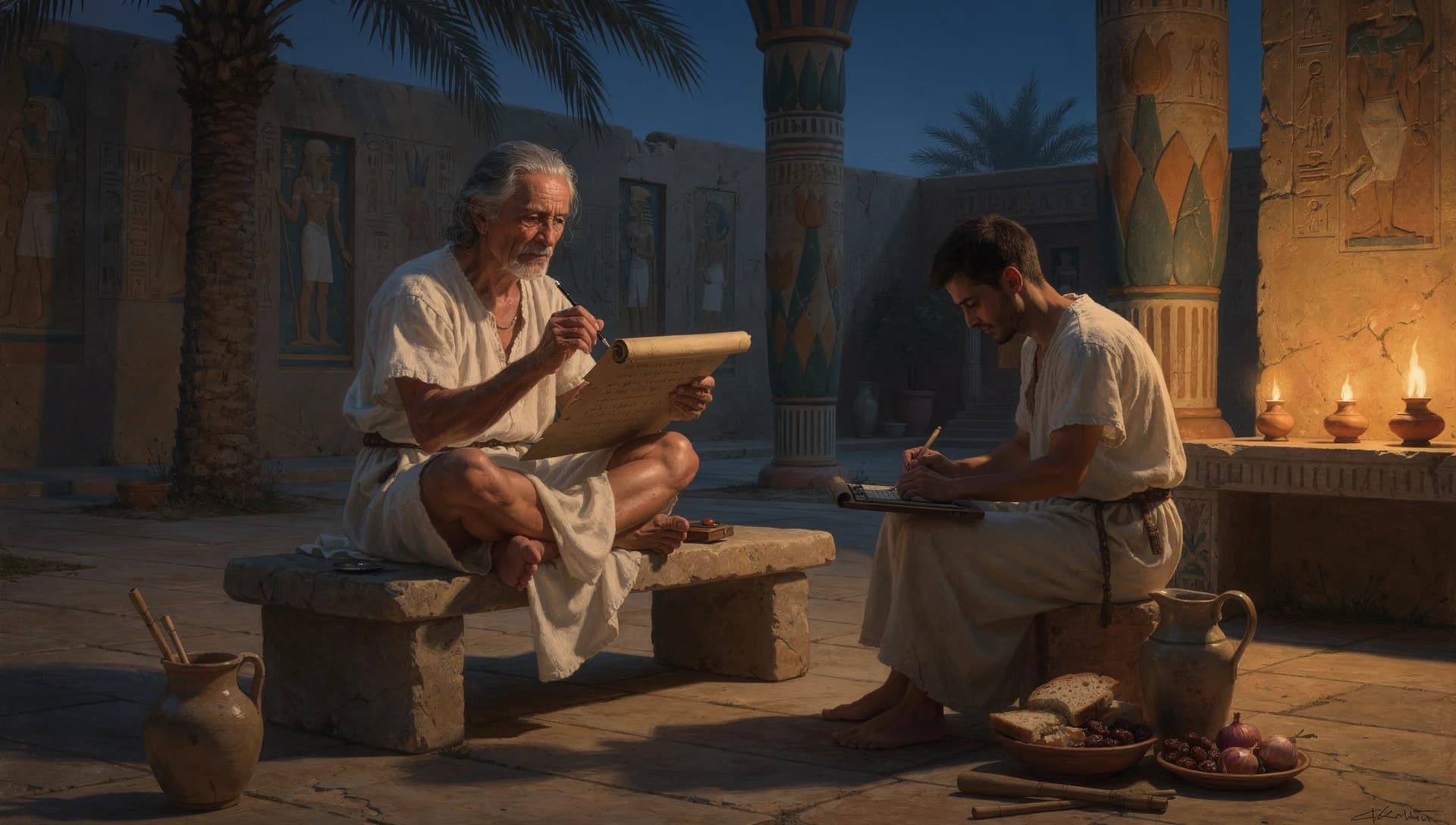
Amenemope, Egyptian conscience teacher = "Son of Man," source for Proverbs and Psalm 1
This article expands on the decoder mapping. For the side-by-side card and quick reference, see the mapping page.
A Literary Dependency That Changed Biblical Studies
In 1923, E. A. Wallis Budge of the British Museum published the Egyptian papyrus known as the Instruction of Amenemope, a hieratic wisdom text of roughly the thirteenth century BCE. Within a few years of publication, biblical scholars had noticed something unusual. Substantial portions of the Hebrew Book of Proverbs, particularly chapters 22:17 through 24:22 (the so-called "Words of the Wise" section), were almost verbatim translations of sections of Amenemope's text. The direction of dependence was clear from the philological evidence: Amenemope was the source, Proverbs the receiver.
The discovery reshaped the study of Old Testament wisdom literature. The Hebrew Bible contained a layer of wisdom material that was not distinctively Hebrew; it was Egyptian, imported almost intact. The question scholars have been working with since is what to make of this: who was Amenemope, what was his theological context, and how did his work come to be absorbed into the Hebrew canon?
The Urantia Book offers an account that connects these questions to a larger narrative of Salem-derived wisdom traditions spreading across the ancient Near East.
What the Urantia Book Says
The text introduces Amenemope by the title his Egyptian contemporaries used:
"In due time there grew up in Egypt a teacher called by many the 'son of man' and by others Amenemope. This seer exalted conscience to its highest pinnacle of arbitrament between right and wrong, taught punishment for sin, and proclaimed salvation through calling upon the solar deity." (UB 95:4.1)
The title "son of man" is significant. It is not a title the surviving Egyptian record preserves; it is a title the Urantia Book names as having been used by Amenemope's Egyptian contemporaries. The phrase will later become one of the most theologically loaded titles in the Gospels, the title Jesus characteristically uses for himself. That the title had an Egyptian wisdom-teacher antecedent in the late second millennium BCE is an unusual historical claim, and it is consistent with the broader Urantia account of Egyptian wisdom preparing the theological vocabulary for later developments.
The content of Amenemope's teaching is described with specifics:
"Amenemope taught that riches and fortune were the gift of God, and this concept thoroughly colored the later appearing Hebrew philosophy. This noble teacher believed that God-consciousness was the determining factor in all conduct; that every moment should be lived in the realization of the presence of, and responsibility to, God. The teachings of this sage were subsequently translated into Hebrew and became the sacred book of that people long before the Old Testament was reduced to writing." (UB 95:4.2)
"This wise man of the Nile taught that 'riches take themselves wings and fly away'—that all things earthly are evanescent. His great prayer was to be 'saved from fear.' He exhorted all to turn away from 'the words of men' to 'the acts of God.' In substance he taught: Man proposes but God disposes. His teachings, translated into Hebrew, determined the philosophy of the Old Testament Book of Proverbs." (UB 95:4.3)
The historical assessment is pointed:
"Amenemope functioned to conserve the ethics of evolution and the morals of revelation and in his writings passed them on both to the Hebrews and to the Greeks. He was not the greatest of the religious teachers of this age, but he was the most influential in that he colored the subsequent thought of two vital links in the growth of Occidental civilization—the Hebrews, among whom evolved the acme of Occidental religious faith, and the Greeks, who developed pure philosophic thought to its greatest European heights." (UB 95:4.4)
The textual claim is specific:
"In the Book of Hebrew Proverbs, chapters fifteen, seventeen, twenty, and chapter twenty-two, verse seventeen, to chapter twenty-four, verse twenty-two, are taken almost verbatim from Amenemope's Book of Wisdom. The first psalm of the Hebrew Book of Psalms was written by Amenemope and is the heart of the teachings of Ikhnaton." (UB 95:4.5)
Two claims in this single paragraph. First, that chapters 15, 17, and 20 of Proverbs, along with the well-known section 22:17-24:22, derive from Amenemope. Second, that Psalm 1, the opening gate of the Hebrew Psalter, was written by Amenemope himself and expresses the theological core of Ikhnaton's later monotheistic reformation. Both claims are verifiable in different ways against the surviving textual record.
What the Ancient Source Says
The Instruction of Amenemope survives in several manuscript witnesses. The principal manuscript, Papyrus British Museum 10474, was acquired in 1888 and first published by E. A. Wallis Budge in Facsimiles of Egyptian Hieratic Papyri in the British Museum (1923). Miriam Lichtheim's translation in Ancient Egyptian Literature, Volume II: The New Kingdom (University of California Press, 1976) is the standard English reference. The Demotic survival of some passages in Papyrus Louvre E 10351 and the Turin fragments confirm the stability of the textual tradition across centuries.
The dependency of Proverbs 22:17-24:22 on Amenemope was first proposed by Adolf Erman in 1924 (Eine ägyptische Quelle der "Sprüche Salomos"). The thesis has been progressively confirmed. Glendon E. Bryce's A Legacy of Wisdom: The Egyptian Contribution to the Wisdom of Israel (Bucknell University Press, 1979) provides the book-length defense. The Anchor Yale Bible Commentary volume on Proverbs (Michael V. Fox, Proverbs 10-31, Yale University Press, 2009) treats the dependency as established and unproblematic.
The list of correspondences is extensive. Proverbs 22:17 ("Incline your ear, and hear the words of the wise") mirrors Amenemope's opening admonition. Proverbs 22:20 ("Have I not written thirty sayings for you?") reflects Amenemope's explicit thirty-chapter structure. Proverbs 22:22 ("Do not rob the poor because he is poor") mirrors Amenemope's prohibition of robbing the weak. Dozens of similar specific correspondences have been catalogued. The direction of dependence is established by several philological markers, including the fact that the Hebrew text sometimes reproduces idiomatic Egyptian phrasings that are awkward in Hebrew.
The Psalm 1 claim is more specific and more controversial. The Urantia Book states that Psalm 1 was written by Amenemope himself. Academic scholarship has identified thematic parallels between Psalm 1 and Egyptian wisdom literature, particularly the theme of the righteous person as a fruitful tree and the wicked as chaff. John Day's Psalms (Sheffield, 1990) and the Anchor Yale Bible Psalms commentary by Mitchell Dahood (3 volumes, Doubleday, 1965-1970) discuss the Egyptian background. The direct-authorship claim is not something independent scholarship has asserted, but the presence of substantial Egyptian wisdom material in the Psalter is well-documented.
The Proverbs chapters 15, 17, and 20 claim is philologically testable. Closer analysis reveals significant parallels to Egyptian wisdom material in exactly these chapters, though the dependency is less direct than in the 22:17-24:22 section. The Urantia Book's specific attribution identifies four distinct zones of Amenemope influence in Proverbs (chapters 15, 17, 20, and the major block 22:17-24:22), a four-zone distribution that aligns with what modern commentary has independently noted about the Egyptian character of these specific sections.
Why This Mapping Matters
The Amenemope-Proverbs dependency is one of the clearest cases in biblical scholarship of non-Hebraic source material embedded in the Hebrew canon. The Hebrew Bible is not a closed book. It is a literary stratification that absorbed wisdom material from older Near Eastern sources and integrated it under Israelite theological editing. Amenemope is the best-documented single source for the non-Hebraic wisdom layer of the Bible.
The Urantia Book's contribution to the academic picture is threefold. First, it identifies Amenemope as a figure in a specifically Salem-derived tradition, connecting his wisdom teaching to the broader Melchizedek missionary program. Second, it names Amenemope as the author not only of the Proverbs material (which academic scholarship independently confirms) but also of Psalm 1 (which is a stronger claim than academic scholarship has asserted). Third, it names Amenemope's Egyptian contemporaries as having called him "the son of man," a title that later became the central self-designation of Jesus in the Gospels.
The third claim is the theologically most loaded. The "son of man" title in later Jewish and Christian literature derives from Daniel 7:13 and from Enochic apocalyptic traditions. If the title was already in use in Egyptian wisdom literature in the thirteenth century BCE, it shifts the trajectory of the title's history. The Urantia Book is making a specific historical claim about how this theologically central phrase came into the Western religious vocabulary: through the Salem-Egyptian wisdom stream.
The mapping places Amenemope alongside Ikhnaton as the two principal human vehicles through which the Salem teaching shaped Egyptian religion and, through Egypt, the Hebrew canon and eventually the religious vocabulary of the first-century Palestine into which Jesus was born. The Urantia Book's picture is of a continuous two-thousand-year trajectory: Salem missionary organization establishes a presence in Egypt, Amenemope's wisdom tradition preserves and transmits the teaching, Ikhnaton's royal monotheism attempts the full public expression, Moses carries the distilled monotheism to the Hebrew people, the Hebrew Bible absorbs and preserves the Amenemope wisdom layer along with its own contributions, and the theological vocabulary develops over millennia toward the conditions in which the Michael bestowal could occur (UB 93:2.1).
Sources
- The Urantia Book, Paper 95 (The Melchizedek Teachings in the Levant). Urantia Foundation, first printing 1955. Cited passages: 95:4.1, 95:4.2, 95:4.3, 95:4.4, 95:4.5, 95:5.3.
- Budge, E. A. Wallis. Facsimiles of Egyptian Hieratic Papyri in the British Museum, Second Series. Trustees of the British Museum, 1923. Papyrus BM 10474.
- Erman, Adolf. "Eine ägyptische Quelle der 'Sprüche Salomos'," Sitzungsberichte der Preussischen Akademie der Wissenschaften zu Berlin, 1924, pp. 86-93.
- Lichtheim, Miriam. Ancient Egyptian Literature, Volume II: The New Kingdom. University of California Press, 1976.
- Bryce, Glendon E. A Legacy of Wisdom: The Egyptian Contribution to the Wisdom of Israel. Bucknell University Press, 1979.
- Fox, Michael V. Proverbs 10-31: A New Translation with Introduction and Commentary. Anchor Yale Bible, Yale University Press, 2009.
- Washington, Harold C. Wealth and Poverty in the Instruction of Amenemope and the Hebrew Proverbs. Society of Biblical Literature Dissertation Series 142, Scholars Press, 1994.
- Dahood, Mitchell. Psalms. 3 volumes, Anchor Yale Bible, Doubleday, 1965-1970.
Confidence and Evidence
- Confidence: UB CONFIRMED
- Evidence rating: STRONG
- Basis: The Proverbs-Amenemope textual dependency is established in biblical scholarship as one of the clearest cases of non-Hebraic material in the Hebrew canon. The Urantia Book's specific four-zone identification of Amenemope influence in Proverbs (chapters 15, 17, 20, 22:17-24:22) aligns with modern commentary. The Psalm 1 direct-authorship claim is stronger than academic scholarship asserts but is consistent with documented Egyptian thematic influence on the Psalter. The "son of man" title claim is novel to the Urantia account.
Related Decoder Articles
- Salem Missionaries = Ikhnaton / Akhenaten
- Salem Teaching Corrupted = Osiris and Isis Mystery Cult
- Salem Missionaries' Purest European Teaching = Cynics
By Derek Samaras
Connecting Articles
The Prophet Egypt Murdered: Okhban and the Four Great Prophets

The Longest Memory: Australian Aboriginal Dreamtime and the Primordial Teaching-Ancestors
The Final Adjudication: Ragnarok and the Pending Verdict

We Come From One: African First-Family Traditions and the Sangik Origin
The Newsletter
Get the research behind each piece
Free. New Urantia Book explorations, the sources behind the videos, and early looks. No spam, unsubscribe anytime.
Prefer video? Follow on YouTube and Facebook.
Delivered through Substack. You can also read past issues.