
The Mountain at the Center of the World: Mount Meru, Kailash, and the Universe Administration
Tibetan Buddhism, Hindu traditions, Jain cosmology, and Bön religion all center their sacred geography on a cosmic mountain: Meru in cosmology, Mount Kailash as its physical anchor in western Tibet. The Urantia Book documents real headquarters worlds at each level of the cosmic administration: Jerusem for the local system, Edentia for the constellation, Salvington for the local universe. The Himalayan tradition preserves structural memory of a genuine cosmic hierarchy.
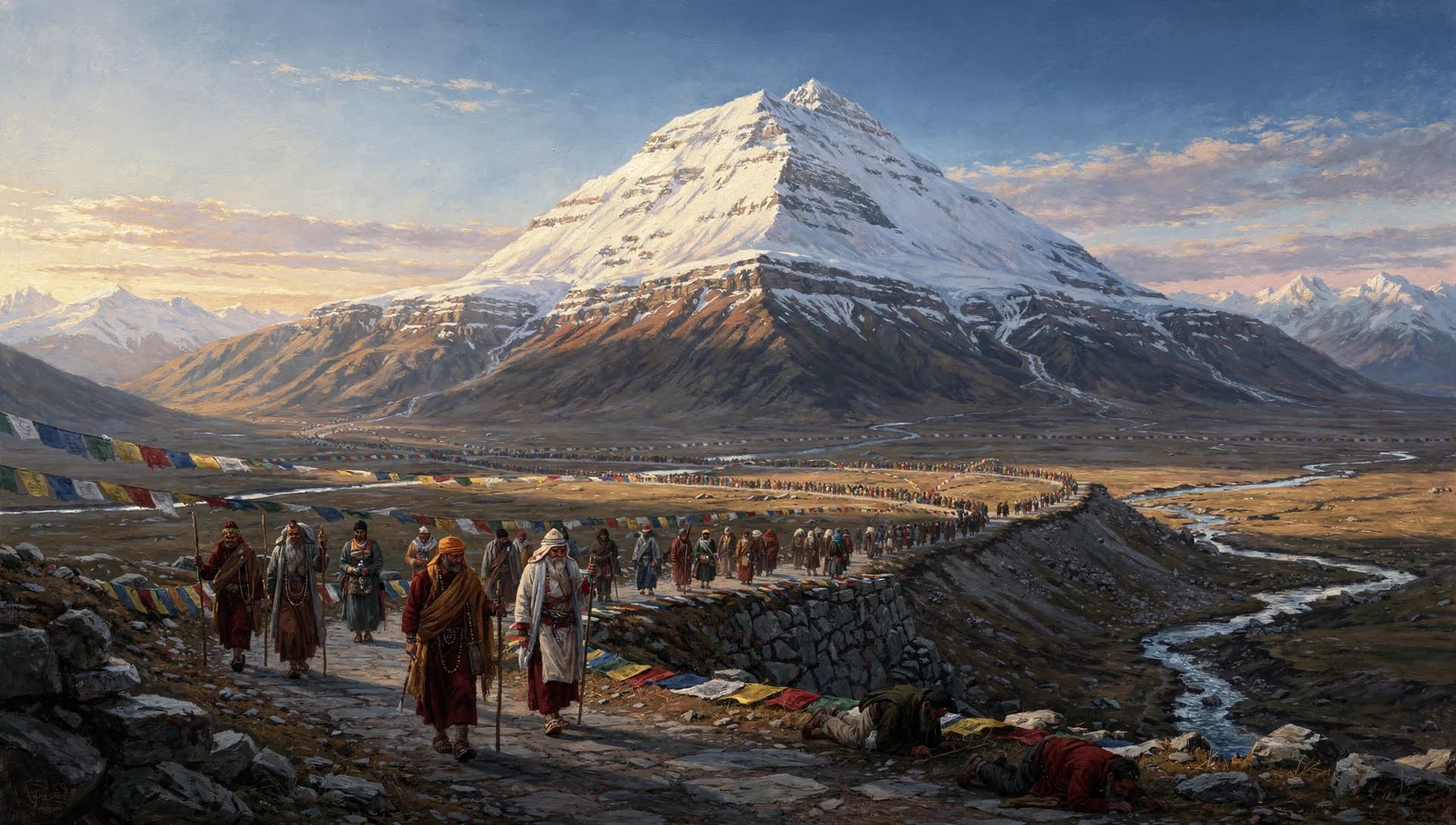
Headquarters worlds of the cosmic administration = Mount Meru and Mount Kailash, the cosmic axis of Himalayan religion
This article expands on the decoder mapping. For the side-by-side card and quick reference, see the mapping page.
The Cosmic Mountain Tradition
Tibetan Buddhism, the major Hindu schools (Shaiva, Vaishnava, Shakta), Jain cosmology, and the pre-Buddhist Bön religion all center their sacred geography on a single cosmic mountain. The mountain is called Meru in Sanskrit, or Sumeru in Buddhist usage. Mount Kailash in western Tibet serves as its physical anchor.
In Hindu cosmology, Meru is the axis around which the heavens, the earth, and the netherworlds are arranged. It is the dwelling of the gods, the source of the four great rivers of the world (Ganges, Indus, Brahmaputra, Sutlej), and the gathering point of pilgrimage. Buddhist cosmology places Sumeru in the same axial position, surrounded by seven continents, seven seas, and the heavens of the devas. Jain cosmology sets Meru at the center of the Jambudvipa continent, with dimensions and arrangements preserved in the canonical texts.
Mount Kailash itself is a real physical mountain (6,638 meters, in western Tibet at the source of the four rivers). Pilgrims from all four traditions circumambulate it, sometimes in opposite directions, as the principal Himalayan pilgrimage site. That four mutually independent religious traditions converge on the same sacred mountain points to a shared substrate, not later borrowing.
The Urantia Book identifies that substrate.
What the Urantia Book Says
The Urantia Book documents a real cosmic administration with physical headquarters worlds at each ascending level. The system, the constellation, the local universe, the superuniverse, and the central universe each have a headquarters sphere that serves as the administrative and spiritual center for its scope.
The system headquarters is named:
"Jerusem, the headquarters of your local system of Satania, has its seven worlds of transition culture, each of which is encircled by seven satellites, among which are the seven mansion worlds of morontia detention, man's first postmortal residence. As the term heaven has been used on Urantia, it has sometimes meant these seven mansion worlds, the first mansion world being denominated the first heaven, and so on to the seventh." (15:7.5)
The constellation headquarters is named:
"Edentia, the headquarters of your constellation of Norlatiadek, has its seventy satellites of socializing culture and training, on which ascenders sojourn upon the completion of the Jerusem regime of personality mobilization, unification, and realization." (15:7.6)
The administrative chain is laid out plainly:
"Satania has a headquarters world called Jerusem, and it is system number twenty-four in the constellation of Norlatiadek. Your constellation, Norlatiadek, consists of one hundred local systems and has a headquarters world called Edentia. Norlatiadek is number seventy in the universe of Nebadon. The local universe of Nebadon consists of one hundred constellations and has a capital known as Salvington. The universe of Nebadon is number eighty-four in the minor sector of Ensa." (15:14.6)
Papers 43 (The Constellations), 46 (The Local System Headquarters), and 15 (The Seven Superuniverses) emphasize the physical character of these worlds. They are not metaphorical realms. They are real spheres in cosmic space, with their own architecture (the ten council mansions of Jerusem, the seventy training satellites of Edentia, the schools and universities of Salvington), their own resident populations of ascending mortals and celestial personalities, and their own administrative functions within the universe hierarchy.
The Himalayan sacred-mountain tradition, organized around an axis that rises at the center of the world with the heavens above and the lower worlds below, preserves the structural memory of this real cosmic hierarchy.
What the Ancient Sources Say
The Meru cosmology is documented across substantial primary sources. The Hindu sources include the Vishnu Purana (around 400 CE), the Bhagavata Purana (around 900 CE), the Shiva Purana, and the Mahabharata, all carrying detailed Meru cosmology with articulated geography and architecture.
The Buddhist material includes the Abhidharma-kosa of Vasubandhu (fourth to fifth century CE), which presents the systematic Sumeru cosmology with its elaborated seven-continent, seven-sea structure. The text gives the dimensions of Sumeru (84,000 yojanas tall), the arrangement of the heavens of the devas at its peak, and the structure of the Four Great Kings' heaven on its slopes.
The Tibetan Buddhist Kalachakra Tantra (eleventh century CE) preserves an elaborated Sumeru cosmology that integrates astronomical and calendrical content into the cosmic geography. Its treatment of Sumeru as a temporal as well as spatial center parallels the administrative function the Urantia Book assigns to Jerusem and Edentia.
The Jain cosmological sources include the Tattvartha-sutra of Umasvati (second century CE) and the later Digambara and Shvetambara texts, which preserve an articulated Meru cosmology at the center of Jambudvipa.
The Bön cosmological tradition, documented in the Yungdrung Bön canonical sources treated in the companion Bön-Shenrab article, preserves a pre-Buddhist Mount Kailash cosmology with features that predate the Buddhist elaborations. Bön identifies Mount Kailash as the axis mundi and arranges the cosmos around it in nine vertical levels.
Mount Kailash itself is the principal pilgrimage site for all four traditions. Diana Eck's India: A Sacred Geography (Harmony Books, 2012) documents the Meru cosmology and the role of Kailash as its physical embodiment. Hindu, Buddhist, and Jain pilgrims circumambulate clockwise; Bön pilgrims circumambulate counterclockwise. The distinct ritual conventions sit alongside a shared sacred-mountain focus.
The four-rivers geography of the Kailash region carries cultural weight on its own terms. The Indus, Sutlej, Brahmaputra, and Karnali (which feeds the Ganges) all originate in the Kailash-Manasarovar region. The physical geography supports the cosmological claim that Meru is the source of the four great rivers of the world. That is a striking case of religious cosmology aligning with physical fact.
Kailash Nath Sharma's Kailash, Manasarovar: Sacred Geography (Indus, 2009) and Charles Allen's The Search for Shangri-La (Little, Brown, 1999) document the broader cultural and historical context.
How four distinct traditions came to share the same cosmic-mountain cosmology has been treated extensively in the scholarly literature. The mainstream position reads the convergence as a shared Indo-Tibetan cultural substrate from which each tradition emerged. The Urantia framework supplies a deeper substrate: the shared cosmology traces to genuine cosmic reality that each tradition preserved in its own cultural and religious idiom.
Why This Mapping Matters
The cross-cultural persistence of the cosmic-mountain tradition across Hindu, Buddhist, Jain, and Bön religion, with Mount Kailash as the shared physical anchor, points to a substrate that the standard Indo-Tibetan cultural account does not fully explain at the level of cosmological content.
The Urantia Book's framework supplies that content. The universe administration is a real hierarchical structure with physical headquarters worlds at each level. The Himalayan cosmic-mountain tradition preserves, in geographic form, the structural memory of that hierarchy.
The ascending structure that the Himalayan cosmology preserves (Meru's slopes, peaks, and heavens above; the lower worlds below; the cosmos arranged around the axis) maps onto the ascending administration the Urantia Book documents: Jerusem the system headquarters, Edentia the constellation headquarters, Salvington the local universe headquarters, Uversa the superuniverse headquarters, and Paradise at the center. Both cosmologies organize around a vertical, ascending hierarchy with an axial center.
The "heaven of the gods" association in Himalayan cosmology parallels the function of the Urantia Book's headquarters worlds. Meru is the dwelling of the gods in Hindu cosmology; the Four Great Kings' heaven occupies the slopes of Sumeru in Buddhist cosmology; the Tushita heaven sits above Sumeru. Jerusem is inhabited by the System Sovereign (the Lanonandek rulers), the mansion-world directors, and the ascending mortals in morontia progression. Edentia is inhabited by the Most Highs (the Constellation Fathers) and their administrative staff.
The pilgrimage focus carries a further resonance. The Urantia Book documents that mortal ascenders physically journey through the headquarters worlds across the morontia progression, advancing from the mansion worlds to Jerusem, from Jerusem to Edentia, from Edentia to Salvington, and beyond. Physical pilgrimage to Mount Kailash, institutionalized in all four traditions, may preserve memory of the actual cosmic ascent.
The four-rivers feature has additional implications. The four rivers of paradise in Genesis 2 (Pishon, Gihon, Tigris, Euphrates), the four rivers of Meru in Hindu cosmology, and the river and water geography of the first Eden documented in UB Papers 73-74 may represent shared cosmological content preserved across widely separated traditions. The Edenic features (the central tree, the four rivers, the structure of a paradisal sacred center) parallel the Meru features in substantial detail.
The point of the mapping is that the Himalayan cosmic-mountain tradition should not be read as symbolic religious cosmology only. It is the structural preservation of a genuine cosmic reality the Urantia Book documents explicitly. The physical Mount Kailash, as pilgrimage anchor for four traditions, is a geographic witness to a cosmic ascending hierarchy that the Urantia revelation describes in administrative detail.
The convergence on Kailash across Hindu, Buddhist, Jain, and Bön religion suggests that the shared cosmological content predates the distinct religious-cultural formulations each tradition eventually produced. The shared substrate is the older insight that all four traditions preserve in elaborated but recognizable form, and it points toward the real cosmic hierarchy the Urantia Book describes.
Sources
- The Urantia Book, Paper 15 (The Seven Superuniverses), Paper 43 (The Constellations), Paper 46 (The Local System Headquarters). Urantia Foundation, first printing 1955. Cited passages: 15:7.5, 15:7.6, 15:14.6.
- Eck, Diana L. India: A Sacred Geography. Harmony Books, 2012.
- Kloetzli, W. Randolph. Buddhist Cosmology: From Single World System to Pure Land. Motilal Banarsidass, 1983.
- Kinsley, David. Hindu Goddesses: Visions of the Divine Feminine in the Hindu Religious Tradition. University of California Press, 1988.
- Pranavananda, Swami. Kailas-Manasarovar. Swami Pranavananda, Calcutta, 1949.
- Allen, Charles. The Search for Shangri-La: A Journey into Tibetan History. Little, Brown, 1999.
- Karmay, Samten. The Arrow and the Spindle: Studies in History, Myths, Rituals and Beliefs in Tibet. Mandala Book Point, 1998.
- Vasubandhu. Abhidharmakosabhasyam. Translated by Leo M. Pruden from the French of Louis de La Vallée Poussin, Asian Humanities Press, 1988-1990.
Confidence and Evidence
- Confidence: INFORMED SPECULATION
- Evidence rating: MODERATE
- Basis: The Urantia Book directly documents the cosmic administrative hierarchy with physical headquarters worlds at Papers 15, 43, and 46. The Himalayan cosmic-mountain tradition across Hindu, Buddhist, Jain, and Bön religion preserves an ascending hierarchy centered on an axial point. The shared Mount Kailash anchor across all four traditions indicates a substrate that predates their distinct religious formulations. The physical reality of Kailash as the source of the four great rivers supports the cosmological-geographic integration.
Related Decoder Articles
- Bardo Thödol = Mansion World Progression
- Tree of Life = Universal Tree Cult
- Eden = Atlantis / Dilmun, the Sunken Paradise
Byline: Derek Samaras | Urantia Book Network | April 2026
Connecting Articles
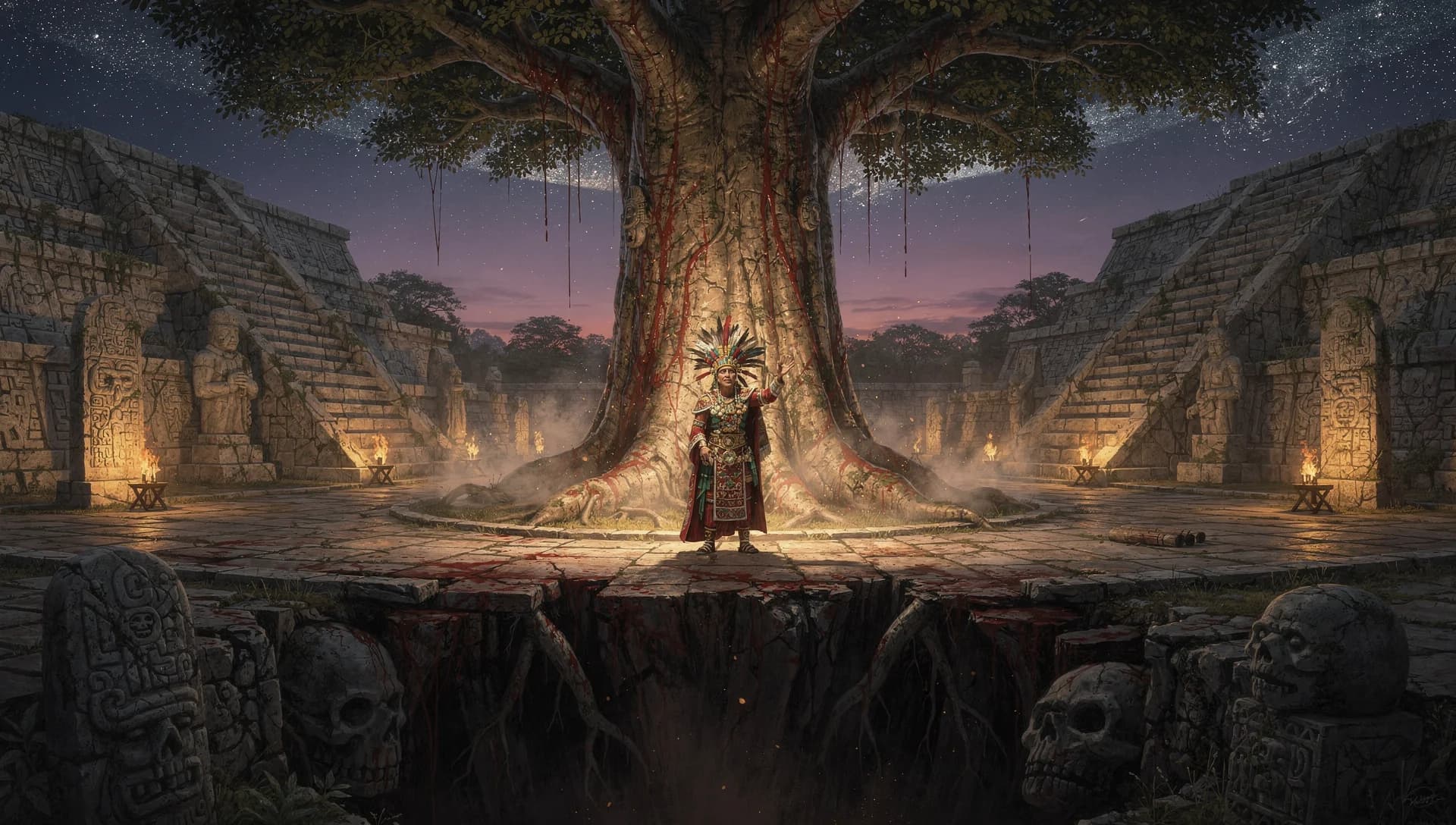
The Tree at the Center of the World: Maya Ceiba Yaxche' and the Tree of Life
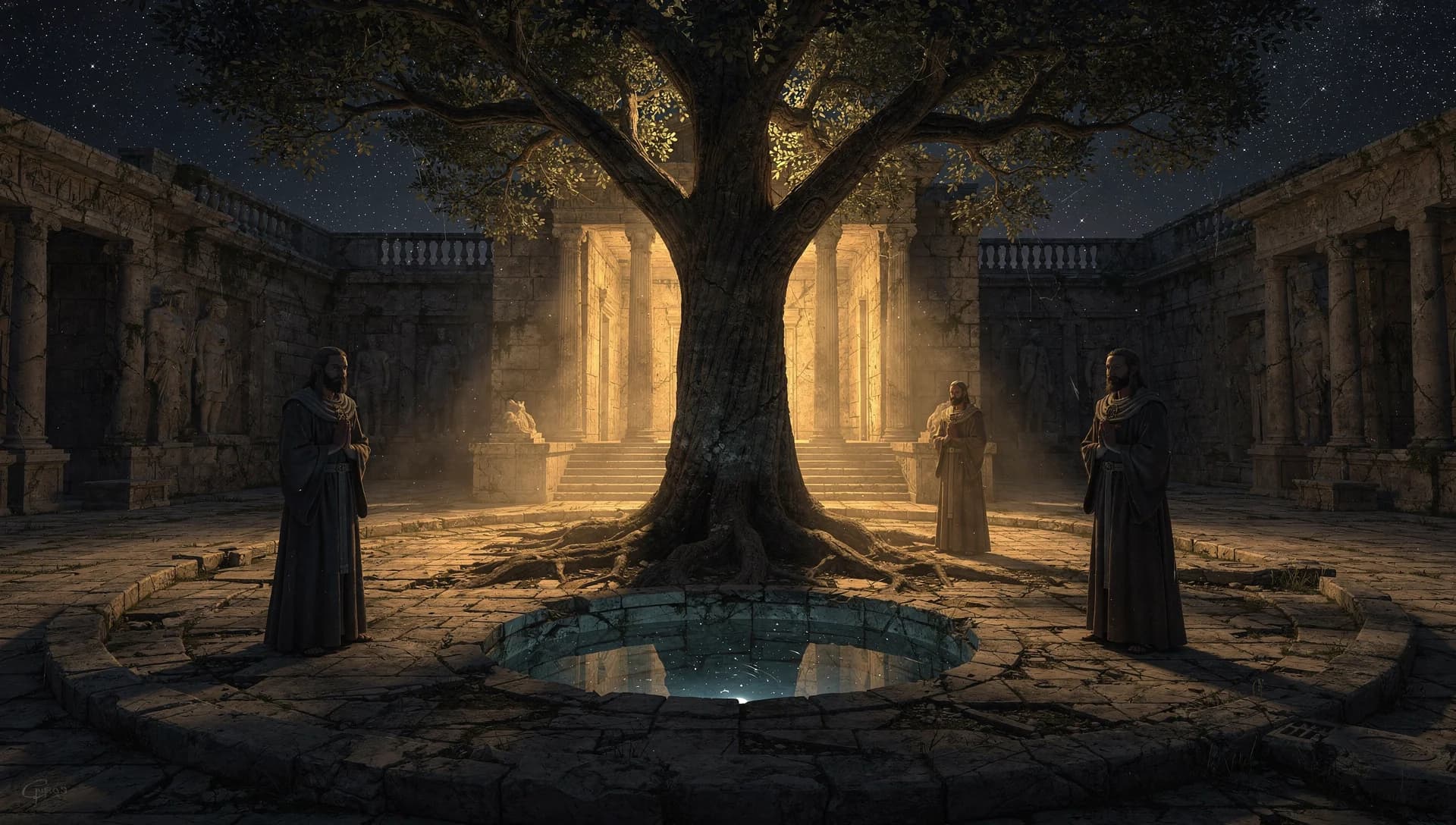
The Cosmic Tree: The Tree of Life and Norse Yggdrasil

The Morontia Career: What Actually Happens When You Die
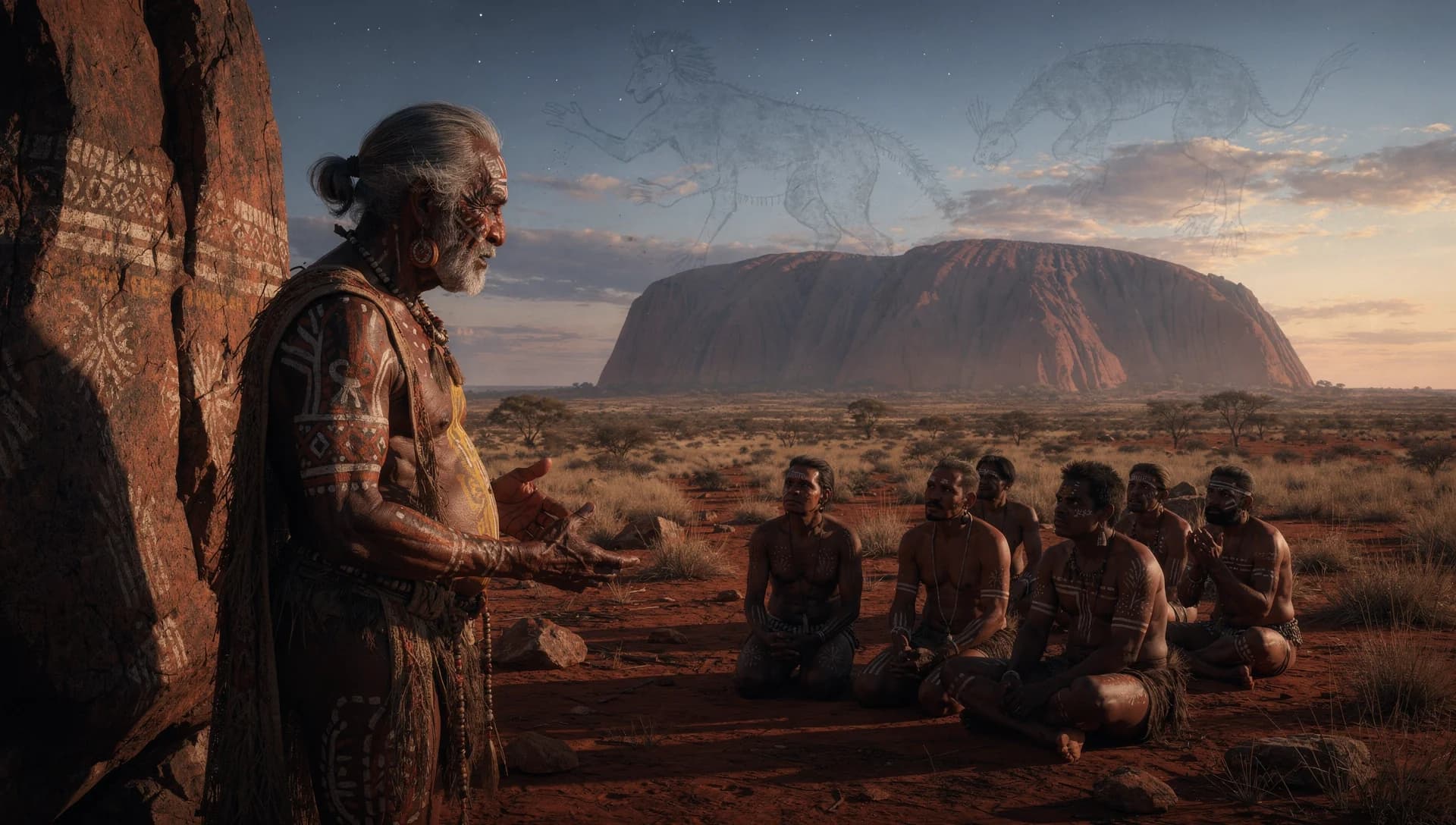
The Longest Memory: Australian Aboriginal Dreamtime and the Primordial Teaching-Ancestors
The Newsletter
Get the research behind each piece
Free. New Urantia Book explorations, the sources behind the videos, and early looks. No spam, unsubscribe anytime.
Prefer video? Follow on YouTube and Facebook.
Delivered through Substack. You can also read past issues.