
The Morontia Career: What Actually Happens When You Die
Most religious traditions describe one or two stops after death. The Urantia Book describes an ascending career through seven mansion worlds, system and constellation and local universe capitals, the seven superuniverses, the billion worlds of Havona, and finally Paradise. A traveler's primer to the road that begins on the morning after the grave.

The Morning You Wake Up
Most of what religion has said about death has been one or two sentences long. You go to heaven. You go to hell. You come back as something else. You merge into the One. You sleep until a final trumpet. Each tradition reaches for what it can see and stops at the edge of vision.
The Urantia Book does something different. It describes the road in detail. It tells you who is waiting, what the building looks like, how long you stay, what the next stop is, and where the whole thing is heading. The journey it describes is so far beyond the popular imagination of heaven that the popular imagination starts to look, by comparison, like a child's drawing of the sun.
The first claim is concrete and almost startling in its plainness. When you go to sleep in death you wake up somewhere specific. There is an address, a building, and people waiting for you. You are not floating, not dreaming, not absorbed into anything. You are standing in a place called the first mansion world, in the middle of what the revelation calls the resurrection hall, in possession of a body of a kind you have never had before. The text frames the transition not as an escape from yourself but as a continuation of yourself in a new medium.
"On the mansion worlds the resurrected mortal survivors resume their lives just where they left off when overtaken by death. When you go from Urantia to the first mansion world, you will notice considerable change, but if you had come from a more normal and progressive sphere of time, you would hardly notice the difference except for the fact that you were in possession of a different body; the tabernacle of flesh and blood has been left behind on the world of nativity." (47:3.1)
The phrase "resume their lives just where they left off" is the thesis of the entire itinerary, and everything that follows is a primer on the route it opens.
You Don't Go to Heaven. You Go to School.
The deepest single misunderstanding in popular religion is the picture of heaven as a destination. Arrive, and you are done. Sit on a cloud. Sing. Rest. Time stops.
The Urantia Book reverses this picture. The afterlife is not a destination but a school, and also a journey. Every stage trains you for the next. Every world adds something you did not know how to be when you arrived. There is no terminal stop short of Paradise itself, and even Paradise, as the closing sections will show, is not where the story ends.
The architecture is staggering, and the revelation lays it out with the matter of fact precision of a railway timetable rather than the soft focus of myth. Above your planet sits Jerusem, the capital of the local system of Satania, which the text places as "system number twenty-four in the constellation of Norlatiadek" (15:14.6). Above Jerusem sits Edentia, capital of that constellation of one hundred local systems. Above Edentia sits Salvington, capital of the local universe of Nebadon, itself a creation of one hundred constellations and, the same passage notes, "number eighty-four in the minor sector of Ensa." Above the local universe stand the seven superuniverses. At the heart of all of it lies Havona, the perfect central creation of one billion worlds, and at the geographic center of infinity sits Paradise (14:0.1). The road from a deathbed to that central Isle is presented as an actual road, every step of which has a name, a purpose, and a teacher.
The general term for the whole intermediate phase, between fleshly mortality and final spirit attainment, is the morontia career. Morontia is not a metaphor. The revelation insists it is a genuine third state of reality, as real as matter and as real as spirit, occupying the level between them.
"Morontia is a term designating a vast level intervening between the material and the spiritual. It may designate personal or impersonal realities, living or nonliving energies. The warp of morontia is spiritual; its woof is physical." (0:5.12)
That weaving image, a spiritual warp crossed by a physical woof, is the substance of your new body, your new senses, your new thinking, and the worlds you walk on for what the revelation describes as ages of time. It is the cloth of the long ascent.
Mansonia One: The Repair Shop
You wake in the resurrection hall on the first mansion world. The Thought Adjuster, which has carried your spiritized memory and meaning since departure, rejoins the soul pattern carried by the seraphim, personality reassembles, and you open new eyes. The setting is described with architectural specificity: seven radial wings extend from the Temple of New Life, one resurrection hall for each of the seven races of time, each wing holding "one hundred thousand personal resurrection chambers" and serving "as the awakening chambers for as many as one million individuals" (47:3.5). It is in these halls, the text says, that "the real and conscious reassembly of actual and complete personality takes place."
What follows the awakening is not immediate labor but rest. You are assigned permanent residence in the Melchizedek sector and then granted ten days of personal liberty, time to explore, to orient yourself, and, most tenderly, to "consult the registry and call upon your loved ones and other earth friends who may have preceded you to these worlds" (47:3.6). Only after that interval does structured work begin, because, as the same passage is careful to add, "the mansion worlds are actual training spheres, not merely detention planets."
Then the work begins, and its character is corrective rather than punitive. The first mansion world is, in effect, a repair shop. Its activity is what the revelation calls "deficiency ministry": survivors arrive presenting "so many and such varied defects of creature character and deficiencies of mortal experience" that the realm's chief business is "the correction and cure of these manifold legacies of the life in the flesh" (47:3.8). The deficits of education, the unhealed wounds, the unfinished growth that mortal life never got around to addressing, all of it is taken up here.
You are not left to manage this alone. The center of the first mansion world is the temple of the Morontia Companions, offspring of the local universe Mother Spirit who serve as personal guides and hosts through the entire mansonia experience. One companion is assigned to every thousand ascending mortals at the outset, and the text describes them in frankly affectionate language as "companionable associates and charming guides" (47:3.12), free to escort individuals and groups across the transition spheres.
For all this ministry, the revelation is candid that mortal death does not advance you spiritually by a single inch. Survival is the only thing death itself confers.
"On mansion world number one (or another in case of advanced status) you will resume your intellectual training and spiritual development at the exact level whereon they were interrupted by death. Between the time of planetary death or translation and resurrection on the mansion world, mortal man gains absolutely nothing aside from experiencing the fact of survival. You begin over there right where you leave off down here." (47:3.7)
This is among the most consequential sentences in the entire revelation, and it is worth letting it stand undiluted. The work of character building you do now, on Urantia, is the very work you will resume on the first mansion world. Death is a doorway, not a graduation.
Mansonia Two: The Mind Cure
Advancement runs on a rhythm. Unless you are detained to consolidate further work, "at the end of ten days you will enter the translation sleep and proceed to world number two, and every ten days thereafter you will thus advance until you arrive on the world of your assignment" (47:3.10). A new body, a new sphere, the same continuous personality and memory.
Where the first world worked on the wounds of body and biography, the second works on the mind. Mansonia number two, the text states, "more specifically provides for the removal of all phases of intellectual conflict and for the cure of all varieties of mental disharmony" (47:4.8), and it continues the effort, begun on world one, to master something called morontia mota. Mota is one of the revelation's loveliest terms: a kind of supermortal philosophy, the bridge between human reason and spiritual insight, the way of thinking that animates the entire morontia career. You begin learning it on world one, continue it more earnestly on world two, and work at it for the whole ascent.
The morontia body, meanwhile, is no phantom. Through all seven worlds you continue to "eat, drink, and rest," partaking of "the morontia order of food, a kingdom of living energy unknown on the material worlds," fully utilized with "no residual waste" (47:4.6). The change from material to spiritual is gradual, the same passage explains, with each world disclosing "definite progress" as the ascender grows "less material, more intellectual, and slightly more spiritual," the spiritual gains weighted toward the last three worlds.
Continuity of self is secured by the Adjuster. The animal layers of consciousness die with the brain, but the meaningful patterns are preserved and travel onward. Everything in your mental life "which was worth while, and which had survival value, was counterparted by the Adjuster and is retained as a part of personal memory all the way through the ascendant career," so that you remain conscious of your worthwhile experiences "from one section of the universe to another—even to Paradise" (47:4.5). The good in you is durable. The good in you travels.
Mansonia Three: The Mind Begins to Flower
The third mansion world is the headquarters of the Mansion World Teachers, advanced cherubim who specialize in the ascender's education across the whole local universe. The training changes character here. Worlds one and two were corrective, their work, in the revelation's own framing, "mostly of a deficiency nature—negative—in that it has to do with supplementing the experience of the life in the flesh" (47:5.3). World three is the point where "the survivors really begin their progressive morontia culture."
The purpose now is generative: to enhance "the correlation of morontia mota and mortal logic, the co-ordination of morontia mota and human philosophy," yielding "practical insight into true metaphysics" and "the intelligent comprehension of cosmic meanings and universe interrelationships" (47:5.3). This is the world where the philosopher in you, who could only ever guess on Urantia, finally begins to see. Mortal logic and morontia mota start to fit together, and reality begins to disclose its actual structure. You are a long way from understanding it. You are no longer outside it.
Mansonia Four: The First Real Society
By the fourth mansion world the wounds are largely behind you and the mind has begun to flower. Now comes the social work. The ascender "more fittingly finds his place in the group working and class functions of the morontia life" and develops a greater appreciation of "the broadcasts and other phases of local universe culture and progress" (47:6.2).
The novelty here is not merely social activity but the motive underneath it. Earthly society runs largely on competition for advantage. Morontia society runs on something the text says evolutionary creatures have never experienced, social activity "predicated neither on personal aggrandizement nor on self-seeking conquest." The fourth world is where that new order is formally introduced, and the passage describing it deserves to stand whole, because it is effectively the constitution of the world to come.
"It is during the period of training on world number four that the ascending mortals are really first introduced to the demands and delights of the true social life of morontia creatures. And it is indeed a new experience for evolutionary creatures to participate in social activities which are predicated neither on personal aggrandizement nor on self-seeking conquest. A new social order is being introduced, one based on the understanding sympathy of mutual appreciation, the unselfish love of mutual service, and the overmastering motivation of the realization of a common and supreme destiny—the Paradise goal of worshipful and divine perfection. Ascenders are all becoming self-conscious of God-knowing, God-revealing, God-seeking, and God-finding." (47:6.3)
A common destiny, a shared road, no one climbing over anyone else, because everyone is on the same staircase by the same Father's invitation. That is the social fabric of the morontia worlds.
Mansonia Five: Cosmic Consciousness
The fifth mansion world represents what the revelation calls "a tremendous forward step in the life of a morontia progressor," its experience "a real foretaste of Jerusem life," its culture corresponding to "the early era of light and life on the planets of normal evolutionary progress" (47:7.1). The horizon widens.
What opens here is a new size of mind. The text names it precisely: "A real birth of cosmic consciousness takes place on mansonia number five. You are becoming universe minded" (47:7.5). It begins to dawn on the enlarging mind that some "supernal and divine, destiny awaits all who complete the progressive Paradise ascension," and the ascender starts to feel a genuine "experiential enthusiasm for the Havona ascent." Most telling is what the same passage observes about motive: "Study is becoming voluntary, unselfish service natural, and worship spontaneous." The dispositions that had to be cultivated by discipline on Urantia are now arising on their own. A real morontia character, the text says, is budding. The character that earthly life only sketched is filling in.
Mansonia Six: Fusion with the Adjuster
The sixth mansion world is where, for many ascenders, the deepest event of their existence finally occurs: the fusion of the evolving human soul with the Thought Adjuster, the divine fragment of the Universal Father that has indwelt the mind since childhood. The revelation calls it "a brilliant age for ascending mortals" that "usually witnesses the perfect fusion of the human mind and the divine Adjuster," noting that while the potential may have existed earlier, "the actual working identity many times is not achieved until the time of the sojourn on the fifth mansion world or even the sixth" (47:8.3).
The ceremony itself is described with restrained grandeur, and it carries an unmistakable echo. The same words spoken over Jesus at his baptism are now spoken over the survivor.
"The union of the evolving immortal soul with the eternal and divine Adjuster is signalized by the seraphic summoning of the supervising superangel for resurrected survivors and of the archangel of record for those going to judgment on the third day; and then, in the presence of such a survivor's morontia associates, these messengers of confirmation speak: 'This is a beloved son in whom I am well pleased.' This simple ceremony marks the entrance of an ascending mortal upon the eternal career of Paradise service." (47:8.4)
What follows the fusion is intimate. The new being is "introduced to his fellows for the first time by his new name" and granted "the forty days of spiritual retirement from all routine activities wherein to commune with himself and to choose some one of the optional routes to Havona" (47:8.5). Forty days alone with the new self, choosing the route home.
Mansonia Seven: The Mark of the Beast Falls Away
The seventh mansion world is the last station of the mansonia career, "the crowning achievement of the immediate postmortal career," where many teachers cooperate in preparing the ascender for residence on Jerusem (47:9.1). Its distinctive work is leveling and cleansing. Whatever differences remain between a survivor from an isolated and retarded world such as Urantia and one from a more advanced sphere are, the text says, "virtually obliterated" here. The ascender is "purged of all the remnants of unfortunate heredity, unwholesome environment, and unspiritual planetary tendencies," and "the last remnants of the 'mark of the beast' are here eradicated."
A new and more inward devotion takes hold as well. Granted permission to visit transition world number seven, the world of the Universal Father, the ascender begins "a new and more spiritual worship of the unseen Father, a habit you will increasingly pursue all the way up through your long ascending career," finding the Father's temple though not yet the Father himself (47:9.2).
The cumulative effect of the seven worlds is a change of state, not merely of address. They are, in the revelation's exact phrasing, "dematerializing worlds" that are "really demortalizing spheres" (47:9.5). The ascender is "mostly human on the first mansion world, just a mortal being minus a material body," and only "really pass[es] from the mortal state to the immortal status at the time of Adjuster fusion," becoming a full morontian by the end of the Jerusem career. You did not arrive on the mansion worlds as a finished being. You leave as something the universe has names for.
Jerusem: Citizenship of a System
When the seventh mansonia class graduates, its personnel "assemble on the sea of glass to witness your departure for Jerusem with residential status" (47:9.4). You may have visited the system capital hundreds or thousands of times as a guest, but this time you go for residence, bidding "an eternal farewell to the whole mansonia career as ascending mortals" and arriving as a Jerusem citizen.
Jerusem is the capital of the local system of Satania, the administrative seat over a thousand inhabited and inhabitable worlds, and it is here that the full spectrum of created life first mingles with the ascender. The text describes "the first intermingling of Material Sons, angels, and ascending pilgrims," where "beings who are wholly spiritual and semispiritual and individuals just emerging from material existence" fraternize freely, their forms so modified that "all are able to enjoy mutual recognition and sympathetic personality understanding" (39:4.18). It is precisely these friendly relationships, the passage adds, that endear a system capital to ascending mortals.
This arrival, the revelation claims, was glimpsed in vision by John on Patmos, who saw the same scene through the imagery of his own apocalypse.
"John the Revelator saw a vision of the arrival of a class of advancing mortals from the seventh mansion world to their first heaven, the glories of Jerusem. He recorded: 'And I saw as it were a sea of glass mingled with fire; and those who had gained the victory over the beast that was originally in them and over the image that persisted through the mansion worlds and finally over the last mark and trace, standing on the sea of glass, having the harps of God, and singing the song of deliverance from mortal fear and death.'" (47:10.2)
On Jerusem the long initial assembly of the mortal personality is at last completed. The personality "initiated on the evolutionary worlds and tabernacled in the flesh—indwelt by the Mystery Monitors and invested by the Spirit of Truth—" is "not fully mobilized, realized, and unified" until the citizen is cleared for Edentia and proclaimed "a true member of the morontia corps of Nebadon," an immortal survivor and a true child of the Most Highs (47:10.6). A structural change accompanies this milestone: the breaks of consciousness end. "After mortals have attained residence on the system headquarters, no more literal resurrections will be experienced," because the morontia form granted on leaving the mansion worlds "is such as will see you through to the end of the local universe experience" (47:10.4). Form will keep changing. The sleep and the waking again do not.
Edentia: The Most Highs and the Mount of Assembly
Above the system stands the constellation, and above Jerusem stands Edentia, ruled by the three Constellation Fathers, the Most Highs of Norlatiadek. The administrative cluster alone is vast: "a cluster of 771 architectural spheres," the largest of which, Edentia itself, is "approximately one hundred times as large as your world," surrounded by seventy major spheres each ten times the size of Urantia (43:0.2). The scale is a reminder that the ascent is not a retreat into smaller and dimmer places but an advance into ever larger arenas of life.
The revelation reads the Hebrew scriptures as carrying a half-glimpsed memory of this realm. The Psalmist, it says, "knew that Edentia was ruled by three Constellation Fathers and accordingly spoke of their abode in the plural," citing the line about "the most holy place of the tabernacles of the Most Highs" (43:3.3). The plural "tabernacles," on this reading, was no accident of poetry.
Edentia also holds a holy mountain. To the north of the residences of the Most Highs lies "the 'mount of Paradise assembly,'" where the ascending mortals periodically gather to hear the Faithful of Days, a Paradise Son, "tell of the long and intriguing journey of progressing mortals through the one billion perfection worlds of Havona and on to the indescribable delights of Paradise" (43:4.5). These are the worlds of the univitatia, the permanent citizens of the constellation, and the character cultivated here is patience, steadiness, and a long view of things.
Salvington: Where You Meet Christ Michael
Above the constellation stands the local universe, and the capital of Nebadon is Salvington, the headquarters of Michael, the Creator Son who walked your world as Jesus of Nazareth. The revelation states the identity flatly: Urantia "belongs to a local universe whose sovereign is the God-man of Nebadon, Jesus of Nazareth and Michael of Salvington," whose plans for the universe "were fully approved by the Paradise Trinity before he ever embarked upon the supreme adventure of space" (32:0.3).
Salvington holds his personal headquarters, a structure that mirrors the three states of being he has himself lived. His dwelling is "the threefold mansion of light," ordered that way "because Michael has experienced the living of all three phases of intelligent creature existence: spiritual, morontial, and material," and it is "because of the name associated with his seventh and final bestowal on Urantia" that "he is sometimes spoken of as Christ Michael" (33:1.1). The architecture is biography rendered in light.
It is here, after the mansion worlds and Jerusem and Edentia, that the ascending mortal of Urantia comes face to face with the Master who walked the dust of Galilee. He is the same person, the crucified one, the resurrected one, now the sovereign of a universe of ten million inhabited worlds. He was, on Urantia, what was nearest to the human heart in all of creation. He is, on Salvington, what you finally see for who he really is. The encircling worlds of Salvington are the finishing schools of the local universe, where the ascender becomes a first stage spirit, ready to leave Nebadon and proceed outward to the superuniverse.
The Superuniverses: Spirit Training
Above the local universe stand the seven superuniverses, and Urantia belongs to Orvonton, the seventh, whose administrative center is Uversa, ruled by the Ancients of Days. The superuniverse arc is far longer than everything that preceded it. Arriving ascenders "become the wards of the Ancients of Days," having "traversed the morontia life of the local universe" to become "accredited spirits," and as young spirits they begin a course of training "extending from the receiving spheres of their minor sector in through the study worlds of the ten major sectors and on to the higher cultural spheres of the superuniverse headquarters" (30:4.22).
The morontia career proper is over by the time the superuniverse is entered. The ascender is now a spirit. The gradient continues, but the direction never changes. Inward. Always inward. Toward the center.
Havona: The Pilgrim of Time
Beyond the seven superuniverses, at the heart of all things, lies Havona, one billion worlds of perfection and the eternal central creation. It is, the revelation says, the proving ground for everyone bound for Paradise. The billion spheres serve "as the final proving grounds for ascending creatures from the evolutionary worlds of time," who are "landed on the receiving worlds of the outer or seventh circuit" and then "progressively advanced inward, planet by planet and circle by circle, until they finally attain the Deities and achieve residence on Paradise" (14:3.4).
The inward movement through Havona's seven circuits is also a sequence of recognitions, each circle marked by the attainment of a successive Deity, until from the innermost circuit "the ascending pilgrims pass inward to Paradise residence and admission to the Corps of the Finality" (14:5.4). The pace is unhurried and the teaching direct, because reality here is undistorted by the evolutionary struggle that shaped every other world the pilgrim has lived on. Worship is no longer something climbed toward. It is the air. Service is no longer something offered in defiance of self interest. It is who the pilgrim has become.
Paradise: The Father's House
At the heart of Havona lies the stationary Isle of Paradise, which the revelation places as "the geographic center of infinity and the dwelling place of the eternal God" (0:0.5). It is the end of the long road and the beginning of an even longer one.
You will not arrive there as you were. You will arrive having walked an immense distance, transformed by every step, and you will, the revelation says, find God as the Father, seeing with your own perfected eyes the One whose fragment has indwelt you since you were a child capable of moral choice. The arrival is recognized by a series of seven jubilees across the ascending career, the seventh of which marks entrance into the mortal finaliter corps.
The Eternal Career: The Finaliter
The end of the ascent is not, in fact, the end. Upon attaining Paradise the perfected mortal is mustered into the Corps of the Finality, and the destiny of the finaliters is described as genuinely undisclosed. The revelation presents the whole ascension plan as one of the chief concerns of the universe while pointedly declining to say where it leads, calling it a plan that culminates in "their attainment of Paradise and the Corps of the Finality" and then "providing further training for some undisclosed future work" (4:0.3).
The current speculation, recorded candidly in the revelation itself, is that the finaliters are being prepared for the ministry of universes yet to come. The outer space levels beyond the present grand universe are still being organized, and the finaliters appear to be the cadre intended to staff them.
"Throughout Orvonton it is believed that a new type of creation is in process, an order of universes destined to become the scene of the future activities of the assembling Corps of the Finality; and if our conjectures are correct, then the endless future may hold for all of you the same enthralling spectacles that the endless past has held for your seniors and predecessors." (12:2.6)
You who began as a thinking animal on the dust of one struggling planet are destined, the revelation says, to administer creations that have not yet been built.
What This Implies
Stand back from the road and look at it whole. Three consequences follow if the account is true.
The first concerns grief. The sorrow that comes at the death of someone we love is not, on this telling, a permanent grief but the grief of separation across a distance that will be closed. The revelation is plain that the loved ones who arrived ahead of you are among the first you can find, and it locates the means precisely: the registry on the first mansion world exists for exactly that purpose, consulted during the ten days of liberty before any work begins. The reunion is not abstract. It is named.
The second concerns fear. If the account holds, then the fear of death is a fear without an object. Death is simply the technique by which the in flesh phase of existence concludes, no more frightening in itself than graduation, even though the human nervous system, which evolved to fear death, will go on fearing it in its way. The mind that has grasped the road can hold the fear of the body without being run by it.
The third concerns the present. If the account holds, then nothing matters more, today, on Urantia, than the work of character building, because nothing else carries forward. Wealth does not. Reputation does not. The body does not. The brain does not. The durable shape of the soul, the pattern preserved by the Adjuster, the moral choices actually made, the love actually given, the worship actually offered, the unselfish service actually rendered, this is what the seraphim carry and what stands up on the morning of resurrection. The revelation gathers the whole arc into a single sentence that doubles as its definition of death.
"Mortal death is a technique of escape from the material life in the flesh; and the mansonia experience of progressive life through seven worlds of corrective training and cultural education represents the introduction of mortal survivors to the morontia career, the transition life which intervenes between the evolutionary material existence and the higher spirit attainment of the ascenders of time who are destined to achieve the portals of eternity." (47:10.7)
You begin over there right where you leave off down here. That sentence from the first mansion world account ought to be carved in stone over every mortal door. The slow work of becoming who you are meant to be is the work of this life. It does not start somewhere else, and it does not finish somewhere else either, but its foundation is laid right here, in the years you have, in the relationships you keep, in the choices you make today.
The Urantia Book describes a road that no human writer would have invented. It is too long, too detailed, too tender, too patient with the slowness of creatures. It treats us, the dust born inhabitants of one wounded world, as worth a journey that will take ages and that ends at the Father's own house.
That is the destiny the revelation describes. That is the morning that waits. And it begins on the day, no one knows when, when the breath stops here and you wake up there, in a new body, in a great hall, with someone calling your name, and the rest of forever in front of you.
Byline: Urantia Book Network | May 2026
Connecting Articles
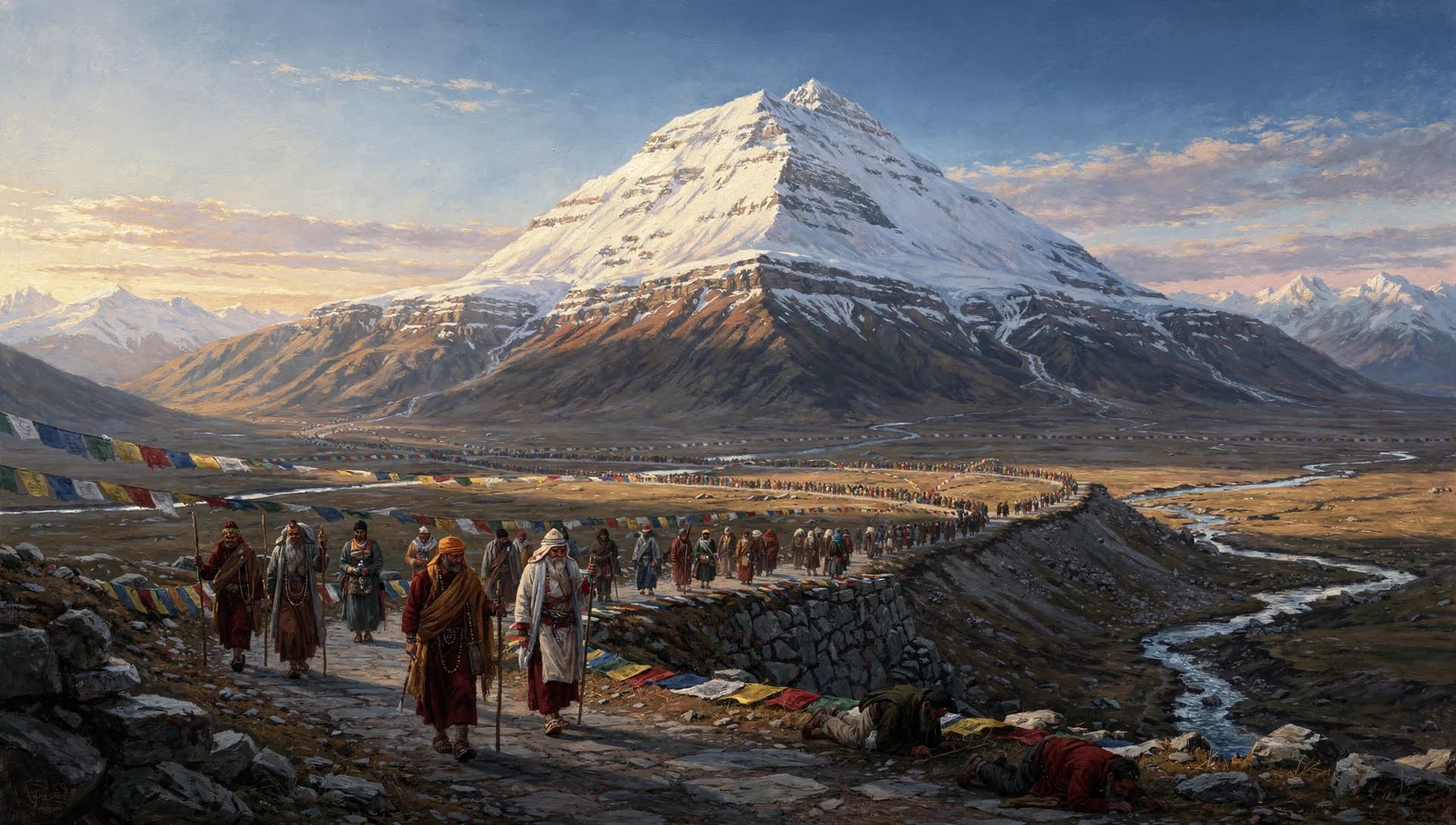
The Mountain at the Center of the World: Mount Meru, Kailash, and the Universe Administration
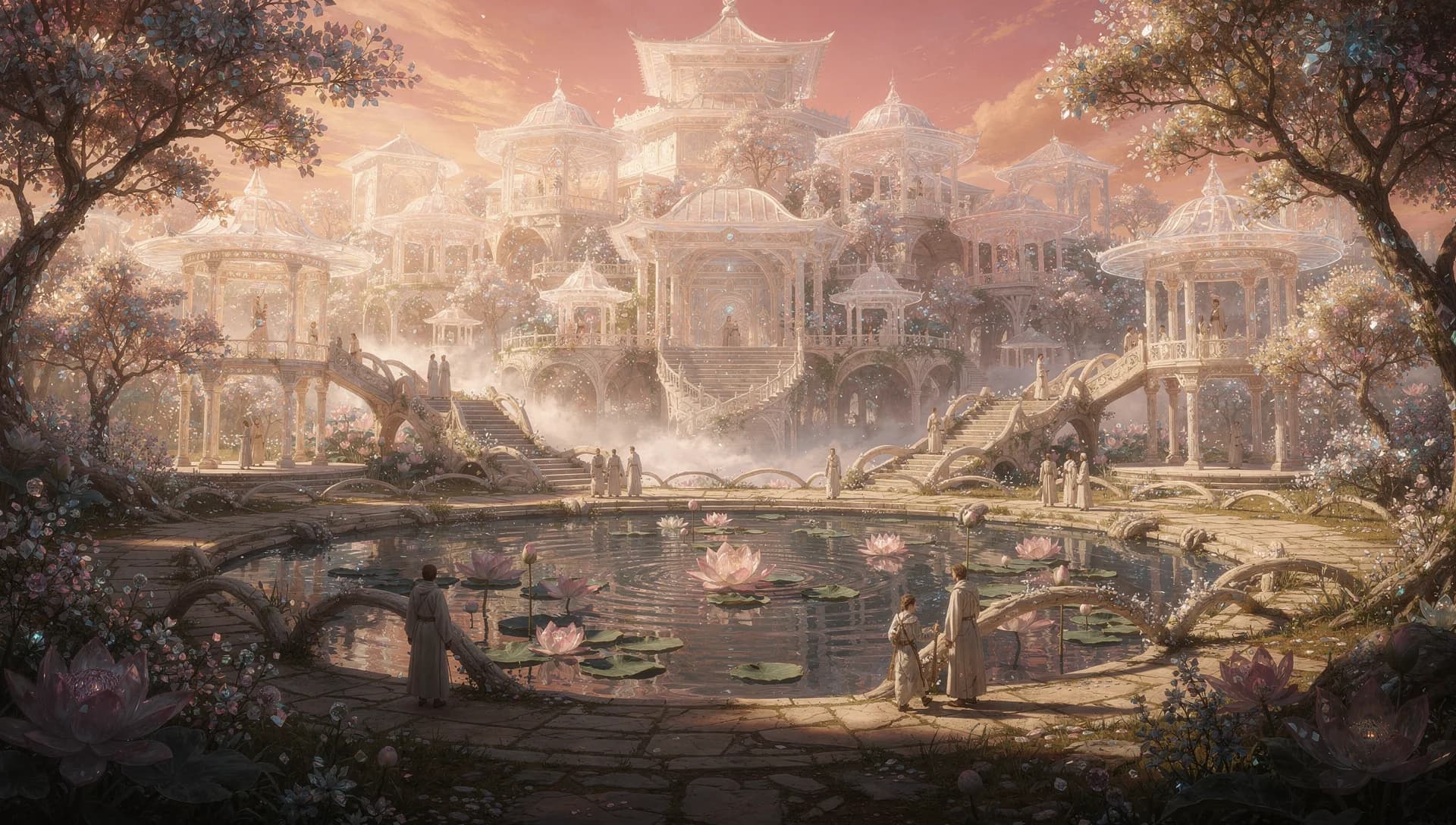
Rebirth in the Western Paradise: The Mansion Worlds and Pure Land Buddhism

Near-Death Experiences: What Are People Actually Seeing?

Reincarnation and the Mansion Worlds: What Comes Next
The Newsletter
Get the research behind each piece
Free. New Urantia Book explorations, the sources behind the videos, and early looks. No spam, unsubscribe anytime.
Prefer video? Follow on YouTube and Facebook.
Delivered through Substack. You can also read past issues.