
Staged Passage Through the Intermediate State: The Bardo Thödol and the Mansion World Progression
The Tibetan Bardo Thödol, often called the Book of the Dead, maps the experience after death as a sequence of phases, each with its own perceptions, encounters, and chances for liberation. The Urantia Book describes the same passage as a progression through seven mansion worlds, each with its own developmental focus and its own testing. Two detailed maps of the same territory.
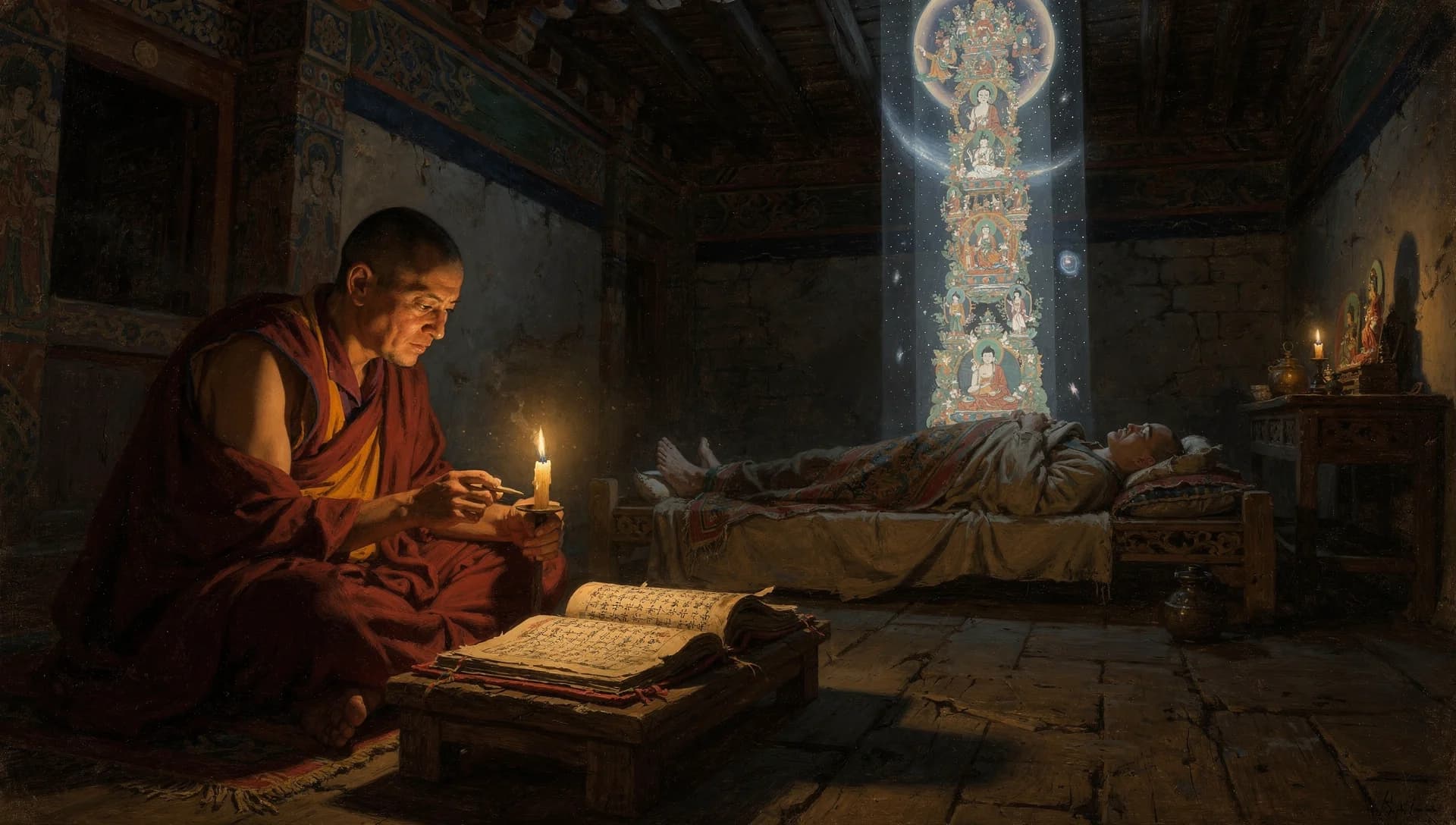
Morontia progression through the seven mansion worlds = Bardo Thödol staged post-mortem progression
This article expands on the decoder mapping. For the side-by-side card and quick reference, see the mapping page.
The Tibetan Post-Mortem Map
The Bardo Thödol, commonly translated as the Tibetan Book of the Dead and more literally as Liberation through Hearing during the Intermediate State, is one of the most carefully worked-out maps of life after death in any world religion. The text is traditionally attributed to the eighth-century teacher Padmasambhava, the Lotus-Born, principal founder of Tibetan Buddhism. Earlier Bön-era oral material was absorbed into the written tradition as the Nyingma school consolidated it.
The Bardo Thödol identifies three principal intermediate states, or bardos. The chikhai bardo is the bardo of dying: the moment of death and the immediate aftermath. The chönyid bardo is the bardo of dharmata, the luminous recognition of ultimate reality. The sidpa bardo is the bardo of becoming, the intermediate state leading to the next birth. Each bardo has its own characteristic experiences, its own encounters with peaceful and wrathful deities from the Nyingma iconographic tradition, and its own chances for recognition and liberation.
The Urantia Book describes a parallel staged progression: seven mansion worlds in the system of Jerusem, each one a phase in the morontia ascent (15:7.5).
What the Urantia Book Says
The Urantia Book documents the post-mortem progression in detail across Papers 47 and 48. The ascending mortal awakens on the first mansion world, where Morontia Companions are present at the awakening from the first transit sleep of time and remain present throughout the entire local-universe ascent (48:3.8). Resurrected mortals resume their lives just where they left off when overtaken by death (47:3.1).
The seven mansion worlds form an ordered, ascending sequence devoted to the morontia training of mortal ascenders. The developmental focus of each mansion world is described across UB 47:3-10. The first focuses on overcoming the deficiencies the individual carried forward from mortal life. The second through seventh worlds elaborate the morontia experience progressively, each with its own testing, its own social development, and its own preparation for the next stage of ascent toward Jerusem and beyond.
The progression is gradual, not sudden. The Urantia Book is candid that mansion world life retains many human traits even as the morontia technique deepens (47:3.10).
The structural parallel with the Bardo Thödol is striking. Both maps describe what happens after death as a staged passage through distinct phases. Both identify the experiences of each phase, the personalities encountered, the developmental focus, and the moments of testing and recognition. Both treat the passage as a structured journey rather than as either simple survival, oblivion, or undifferentiated mystical union.
What the Ancient Sources Say
The Bardo Thödol entered Western scholarship through W.Y. Evans-Wentz's The Tibetan Book of the Dead (Oxford University Press, 1927). Evans-Wentz worked from the Kazi Dawa-Samdup translation and framed the text in conversation with Western Theosophical and occultist traditions. More philologically careful translations have appeared since.
Francesca Fremantle and Chögyam Trungpa's The Tibetan Book of the Dead: The Great Liberation through Hearing in the Bardo (Shambhala, 1975) presented the text with Nyingma-lineage commentary, treating the bardos as a map of consciousness states rather than as literal post-mortem geography. Robert Thurman's The Tibetan Book of the Dead: Liberation Through Understanding in the Between (Bantam, 1994) gave a more accurate translation alongside detailed scholarly introduction.
Whether to read the Bardo Thödol literally or psychologically has been debated extensively. The traditional Nyingma reading takes the bardos as literal post-mortem progression, with the peaceful and wrathful deities as real transpersonal beings whose recognition leads to liberation. The modern psychologizing reading, found in Trungpa's qualifications, in Jung's commentary in Collected Works Volume 11, and in subsequent Buddhist-psychological synthesis, treats the bardos as symbolic mappings of states the dying and post-death consciousness moves through.
Either way, the staged structure is the same. The text's detail, the characterized phenomena of each phase, the ordered encounter with specific deity-types, and the described moments of recognition and liberation make it a more systematic map of the after-death experience than the looser cosmologies of many other religions.
The Tibetan reading fills in the developmental content. The chikhai bardo presents the luminous ground of being, the dharmakaya clear-light, whose recognition leads to immediate liberation. The chönyid bardo presents the deity encounters: peaceful deities on days 1 through 7, wrathful deities on days 8 through 14, whose recognition leads to intermediate liberation. The sidpa bardo is the choosing process by which consciousness selects its next rebirth, with guidance about how to choose wisely.
The text serves a practical purpose. It is read aloud to the dying and the recently deceased, to help the consciousness recognize what is happening and respond well at each stage. The institutional practice of reading to the dying across Tibetan Buddhist culture is a much more concrete engagement with the after-death map than the abstract theological interest most other traditions show.
Why This Mapping Matters
The structural parallel between the Bardo Thödol and the Urantia Book's mansion worlds matters because both maps share features that set them apart from most other religious cosmologies of the afterlife.
Both describe the after-death experience as a structured progression rather than as undifferentiated mystical union (in contrast to Hindu moksha as direct dissolution into Brahman) or as simple survival or oblivion (in contrast to the folk afterlife-locations of most world traditions). Both lay out distinct stages with characterized content. Both describe personalities encountered at each stage: peaceful and wrathful deities for the Bardo, seconaphim, morontia companions, and reversion directors for the Urantia Book. Both describe a developmental focus at each stage. Both describe moments of testing and recognition.
These shared features point to shared content the two traditions are preserving. The Urantia Book gives a literal cosmological account: the mansion worlds are real transitional administrative spheres where real morontia progression takes place. The Bardo Thödol preserves, in psychological and symbolic form, what looks like genuinely parallel cosmological insight. The after-death journey is staged, and each stage has its own work.
Read through the Urantia Book, the Bardo Thödol becomes more than psychological symbolism. It can be received as partial preservation of a real cosmological reality. The shared structural features (staged progression, distinct phases, personality encounters, developmental testing) go beyond what independent psychological development alone would produce. Something is being remembered.
How the Tibetan tradition might have received this content has several possible answers within the Urantia Book framework. The Andite cultural transmission through the Tibetan region, documented at UB 78:5.6 and 79:1.1-8, would have carried Adamic-era cosmological content into the local substrate. Salem-era missionaries may have transmitted Salem-derived soteriological content into the pre-Buddhist Tibetan substrate, later preserved through the Bön tradition and integrated into Tibetan Buddhism. And the deep mystical practitioners within the Tibetan Buddhist lineage (Milarepa, Longchenpa, and the long tulku tradition that preserved experiential content) may have accessed genuine cosmological insight through direct spiritual contact with the morontia progression itself.
The Urantia Book framework does not require choosing among these. Genuine cosmological insight may have been accessed through several pathways at once, then preserved across the Tibetan Buddhist tradition in the elaborated form the Bardo Thödol gives us.
For Tibetan Buddhist studies, the practical takeaway is this: the Bardo Thödol can be read not only as psychological symbol, but as partial preservation of real cosmological content that runs parallel to the detailed account in the Urantia Book. The shared structure between the two traditions points to shared substrate, and reading them together enriches both.
Sources
- The Urantia Book, Paper 47 (The Seven Mansion Worlds), Paper 48 (The Morontia Life). Urantia Foundation, first printing 1955.
- Padmasambhava (attrib.). The Tibetan Book of the Dead: Liberation Through Understanding in the Between. Translated by Robert A. F. Thurman, Bantam, 1994.
- Fremantle, Francesca and Chögyam Trungpa. The Tibetan Book of the Dead: The Great Liberation through Hearing in the Bardo. Shambhala, 1975.
- Evans-Wentz, W.Y. The Tibetan Book of the Dead. Oxford University Press, 1927; revised third edition 1957.
- Jung, C.G. "Psychological Commentary on The Tibetan Book of the Dead." In Collected Works Volume 11, Princeton University Press, 1958.
- Lopez, Donald S. Jr. The Tibetan Book of the Dead: A Biography. Princeton University Press, 2011.
- Dorje, Gyurme (translator). The Tibetan Book of the Dead: First Complete Translation. Penguin Classics, 2006.
Confidence and Evidence
- Confidence: INFORMED SPECULATION
- Evidence rating: MODERATE
- Basis: The Urantia Book documents the mansion-world progression at Papers 47 and 48 in substantial cosmological detail. The Bardo Thödol preserves a staged after-death progression whose features (distinct phases, personality encounters, developmental testing) closely parallel the Urantia Book's mansion-world structure. The shared structure exceeds what independent psychological development alone would produce. Several plausible transmission mechanisms (Andite contact, Salem-era missionary transmission, direct mystical experience) fit within the Urantia Book framework.
Related Decoder Articles
- Bön Shenrab = Pre-Buddhist Salem Teaching Layer
- Thought Adjuster = Tathagatagarbha Buddha-Nature
- Mount Meru = Cosmic Axis of Universe Administration
Byline: Derek Samaras | Urantia Book Network | April 2026
Connecting Articles
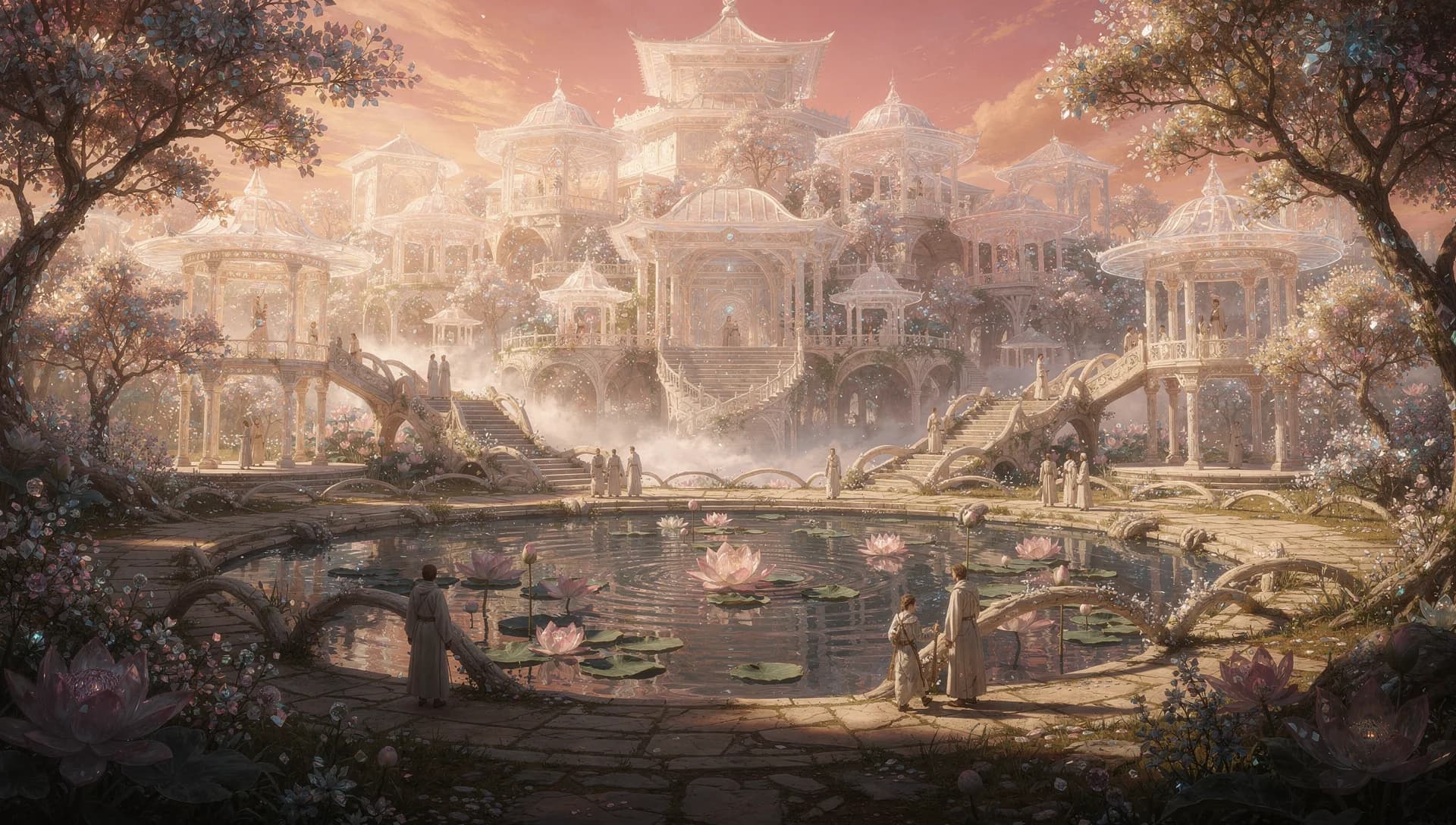
Rebirth in the Western Paradise: The Mansion Worlds and Pure Land Buddhism
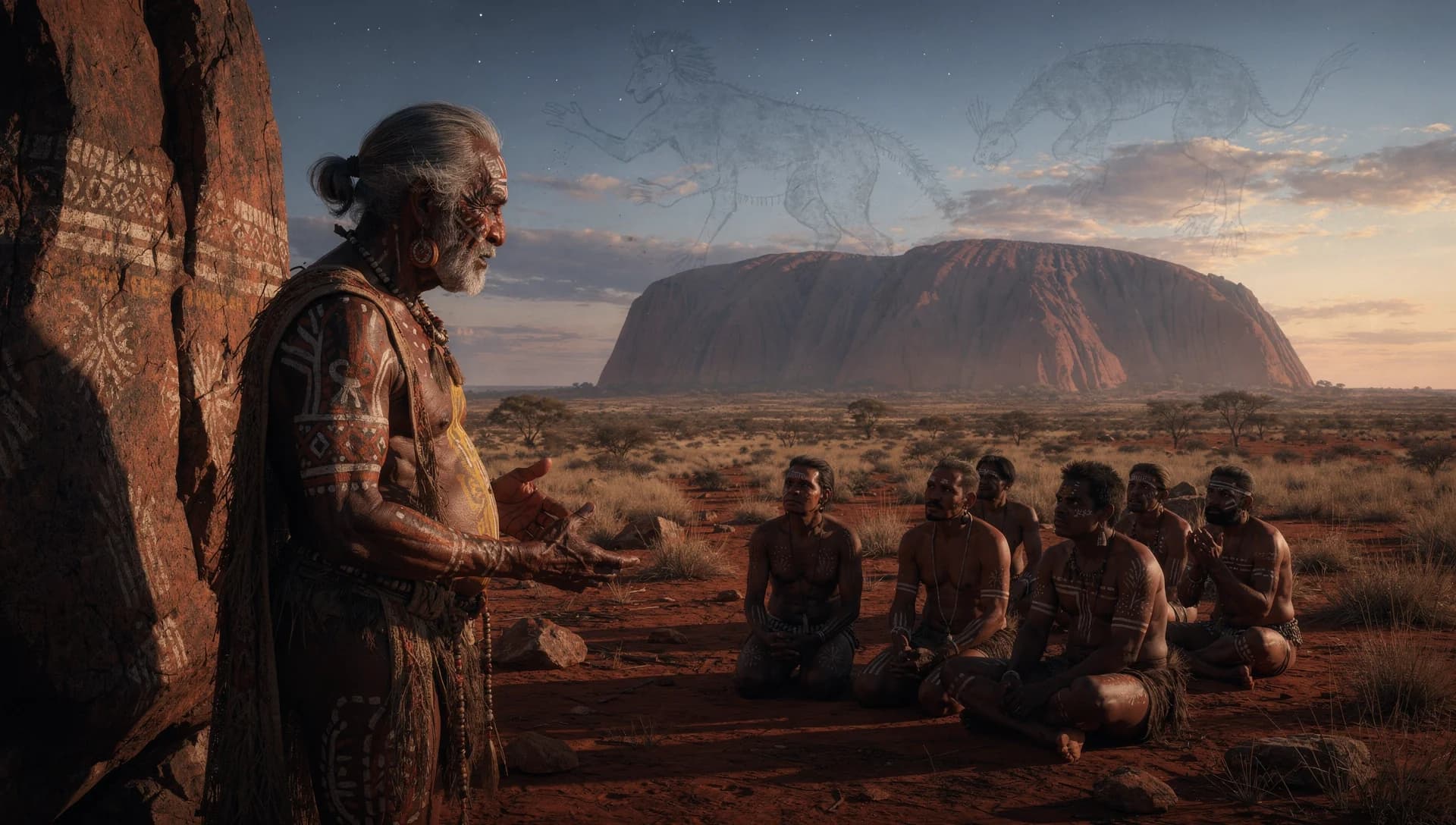
The Longest Memory: Australian Aboriginal Dreamtime and the Primordial Teaching-Ancestors
The Final Adjudication: Ragnarok and the Pending Verdict
We Come From One: African First-Family Traditions and the Sangik Origin
The Newsletter
Get the research behind each piece
Free. New Urantia Book explorations, the sources behind the videos, and early looks. No spam, unsubscribe anytime.
Prefer video? Follow on YouTube and Facebook.
Delivered through Substack. You can also read past issues.