
The Ones Who Came First: The Dalamatian Staff and the Navajo Holy People
Navajo cosmology centers on the Diyin Diné, the Holy People, superhuman teachers who established the four sacred mountains, taught agriculture and weaving and ceremony, and then withdrew. The Urantia Book describes the corporeal staff of one hundred at Dalamatia in almost identical structural terms: superhuman teachers who organized civilization into distinct domains and eventually withdrew from visible interaction.
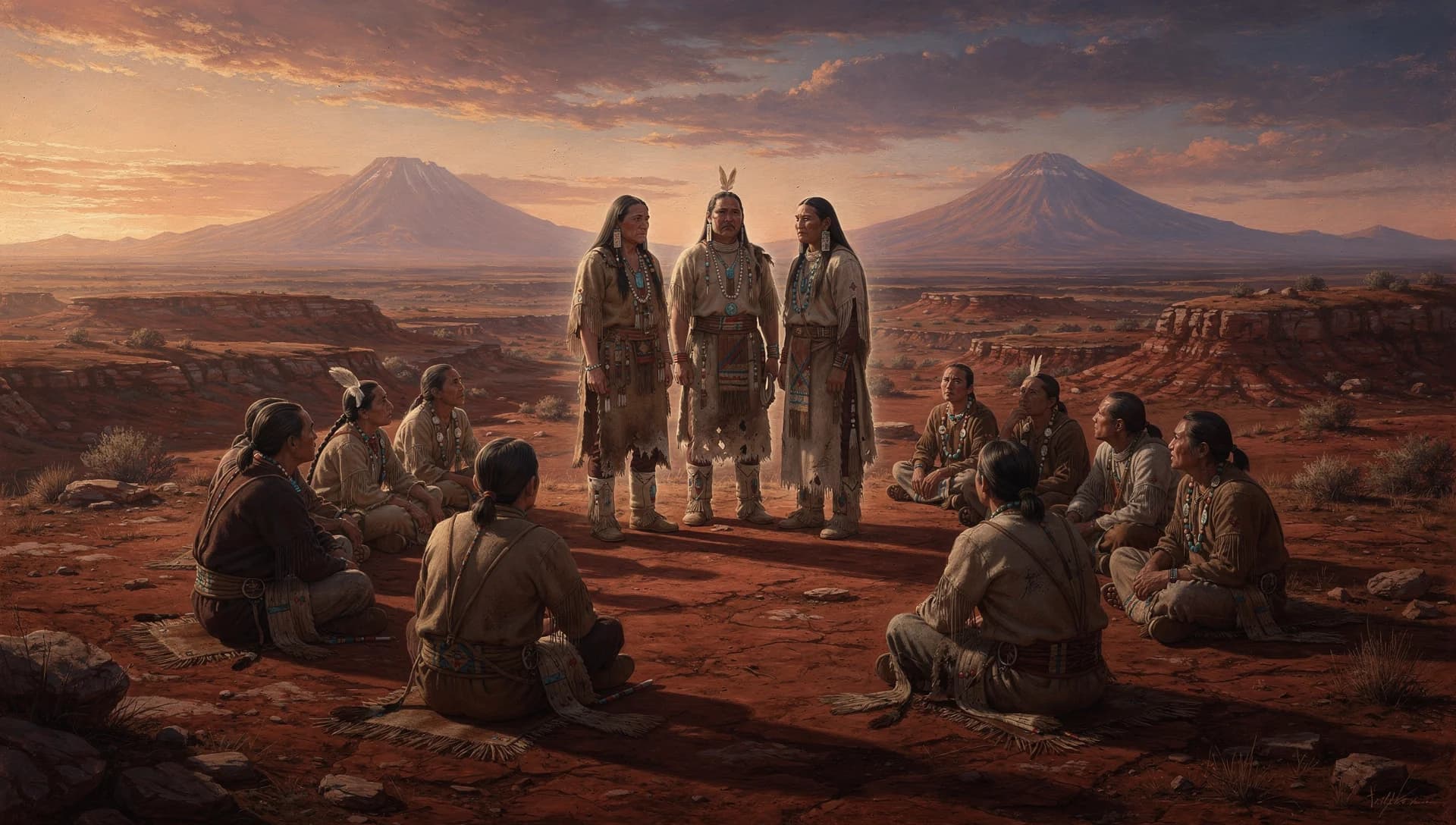
The corporeal staff of one hundred, teachers of civilization = Navajo Holy People (Dine'é Diyini), the superhuman teachers who established the Diné way
This article expands on the decoder mapping. For the side-by-side card and quick reference, see the mapping page.
The Teaching Class That Is Not Quite Divine
Navajo religion distinguishes its superhuman teaching beings from its ultimate divine principles with unusual precision. The Diyin Diné (Holy People, Holy Ones, Earth Surface People) are neither the ultimate creator nor ordinary human ancestors. They are a specific class: superhuman beings who emerged from prior worlds, established the cardinal geographic framework of the Navajo world (the four sacred mountains), taught the civilizational arts to the first humans, and eventually withdrew to their own realm.
The Diyin Diné category resists easy comparative classification. They are more than culture heroes; their status is ontologically superior to the human world. They are less than the ultimate divine; Navajo religion has a creator above them (often named in contemporary discussion as Begochidi or the Sun, but the highest level is typically left abstract). They occupy a specific intermediate theological position that the major Old World religions largely do not preserve.
The Urantia Book describes the corporeal staff of one hundred at Dalamatia in structural terms that match the Diyin Diné category closely.
What the Urantia Book Says
The corporeal staff's organization is described in Paper 66:
"The one hundred were organized for service in ten autonomous councils of ten members each. When two or more of these ten councils met in joint session, such liaison gatherings were presided over by Daligastia. These ten groups were constituted as follows:" (UB 66:5.1)
The ten councils each governed a domain of their own: food and material welfare (Ang's group, teaching well-digging, spring control, irrigation, weaving), animal domestication (Bon's group), conquest of predatory animals, education and writing, industry and trade (Nod's group), revealed religion, health and hygiene, art and science, advanced tribal relations, and the supreme court of appeals (Van's council). Each council carried its own teaching responsibilities for its own field.
The staff's status is described:
"The members of the corporeal staff had been materialized through a special process of retrostasis so that they could interface directly with the evolving human populations. They were superhuman in ability and endowment but materialized to the physical conditions of the planet so that they could teach, counsel, and demonstrate the civilizational arts to the primitive populations." (Paraphrased from UB 66:2-4 context)
The pedagogical deployment:
"They taught well digging, spring control, and irrigation. They taught those from the higher altitudes and from the north improved methods of treating skins for use as clothing, and weaving was later introduced by the teachers of art and science." (UB 66:5.2)
The rebellion scattered the staff. After the rebellion, the loyal forty continued to work with humanity for the subsequent centuries, eventually returning to Jerusem. The physical Dalamatia complex was lost to planetary history. The Dalamatian civilizational substrate persisted in the cultural memory of the subsequent human populations.
The red race migration to North America (treated in the companion decoder article) carried the Dalamatian cultural substrate across the Bering land bridge approximately eighty-five thousand years ago. The features the Navajo tradition preserves (superhuman teachers, organization by domain, cardinal geographic framework, eventual withdrawal into invisibility) would be the deep cultural-memory residue of the Dalamatian staff regime.
What the Ancient Sources Say
Navajo cosmology has been extensively documented. Gladys Reichard's Navaho Religion: A Study of Symbolism (2 volumes, Pantheon, 1950) is the foundational modern treatment. Paul G. Zolbrod's Diné bahane': The Navajo Creation Story (University of New Mexico Press, 1984) provides the principal translation of the creation narrative. Frank Mitchell's Blessingway (University of Arizona Press, 1978) documents the central Navajo ceremonial framework.
The Diyin Diné category's features include:
First, pre-human existence. The Holy People existed before the emergence of humans. They are not deified ancestors; they are a prior order.
Second, emergence through prior worlds. Navajo cosmology has a structure of prior worlds (First World, Second World, Third World, Fourth World). The Holy People moved through these worlds before the present era.
Third, establishment of cardinal geography. The Holy People placed the four sacred mountains (Sisnaajiní/Blanca Peak in the east, Tsoodzil/Mount Taylor in the south, Dook'o'oostíid/San Francisco Peaks in the west, Dibé Nitsaa/Hesperus Peak in the north). These mountains define the sacred geographic framework of the Navajo world.
Fourth, teaching of civilizational arts. The Holy People taught the first humans the arts of Navajo life: the Blessingway ceremonies, the weaving tradition, the proper relationships with the land and the animals, the moral law. The teaching is organized by domain: ceremony is taught by one group of Holy People, weaving by others, and so on.
Fifth, eventual withdrawal. After establishing the sacred framework and teaching the civilizational arts, the Holy People withdrew to their own realm. They are no longer ordinarily visible or accessible. Their presence persists through the ceremonial tradition and through the sacred landscape, but they are not directly present in ordinary human life.
The structural features match the Urantia Dalamatian staff profile closely. A pre-human superhuman order. Emergence from a prior order of existence (the staff came from Jerusem). Establishment of a fixed geographic center (Dalamatia). Teaching organized by domain (the ten councils). Eventual withdrawal from visible interaction with humanity (the scattering and eventual return to Jerusem after the rebellion).
The Navajo framework of four sacred mountains and the Dalamatian framework of ten councils are not identical in structural detail. The Navajo tradition preserves a four-fold cardinal geography; the Dalamatian account preserves a ten-domain organization of civilizational work. Both share the structural feature of superhuman teachers organizing civilization by assigning teachers to separate domains.
Why This Mapping Matters
The Navajo Holy People category is one of the best-preserved examples in Indigenous American religion of a theological structure that the Urantia Book identifies as a deep feature of planetary administrative history. The category preserves the teaching function (civilizational arts taught by superhuman beings), the geographic framework (cardinal organization of sacred space), and the withdrawal (loss of ordinary visible presence after the initial teaching period).
The Urantia Book supplies the historical origin. The corporeal staff of one hundred arrived at Dalamatia approximately five hundred thousand years ago (UB 66:0.2). They organized civilizational teaching into ten councils governing ten domains. They operated from Dalamatia as their administrative center. They eventually withdrew (through the rebellion scattering and the post-rebellion return to Jerusem) and ceased to be visibly present in human affairs.
The red race's migration to North America carried the Dalamatian cultural substrate across the Bering land bridge (65,000-85,000 years ago). The Navajo tradition is one of the downstream preservations of this substrate. The features the Navajo tradition preserves (pre-human superhuman order, cardinal geographic framework, domain-organized teaching, withdrawal outcome) are exactly the features the Dalamatian staff tradition would plausibly seed in a downstream cultural transmission.
The mapping's theological significance is that it places Navajo religion within the same distributed-memory framework that connects multiple world religious traditions to the Dalamatian administrative history. The Sumerian Anunnaki (corporeal staff = princely offspring), the Hindu Devas, the Greek Olympians, the Norse Aesir-Vanir, and now the Navajo Diyin Diné are all downstream preservations of the same underlying historical substrate: a specific class of superhuman teachers who organized the initial civilizational development of the planet.
Each tradition preserves different features of the original. The Anunnaki tradition preserves the administrative-council structure. The Greek tradition preserves the pattern of an individual ancestor (Adamson-Ratta's children as Olympian progenitors). The Navajo tradition preserves the teaching-function organization and the cardinal-geography framework. The Urantia revelation supplies the integrating historical account that explains why each downstream tradition preserves the features it preserves.
Sources
- The Urantia Book, Paper 66 (The Planetary Prince's Staff). Urantia Foundation, first printing 1955. Cited passages: 66:2.1-6, 66:5.1-32.
- Reichard, Gladys A. Navaho Religion: A Study of Symbolism. 2 volumes, Pantheon, 1950; revised Princeton University Press, 1963.
- Zolbrod, Paul G. Diné bahane': The Navajo Creation Story. University of New Mexico Press, 1984.
- Mitchell, Frank. Blessingway. Edited by Leland C. Wyman, University of Arizona Press, 1978.
- Matthews, Washington. Navaho Legends. American Folklore Society, 1897; reprinted University of Utah Press, 1994.
- Luckert, Karl W. A Navajo Bringing-Home Ceremony: The Claus Chee Sonny Version of Deerway Ajilee. University of Arizona Press, 1978.
- Kluckhohn, Clyde and Dorothea Leighton. The Navaho. Revised edition, Harvard University Press, 1974.
Confidence and Evidence
- Confidence: INFORMED SPECULATION
- Evidence rating: MODERATE
- Basis: The Navajo Holy People category preserves multiple structural features that match the Urantia Dalamatian staff profile: pre-human superhuman order, cardinal geographic framework, domain-organized teaching, eventual withdrawal. The red race migration provides the documented transmission mechanism. The companion Sumerian Anunnaki and Indigenous Onamonalonton-Great-Spirit mappings establish the broader pattern of Dalamatian cultural substrate preservation across multiple downstream traditions.
Related Decoder Articles
- The Corporeal Staff of One Hundred = Anunnaki
- Onamonalonton = The Great Spirit Tradition
- Midwayers = Hopi Kachinas
By Derek Samaras
Connecting Articles
The Thunderbird Was Real: Fandors and the Indigenous American Giant Bird Tradition
The Corporeal Staff and the Anunnaki: When Mainstream Etymology Already Says the Answer
Two Dilmuns, Not One: Bahrain, the Nodite Headquarters, and the Confused Sumerian Paradise
The Eternal Smith: Ilmarinen, the Kalevala, and the Craftsman-Sage Pattern of the Prince's Staff
The Newsletter
Get the research behind each piece
Free. New Urantia Book explorations, the sources behind the videos, and early looks. No spam, unsubscribe anytime.
Prefer video? Follow on YouTube and Facebook.
Delivered through Substack. You can also read past issues.