
The Late Book of the Law: Deuteronomy and the Torah Composition Timeline
The Book of Deuteronomy presents itself as the final discourse of Moses. Modern biblical scholarship has established that its actual composition is centuries later than the Mosaic period. The Urantia Book's brief but specific statement about Moses confirms the scholarly reconstruction: there was no written record of Moses' work until more than a thousand years after his death.
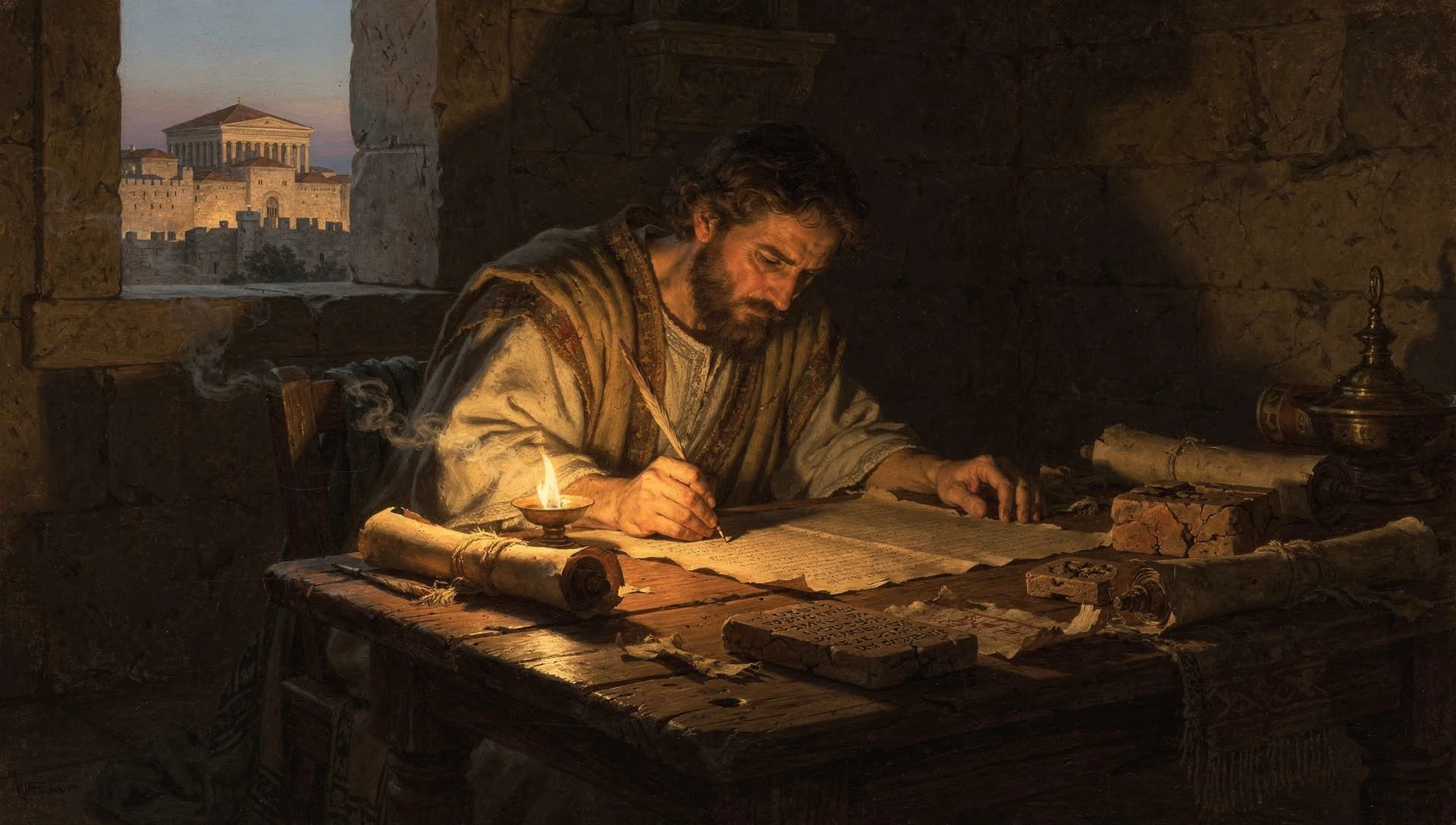
Deuteronomy written centuries after Moses = Torah composition timeline
This article expands on the decoder mapping. For the side-by-side card and quick reference, see the mapping page.
The Book Moses Did Not Write
The Book of Deuteronomy presents itself as the farewell discourse of Moses, delivered to the Israelites on the plains of Moab before his death. The text has been read across two millennia of Jewish and Christian tradition as the authentic record of Moses' own words. Modern biblical scholarship, beginning with the work of de Wette in 1805 and consolidating through the nineteenth and twentieth centuries, has established that Deuteronomy is a late composition, probably assembled in its core form during the reign of Josiah in the late seventh century BCE, with substantial subsequent editorial layers added during and after the Babylonian exile.
The Urantia Book's brief comment on Moses confirms the scholarly reconstruction and supplies a specific reason why the historical record of Moses is so sparse relative to his importance.
What the Urantia Book Says
The Urantia Book's treatment of Moses is extensive and admiring. Paper 96 devotes a full section to his career as "the most important individual world teacher and leader between the times of Machiventa and Jesus" (UB 96:5.1). But the text makes one specific observation about the documentary record:
"There is so little on record of the great work of Moses because the Hebrews had no written language at the time of the exodus. The record of the times and doings of Moses was derived from the traditions extant more than one thousand years after the death of the great leader." (UB 96:5.2)
The statement is compact but historically pointed. Moses lived in the thirteenth century BCE (conventional exodus dating). The Hebrews did not have a fully developed written language at the time of the exodus. The documentary record of Moses and his teachings was assembled from oral traditions preserved across a gap of more than a millennium.
The subsequent paragraphs describe what the oral transmission preserved and what it did not:
"Many of the advances which Moses made over and above the religion of the Egyptians and the surrounding Levantine tribes were due to the Kenite traditions of the time of Melchizedek. Without the teaching of Machiventa to Abraham and his contemporaries, the Hebrews would have come out of Egypt in hopeless darkness." (UB 96:5.3)
The distinction between the Moses that the text preserves and the actual Moses is developed:
"But it was truly pitiful to watch this great mind of Moses trying to adapt his sublime concept of El Elyon, the Most High, to the comprehension of the ignorant and illiterate Hebrews. To his assembled leaders he thundered, 'The Lord your God is one God; there is none beside him'; while to the mixed multitude he declared, 'Who is like your God among all the gods?'" (UB 96:5.5)
The Urantia account preserves a two-level theology: Moses' actual advanced monotheistic understanding (via the Kenite preservation of the Salem Melchizedek tradition) and the more primitive polytheistic-leaning tribal Yahweh that he had to present publicly because his audience could not receive the advanced teaching. The documentary record, compiled a millennium later, preserves the public teaching better than the advanced teaching; the public record is what entered the Pentateuch.
What the Ancient Source Says
The Documentary Hypothesis, developed by de Wette, Graf, Kuenen, and Wellhausen in the nineteenth century, identified four principal sources for the Pentateuch: J (Yahwist), E (Elohist), D (Deuteronomic), and P (Priestly). Deuteronomy was identified as the book found in the temple during Josiah's reforms in 622 BCE (described in 2 Kings 22-23), composed probably shortly before that discovery, and incorporated into the growing Pentateuchal tradition as the fifth book.
Moshe Weinfeld's Deuteronomy and the Deuteronomic School (Oxford University Press, 1972) and Bernard M. Levinson's Deuteronomy and the Hermeneutics of Legal Innovation (Oxford University Press, 1997) provide the principal modern scholarly treatments. The Deuteronomic school's distinctive theological features (centralization of worship at Jerusalem, the chosen-people framework, the covenant structure of blessing and curse) reflect the seventh-century reform context, not the thirteenth-century Mosaic context.
The linguistic evidence supports the late-composition reading. The Hebrew of Deuteronomy is classical Biblical Hebrew, the language of the first millennium BCE. The Hebrew that would have been spoken in the thirteenth century BCE (if Hebrew as a distinct dialect existed at that early date, which is itself contested) would have been substantially different from the classical form. Ron Hendel and Jan Joosten's How Old Is the Hebrew Bible? (Yale University Press, 2018) documents the linguistic dating evidence.
The broader Pentateuchal composition timeline is now generally reconstructed as follows: the earliest compositional strata (J and E) emerge in the ninth and eighth centuries BCE respectively, probably from oral traditions extending back several centuries earlier. Deuteronomy's core is composed in the late seventh century in the context of Josiah's reforms. The Priestly source is composed during and after the Babylonian captivity (sixth century BCE). The final redaction combining the sources is completed in the fifth or fourth century BCE by the post-exilic priesthood.
This places the final textual form of the Pentateuch roughly eight hundred to a thousand years after the historical Moses, which corresponds closely to the Urantia Book's claim of "more than one thousand years" of oral transmission before documentary record (UB 96:5.2).
Why This Mapping Matters
The compositional dating of the Pentateuch has significant consequences for reading the text. The Moses the text presents is filtered through a millennium of oral tradition, edited by the Josianic reform movement, further edited by the exilic Priestly source, and finalized by the post-exilic redactors. The historical Moses is behind the text but not identical to the text.
This matters for several specific interpretive questions. The Mosaic authorship of the Torah, claimed by traditional Jewish and Christian tradition, is not defensible on modern scholarly grounds. The specific legal codes in Deuteronomy reflect seventh-century concerns (cult centralization at Jerusalem) rather than thirteenth-century concerns (tribal confederation religion in the Sinai wilderness). The narrative framework within which Moses' actual work is presented has been substantially restructured by the editorial tradition.
The Urantia Book's contribution is to confirm the scholarly reconstruction and to supply a specific reason. The Hebrews did not have a written language at the time of the exodus. The oral tradition preserved Moses' work with the limitations of oral transmission across many centuries. The eventual documentary compilation, undertaken after the Hebrews acquired full literary capacity, drew on traditions already substantially reshaped by the intervening millennium.
This does not diminish Moses. The Urantia Book calls him "the most important individual world teacher and leader between the times of Machiventa and Jesus." His actual achievement was substantial and the book treats it respectfully. What the Urantia account adjusts is the relationship between the historical Moses and the textual Moses. The two are not identical; the textual Moses is the millennium-later reconstruction of the historical figure through the particular lens of the Josianic and post-exilic editorial tradition.
Reading the Pentateuch with this framework in view produces clearer access to what the text is actually doing. The Moses narrative is valuable. The specific legal codes of Deuteronomy are valuable. The Ten Commandments preserve genuinely ancient moral material. But none of these preserve Moses' own words in their original form. All have been transmitted through a long editorial chain, and the final text reflects as much about the editors as about the historical figure.
Sources
- The Urantia Book, Paper 96 (Yahweh, God of the Hebrews). Urantia Foundation, first printing 1955. Cited passages: 96:5.1, 96:5.2, 96:5.3, 96:5.5, 96:5.8, 96:5.9.
- Wellhausen, Julius. Prolegomena to the History of Israel. Translated by Menzies and Black, A. & C. Black, 1885.
- Weinfeld, Moshe. Deuteronomy and the Deuteronomic School. Oxford University Press, 1972.
- Levinson, Bernard M. Deuteronomy and the Hermeneutics of Legal Innovation. Oxford University Press, 1997.
- Baden, Joel S. The Composition of the Pentateuch: Renewing the Documentary Hypothesis. Yale University Press, 2012.
- Hendel, Ronald and Jan Joosten. How Old Is the Hebrew Bible? A Linguistic, Textual, and Historical Study. Yale University Press, 2018.
- Friedman, Richard Elliott. Who Wrote the Bible? Summit Books, 1987.
- Römer, Thomas. The So-Called Deuteronomistic History. T&T Clark, 2007.
Confidence and Evidence
- Confidence: UB CONFIRMED
- Evidence rating: STRONG
- Basis: The Urantia Book's claim of "more than one thousand years" between Moses and the documentary record (UB 96:5.2) corresponds to the academic consensus compositional timeline for the Pentateuch. The linguistic evidence (classical Biblical Hebrew in Deuteronomy) supports the late first millennium BCE composition dating. The specific reason given (no written Hebrew at the time of the exodus) is consistent with the archaeological evidence for alphabetic-Hebrew script development.
Related Decoder Articles
- Hebrew Scribal Revision During Babylonian Captivity
- Machiventa Melchizedek = Deleted Priest-King of Genesis
- Three Noahs, One Story: Composite Biblical Noah
By Derek Samaras
Connecting Articles
The Prophet Egypt Murdered: Okhban and the Four Great Prophets

The Longest Memory: Australian Aboriginal Dreamtime and the Primordial Teaching-Ancestors
The Final Adjudication: Ragnarok and the Pending Verdict

We Come From One: African First-Family Traditions and the Sangik Origin
The Newsletter
Get the research behind each piece
Free. New Urantia Book explorations, the sources behind the videos, and early looks. No spam, unsubscribe anytime.
Prefer video? Follow on YouTube and Facebook.
Delivered through Substack. You can also read past issues.